

Blog > Palo Alto, Los Altos, Mountain View, and Sunnyvale: Which Silicon Valley City Fits Your Lifestyle?
Palo Alto, Los Altos, Mountain View, and Sunnyvale: Which Silicon Valley City Fits Your Lifestyle?
by
A Property Nerd’s Strategic Guide to Prestige, Space, Walkability, Schools, Commutes, and Long-Term Value
For Silicon Valley buyers, choosing between Palo Alto, Los Altos, Mountain View, and Sunnyvale is not simply a matter of comparing home prices. It is a lifestyle strategy, a school-boundary decision, a commute calculation, a land-use question, and a long-term resale thesis all wrapped into one. These four cities sit within one of the most valuable real estate corridors in the country, yet each city solves a very different buyer problem.
Palo Alto is the prestige-and-institution market. Los Altos is the land-and-privacy market. Mountain View is the walkability-and-Google-convenience market. Sunnyvale is the value-and-flexibility market. All four are powered by the same Silicon Valley engine, but they convert that demand into housing value in different ways.
The most sophisticated buyers do not ask, “Which city is best?” They ask, “Which city best fits how we actually live?” That means evaluating commute patterns, school goals, lot size, walkability, architectural taste, home-office needs, future family plans, remodel appetite, and eventual resale audience. In a region where a few blocks can change value by hundreds of thousands of dollars, the right city choice is not emotional fluff. It is asset strategy.
Palo Alto is the city for buyers who want to be close to the intellectual and innovation center of Silicon Valley. The City of Palo Alto describes itself as the “Birthplace of Silicon Valley” and notes that it is home to Stanford University, nearly 100,000 jobs, 36 parks, five libraries, and 41 miles of walking and biking trails. That combination of Stanford proximity, employment density, public amenities, and global name recognition is why Palo Alto remains one of the most powerful residential brands in the Bay Area.
Palo Alto buyers are often buying identity as much as property. They may be founders, venture capital professionals, Stanford affiliates, physicians, academics, executives, international relocation buyers, or families who want the confidence of a globally understood address. A home in Old Palo Alto, Professorville, Crescent Park, Community Center, Southgate, College Terrace, Midtown, Barron Park, or Greenmeadow is not just a structure. It is a position inside the Silicon Valley ecosystem.
The Palo Alto lifestyle is intellectual, polished, connected, and expensive. Buyers value University Avenue, California Avenue, Stanford Shopping Center, Caltrain, Stanford campus access, cafes, restaurants, parks, and the ability to move between home, work, school, and cultural life with relative ease. Palo Alto Station is part of the Caltrain system, and Caltrain also serves California Avenue, San Antonio, Mountain View, and Sunnyvale along this corridor, which matters for buyers who want transit optionality.
The school premium in Palo Alto is also powerful. Palo Alto Unified School District states that students whose parent or guardian resides within PAUSD boundaries are qualified to attend PAUSD schools, and the district uses School Finder tools to verify whether an address is within district boundaries. For buyers, that means school confidence is an asset, but it still needs to be verified address by address.
Los Altos is the city for buyers who want Silicon Valley access without feeling like they live inside the machinery of Silicon Valley. It is quieter, more residential, more private, and more land-driven than Palo Alto or Mountain View. The Los Altos buyer often values larger lots, tree-lined streets, village charm, outdoor living, remodel potential, ADU flexibility, and a home that feels like a retreat after a high-pressure workday.
Los Altos is not trying to be urban. That is part of its value. It is the place for buyers who want space, privacy, and a more traditional luxury-family environment while still being close to Apple, Google, Stanford, Nvidia, LinkedIn, Meta, and the broader Peninsula and South Bay employment base. The city’s park network includes Grant Park, Shoup Park, Heritage Oaks Park, Rosita Park, Hillview Park, Redwood Grove, McKenzie Park, and Marymeade Park, reinforcing its family-oriented, outdoor-residential feel.
From a Property Nerd perspective, Los Altos is fundamentally a land-value market. The home matters, of course, but the lot often matters more. Buyers pay for street quality, privacy, usable yard space, expansion potential, architectural flexibility, and neighborhood consistency. In Los Altos, a dated home on a strong lot can be more strategically valuable than a newer home on a compromised parcel.
Schools are a major driver in Los Altos, but the school story is more nuanced than many buyers realize. The City of Los Altos lists multiple school districts serving residents, including Los Altos School District, Cupertino Union School District, Mountain View Los Altos High School District, Fremont Union High School District, and others depending on grade level and exact address. That means buyers should never assume school assignment based only on the city name.
Mountain View is the city for buyers who want convenience, walkability, technology access, and a more active daily lifestyle. It has a stronger urban-suburban rhythm than Los Altos and a more practical price-to-function equation than Palo Alto. Mountain View is where downtown energy, Caltrain, bike routes, Google proximity, restaurants, trails, and neighborhood variety come together.
The Google connection is central to Mountain View’s identity. Google’s official visitor experience is located at the Gradient Canopy office in Mountain View, and the city has long been tied to the daily life of Google employees, startup teams, engineers, and product leaders. For buyers searching for homes near Google, Mountain View offers a level of commute convenience that is difficult to replicate.
Mountain View’s walkability is one of its strongest lifestyle advantages. The City of Mountain View adopted an ordinance in 2022 establishing pedestrian malls on portions of Castro Street, strengthening downtown Mountain View’s role as one of the most active restaurant and pedestrian districts in Silicon Valley. For buyers who want to walk to dinner, ride Caltrain, bike to work, or live with less daily car dependence, Mountain View can be extremely compelling.
Mountain View also offers a broader housing mix than Palo Alto or Los Altos. Buyers can find condos, townhomes, Eichlers, mid-century homes, older ranch homes, remodeled single-family homes, downtown-adjacent properties, and newer construction. Neighborhoods such as Old Mountain View, Cuesta Park, Waverly Park, Monta Loma, Shoreline West, Rex Manor, Blossom Valley, St. Francis Acres, North Whisman, Whisman Station, and The Crossings each attract different buyer profiles.
Mountain View’s school story is address-sensitive and needs careful analysis. Mountain View Whisman School District directs families to use SchoolLocator and boundary maps to verify school assignment, and Mountain View Los Altos High School District states that both Los Altos High and Mountain View High rank in the top 2% nationally according to U.S. News & World Report. For buyers, that creates a strong school opportunity, but one that requires parcel-level due diligence.
Sunnyvale is the city for buyers who want Silicon Valley value without leaving the core employment corridor. It is one of the most practical cities in the region because it offers access to Apple, Google, LinkedIn, Nvidia, Amazon, Meta, Santa Clara, Mountain View, Cupertino, Palo Alto, and San Jose. Sunnyvale is not simply a “more affordable” alternative. It is a diversified real estate market with multiple buyer pools and multiple demand drivers.
Sunnyvale’s strongest advantage is flexibility. A buyer can choose a downtown townhome, a Fairbrae Eichler, a Cherry Chase or Cumberland-area family home, a Birdland ranch, a Raynor Park property, a West Sunnyvale home near Cupertino influences, or a North Sunnyvale property closer to major employment. That range makes Sunnyvale useful for many different life stages and budgets.
Sunnyvale also has a meaningful downtown growth story. The City of Sunnyvale notes that many new projects are underway downtown, with a majority in the CityLine project, which includes office, residential, and commercial space. For buyers who care about long-term lifestyle upside, downtown Sunnyvale and CityLine create an urban-suburban catalyst that supports the city’s value narrative.
Sunnyvale schools are extremely address-sensitive. Sunnyvale School District includes schools such as Cherry Chase Elementary, Cumberland Elementary, Bishop Elementary, Columbia Middle, Sunnyvale Middle, and others, and the district describes itself as including eight elementary schools and two middle schools. That variety creates both opportunity and confusion, because one Sunnyvale address may carry a very different resale story than another.
Current market data shows why buyers analyze these cities so differently. A Zillow result showed approximate home-value benchmarks of about $3.68 million for Palo Alto, $4.65 million for Los Altos, $2.02 million for Mountain View, and $2.12 million for Sunnyvale. Redfin data also shows meaningful price-per-square-foot differences, with Palo Alto around $1.95K per square foot, Mountain View around $1.05K, and Sunnyvale around $1.26K in recent three-month housing market snapshots. These numbers change constantly, but the structural pattern is clear: Los Altos and Palo Alto command major premiums, while Mountain View and Sunnyvale often offer more flexible value equations.
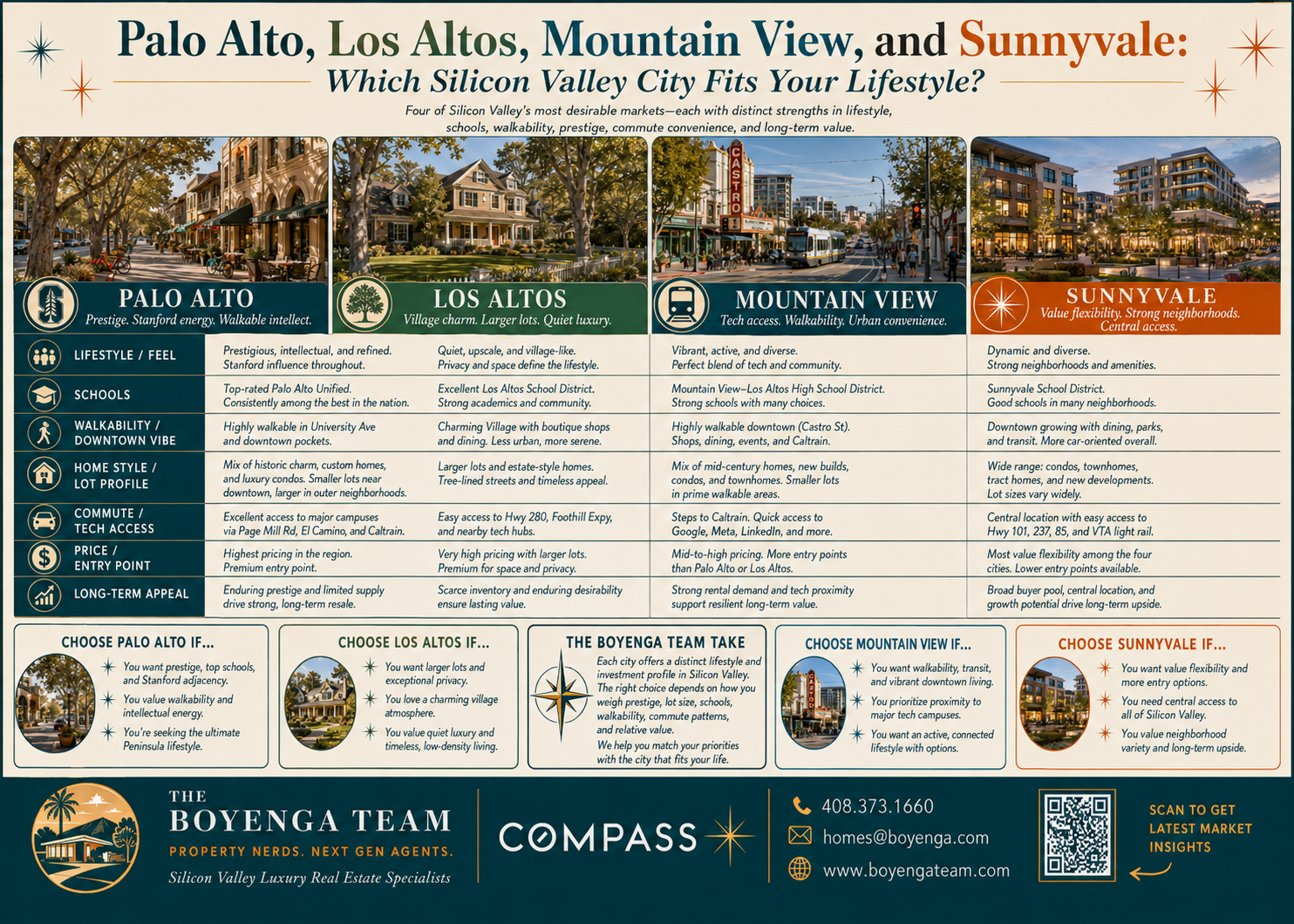
The city that fits best depends on what a buyer is optimizing for. A buyer who values prestige, Stanford proximity, intellectual energy, PAUSD, historic neighborhoods, and high-liquidity resale will often gravitate toward Palo Alto. A buyer who values bigger lots, quiet streets, privacy, village charm, and luxury residential calm will often prefer Los Altos. A buyer who values Google convenience, walkability, Caltrain, downtown restaurants, and tech-centered daily life will often choose Mountain View. A buyer who values better relative value, commute flexibility, school-pocket strategy, Eichler neighborhoods, and long-term upside may find Sunnyvale the smartest move.
The commute equation is different in every city. Palo Alto works especially well for Stanford, Stanford Research Park, Menlo Park, Sand Hill Road, downtown Palo Alto, and parts of the Peninsula. Los Altos works well for buyers who want access to Palo Alto, Mountain View, Cupertino, Apple, Google, and the 280 corridor while maintaining a quieter home base. Mountain View is the cleanest fit for Google, downtown Mountain View, Intuit, LinkedIn-adjacent corridors, Caltrain commuters, and buyers who want to reduce daily friction. Sunnyvale is the broadest commute hedge, especially when one household has multiple job centers across Apple, Google, Nvidia, LinkedIn, Amazon, and Santa Clara.
The school equation is equally nuanced. Palo Alto offers one of the strongest district brands in California real estate. Los Altos offers powerful school demand, but with multiple district paths depending on address. Mountain View offers strong school opportunities, especially through MVLA high schools, but requires boundary-level verification. Sunnyvale offers some of the best micro-market school plays in Silicon Valley, but the difference between pockets can be enormous.
The lifestyle equation is where buyers need to be brutally honest. Palo Alto is for buyers who want to be plugged into the region’s prestige network. Los Altos is for buyers who want to unplug in a more private setting. Mountain View is for buyers who want their daily life to feel efficient, walkable, and connected. Sunnyvale is for buyers who want options, access, and value without sacrificing Silicon Valley location.
Architecture also varies across the four cities. Palo Alto offers historic homes, Craftsman properties, Spanish-style residences, Eichlers, mid-century modern homes, ranch homes, townhomes, and luxury rebuilds. Los Altos offers ranches, expanded ranches, custom homes, new construction, larger-lot estates, and quiet residential streets. Mountain View offers Eichlers, mid-century modern homes, ranch homes, townhomes, condos, and walkable downtown housing. Sunnyvale offers Eichlers, classic ranch homes, West Sunnyvale family homes, downtown townhomes, North Sunnyvale properties, and a wide spectrum of price points.
For sellers, each city requires a different marketing narrative. A Palo Alto seller should emphasize prestige, Stanford proximity, school demand, architectural character, walkability, and long-term liquidity. A Los Altos seller should emphasize lot size, privacy, schools, quiet streets, outdoor living, and estate potential. A Mountain View seller should emphasize Google convenience, walkability, Caltrain, Castro Street, tech access, and lifestyle efficiency. A Sunnyvale seller should emphasize value relative to neighboring cities, school path, tech commute access, downtown growth, Eichler or mid-century appeal, and long-term flexibility.
For buyers, the biggest mistake is using the wrong city framework. Do not judge Sunnyvale by Los Altos standards if your true goal is value and flexibility. Do not judge Los Altos by Mountain View standards if your true goal is privacy and land. Do not judge Palo Alto by price per square foot alone if your true goal is prestige and institutional access. Do not judge Mountain View as “lesser Palo Alto” if your true goal is walkability and daily convenience.
Smart-home readiness matters across all four cities. Buyers increasingly value EV charging, solar, battery backup, heat pump HVAC, induction cooking, strong Wi-Fi, smart thermostats, leak detection, smart irrigation, advanced security, flexible home offices, and ADU potential. In Palo Alto, these features support future-proof luxury. In Los Altos, they support comfort, resilience, and estate management. In Mountain View, they support convenience and tech-forward living. In Sunnyvale, they support practical efficiency, resale appeal, and long-term flexibility.
ADUs and flexible space are also becoming more important. Palo Alto buyers may value guest suites, detached offices, and Stanford-adjacent flexibility. Los Altos buyers often view ADUs as part of estate planning, multigenerational living, or guest accommodations. Mountain View buyers may see ADUs and detached offices as hybrid-work infrastructure. Sunnyvale buyers may value ADUs for rental flexibility, family support, or future income potential.
The long-term resale thesis differs by city. Palo Alto resale is supported by global recognition, Stanford proximity, PAUSD demand, historic neighborhoods, and luxury liquidity. Los Altos resale is supported by land scarcity, privacy, larger lots, school demand, and premium residential identity. Mountain View resale is supported by Google proximity, Caltrain, walkability, downtown energy, housing diversity, and tech employment. Sunnyvale resale is supported by central location, multiple employer corridors, school pockets, downtown redevelopment, Eichler demand, and relative affordability.
At the Boyenga Team at Compass, we view these four cities as different asset classes within the same Silicon Valley portfolio. Eric and Janelle Boyenga, known as Property Nerds and Next Gen Agents, help clients evaluate the variables that actually drive value: school boundaries, commute patterns, lot utility, neighborhood psychology, architectural style, remodel risk, smart-home readiness, ADU potential, buyer demand, Compass technology, and future resale positioning.
Compass gives the Boyenga Team a technology-forward platform that fits the way Silicon Valley buyers and sellers make decisions. In a market shaped by private inventory, digital marketing, pricing intelligence, buyer behavior, and rapid micro-market shifts, tools matter. But interpretation matters more. Data can show what happened. Local expertise explains why it happened and how to use that information to make a better decision.
The final takeaway is simple. Choose Palo Alto if you want prestige, Stanford energy, elite school identity, walkability, and global resale recognition. Choose Los Altos if you want bigger lots, privacy, quiet streets, village charm, and a luxury family environment. Choose Mountain View if you want Google convenience, downtown walkability, transit, and tech-centered daily life. Choose Sunnyvale if you want better relative value, commute flexibility, strong school pockets, downtown upside, and a wide range of housing choices.
Palo Alto, Los Altos, Mountain View, and Sunnyvale are all excellent Silicon Valley markets. The winning move is not chasing the city with the biggest reputation. The winning move is choosing the city that best fits your lifestyle, your budget, your commute, your school goals, your home preferences, and your long-term resale strategy.
The Boyenga Team at Compass represents buyers and sellers throughout Silicon Valley with a focus on luxury homes, Eichler and mid-century modern properties, school-driven moves, estate homes, trust sales, and high-value residential strategy. Known as Property Nerds and Next Gen Agents, Eric and Janelle Boyenga combine data, design, technology, negotiation, and local market intelligence to help clients make smarter real estate decisions in Palo Alto, Los Altos, Mountain View, Sunnyvale, Cupertino, Menlo Park, Saratoga, Los Gatos, and the greater Silicon Valley market. For expert guidance, contact the Boyenga Team at Compass at homes@boyenga.com or visit www.BoyengaTeam.com.