

Blog > San Jose Property Tax Rate: What You’ll Pay on a San Jose Home (2026)
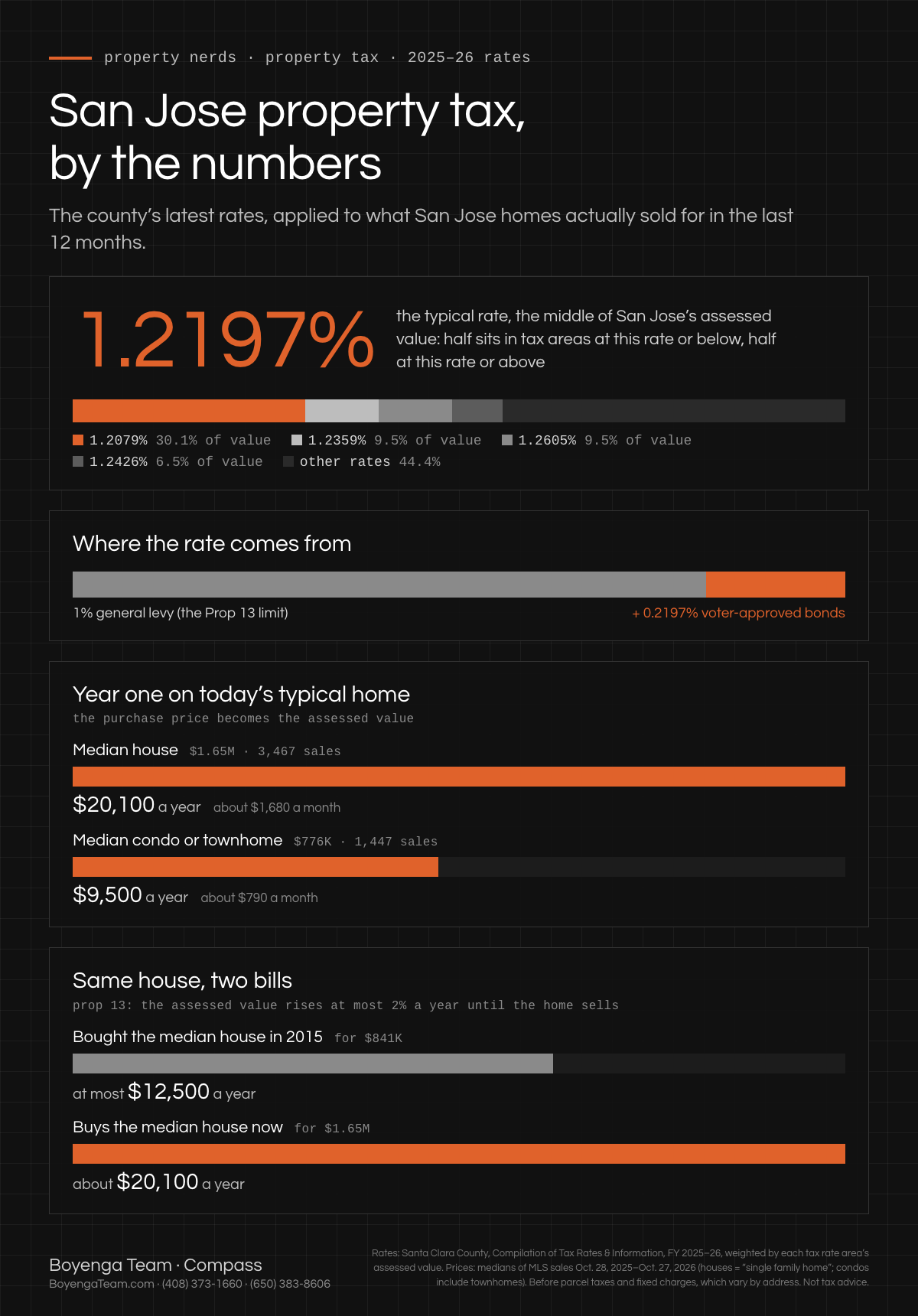
San Jose’s typical property tax rate for 2025–26 is 1.2197%, the highest typical rate of the six cities in this comparison. On the median San Jose house, which sold for $1.65M in the last 12 months, that’s about $20,100 a year. Here’s where the rate comes from, what you’d pay on a house or a condo, why a longtime owner down the street may pay far less, and when the bills are due. We’re the Property Nerds, so the numbers come from the county’s own rate book and our MLS sales data.
The short answer
- The rate: 1.2197% is the middle of the city’s assessed value: half of it sits in tax rate areas at this rate or below, and half at this rate or above. The most common rate, 1.2079%, covers 30.1% of the value. Across San Jose’s 167 tax rate areas, rates run from 1.147% to 1.3161%.
- The median house ($1.65M, 3,467 sales): about $20,100 a year, or $1,680 a month.
- The median condo or townhome ($776K, 1,447 sales): about $9,500 a year, or $790 a month.
- Bought in 2015? The median house then sold for $841K. Under Prop 13 its 2025–26 tax is at most $12,500, at least $7,600 less than a buyer pays today.
- Due dates: November 1 (late after December 10) and February 1 (late after April 10).
Tap the graphic to open it full size.
Buying or selling in San Jose?
- What’s my home worth? Ask for the recent sales on your street.
- Selling a home in San Jose: pricing, prep and what’s selling now.
- Talk to a Property Nerd about what a move would do to your tax bill.
Where the 1.2197% comes from
California caps the general property tax at 1% of assessed value. Everything above that pays for bonds and other debt that voters approved. At San Jose’s typical rate those add 0.2197%, for 1.2197% in all.
Why two San Jose homes can pay different rates
The county divides itself into tax rate areas along the boundaries of cities and of the districts that carry voter-approved bonds. A home pays the bonds of every district it sits in. San Jose has 167 tax rate areas with assessed value, numbered 017-xxx in the county’s book, carrying 22 different rates. Here’s how its assessed value splits by rate:
| Rate | Share of San Jose’s assessed value |
|---|---|
| 1.2079% | 30.1% |
| 1.2359% | 9.6% |
| 1.2605% | 9.5% |
| 1.2426% | 6.5% |
| 1.2172% | 6.3% |
| 1.1735% | 5.9% |
| 1.2614% | 5.4% |
| 1.2246% | 4.9% |
| 1.2631% | 4.3% |
| 1.2416% | 4.0% |
| 1.2789% | 4.0% |
| 1.1795% | 3.8% |
| 1.1913% | 2.5% |
| 9 other rates | 3.2% |
Your exact rate is on your tax bill, next to your tax rate area number.
Because San Jose’s rates are spread out, its typical rate, 1.2197%, is the middle of the city’s assessed value rather than its most common rate: 49.9% of the value sits below it, 0.8% at it and 49.4% above it. A home in an area at 1.147% pays about $11,470 a year per $1 million of assessed value; at 1.3161%, about $13,160.
What a buyer pays in year one
When a home sells, its assessed value resets to the market value at the sale, which is normally the price. So year one is roughly the price times the rate:
| Home | Median price | Sales | Year one | Per month |
|---|---|---|---|---|
| Median house | $1.65M | 3,467 | $20,100 | $1,680 |
| Median condo or townhome | $776K | 1,447 | $9,500 | $790 |
- Add parcel taxes and fixed charges. They’re flat amounts that vary by address, listed on the bill.
- Take off the homeowners’ exemption if it’s your main home: $7,000 off the taxable value, worth about $85 a year at San Jose’s rate. File by February 15 for the full exemption (State Board of Equalization).
- Expect a supplemental bill. The regular bill starts from the seller’s old value, and a supplemental bill catches it up to your price.
Same house, two bills: Prop 13 in San Jose
The median San Jose house sold for $841K in 2015 (5,444 sales). While an owner keeps a home, Prop 13 lets its assessed value rise at most 2% a year, so that 2015 purchase is assessed at no more than $1.02M on the 2025–26 roll, for a tax of at most $12,500. A buyer of today’s median house, at $1.65M, pays about $20,100 in year one: at least $7,600 more a year, about 1.6 times as much.
That gap works both ways. It’s why longtime owners think hard about moving, and it’s the size of the supplemental bill a buyer should plan for: buy the median house from a 2015 owner, and the catch-up runs at least $7,600 a year’s worth, prorated for the months left in the tax year.
Selling and staying in California: Prop 19
If you’re 55 or older, severely disabled, or lost your home to a wildfire or natural disaster, Prop 19 lets you move your assessed value to a replacement home anywhere in California: up to three times if you’re 55 or older or severely disabled, with no set limit after a wildfire or natural disaster. Buy or build the new home within two years of selling. If it costs more than the home you sold, the difference is added to the value you carry over. “More” means above 100% of the sale price if you buy first, 105% in the first year after selling and 110% in the second. Our Prop 19 guide walks through it, and the State Board of Equalization’s Prop 19 page has the details.
Inheriting a home works differently since February 16, 2021. A parent-to-child transfer keeps the parent’s assessed value only if the child makes it their main home, and only up to the parent’s value plus $1,044,586, the figure for transfers from February 16, 2025 to February 15, 2027. Any market value above that is added to the assessed value.
When the bills come due
- First installment: due November 1, late after December 10.
- Second installment: due February 1, late after April 10.
- Late payments carry a 10% penalty. The county mails regular bills by November 1, and the tax is owed whether or not the bill arrives.
- Supplemental bills are due when they’re issued. Read the supplemental property tax bill after you buy for how they’re figured.
San Jose against five other Santa Clara County cities
Typical 2025–26 rates, the range across each city’s tax rate areas, and year one on each median house. For Palo Alto, Los Altos, Sunnyvale, Cupertino, Santa Clara, Los Gatos, Saratoga, Los Altos Hills and Monte Sereno, see Silicon Valley property tax rates by city.
| City | Typical rate | Range across its tax areas | Median house | Year one |
|---|---|---|---|---|
| San Jose | 1.2197% | 1.147%–1.3161% | $1.65M | $20,100 |
| Gilroy | 1.2186% | 1.2186% | $1.16M | $14,100 |
| Campbell | 1.2169% | 1.191%–1.2413% | $2.17M | $26,400 |
| Mountain View | 1.1599% | 1.1506%–1.173% | $2.95M | $34,200 |
| Milpitas | 1.1389% | 1.1389%–1.2253% | $1.62M | $18,500 |
| Morgan Hill | 1.1297% | 1.1297% | $1.52M | $17,200 |
How we counted
Rates come from the Santa Clara County Controller-Treasurer’s “Compilation of Tax Rates & Information, Fiscal Year 2025–2026”, which lists all 816 tax rate areas in the county. For each area we used the rate on a home’s full assessed value (the 1% levy, voter-approved debt on full value and the county’s land-and-improvement charges, as the book defines them) and weighted it by the area’s net local secured value from the same book. The “typical rate” is the rate where the middle dollar of a city’s assessed value sits. These figures cover San Jose inside its city limits. Unincorporated pockets with a San Jose mailing address are in other tax rate areas. Prices are medians of closed sales reported to the MLS from October 28, 2025 to October 27, 2026, read through the IDX feeds that power our home search: houses (MLS property type “single family home”) and condos with townhomes, one record per sale with a usable living area and map position, the same rules as our city price posts. The 2015 figures use calendar-2015 house sales, grown at the 2% Prop 13 cap for the ten tax years from 2016–17 to 2025–26. The actual yearly factor was lower in some years, so those are upper bounds. Year-one figures leave out parcel taxes and other fixed charges, which are flat amounts that vary by address and appear on the bill. Bills mailed in fall 2026 use the 2026–27 rates, which can differ slightly from the county’s 2025–26 book. Your bill shows your exact rate. Nothing here is tax or legal advice.
More San Jose numbers from the Property Nerds
Go deeper
what it costs to own in San Jose each month, San Jose home prices by neighborhood, San Jose condo and townhome prices, San Jose’s transfer tax and Measure E, the supplemental bill after you buy, Prop 19 for homeowners 55+, transfer tax by city, and our real estate calculators.
Talk to a Property Nerd
We’re the Property Nerds at Compass, recognized as NextGenAgents by a national real estate portal. Whether you’re budgeting for a purchase or working out what a move would do to your tax bill, we’ll run the numbers on your home and the one you’re eyeing. Call (408) 373-1660 or (650) 383-8606, or book a strategy call. Commissions are negotiable, and we offer bundled services, so ask us what’s included.