

Blog > How ADU Potential Influences Cambrian Buyer Demand
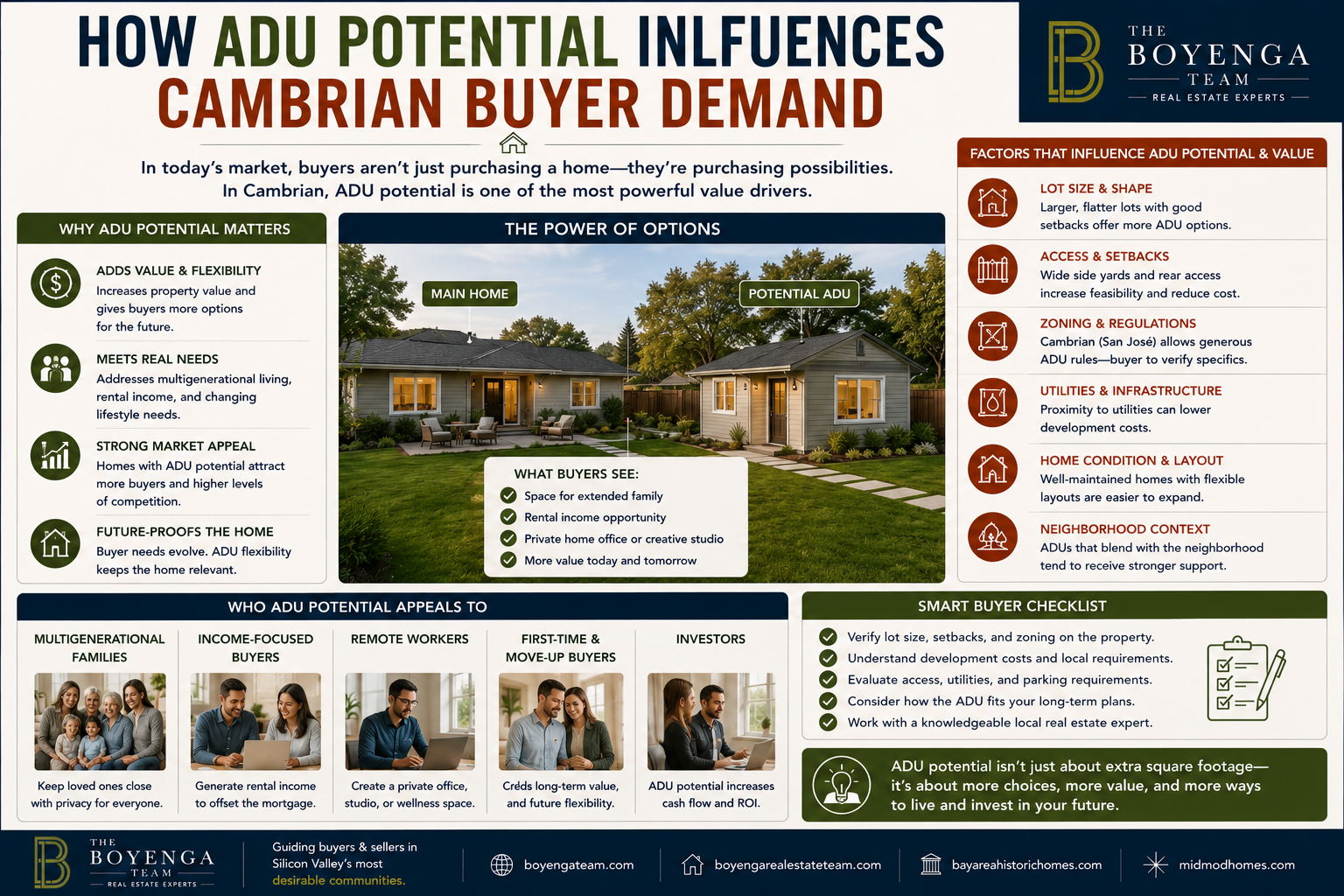 Today's homebuyers are increasingly looking beyond the house itself.
They're evaluating what a property could become.
That shift has made accessory dwelling units (ADUs) one of the most important long-term considerations in many Silicon Valley neighborhoods, including Cambrian. While not every buyer plans to build an ADU immediately, many recognize that the possibility alone can influence future flexibility, lifestyle, and resale value.
In Cambrian, where many ranch homes sit on practical, usable lots, ADU potential has become another factor that distinguishes one property from another.
The Boyenga Team regularly explores these evolving buyer preferences through the Property Nerds Blog at https://www.boyengateam.com/blog, helping homeowners understand how long-term flexibility increasingly influences real estate value.
Buyers Are Purchasing Optionality
An ADU is not valuable simply because it adds square footage.
Its value comes from the choices it creates.
For some buyers, it represents housing for aging parents. Others envision space for adult children returning home after college. Remote workers may imagine a detached office or studio, while investors see opportunities for rental income where permitted.
Even buyers with no immediate plans often appreciate knowing those options exist for the future.
Flexibility has become a premium feature in Silicon Valley housing.
Cambrian's Housing Stock Creates Opportunity
Much of Cambrian was developed during the postwar expansion of Silicon Valley.
The neighborhood's classic ranch homes often sit on relatively level lots with practical layouts, attached garages, and backyards that can accommodate future improvements more easily than many higher-density neighborhoods.
Of course, not every parcel is equally suitable.
Lot dimensions, setbacks, utility locations, easements, trees, slope, access, and local regulations all influence whether an ADU is feasible and what type of structure may ultimately be possible.
Each property should be evaluated individually.
Multi-Generational Living Continues Growing
One of the strongest drivers of ADU demand has been the rise of multigenerational households.
Many families prefer keeping parents, grandparents, or adult children nearby while maintaining greater privacy than a shared interior living arrangement provides.
A thoughtfully designed ADU can create that balance.
The ability to remain close while preserving independent living spaces has become increasingly attractive as housing costs continue rising throughout Silicon Valley.
Rental Income Appeals to Many Buyers
For other purchasers, ADU potential represents future financial flexibility.
While rental markets and local regulations continue evolving, many buyers appreciate the possibility of generating supplemental income through an additional dwelling unit where legally permitted.
Even if those plans never materialize, buyers frequently assign value to the option itself.
The possibility of future income can broaden the property's long-term appeal.
Remote Work Changed Buyer Priorities
The shift toward hybrid work has also expanded how buyers think about detached living space.
Instead of viewing an ADU only as a rental opportunity, many now imagine private offices, creative studios, fitness spaces, guest accommodations, or quiet work environments separated from the main residence.
These uses often require privacy more than additional bedrooms.
That distinction has significantly broadened the appeal of properties with expansion potential.
ADU Potential Is About More Than Lot Size
Many homeowners assume that larger lots automatically create better ADU opportunities.
While lot size certainly matters, it is only one piece of the equation.
The shape of the parcel, side-yard access, existing improvements, utility connections, setbacks, topography, and local development standards often play equally important roles.
A smaller but efficiently configured lot may ultimately support a more practical ADU than a much larger parcel with significant physical constraints.
Buyers Should Avoid Assumptions
Although California has significantly expanded ADU opportunities in recent years, every property remains unique.
Permitting requirements, utility considerations, site conditions, parking rules, local ordinances, and building codes continue affecting what can actually be constructed.
Buyers should avoid assuming that every ranch home automatically qualifies for an ADU simply because neighboring properties have built one.
Professional due diligence remains essential before making purchasing decisions based on future development plans.
ADU Potential Can Expand the Buyer Pool
Properties with credible expansion potential often appeal to more types of buyers.
Families see flexibility.
Professionals see work space.
Investors see optional income.
Retirees see housing for caregivers or visiting family.
Because more buyer groups recognize value in the same property, demand can become broader over time.
That broader demand may support stronger resale performance, even among buyers who never intend to build an ADU themselves.
Flexibility Has Become Part of Value
The real significance of ADU potential is not construction.
It is adaptability.
Homes capable of evolving alongside changing family structures, careers, and financial goals often remain competitive through multiple housing cycles because they continue solving new problems as buyer priorities change.
The Boyenga Team also publishes neighborhood-level market analysis at https://boyengarealestateteam.com, helping buyers evaluate lot characteristics, schools, commute patterns, architecture, and long-term appreciation across Silicon Valley.
For buyers interested in Cambrian's classic ranch homes and California's postwar residential architecture, additional resources are available through the Boyenga Team's dedicated site at https://midmodhomes.com.
The Property Nerd Take
ADU potential isn't about adding another building—it's about adding future choices. In Cambrian, buyers increasingly value homes that can adapt to changing lifestyles, whether that means supporting multigenerational living, creating workspace, or generating future income. The most valuable feature may not be the ADU itself, but the flexibility it represents.