

Blog > How Campbell School Assignments and District Boundaries Affect Home Searches
How Campbell School Assignments and District Boundaries Affect Home Searches
by
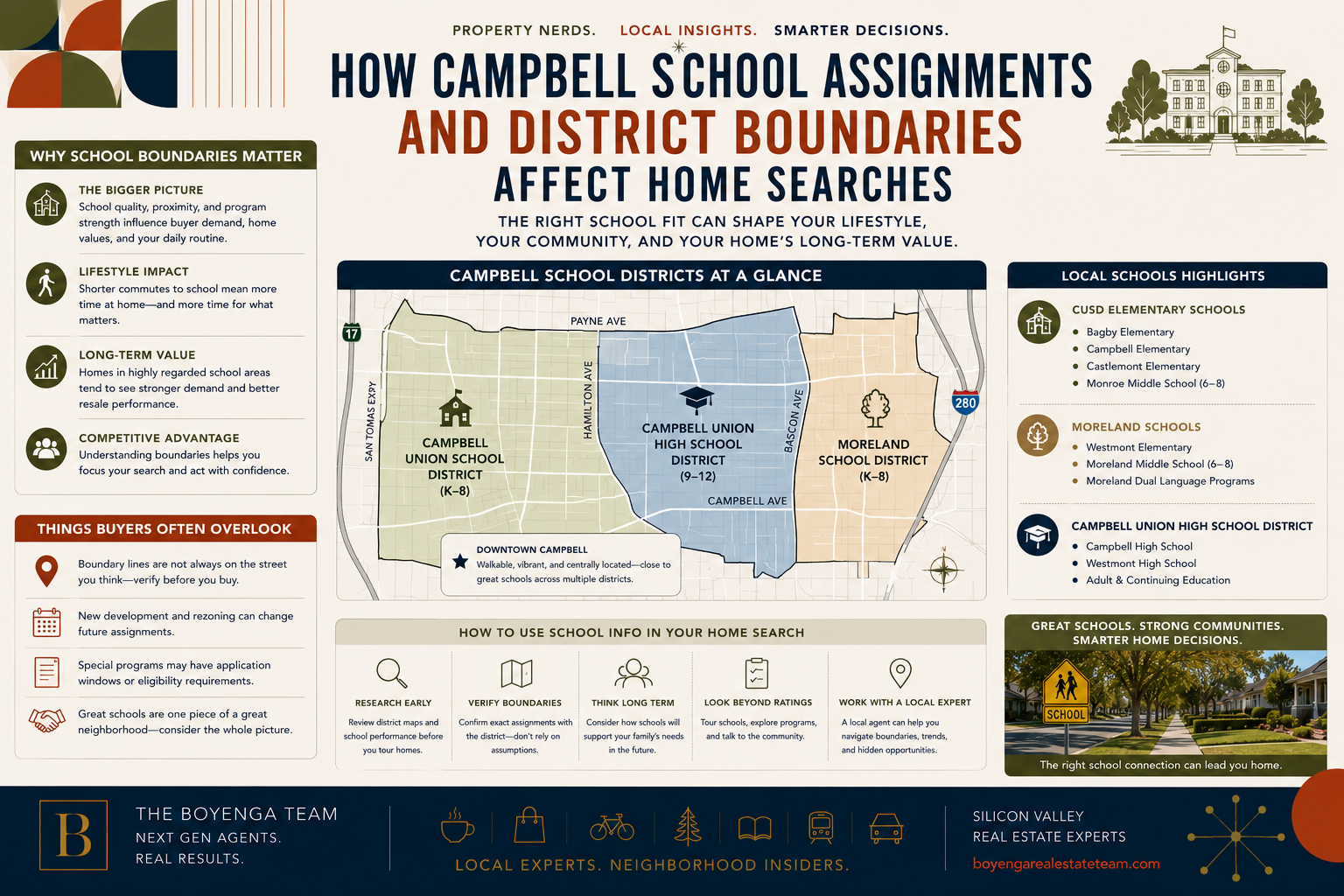 One of the biggest surprises for buyers searching in Campbell has nothing to do with home prices.
It has to do with schools.
Many buyers assume that purchasing a home within Campbell automatically means attending a single school district. In reality, Campbell is served by multiple elementary and high school districts, with attendance boundaries that often shift from one neighborhood to the next. Two homes only a few blocks apart can feed into entirely different schools, creating meaningful differences in buyer demand, resale activity, and search criteria.
Understanding those boundaries early allows buyers to search more efficiently while avoiding costly assumptions later in the process.
The Boyenga Team regularly analyzes these neighborhood dynamics through the Property Nerds Blog at https://www.boyengateam.com/blog, helping buyers understand how schools, neighborhood planning, and buyer behavior intersect throughout Silicon Valley.
One reason Campbell attracts such a broad range of buyers is because there isn't a single "Campbell school system." Instead, homes may be assigned to elementary districts such as Campbell Union, Moreland, Union, or other neighboring districts depending on their exact location. High school assignments similarly vary, with many Campbell neighborhoods feeding into the Campbell Union High School District while others follow different attendance patterns.
For families, these boundaries often become one of the first search filters.
Buyers frequently begin with a preferred school assignment before selecting neighborhoods, home styles, or even budgets. A property that checks every box architecturally may still be eliminated if it falls outside the desired attendance area. Conversely, a home requiring cosmetic updates may generate substantial buyer interest simply because of its assigned schools.
School assignments also influence market behavior beyond families with children.
Many buyers without school-aged children still recognize that desirable attendance areas typically attract a larger pool of future purchasers. Broader buyer demand often contributes to stronger liquidity over time because homes appeal to both lifestyle buyers and families prioritizing education. Schools therefore become part of the home's long-term marketability rather than simply an immediate household decision.
Of course, school quality extends beyond ratings.
Successful buyers also evaluate academic programs, extracurricular opportunities, campus culture, transportation, after-school activities, and how individual schools fit their family's goals. Two highly regarded schools may offer very different educational experiences, making personal research just as important as published rankings.
Neighborhood identity often develops alongside those school communities. Families participate in local events, youth sports, volunteer organizations, and parent networks that strengthen community connections well beyond the classroom. Buyers frequently discover they're choosing not only a school but also a neighborhood ecosystem that shapes everyday life for many years.
Architecture and neighborhood planning continue supporting these communities as well. Campbell's established ranch neighborhoods, tree-lined streets, walkable parks, and thoughtfully developed residential areas create environments that remain attractive to families regardless of shifting market conditions. Buyers interested in how architecture contributes to neighborhood desirability can also explore https://midmodhomes.com, where California residential design is examined across many of Silicon Valley's most enduring communities.
Perhaps the most important lesson for buyers is that assumptions rarely work.
ZIP codes, mailing addresses, and city boundaries do not necessarily determine school assignments. Even homes located on the same street may occasionally fall within different attendance boundaries. Because districts periodically adjust attendance areas or enrollment policies, buyers should always verify current assignments directly through the appropriate school district before removing contingencies or making purchasing decisions.
The Boyenga Team's neighborhood guides at https://boyengarealestateteam.com regularly help buyers navigate these nuances, comparing neighborhoods not simply by price or square footage but by the complete ownership experience—including schools, community identity, and long-term market demand.
Ultimately, Campbell's multiple school districts are one of the reasons the housing market remains so dynamic.
Different buyers prioritize different educational opportunities, creating demand across multiple neighborhoods rather than concentrating interest in one small portion of the city. For buyers willing to understand those distinctions, Campbell offers exceptional flexibility while still providing access to one of Silicon Valley's strongest residential communities.
For buyers interested in thoughtfully planned neighborhoods throughout Silicon Valley—including architecturally significant Eichler communities and other examples of enduring California residential design—https://bayareaeichlerhomes.com offers additional perspective on how neighborhood planning continues influencing long-term desirability.
The Property Nerd Take
School boundaries don't simply determine where children attend class—they influence buyer demand, neighborhood identity, and long-term resale potential. The smartest Campbell buyers treat school assignments as one important piece of the ownership equation, researching each property individually rather than relying on assumptions based on the city address alone.