

Blog > Best Silicon Valley Neighborhoods for School-Focused Buyers: Palo Alto, Los Altos, Mountain View, and Sunnyvale
Best Silicon Valley Neighborhoods for School-Focused Buyers: Palo Alto, Los Altos, Mountain View, and Sunnyvale
by
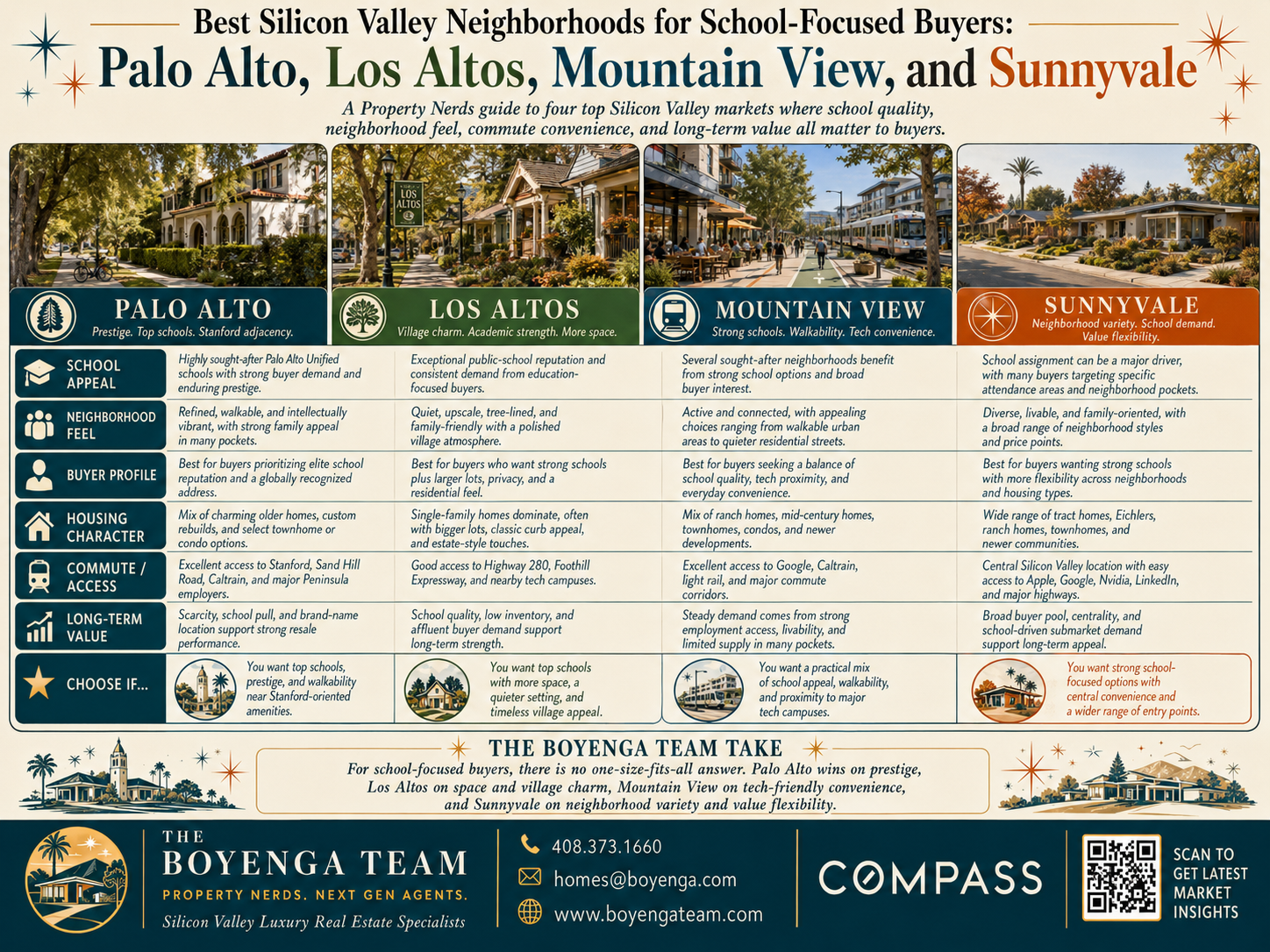
A Property Nerd’s Strategic Guide to School Boundaries, Buyer Demand, Neighborhood Fit, and Long-Term Real Estate Value
For school-focused buyers in Silicon Valley, the home search is rarely just about bedrooms, square footage, or curb appeal. It is about the intersection of education, commute, neighborhood identity, long-term resale value, and daily family life. A buyer may start by saying, “We want the best schools,” but in real estate terms, that question quickly becomes more complicated. Which district? Which elementary boundary? Which high school path? Which neighborhood has the deepest resale demand? Which city gives the strongest balance between school reputation, home value, commute convenience, and lifestyle?
In Palo Alto, Los Altos, Mountain View, and Sunnyvale, school demand is one of the strongest forces shaping home values. These cities attract buyers who work at Stanford, Apple, Google, Nvidia, Meta, LinkedIn, Amazon, venture-backed startups, medical institutions, and AI companies across the region. Many of these buyers are highly analytical. They compare school districts like they compare stock options, commute routes, mortgage rates, remodel budgets, and future resale scenarios. That is exactly why the school-focused buyer needs a Property Nerd approach.
The first rule is simple: never buy based on a school assumption. In Silicon Valley, the city name is not enough. The listing description is not enough. A neighbor’s comment is not enough. School assignment can depend on the exact property address, district boundaries, grade level, enrollment capacity, transfer rules, and future boundary changes. Palo Alto Unified tells families to use its School Finder to identify the neighborhood school, and Mountain View Whisman also directs families to use SchoolLocator and boundary maps for address-specific assignments. That address-level verification is not a formality; it is part of the value analysis.
The second rule is that school demand is not the same thing as school ranking. Rankings can change, methodologies can be imperfect, and student fit matters. But real estate demand is very real. When a large pool of buyers wants a certain district or school path, that demand can create pricing strength, multiple-offer urgency, and future resale confidence. In other words, schools function like invisible infrastructure. You do not see them in the kitchen photos, but they can be one of the most important value drivers in the transaction.
Palo Alto is often the most recognizable school-driven market in the group. Palo Alto Unified School District has enormous brand power with relocation buyers, Stanford-affiliated families, technology executives, academics, physicians, and international buyers. For many buyers, PAUSD plus Stanford proximity plus Palo Alto’s global reputation creates one of the clearest long-term real estate stories in Silicon Valley. Palo Alto Unified states that school assignment is based on the location of the family residence within a school boundary, which is why the exact address still matters even in a city with such a strong district brand.
From a neighborhood perspective, Palo Alto school-focused buyers often evaluate Old Palo Alto, Professorville, Crescent Park, Community Center, Southgate, College Terrace, Midtown, Barron Park, Greenmeadow, Duveneck/St. Francis, Charleston Meadow, and other family-oriented pockets. Each neighborhood has a different lifestyle profile. Old Palo Alto and Professorville deliver prestige, charm, and proximity to Stanford and downtown. Crescent Park offers a more estate-like residential feel near downtown Palo Alto. Midtown offers practical family living and neighborhood services. Barron Park has a more relaxed, eclectic personality. Greenmeadow and other mid-century pockets appeal to buyers who love Eichler and modernist architecture.
The Palo Alto buyer often values school confidence and resale liquidity more than pure square footage. A home may be older, smaller, or on a more compact lot, but if the location, school path, street, and architectural story are compelling, buyers may still compete aggressively. That is Palo Alto’s school-market power. It is not just that families want the schools. It is that future families are likely to want the same thing, and that expectation supports resale demand.
Los Altos is another major school-focused market, but it requires more precision than many buyers expect. The City of Los Altos lists multiple school districts serving residents, including Los Altos School District, Cupertino Union School District, Mountain View Los Altos High School District, and Fremont Union High School District depending on the property and grade level. That means “Los Altos schools” is not a complete answer. A buyer needs to verify the exact elementary, middle, and high school path before assigning value to the home.
Los Altos appeals to school-focused buyers who also want space, privacy, larger lots, quiet streets, and a more residential luxury lifestyle. Compared with Palo Alto, Los Altos often feels less urban and more retreat-like. Buyers may be drawn to North Los Altos, Old Los Altos, Country Club, Loyola Corners, South Los Altos, Highlands, Rancho, Grant Park-adjacent pockets, and areas near the Los Altos-Mountain View or Los Altos-Sunnyvale border. The right neighborhood depends on whether the buyer prioritizes walkability to the village, lot size, commute to Apple or Google, access to Foothill Expressway or 280, or a specific school path.
The Los Altos school premium is closely tied to land value. Buyers are not only buying access to strong schools. They are often buying a home environment that supports long-term family life: a backyard, room to expand, ADU potential, outdoor entertaining, quiet streets, and privacy. For many tech executives and founders, Los Altos feels like the place where a high-pressure work life can be balanced by a calmer home environment.
Mountain View is one of the most interesting school-focused markets because it combines school demand with Google convenience, Caltrain access, walkability, and a broader range of price points. Mountain View Whisman School District serves K–8 students in Mountain View, while Mountain View Los Altos High School District serves high school students in both Mountain View and Los Altos. MVLA describes both Los Altos High and Mountain View High as ranking in the top 2% nationally according to U.S. News & World Report, which helps explain why school-focused buyers pay close attention to this corridor.
Mountain View school-focused buyers often evaluate Cuesta Park, Waverly Park, Old Mountain View, Shoreline West, Monta Loma, Rex Manor, Blossom Valley, St. Francis Acres, Grant/Sylvan Park, Whisman Station, The Crossings, and North Whisman. The city has more housing variety than Palo Alto or Los Altos, with single-family homes, Eichlers, mid-century homes, ranch homes, townhomes, condos, and downtown-adjacent properties. That variety creates more opportunity, but also more need for micro-market analysis.
Mountain View’s appeal is strongest for families who want both school access and daily convenience. A buyer may want a strong school path, but also wants to bike to Google, walk to Castro Street, use Caltrain, reach Stevens Creek Trail, or avoid a long commute. For these buyers, Mountain View can offer a compelling blend of education, technology access, and lifestyle efficiency. The city may not have the same global school-brand premium as Palo Alto, but it can offer a smarter value equation for buyers who want to stay close to the tech engine.
Sunnyvale may be the most underrated school-focused market in this group because it is highly address-sensitive. Sunnyvale includes multiple school paths, and the differences can be enormous. Sunnyvale School District lists schools including Cherry Chase Elementary, Cumberland Elementary, Columbia Middle, Sunnyvale Middle, Bishop, Ellis, Fairwood, Lakewood, San Miguel, and Vargas, among others. Fremont Union High School District, headquartered in Sunnyvale, also provides an address check tool for determining which high school serves a specific property.
Sunnyvale school-focused buyers often look closely at Cherry Chase, Cumberland South, Birdland, Raynor Park, Las Palmas, Ortega Park, Fairbrae, Heritage District, Washington Park, Ponderosa Park, West Sunnyvale, and other neighborhood pockets. Some buyers are drawn to specific elementary schools. Others focus on high school paths. Others want a balance of schools, commute, Eichler architecture, downtown access, or value relative to Cupertino, Los Altos, and Mountain View.
Sunnyvale’s school-focused value proposition is flexibility. A buyer may find a strong school pocket, a shorter Apple or Google commute, a more updated home, a better floor plan, or a lower overall price compared with Los Altos or Palo Alto. Sunnyvale is not simply the “more affordable” choice. It is a strategic choice for buyers who understand that school demand, commute access, and neighborhood identity can combine to create strong long-term value.
Current market data reinforces why school-focused buyers analyze these four cities differently. Redfin’s three-month data ending May 2026 showed Palo Alto with a median sale price of about $3.6 million, Los Altos around $4.2 million, Mountain View around $1.9 million, and Sunnyvale around $1.8 million. These citywide numbers can be distorted by housing mix and small sample sizes, but the pattern is useful: Palo Alto and Los Altos command premium pricing, while Mountain View and Sunnyvale often provide more flexible entry points into highly desirable school and commute corridors.
The school-focused buyer should think less like a consumer and more like an allocator of capital. A Palo Alto purchase may be a bet on global school prestige, Stanford proximity, and long-term liquidity. A Los Altos purchase may be a bet on schools plus land, privacy, and family lifestyle. A Mountain View purchase may be a bet on schools plus Google convenience, walkability, and daily efficiency. A Sunnyvale purchase may be a bet on strong school pockets, tech commute flexibility, and value relative to neighboring premium cities.
For buyers, the key is to understand the difference between citywide reputation and address-specific value. A property in a famous city can still be compromised. A property in a less globally recognized city can still be an exceptional school-and-resale asset. The best purchases usually combine several value drivers at once: the right school path, a functional floor plan, good street quality, commute convenience, lot utility, strong neighborhood demand, and a clear future resale story.
For sellers, school-focused marketing should be handled carefully and accurately. The best approach is not to overpromise or casually advertise schools without verification. Instead, the marketing should make the buyer understand the lifestyle and resale logic of the neighborhood. A Palo Alto seller should usually emphasize PAUSD confidence, Stanford proximity, walkability, and long-term demand. A Los Altos seller should emphasize school path, land, privacy, outdoor living, and premium residential lifestyle. A Mountain View seller should emphasize school access, Google convenience, Caltrain, downtown walkability, and practical family living. A Sunnyvale seller should emphasize address-specific school path, commute flexibility, neighborhood identity, Eichler or mid-century appeal, and value compared with nearby cities.
The school-focused buyer also needs to evaluate commute. In Silicon Valley, the best school on paper may not be the best family decision if the commute destroys daily life. A household commuting to Stanford, Meta, or Sand Hill Road may view Palo Alto differently than a household commuting to Apple, Google, Nvidia, or LinkedIn. Mountain View and Sunnyvale can be especially powerful for two-career households because they sit near multiple tech corridors. Los Altos can be ideal for families who want quieter streets and can manage a slightly more car-oriented routine. Palo Alto can be ideal for families tied to Stanford, downtown Palo Alto, Menlo Park, or Peninsula employment.
Architecture matters too. Palo Alto offers historic homes, Craftsman properties, Spanish-style residences, Eichlers, mid-century modern homes, ranch homes, and luxury rebuilds. Los Altos offers ranch homes, expanded ranches, new construction, custom homes, and larger-lot properties. Mountain View offers Eichlers, mid-century homes, ranch homes, downtown townhomes, and walkable housing options. Sunnyvale offers Eichlers, ranch homes, remodeled family homes, townhomes, condos, and a wide range of neighborhood styles. School-focused buyers should not ignore architecture, because the next buyer will care about how the home lives.
Lot utility is one of the most overlooked school-market variables. Families often need usable yards, play space, outdoor dining, future ADU potential, detached office flexibility, storage, and safe street environments. Los Altos usually has the strongest larger-lot story. Palo Alto often trades lot size for prestige and location. Mountain View trades some space for convenience and walkability. Sunnyvale offers a mix, with certain pockets delivering surprising lot utility and others functioning more as compact commute-oriented housing.
Smart-home readiness is increasingly important for school-focused tech families. Buyers often value EV charging, solar, battery backup, heat pump HVAC, induction cooking, smart thermostats, strong Wi-Fi, leak detection, smart irrigation, security systems, air filtration, and functional home office infrastructure. These features matter because modern Silicon Valley families are not just buying a school boundary. They are buying a home operating system that supports work, school, commuting, energy resilience, and daily convenience.
The biggest mistake school-focused buyers make is over-weighting one factor. A school boundary matters, but it is not the only factor. A great district does not fix a bad floor plan, a compromised lot, a noisy location, poor drainage, deferred maintenance, or a commute that does not work. The best Silicon Valley school-neighborhood purchases usually have balance. They support the student, the parents, the household routine, and the future resale buyer.
The second biggest mistake is failing to verify. School boundaries can change, enrollment policies can shift, and address assignments can surprise buyers. Before writing an offer, buyers should verify directly with the relevant district, review the district’s official locator tools, and understand whether any transfer, overflow, or enrollment rules may apply. This is especially important in Los Altos, Mountain View, and Sunnyvale, where multiple districts and boundary layers can overlap.
At the Boyenga Team at Compass, we view school-focused buying as a strategic real estate discipline. Eric and Janelle Boyenga, known as Silicon Valley Property Nerds and Next Gen Agents, help clients evaluate the full value stack: school boundaries, district paths, commute patterns, neighborhood demand, lot utility, remodel risk, architectural style, buyer psychology, Compass technology, private inventory, and future resale positioning.
Compass gives the Boyenga Team a technology-forward platform that fits how Silicon Valley buyers make decisions. Data matters, but interpretation matters more. A school map can show a boundary. A market expert explains what that boundary means for buyer urgency, pricing, negotiation leverage, and long-term resale.
The final takeaway is simple. Palo Alto is often the strongest fit for buyers who want elite district recognition, Stanford proximity, prestige, and resale liquidity. Los Altos is often the strongest fit for buyers who want schools plus space, privacy, larger lots, and a premium family lifestyle. Mountain View is often the strongest fit for buyers who want schools plus Google convenience, walkability, Caltrain, and daily efficiency. Sunnyvale is often the strongest fit for buyers who want school-pocket strategy, value, commute flexibility, Eichler neighborhoods, and access to multiple tech employers.
There is no single best Silicon Valley school neighborhood for every family. There is only the best fit for a specific child, household, commute, budget, lifestyle, and long-term real estate strategy. That is why school-focused buying in Palo Alto, Los Altos, Mountain View, and Sunnyvale deserves more than a ranking list. It deserves a Property Nerd analysis.
The Boyenga Team at Compass represents buyers and sellers throughout Silicon Valley with a focus on luxury homes, Eichler and mid-century modern properties, school-driven moves, estate homes, trust sales, relocation strategy, and high-value residential positioning. Known as Property Nerds and Next Gen Agents, Eric and Janelle Boyenga combine data, design, technology, negotiation, and local market intelligence to help clients make smarter real estate decisions in Palo Alto, Los Altos, Mountain View, Sunnyvale, Cupertino, Menlo Park, Saratoga, Los Gatos, and the greater Silicon Valley market. For expert guidance, contact the Boyenga Team at Compass at homes@boyenga.com or visit www.BoyengaTeam.com.