

Blog > Best Mid-Century Modern Neighborhoods in Silicon Valley
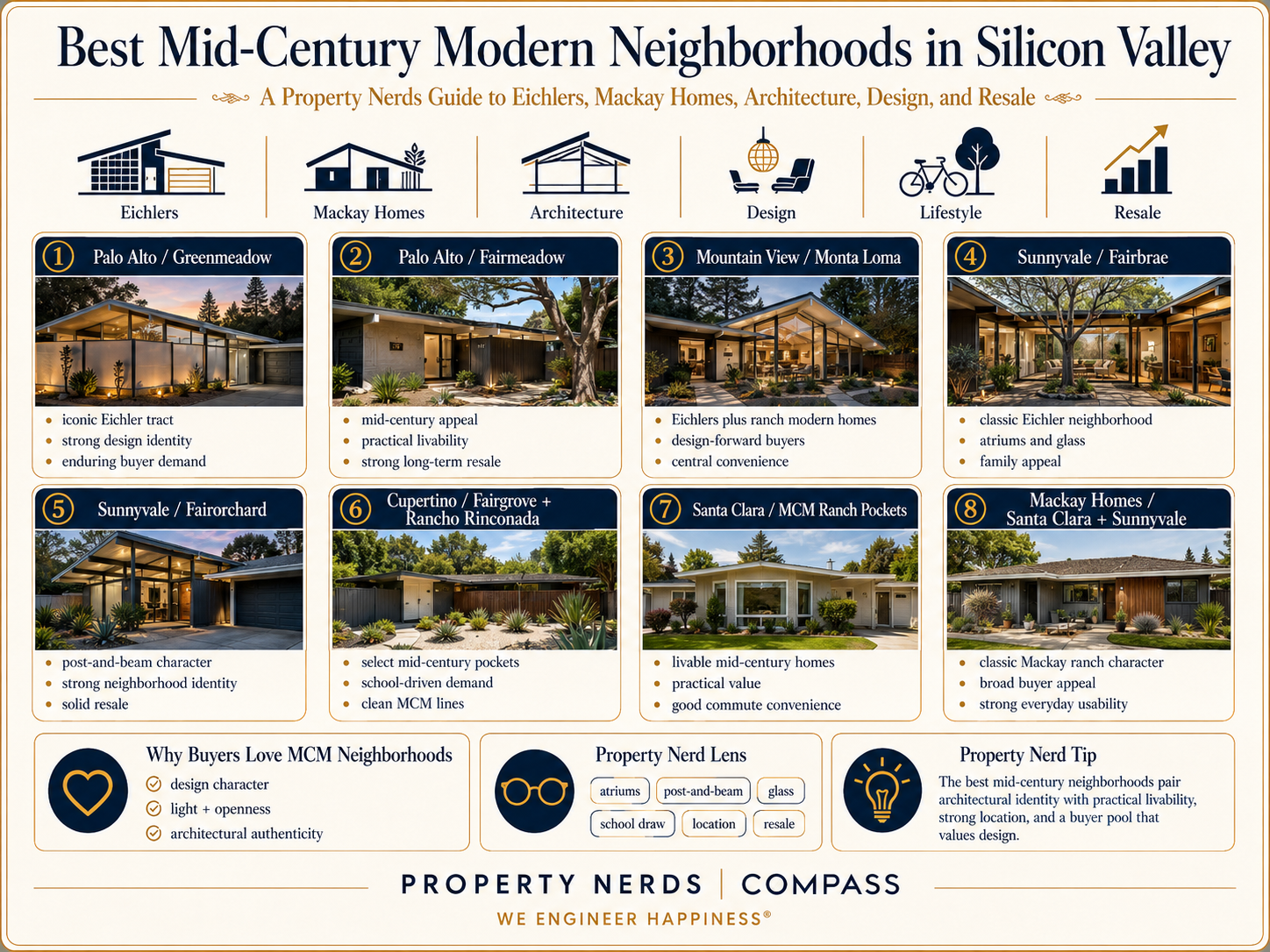
Silicon Valley has always had a modernist streak.
Before it became the global center of technology, it was already a place where new ideas about architecture, indoor-outdoor living, postwar optimism, and California casual design were taking shape. Mid-century modern homes were not just houses. They were a lifestyle experiment.
Open plans. Low-slung rooflines. Walls of glass. Atriums. Courtyards. Radiant heat. Beamed ceilings. Clerestory windows. Carports. Slab foundations. Private fronts. Transparent backs. A feeling that the house was not separate from the landscape, but part of it.
That is why mid-century modern homes in Silicon Valley still have such a passionate buyer pool.
For some buyers, a mid-century modern home is an architectural statement. For others, it is about light, simplicity, and indoor-outdoor living. For others, it is about owning something with soul in a market full of generic rebuilds. And for sellers, the right positioning matters because mid-century homes do not sell like standard ranch homes.
The Boyenga Team’s Property Nerds approach is especially important in this category because mid-century modern value is not just about square footage. It is about architecture, preservation, neighborhood context, systems, lot orientation, remodel sensitivity, and buyer-pool fluency.
A great mid-century home should not be marketed as simply “updated.” It should be marketed as design-forward, lifestyle-rich, and architecturally intentional.
What Makes a Mid-Century Modern Neighborhood Valuable?
The best mid-century modern neighborhoods in Silicon Valley usually share a few traits.
They have architectural consistency. Buyers can feel that the neighborhood has a point of view.
They have indoor-outdoor design. Homes often connect to patios, atriums, courtyards, and gardens.
They have strong light. Windows, rooflines, and open plans create a sense of airiness.
They have a passionate buyer pool. Design buyers, Eichler enthusiasts, tech buyers, and architecture-minded families often compete for the right home.
They have location strength. Schools, commute access, parks, downtowns, and resale demand still matter.
They have preservation potential. The best homes retain enough original character to feel authentic while still supporting modern living.
The Property Nerds read: Mid-century modern value comes from both design and discipline. The wrong remodel can erase the premium.
Eichler, Mackay, Mardell, and the Broader Mid-Century Modern Market
When buyers say they want a mid-century modern home in Silicon Valley, they often say “Eichler.”
That makes sense. Joseph Eichler helped define California modern tract housing, and Silicon Valley has some of the most recognizable Eichler neighborhoods in the Bay Area.
But Eichler is not the whole story.
There are also Mackay homes, Mardell homes, other postwar contemporary tracts, custom mid-century homes, architect-designed one-offs, and modernist-influenced neighborhoods that share many of the same design principles.
A true Property Nerd buyer looks beyond the label and studies the architecture.
Is it post-and-beam?
Does it have original paneling?
Does it have an atrium or courtyard?
Does the floor plan connect to the yard?
Does the roofline preserve the original design?
Has the home been sensitively restored or generically remodeled?
Are the systems appropriate for the structure?
Does the neighborhood support the design value?
That is how you separate a special mid-century home from a standard older ranch.
1. Greenmeadow, Palo Alto
Best for: iconic Eichler living, community feel, Palo Alto schools, design buyers
Greenmeadow is one of the most beloved mid-century modern neighborhoods in Silicon Valley. It has the full Eichler neighborhood feeling: low-slung homes, indoor-outdoor flow, glass, beams, private fronts, open backs, and a strong sense of architectural identity.
For buyers, Greenmeadow offers something rare: design credibility combined with Palo Alto location strength.
This is not just about owning an Eichler. It is about owning an Eichler in a neighborhood where other buyers understand what that means.
Greenmeadow buyers often value the community feel, the architectural consistency, the South Palo Alto location, and the lifestyle that comes with a true mid-century environment. They may be drawn to the pool and community-oriented feel, the walkable neighborhood pattern, and the overall design culture.
Seller strategy matters here. A Greenmeadow Eichler should not be marketed like a generic ranch. Buyers will want to understand the roof, radiant heat, slab, glass, paneling, atrium or courtyard flow, and any remodel history.
The Property Nerds read: Greenmeadow sells best when the architecture feels respected, not erased.
2. Fairmeadow, Palo Alto
Best for: classic Eichler design, South Palo Alto lifestyle, family-friendly modernism
Fairmeadow is another major Palo Alto Eichler area that attracts buyers who want a true mid-century experience with strong location fundamentals.
Fairmeadow homes often appeal to buyers who want the clean lines, light, and indoor-outdoor rhythm of Eichler living, but also want access to Palo Alto’s broader school, commute, and resale ecosystem.
This neighborhood tends to attract buyers who understand the difference between original character and generic updating. A home with thoughtful preservation, improved systems, and warm design continuity can stand out.
Fairmeadow also works well for buyers comparing Palo Alto Eichlers with Mountain View, Sunnyvale, and San Mateo Highlands modernist homes. Palo Alto usually commands a premium, but the buyer pool can be deep when the home shows well and the disclosures are clear.
The Property Nerds read: Fairmeadow is a strong fit for buyers who want mid-century design with Palo Alto buyer-pool depth.
3. Green Gables, Charleston Meadow, and Other Palo Alto Eichler Pockets
Best for: Eichler scarcity, Palo Alto address strength, design-sensitive buyers
Palo Alto has multiple Eichler and mid-century modern pockets beyond Greenmeadow and Fairmeadow. Green Gables, Charleston Meadow, Channing Park, Los Arboles, and smaller clusters all contribute to Palo Alto’s mid-century identity.
These homes can attract several buyer pools at once: architecture buyers, school-focused families, Stanford/Palo Alto buyers, tech commuters, and remodel-sensitive buyers.
The key is that each pocket has its own micro-market story. A home in a more cohesive Eichler tract may feel different from a smaller cluster or individual mid-century property surrounded by more traditional homes. That can affect buyer demand, pricing, and how the home should be marketed.
In Palo Alto, mid-century homes often compete against very expensive rebuilds and traditional luxury homes. That makes architectural positioning even more important. The home must explain why design, not just square footage, is the value.
The Property Nerds read: Palo Alto mid-century buyers are often paying for a rare combination of architecture, schools, Stanford access, and long-term scarcity.
4. Monta Loma, Mountain View
Best for: Eichler and Mackay character, Google commute, neighborhood identity, relative value
Monta Loma is one of Silicon Valley’s most important mid-century modern neighborhoods. It offers a mix of Eichler homes, Mackay homes, Mardell homes, and other mid-century contemporaries, giving the neighborhood a distinctive design-forward feel.
This is a favorite for buyers who want architecture, but may not want or be able to pay Palo Alto Eichler pricing.
Monta Loma also has strong commute logic. It is close to Google, North Bayshore, Mountain View employment, Palo Alto, Los Altos, and major Peninsula routes. That makes it especially attractive to tech buyers who want design and convenience.
Monta Loma homes are often modest in size by today’s standards, but they live differently because of the design. Light, glass, roofline, indoor-outdoor connection, and open-beam character can make a smaller home feel larger and more special.
For sellers, the biggest mistake is over-genericizing the home. Monta Loma buyers often like modern updates, but they still want the house to feel like Monta Loma.
The Property Nerds read: Monta Loma is one of the best mid-century value stories in Silicon Valley because it blends design, location, and buyer passion.
5. Fairbrae, Sunnyvale
Best for: cohesive Eichler neighborhood feel, family buyers, Apple commute, community identity
Fairbrae is one of Sunnyvale’s standout Eichler neighborhoods and one of the most recognizable mid-century modern pockets in the South Bay.
Buyers are often drawn to Fairbrae because it feels like a real Eichler community. The streets, rooflines, scale, and design consistency create an environment that architecture buyers understand immediately.
Fairbrae also benefits from Sunnyvale’s strong family demand, Apple commute access, parks, and broader Silicon Valley convenience. For buyers priced out of Palo Alto or Los Altos but still wanting a true mid-century modern neighborhood, Fairbrae can be very compelling.
The best Fairbrae homes usually balance preservation with livability. Buyers may appreciate updated kitchens, baths, roof systems, radiant heat maintenance, and modern comfort, but they do not want the home to lose its Eichler soul.
The Property Nerds read: Fairbrae works because it offers both architecture and everyday practicality.
6. Fairorchard and Other Sunnyvale Eichler Pockets
Best for: Eichler variety, Apple proximity, school-by-address demand, remodel potential
Sunnyvale has one of the richest Eichler landscapes in Silicon Valley. Fairorchard, Rancho Verde, Fairbrae Addition, and other Sunnyvale Eichler pockets offer a range of home sizes, layouts, lot profiles, and neighborhood personalities.
This variety matters because buyers can approach Sunnyvale Eichlers in different ways.
Some want an architectural home to restore.
Some want a move-in ready Eichler.
Some want Apple commute convenience.
Some want a school-focused Sunnyvale address.
Some want a more attainable alternative to Palo Alto.
Some want a design-forward home with future remodel potential.
Sunnyvale’s Eichler market is especially interesting because the buyer pool can include both architecture purists and practical family buyers. The best marketing needs to speak to both.
The Property Nerds read: Sunnyvale mid-century homes sell best when the listing explains both the design story and the daily-life logic.
7. Fairgrove, Cupertino
Best for: Eichler character, Cupertino school demand, Apple commute, rare design appeal
Fairgrove is one of Cupertino’s most important mid-century modern pockets and a key Eichler-related neighborhood for buyers who want design plus Cupertino demand.
This is a powerful combination because Cupertino buyers are often intensely school- and commute-focused, while Eichler buyers are design-focused. When those buyer pools overlap, demand can be strong.
Fairgrove homes require careful positioning. Some buyers may value the home primarily for the school path and Apple proximity. Others may value the architecture. Others may see expansion or remodel potential.
The challenge is not to flatten the home into a generic Cupertino listing. If the home has mid-century character, that character should be part of the story.
The Property Nerds read: Fairgrove is compelling because it combines Cupertino fundamentals with architectural scarcity.
8. Rancho Rinconada and Mid-Century Cupertino Pockets
Best for: Apple commute, remodel opportunity, mid-century scale, value strategy
Rancho Rinconada is not purely an Eichler neighborhood, but it is deeply tied to the postwar ranch and mid-century housing story of Cupertino. Buyers may come for schools, Apple proximity, relative value, remodel potential, or future rebuild logic.
For mid-century-minded buyers, Rancho Rinconada can offer single-level homes, modest footprints, clean lines, and opportunities to create a more modern indoor-outdoor lifestyle.
However, Rancho Rinconada is a very strategy-driven market. Some buyers see the existing home. Some see the lot. Some see a remodel. Some see a rebuild.
That makes positioning critical. A seller should understand whether the likely buyer is a design buyer, family buyer, remodeler, or builder.
The Property Nerds read: Rancho Rinconada is less about pure architectural pedigree and more about mid-century bones, Apple proximity, and future potential.
9. Fairglen, San Jose
Best for: historic Eichler neighborhood feel, Willow Glen-area lifestyle, architectural community
Fairglen is one of San Jose’s best-known Eichler neighborhoods and an important mid-century modern pocket for buyers who want architecture outside the most expensive Peninsula markets.
Fairglen attracts buyers who appreciate Eichler design but also want access to San Jose, Willow Glen, Campbell, and broader South Bay amenities.
The neighborhood has a strong Eichler identity, and that can create a passionate buyer pool. For the right buyer, Fairglen offers a more accessible path into authentic Eichler living compared with Palo Alto or some Sunnyvale pockets.
Buyers should still evaluate systems carefully: roof, radiant heat, slab, drainage, glass, electrical, and remodel history all matter.
The Property Nerds read: Fairglen gives San Jose buyers a real architectural community, not just a mid-century-looking house.
10. Fairhaven / Mossbrook, San Jose-Campbell Edge
Best for: Eichler design, Campbell/San Jose access, neighborhood character
Fairhaven, sometimes associated with the Mossbrook area, is another important Eichler pocket near the San Jose and Campbell edge.
This area can appeal to buyers who want mid-century modern architecture with access to Campbell, Willow Glen, West San Jose, and commuter routes. It may also appeal to buyers who want something more distinctive than a standard ranch home.
As with all Eichler neighborhoods, the best homes are the ones where updates respect the design. A well-preserved or thoughtfully modernized Eichler can feel special. A poorly remodeled one can feel confused.
The Property Nerds read: Fairhaven works for buyers who want Eichler character in a practical South Bay location.
11. Rose Glen and Other San Jose Eichler Pockets
Best for: smaller Eichler clusters, value opportunities, design-minded buyers
San Jose has several Eichler and mid-century modern pockets beyond Fairglen and Fairhaven. These smaller clusters can be interesting for buyers who want architecture, but also want more value flexibility than the most famous tracts.
Smaller Eichler neighborhoods can sometimes be overlooked because they do not have the same name recognition as Palo Alto, Sunnyvale, or San Mateo Highlands. That can create opportunity for buyers who understand the architecture.
For sellers, the key is making sure the home is marketed to the right audience. If the home has true Eichler or mid-century character, the listing should speak to architecture buyers, not just general San Jose buyers.
The Property Nerds read: Smaller Eichler pockets can outperform expectations when the right buyer pool knows they exist.
12. San Mateo Highlands
Best for: one of the Bay Area’s most iconic Eichler communities, larger-scale modernist neighborhood feel
San Mateo Highlands is technically outside the core Silicon Valley cities many South Bay buyers focus on, but it is too important to leave out of any serious mid-century modern conversation.
It is one of the most iconic Eichler communities in the Bay Area, known for its architectural consistency, hillside setting, community feel, and strong design identity.
For buyers comparing Silicon Valley Eichlers, San Mateo Highlands can offer a different lifestyle: more Peninsula-oriented, more hillside/community-driven, and often more architecturally cohesive at scale.
It can appeal to buyers working in San Francisco, the Peninsula, Stanford, or tech corridors who want a true Eichler neighborhood with a strong identity.
The Property Nerds read: San Mateo Highlands is a benchmark Eichler community and a key comparison point for serious mid-century buyers.
13. Orange / Fairhills and Other Peninsula Modernist Pockets
Best for: architecture buyers willing to look beyond the usual search map
Some of the best mid-century opportunities are not always in the obvious neighborhoods. Smaller Peninsula modernist pockets, custom homes, and Eichler-adjacent communities can offer strong design appeal with different pricing and commute trade-offs.
For buyers, this is where architectural fluency matters. The right home may not show up in a simple “Eichler” search. It may be described as contemporary, mid-century, modernist, post-and-beam, or simply a ranch home with original details.
The Property Nerds read: Mid-century buyers should search by architecture, not just by label.
14. Custom Mid-Century Homes in Los Altos and Los Altos Hills
Best for: rare custom modernist homes, larger lots, privacy, design-forward luxury
Los Altos and Los Altos Hills are not primarily tract-Eichler markets, but they have important custom mid-century and modernist homes.
These properties can be extremely special because they often combine architectural design with larger lots, privacy, views, mature landscaping, and premium location.
Buyers may find post-and-beam homes, hillside modernist residences, glass-heavy designs, and custom properties that feel more like California modern retreats than suburban tract homes.
The challenge is that these homes are highly property-specific. They require careful evaluation of structure, roof systems, drainage, slope, remodeling quality, and whether the architecture has been preserved.
The Property Nerds read: Custom mid-century homes in Los Altos and Los Altos Hills can be rare design assets, but each one needs a property-level analysis.
15. Saratoga, Los Gatos, and Monte Sereno Modernist Homes
Best for: mid-century design with foothill privacy, views, and estate lifestyle
Saratoga, Los Gatos, and Monte Sereno are not known primarily as Eichler tract markets, but they have beautiful mid-century and modernist homes tucked into hillside, estate, and private residential settings.
These homes may appeal to buyers who want architecture plus privacy. They often offer glass, views, wood, open plans, courtyards, decks, and indoor-outdoor flow that aligns beautifully with the foothill environment.
A mid-century modern home in these markets should be positioned differently from a standard luxury estate. The value may be in the architecture, setting, light, and sense of retreat.
The Property Nerds read: In foothill markets, the best mid-century homes feel like they grew out of the landscape.
What Mid-Century Buyers Notice First
Mid-century buyers are different from general buyers.
They notice rooflines.
They notice beams.
They notice original paneling.
They notice whether the front is private and the back is open.
They notice if the atrium still works.
They notice flooring choices.
They notice whether the kitchen remodel respects the architecture.
They notice whether the home has been warmed up or stripped down.
They notice windows, sliders, glass, and light.
They notice landscaping.
They notice if the staging understands the house.
They also notice mistakes.
Gray vinyl flooring in an Eichler.
Overly traditional cabinets.
Heavy crown molding.
Random farmhouse finishes.
Generic flip materials.
Blocked glass.
Removed beams.
Poor lighting.
Overdone tile.
A remodel that turns a modernist home into a standard suburban box.
The Property Nerds read: Mid-century buyers are not just buying a house. They are buying design integrity.
What Sellers Should Know Before Remodeling a Mid-Century Home
The biggest mistake mid-century sellers make is assuming all updates add value.
They do not.
A sensitive remodel can increase value. A generic remodel can reduce buyer excitement.
Before updating a mid-century home, sellers should ask:
Is the home architecturally significant?
Which original features should be preserved?
What systems need attention?
Does the roofline need to remain visually clean?
Does the lighting support the architecture?
Are the finishes warm, simple, and appropriate?
Does the landscaping support indoor-outdoor flow?
Will design buyers appreciate the choices?
Will family buyers understand the livability?
Will the updates improve value or erase character?
Sometimes the best pre-sale strategy is not a full remodel. It may be cleaning, landscaping, staging, lighting, paint, minor repairs, inspections, and careful storytelling.
The Property Nerds read: With mid-century homes, restraint can be more valuable than renovation.
Systems Matter More in Mid-Century Homes
Mid-century homes can be magical, but buyers need to understand the systems.
Important areas often include:
Roof condition.
Radiant heat.
Slab foundation.
Drainage.
Original electrical.
Single-pane glass.
Plumbing.
Sewer lateral.
Pest issues.
Atrium drainage.
Window and slider condition.
Insulation and comfort.
Permits for past remodels.
These issues do not make a home bad. They simply require clarity.
A buyer who loves Eichlers may be comfortable with radiant heat or flat-roof maintenance if they understand the condition. A buyer who is new to mid-century homes may need more education and confidence.
The Property Nerds read: A strong inspection package helps architecture buyers become stronger offer writers.
Best Mid-Century Modern Neighborhoods by Buyer Priority
Best for iconic Eichler identity
Greenmeadow, Fairmeadow, Fairbrae, Fairglen, San Mateo Highlands
Best for Palo Alto schools and architecture
Greenmeadow, Fairmeadow, Charleston Meadow, Green Gables, Palo Alto Eichler pockets
Best for Google commute and mid-century value
Monta Loma, Mountain View Eichler and Mackay pockets
Best for Apple commute and design
Fairbrae, Fairorchard, Fairgrove, Sunnyvale and Cupertino Eichler pockets
Best for more accessible Eichler opportunities
Fairglen, Fairhaven / Mossbrook, smaller San Jose Eichler pockets
Best for custom modernist luxury
Los Altos, Los Altos Hills, Saratoga, Los Gatos, Monte Sereno
Best for serious Eichler community feel
Greenmeadow, Fairbrae, San Mateo Highlands, Fairglen
Buying a Mid-Century Modern Home: What to Evaluate
If you are buying a mid-century modern home in Silicon Valley, look beyond style.
Evaluate the roof.
Review radiant heat carefully.
Understand slab condition.
Inspect drainage.
Check permits.
Study original features.
Understand remodel history.
Look at glass and sliders.
Evaluate privacy.
Check indoor-outdoor flow.
Study neighborhood consistency.
Verify school assignment by address.
Understand the commute.
Think about resale to future architecture buyers.
The right mid-century home can be an incredible long-term asset. But it needs to be evaluated with the right lens.
Selling a Mid-Century Modern Home: What to Emphasize
If you are selling a mid-century modern home, do not market it generically.
Emphasize the architecture.
Show the indoor-outdoor connection.
Photograph the rooflines and beams.
Stage with design sensitivity.
Explain the neighborhood.
Prepare inspections.
Clarify systems.
Highlight original features.
Avoid over-personal staging.
Use warm, modern presentation.
Speak to both design buyers and practical buyers.
The best mid-century marketing helps buyers understand why the home is special and why it is still livable today.
The Property Nerds Bottom Line
The best mid-century modern neighborhoods in Silicon Valley are not just about nostalgia.
They are about design, light, lifestyle, community, and scarcity.
Palo Alto offers some of the most valuable and recognizable Eichler pockets, especially Greenmeadow, Fairmeadow, Charleston Meadow, and Green Gables.
Mountain View’s Monta Loma offers one of the strongest combinations of mid-century design, Google commute logic, and neighborhood identity.
Sunnyvale’s Fairbrae, Fairorchard, Rancho Verde, and other Eichler pockets offer architecture with Apple-area practicality.
Cupertino’s Fairgrove adds school demand and Apple proximity to the mid-century conversation.
San Jose’s Fairglen, Fairhaven, Rose Glen, and related Eichler pockets offer authentic architecture with broader South Bay value.
San Mateo Highlands remains one of the Bay Area’s most iconic Eichler communities.
Los Altos, Los Altos Hills, Saratoga, Los Gatos, and Monte Sereno offer rare custom mid-century and modernist homes for buyers who want architecture with privacy, land, and luxury.
The smartest buyers do not simply ask, “Is it an Eichler?”
They ask:
Does the architecture still feel intact?
Does the home live well today?
Are the systems understood?
Does the neighborhood support the design premium?
Is the lot private and usable?
Does the remodel respect the original intent?
Will future buyers value the same character?
That is how you buy mid-century modern real estate intelligently in Silicon Valley.
Thinking About Buying or Selling a Mid-Century Modern Home in Silicon Valley?
The Boyenga Team at Compass helps buyers and sellers evaluate Eichler, Mackay, Mardell, mid-century modern, and architecturally significant homes with a Property Nerds approach — blending design fluency, neighborhood knowledge, systems awareness, buyer-pool analysis, staging strategy, pricing, inspections, and resale thinking.
Whether you are comparing Greenmeadow and Fairmeadow in Palo Alto, Monta Loma in Mountain View, Fairbrae and Fairorchard in Sunnyvale, Fairgrove in Cupertino, Fairglen in San Jose, or a custom modernist home in Los Altos, Los Gatos, Saratoga, Monte Sereno, or Los Altos Hills, Eric and Janelle Boyenga can help you understand the architecture, the market, and the strategy.
In Silicon Valley, mid-century modern homes are not just older homes.
They are design assets.
And design assets need the right strategy.