

Blog > Why Two Homes One Block Apart Can Have Different Buyer Demand
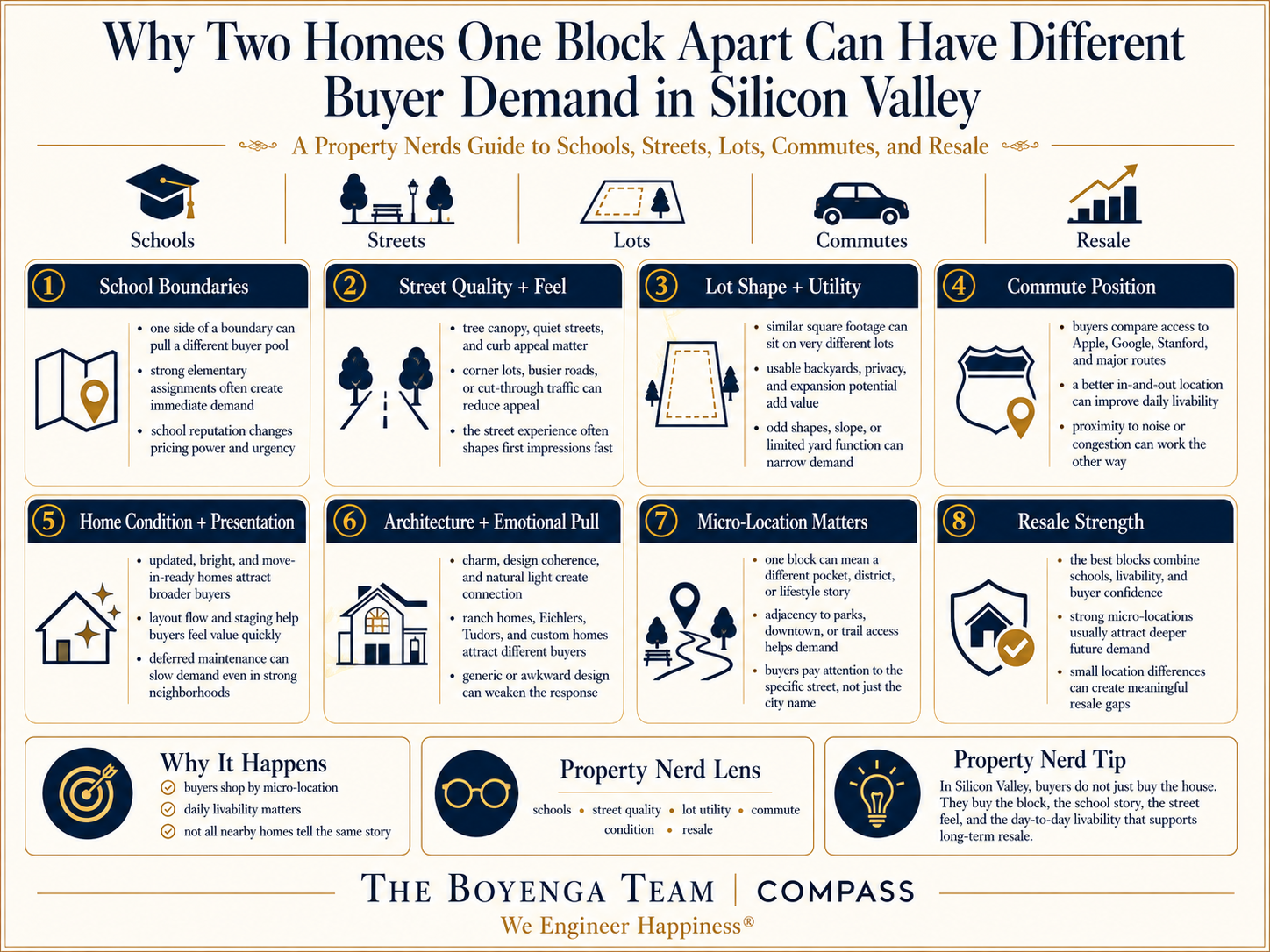
In Silicon Valley real estate, one block can change everything.
Two homes can be nearly identical on paper. Same city. Same zip code. Similar square footage. Similar lot size. Similar bedroom count. Similar age. Similar online estimate.
But one gets 20 showings, multiple offers, and strong buyer urgency.
The other sits.
That is not random. That is micro-market math.
In Silicon Valley, buyers are not just buying a house. They are buying a school path, a commute pattern, a street, a lot, a neighborhood identity, a future resale story, and a daily-life experience. When any one of those factors changes, buyer demand can change too.
That is why the Property Nerds of the Boyenga Team do not evaluate homes only by city, zip code, or price per square foot. Eric and Janelle Boyenga look at the property block by block, buyer pool by buyer pool, and value driver by value driver.
The smartest question is not, “What are homes selling for in this area?”
The better question is:
Which buyers will want this specific home, on this specific block, and why?
That is how you understand Silicon Valley buyer demand.
The One-Block Difference
A one-block difference can affect value because it may change how buyers experience the property.
One block may be quiet. The next may have road noise.
One block may fall inside a more sought-after school boundary. The next may not.
One block may have stronger curb appeal, mature trees, and better surrounding homes. The next may feel more mixed.
One block may provide easier access to Google, Apple, Stanford, Nvidia, Meta, Netflix, or downtown. The next may require a more frustrating route.
One block may have larger lots, better privacy, or more consistent architecture. The next may have smaller parcels, apartment adjacency, or commercial influence.
Buyers may not always articulate these differences perfectly, but they feel them.
And when buyers feel more confidence, they move faster.
1. School Boundaries Can Change the Buyer Pool
School assignment is one of the clearest reasons two nearby homes can attract different demand.
In Silicon Valley, school boundaries can run through neighborhoods, across streets, or between homes that look very similar online. A few houses apart can sometimes mean a different elementary, middle, or high school path.
That can materially change buyer behavior.
A home tied to a highly sought-after school assignment may attract families who would not consider the home across the boundary. A similar home outside that boundary may still be valuable, but the buyer pool may be smaller or different.
This matters in Palo Alto, Los Altos, Cupertino, Sunnyvale, Mountain View, Santa Clara, Menlo Park, Saratoga, Los Gatos, West San Jose, Cambrian, Campbell, and many other Silicon Valley markets.
Always verify school assignment by exact property address with the district.
The Property Nerds read: School boundaries do not just affect where children attend school. They can affect how many buyers compete.
2. Street Quality Matters More Than Buyers Admit
Buyers notice street quality immediately.
They notice whether the street feels quiet, tree-lined, wide, narrow, busy, private, charming, or exposed. They notice the neighboring homes, parked cars, sidewalks, traffic flow, landscaping, and whether the block feels cohesive.
A home on a quiet interior street can attract a much deeper buyer pool than a similar home on a busier cut-through street.
This is especially true for family buyers. Parents often imagine kids biking, walking to school, playing outside, or crossing the street. If the street feels too busy, demand may narrow.
Street quality can matter just as much in luxury markets. Buyers in Palo Alto, Los Altos, Menlo Park, Saratoga, Los Gatos, Monte Sereno, and Los Altos Hills often pay a premium for calm, privacy, and a sense of arrival.
The Property Nerds read: You can remodel a kitchen. You cannot remodel the street.
3. Road Exposure Can Cap the Price
Road exposure is one of the most common reasons two similar homes perform differently.
A home may look great online, but if buyers arrive and hear traffic, see headlights, feel exposed, or worry about backing out of the driveway, demand may soften.
Road exposure can show up in different ways:
Busy frontage road.
Corner lot with traffic.
Backing to a major street.
Freeway or expressway noise.
School pickup traffic.
Commercial corridor influence.
Difficult driveway access.
Cut-through traffic.
Some buyers will accept road exposure for price, location, or schools. Others will not.
The key is pricing and positioning the home correctly. A road-exposed home can still sell well, but it should not be valued the same way as a quiet interior-street comp unless the market clearly supports it.
The Property Nerds read: Road exposure does not make a home unsellable, but it changes the buyer pool.
4. Lot Utility Can Be Different Even on the Same Street
Lot size is important, but lot utility is more important.
Two homes may both have 8,000-square-foot lots, but one lot may be flat, private, sunny, rectangular, and connected to the kitchen and family room. The other may be narrow, sloped, shaded, oddly shaped, or dominated by driveway, easements, trees, or setbacks.
Buyers pay for usable land.
A family buyer wants a yard that works. A luxury buyer wants privacy and outdoor living. A builder wants a lot that supports a strong future project. An Eichler buyer may want an atrium, courtyard, or indoor-outdoor flow. A downsizer may want manageable outdoor space.
In Los Altos Hills, Portola Valley, Saratoga, Los Gatos, and Monte Sereno, lot usability can change value dramatically. In Sunnyvale, Mountain View, Cupertino, Palo Alto, Menlo Park, Santa Clara, and West San Jose, lot shape, orientation, and privacy can still make a major difference.
The Property Nerds read: Bigger is not always better. More usable is better.
5. Architecture Can Attract a Different Buyer Pool
Two nearby homes can attract different buyers because of architectural identity.
A standard ranch home may appeal to a broad family buyer pool.
An Eichler may attract a passionate design buyer.
A historic bungalow may attract a charm buyer.
A modern rebuild may attract a luxury move-in buyer.
A dated original home may attract remodelers and builders.
A Spanish-style or Craftsman home may attract buyers who value character.
This matters because different buyer pools value different things.
An Eichler buyer may pay more for beams, atriums, glass, radiant heat, and preserved mid-century design. A family buyer may pay more for a traditional floor plan and usable yard. A builder may ignore finishes and focus on land. A luxury buyer may expect scale, privacy, materials, and indoor-outdoor flow.
The Property Nerds read: Architecture changes the audience.
6. Commute Geometry Can Shift Demand
In Silicon Valley, commute is not just distance. It is route quality.
Two homes one block apart may technically be the same distance from Apple, Google, Meta, Nvidia, Netflix, Adobe, Stanford, or Sand Hill Road, but the actual daily route can feel different.
One home may have easier access to a main corridor. The other may require a difficult left turn, school-zone traffic, a congested cut-through, or an awkward freeway approach.
Buyers notice commute friction.
This matters in neighborhoods near Apple Park, Google / North Bayshore, Stanford, Meta, Nvidia, Netflix, downtown San Jose, and major expressways like Foothill, Central, Lawrence, San Tomas, 85, 101, 237, 280, and 880.
The Property Nerds read: Buyers do not live in mileage. They live in minutes, turns, traffic, and stress.
7. Walkability Can Change Block by Block
In walkable neighborhoods, exact location matters.
A home that is a true 5-minute walk to downtown, Caltrain, restaurants, coffee, parks, or school may attract more buyers than a home that is technically “near downtown” but not comfortably walkable.
This matters in:
Old Mountain View.
Downtown Los Altos.
Downtown Campbell.
Los Gatos Village.
Palo Alto University Avenue.
Palo Alto California Avenue.
Downtown Menlo Park.
Allied Arts.
Willow Glen.
Downtown Sunnyvale.
Japantown.
Santana Row.
Walkability has to feel easy. If the route crosses a busy road, lacks sidewalks, feels too far, or has awkward parking issues, the buyer response may change.
The Property Nerds read: “Near” is not the same as “walkable.”
8. Neighboring Homes Influence Buyer Confidence
Buyers evaluate the house, but they also evaluate the surroundings.
They notice if neighboring homes are well maintained. They notice remodel activity. They notice whether the block feels pride-of-ownership. They notice if nearby properties are rentals, apartments, commercial uses, or under-maintained homes.
A home surrounded by strong neighboring properties often feels safer from a resale perspective. A similar home one block away with mixed surrounding uses may feel less certain.
This is especially important for luxury buyers and family buyers.
The Property Nerds read: Buyers are not just buying the home. They are buying the context.
9. Condition and Disclosure Confidence Change Urgency
Two homes may look similar online, but one may have a much cleaner condition story.
One home may have pre-sale inspections, a newer roof, sewer clearance, clean termite report, updated electrical, drainage improvements, and clear permits.
The other may have vague disclosures, unknown roof age, pest issues, foundation questions, old systems, or missing documentation.
Buyers move faster when they understand risk.
A home with issues can still sell well, but buyers need clarity. Uncertainty slows demand.
The Property Nerds read: Buyers can handle problems. They hesitate over mystery.
10. Remodel or Rebuild Potential Can Differ
Two homes one block apart may have very different upside.
One may have a lot that supports expansion. The other may be constrained by setbacks, trees, slope, easements, or floor-area rules.
One may be an easy cosmetic remodel. The other may require major structural work.
One may be a strong rebuild candidate because the surrounding homes support a higher finished value. The other may not justify the same investment.
This is especially important in Palo Alto, Los Altos, Cupertino, Sunnyvale, Menlo Park, Saratoga, Los Gatos, Los Altos Hills, Portola Valley, West San Jose, Cambrian, and Santa Clara.
The Property Nerds read: Potential is only valuable when the market and lot support it.
11. Price Bracket Changes the Buyer Pool
A small price difference can push a home into a different buyer category.
One home may sit just under a key budget threshold. Another may be just above it.
This can affect search filters, loan limits, buyer psychology, and competition.
For example, a home priced just under a common buyer search range may get more attention. A home priced above that range may need to justify the premium clearly.
The Property Nerds read: Buyers shop in brackets, not just by value.
12. Online Presentation Can Make Two Similar Homes Feel Completely Different
Two homes can be similar in person but perform very differently online.
One may have professional photography, staging, floor plan, strong copy, beautiful lighting, and a clear property story.
The other may have dark photos, clutter, poor angles, no floor plan, weak copy, and unclear positioning.
The first showing happens online. If buyers do not understand the home digitally, they may never visit.
The Property Nerds read: A poorly presented home can create artificial weakness.
Why This Matters for Buyers
For buyers, the one-block difference can create opportunity.
Sometimes a home is cheaper for a reason: school boundary, road noise, lot constraint, flood zone, poor orientation, weak floor plan, or awkward surroundings.
Other times, a home is overlooked because buyers do not understand its upside.
The key is knowing which difference matters and which difference can be fixed.
Paint can be fixed.
Staging can be fixed.
Flooring can be fixed.
Landscaping can be fixed.
Some layouts can be fixed.
But school assignment, street quality, road exposure, lot shape, commute route, and neighborhood context are much harder to change.
The Property Nerds read: Buy the things you cannot easily improve. Be careful paying too much for the things you can.
Why This Matters for Sellers
For sellers, the one-block difference is critical for pricing and marketing.
Do not assume the home across the street is a perfect comp.
A comp may be in a different school boundary.
It may have a quieter street.
It may have a better lot.
It may have stronger architecture.
It may have better disclosures.
It may have a different buyer pool.
It may have sold in a different market window.
A smart listing strategy explains why your home matters and addresses the issues buyers may notice.
If your home has a superior school path, make verification easy.
If your home has a better lot, show it clearly.
If your home has road exposure, price and position accordingly.
If your home has remodel potential, explain the opportunity.
If your home has architectural value, market it with design fluency.
If your home has strong disclosures, use that confidence.
The Property Nerds read: Pricing is not just comparing homes. It is comparing buyer demand.
The Property Nerds Bottom Line
Two homes one block apart can have very different buyer demand because buyers are not only comparing square footage.
They are comparing:
School assignment.
Street quality.
Road exposure.
Lot utility.
Architecture.
Commute route.
Walkability.
Neighboring homes.
Condition.
Disclosures.
Remodel potential.
Price bracket.
Presentation.
Future resale story.
That is why Silicon Valley real estate is so micro-market driven.
The smartest buyers do not simply ask, “What is the price per square foot?”
They ask:
Why does this block matter?
Who is the buyer pool?
What can be changed?
What cannot be changed?
Is this home cheaper because of a real issue or because the market missed something?
Will future buyers value this location the same way?
The smartest sellers do not simply ask, “What did the neighbor sell for?”
They ask:
Was that home truly comparable?
Did it have the same school path?
Was the street similar?
Was the lot equally usable?
Was the buyer pool the same?
How should we position this property so buyers understand its value?
That is the difference between generic real estate and Property Nerd real estate.
Thinking About Buying or Selling in a Micro-Market?
The Boyenga Team at Compass helps buyers and sellers understand Silicon Valley real estate at the block level — blending school-boundary awareness, neighborhood analysis, lot evaluation, commute logic, pricing strategy, inspection review, staging insight, and buyer-pool positioning.
Whether you are comparing two homes one block apart, pricing a listing, evaluating a school boundary, or trying to understand why one home sold faster than another, Eric and Janelle Boyenga can help you decode the neighborhood math before you make your move.
In Silicon Valley, one block can change the buyer pool.
And the buyer pool can change everything.