

Blog > Why Palo Alto Real Estate Still Commands a Premium
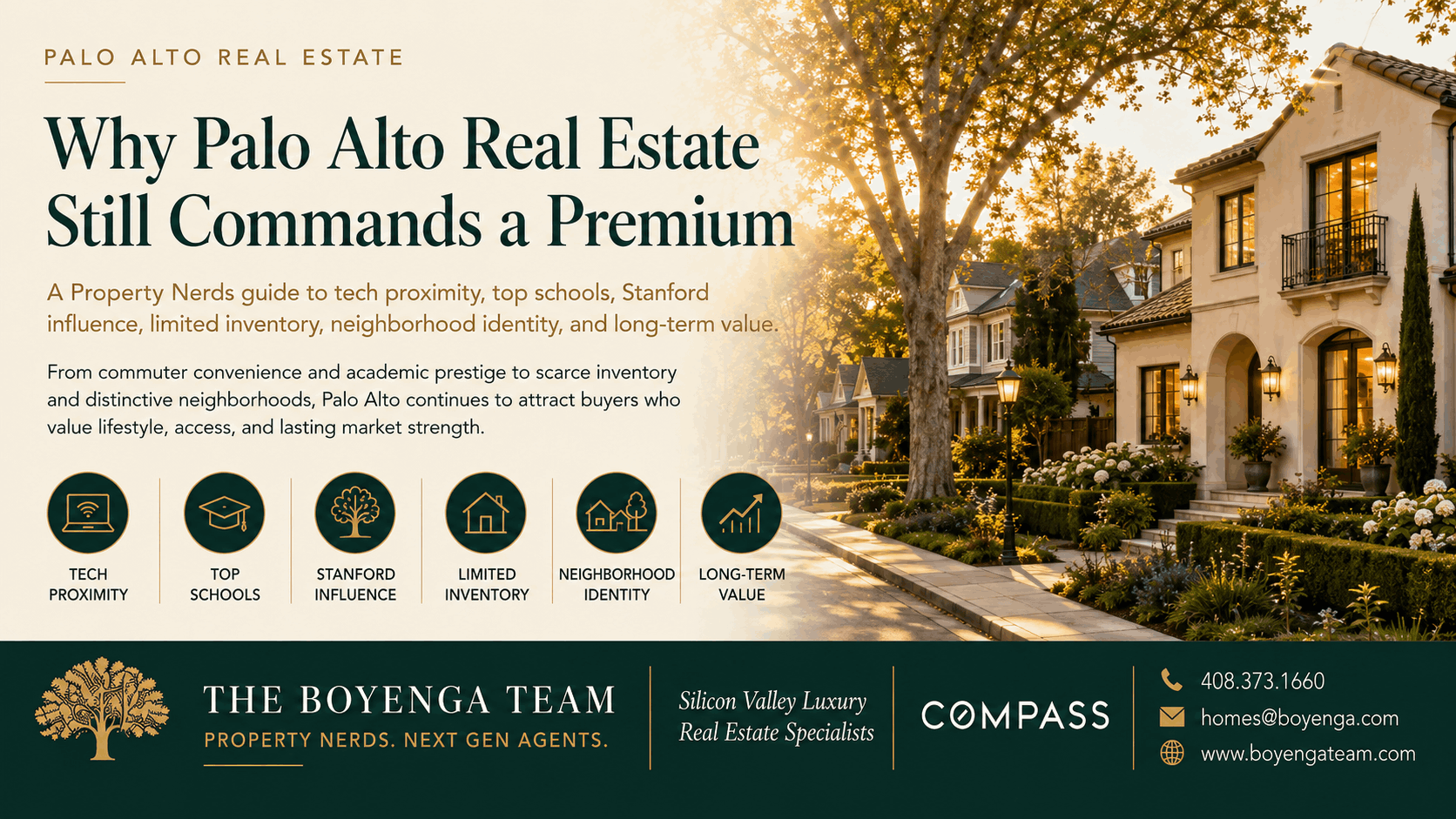
Palo Alto is not just expensive because it is famous.
It is expensive because it is structurally rare.
That is the Property Nerd answer.
Palo Alto sits at the center of Silicon Valley’s economic, academic, and innovation engine. It has Stanford University, world-class employers nearby, nationally recognized schools, historic neighborhoods, luxury homes, architectural variety, mature trees, walkable districts, limited land, and a buyer pool that is both highly educated and highly motivated.
But the real reason Palo Alto real estate still commands a premium is deeper than brand recognition.
Palo Alto offers something buyers cannot easily recreate: proximity, identity, scarcity, and long-term relevance.
In Silicon Valley real estate, those four ingredients are powerful.
At the Boyenga Team, we study Palo Alto not as one market, but as a collection of micro-markets: Old Palo Alto, Crescent Park, Professorville, Community Center, Midtown, Green Gables, Duveneck/St. Francis, Barron Park, Southgate, College Terrace, Palo Verde, Charleston Meadows, and more. Each neighborhood tells a different value story. Some are driven by historic charm and walkability. Others by lot size, schools, commute, architecture, privacy, or redevelopment potential.
This guide explains why Palo Alto homes still trade at a premium — and what buyers and sellers should understand before making a move.
Palo Alto’s Premium Is Built on Location
Palo Alto has one of the most valuable locations in California.
It is positioned between Stanford University, Menlo Park, Mountain View, Los Altos, Los Altos Hills, Redwood City, Sunnyvale, and the broader Silicon Valley job corridor. Buyers who choose Palo Alto are often optimizing for access: Stanford, venture capital, tech campuses, research, medicine, education, startups, downtown amenities, and top-tier schools.
This is not just a commute story. It is an ecosystem story.
Palo Alto gives buyers proximity to:
Stanford University
Stanford Research Park
Stanford Shopping Center
Downtown Palo Alto
California Avenue
University Avenue
Menlo Park
Mountain View
Google
Meta
Apple
Nvidia
VC and startup networks
Stanford Health Care
Major Peninsula employers
That kind of access is difficult to duplicate. A buyer can purchase a larger home farther away, but they cannot move Stanford, Sand Hill Road, downtown Palo Alto, or the center of Silicon Valley closer.
That is why Palo Alto’s location premium remains durable.
Current Market Signals Still Show Strong Demand
Palo Alto remains one of the Bay Area’s most competitive housing markets. Zillow reported the average Palo Alto home value at approximately $3.68 million, with a median sale price of about $3.33 million as of April 30, 2026. Zillow also reported that 71.3% of sales were over list price and that homes went pending in a median of 11 days as of May 31, 2026.
Realtor.com’s market data showed Palo Alto with a median listing price around $3.2 million, a 103% sale-to-list price ratio, 124 homes for sale, and typical market time around 27 days.
Different data sources use different methodologies and time windows, so the exact number varies. But the broader signal is consistent: Palo Alto remains a high-demand, low-tolerance market where well-positioned homes can still generate serious buyer attention.
The Property Nerd takeaway: Palo Alto is not cheap, but demand persists because the value drivers are not temporary.
Stanford Is a Real Estate Anchor
Stanford is one of Palo Alto’s most important long-term value anchors.
It is not just a university. It is a global institution, employment center, research hub, medical ecosystem, innovation network, and cultural force. Stanford’s presence supports demand from professors, physicians, researchers, executives, entrepreneurs, international families, alumni, investors, and families who want proximity to the university’s intellectual and economic orbit.
For many buyers, living near Stanford is not only convenient. It is identity.
Old Palo Alto, Professorville, College Terrace, Southgate, Crescent Park, and nearby pockets all benefit from Stanford’s gravitational pull in different ways. Some buyers want walkability to campus. Others want access to Stanford Health Care. Others want proximity to Sand Hill Road, Stanford Research Park, or the broader venture/startup ecosystem.
This is why Stanford proximity creates a premium that is hard to quantify but easy to feel in buyer behavior.
The Boyenga Team looks at this as a “permanent demand driver.” Companies may move. Interest rates may change. Design trends may shift. But Stanford’s presence gives Palo Alto an enduring institutional anchor.
Schools Add Another Layer of Demand
Palo Alto Unified School District is one of the strongest demand drivers for family buyers. PAUSD describes its schools as offering exceptional academics, arts, athletics, and supportive classrooms guided by the PAUSD Promise.
The district lists Henry M. Gunn High School, Palo Alto High School, and Palo Alto Middle College among its high school options.
For buyers, schools matter not only as an educational decision but as a resale decision. Palo Alto school demand creates a deep, recurring buyer pool. Families move for schools, stay for community, and often compete for homes in specific neighborhoods based on school pathway, commute, and lifestyle.
That said, the Property Nerd rule is simple: never assume school assignment based only on neighborhood name or online portals. Buyers should verify the exact address directly with the district before writing an offer.
For sellers, school demand should be handled accurately and carefully. The right marketing can highlight the appeal of Palo Alto’s education ecosystem while encouraging buyers to verify specific assignments.
Limited Inventory Creates Structural Scarcity
Palo Alto is not a market that can simply build its way out of demand.
The city has limited land, established neighborhoods, mature housing stock, zoning constraints, and a long history of high-value residential ownership. Many owners stay for decades. Others pass homes through family structures or hold properties as long-term assets.
That creates scarcity.
Scarcity does not mean every home sells for any price. Palo Alto buyers are selective. They still care about condition, floor plan, street, privacy, remodel costs, lot utility, and school path. But when a desirable property comes to market in the right location, there are often multiple motivated buyers who understand how rare it is.
This is why inventory matters so much in Palo Alto. A buyer may wait months for the right block, right school path, right lot, or right architectural style. When it appears, urgency can be real.
For sellers, scarcity is an advantage only when the home is positioned correctly. A poor launch, weak photography, wrong pricing, or unclear buyer story can still leave value on the table.
Neighborhood Identity Is a Major Value Driver
Palo Alto is not one homogenous luxury market.
It is a city of micro-identities.
Old Palo Alto feels different from Crescent Park. Professorville is not the same as Midtown. Barron Park has a different rhythm than Community Center. College Terrace attracts different buyers than Green Gables. Southgate, Duveneck/St. Francis, Palo Verde, Charleston Meadows, and Triple El each have their own lifestyle signals.
That neighborhood identity is a major reason Palo Alto commands a premium. Buyers are not simply buying square footage. They are buying a specific version of Palo Alto life.
Old Palo Alto: Prestige, History, and Architectural Presence
Old Palo Alto is one of the city’s most prestigious neighborhoods. Buyers often value its historic homes, tree-lined streets, proximity to Stanford, and elegant residential character.
The premium here is not only about the house. It is about legacy, architecture, location, and neighborhood identity.
Old Palo Alto buyers may be drawn to grand homes, heritage trees, classic architecture, and the sense of being in one of Silicon Valley’s most established luxury neighborhoods.
Crescent Park: Estate Feel and Downtown Access
Crescent Park is known for larger homes, beautiful streets, and proximity to downtown Palo Alto. It often appeals to luxury buyers who want scale, prestige, privacy, and access to University Avenue.
The buyer pool may include executives, founders, venture professionals, international buyers, and families seeking a high-end Palo Alto lifestyle.
Professorville: Charm, Walkability, and Stanford Energy
Professorville has a distinct identity tied to historic character, walkability, and proximity to Stanford and downtown. Homes may be charming, older, and architecturally distinctive.
Buyers here often value authenticity. They are not just buying a home; they are buying a neighborhood with soul.
Community Center and Duveneck/St. Francis: Family Demand and Convenience
These areas often appeal to family buyers who want strong neighborhood feel, school access, parks, and proximity to downtown, libraries, and community amenities.
In these neighborhoods, floor plan, street quality, yard utility, and daily convenience can have a major impact on pricing.
Midtown and Green Gables: Practical Palo Alto Living
Midtown and Green Gables often attract buyers who want strong Palo Alto access with a more practical residential feel. Buyers may compare these neighborhoods based on schools, commute, lot size, price point, and remodel potential.
For sellers, these homes need careful positioning around livability, location, and value relative to more expensive Palo Alto pockets.
Barron Park: Personality, Space, and a Different Palo Alto Feel
Barron Park has a distinct, more relaxed character. It can appeal to buyers who want a less formal Palo Alto lifestyle, larger lots in some areas, creative energy, and a neighborhood with personality.
This is a great example of why Palo Alto real estate cannot be understood by price per square foot alone. The lifestyle matters.
College Terrace and Southgate: Stanford Proximity and Walkability
College Terrace and Southgate often attract buyers who value Stanford proximity, walkability, and access to California Avenue or campus-adjacent amenities.
These neighborhoods may appeal to Stanford-affiliated buyers, investors, academics, families, and professionals who want a highly connected location.
Tech Proximity Keeps the Buyer Pool Deep
Palo Alto sits near the center of Silicon Valley’s talent and capital network.
Even as work patterns evolve, proximity still matters. Many buyers want to be close to the people, institutions, companies, and opportunities that shape their careers. For founders and executives, living near Stanford, Sand Hill Road, downtown Palo Alto, Menlo Park, Mountain View, and key tech corridors can make daily life more efficient.
This is the difference between a home as shelter and a home as strategic location.
Palo Alto gives buyers access to a professional ecosystem that few residential markets can match. That keeps the buyer pool deep, especially at the upper end where time, access, schools, and quality of life carry major value.
Luxury Buyers Pay for Time
In Palo Alto, luxury is not only marble counters and designer lighting.
Luxury is time.
A shorter commute.
A walk to dinner.
A quick drive to Stanford.
A school nearby.
A quiet street.
A home office that works.
A yard that functions.
A neighborhood that reduces daily friction.
Palo Alto buyers often pay a premium because the location gives them back time. For busy families and high-performing professionals, that can be one of the most valuable features a home can offer.
This is why micro-location matters so much. A home closer to downtown, Stanford, a top school pathway, or a preferred commute route may command a premium that a basic valuation model cannot fully capture.
Palo Alto Homes Are Also Long-Term Assets
Many buyers view Palo Alto real estate as a long-term asset, not just a place to live.
That does not mean prices only go up. Real estate markets move. Interest rates, stock-market volatility, tech hiring, inventory, affordability, and buyer sentiment all matter. But Palo Alto has long-term structural advantages: land scarcity, academic prestige, job proximity, global recognition, school demand, and a highly desirable residential environment.
For buyers, this creates confidence.
For sellers, it creates opportunity — but only with the right strategy.
A dated home can still be valuable. A small home can still be valuable. A lot with expansion potential can be extremely valuable. A home near Stanford, downtown, or a sought-after school path can attract attention even if the interior is not perfect.
The key is identifying what kind of value the property has.
The Property Nerd Framework for Palo Alto Value
At the Boyenga Team, we analyze Palo Alto homes using a layered framework.
First, location. Which neighborhood? Which street? How quiet? How walkable? How close to Stanford, downtown, California Avenue, schools, parks, or commute routes?
Second, land. What is the lot size, shape, orientation, privacy, tree impact, slope, and expansion potential?
Third, school pathway. What does the address appear to feed into, and what should buyers verify directly with the district?
Fourth, home condition. Is the home move-in ready, lightly dated, a remodel opportunity, or primarily land value?
Fifth, floor plan. Does the home support modern living, including work-from-home, indoor-outdoor flow, guest space, and storage?
Sixth, buyer pool. Is the likely buyer a family, builder, Stanford-affiliated buyer, relocation buyer, tech executive, investor, downsizer, or luxury end-user?
Seventh, resale narrative. What will future buyers still value about this property?
This is how we avoid generic pricing and generic marketing.
What Sellers Should Know
If you are selling a Palo Alto home, the premium is not automatic.
Yes, Palo Alto has powerful value drivers. But buyers are still highly discerning. They notice dated finishes, dark rooms, awkward layouts, deferred maintenance, poor staging, unrealistic pricing, and weak presentation.
The Boyenga Team helps sellers decide how to position the home based on its highest-value story.
A move-in-ready Crescent Park home may need luxury lifestyle marketing.
A Professorville home may need character, history, and walkability storytelling.
A Midtown home may need family functionality and value positioning.
A Barron Park home may need personality, lot, and lifestyle emphasis.
A trust property may need cleanout, inspections, strategic prep, and opportunity-focused marketing.
A Stanford-adjacent home may need institutional proximity, walkability, and long-term value framing.
The goal is not just to market Palo Alto. The goal is to market the specific Palo Alto property correctly.
What Buyers Should Know
If you are buying in Palo Alto, the premium can be justified — but only if you understand what you are paying for.
Do not pay only for the name.
Pay for the right combination of location, street, school path, lot, light, floor plan, condition, privacy, and long-term desirability.
A smaller home in a better micro-location may be smarter than a larger home with more functional compromises. A dated home on an exceptional lot may be a better long-term asset than a remodeled home with a weak street. A walkable home near downtown or Stanford may hold appeal across multiple future buyer pools.
The Boyenga Team helps buyers separate true premium from surface premium.
That distinction matters in Palo Alto.
Final Property Nerd Takeaway
Palo Alto real estate still commands a premium because it sits at the intersection of scarcity, schools, Stanford, technology, neighborhood identity, and long-term value.
It is not just expensive because people want to live there.
It is expensive because many different buyer groups have strong, rational reasons to compete for a limited number of homes.
Families want schools and community.
Executives want proximity and privacy.
Stanford buyers want access and identity.
Luxury buyers want lifestyle and long-term confidence.
Builders want land and future value.
Relocation buyers want the Silicon Valley center of gravity.
That combination keeps Palo Alto one of the most important real estate markets in the Bay Area.
If you are thinking about buying or selling in Palo Alto, the Boyenga Team brings a Property Nerd approach to pricing, positioning, neighborhood analysis, buyer psychology, and Compass-powered marketing.
We do not just look at the house.
We look at the story behind the premium.
The Boyenga Team
Palo Alto & Silicon Valley Real Estate Experts
Compass
Website: www.BoyengaTeam.com
Email: homes@boyenga.com