

Blog > Why Palo Alto Is Still the Ultimate Silicon Valley Address for Tech Buyers
Why Palo Alto Is Still the Ultimate Silicon Valley Address for Tech Buyers
by
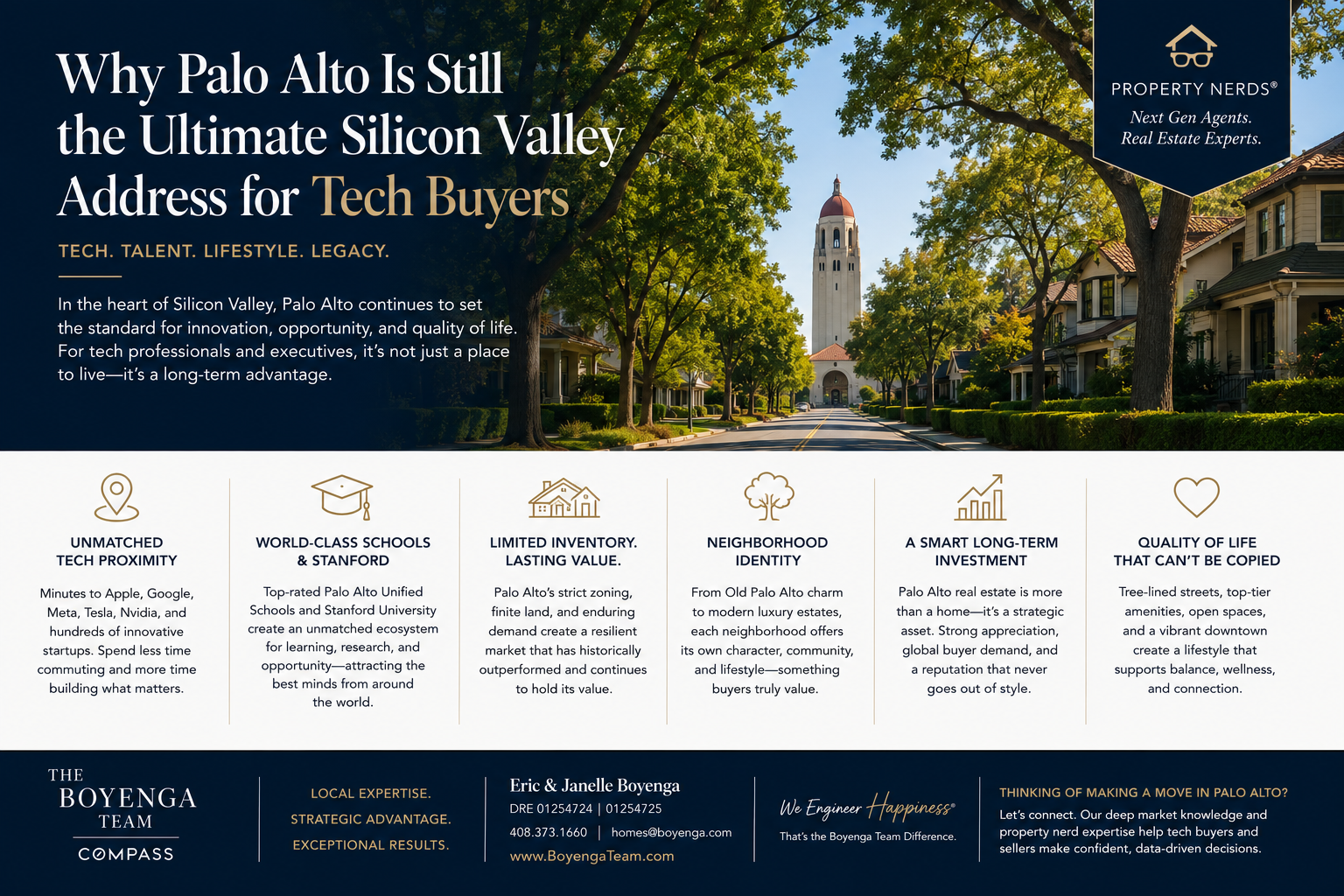
Palo Alto is not just a place tech buyers live.
It is a place tech buyers understand.
For founders, executives, venture capitalists, engineers, Stanford affiliates, AI builders, startup operators, and relocation buyers, Palo Alto represents more than a premium ZIP code. It represents access — to Stanford, Sand Hill Road, venture capital, startup culture, top schools, downtown energy, talent networks, and some of the most important technology companies in the world.
That is why Palo Alto real estate continues to hold a special place in the Silicon Valley buyer mindset.
A buyer can purchase a larger home farther away. They can buy newer construction in another market. They can find more land in Los Altos Hills, Saratoga, or parts of the South Bay. But they cannot easily recreate the specific ecosystem that Palo Alto provides.
That is the Property Nerd answer.
Palo Alto is valuable because it sits inside the operating system of Silicon Valley.
At the Boyenga Team, we work with buyers and sellers across Palo Alto, Los Altos, Menlo Park, Mountain View, Sunnyvale, Cupertino, Saratoga, Los Altos Hills, and the broader Silicon Valley luxury market. What we see over and over again is that tech buyers do not just buy homes based on bedrooms, bathrooms, and square footage. They buy based on time, access, optionality, privacy, schools, work flexibility, and long-term value.
Palo Alto checks those boxes in a way few markets can.
The Property Nerd Thesis: Palo Alto Is a Network-Effect Market
Most real estate markets are location markets.
Palo Alto is a network-effect market.
That means the value is not only in the house or the land. It is also in what the location connects you to.
Palo Alto connects buyers to:
Stanford University
Stanford Research Park
Stanford Health Care
Sand Hill Road venture capital
Downtown Palo Alto
University Avenue
California Avenue
Menlo Park
Mountain View
Los Altos
Los Altos Hills
Google
Meta
Apple
Nvidia
AI startups
Biotech and health-tech networks
Founder communities
Executive networks
Top schools
A global Silicon Valley identity
That kind of proximity compounds.
For a tech buyer, living in Palo Alto can make professional life more efficient, social life more connected, and long-term real estate ownership feel more defensible.
This is why Palo Alto is not just “near tech.”
Palo Alto is part of the tech ecosystem.
Stanford Is the Original Value Anchor
Before Silicon Valley became shorthand for global technology, Stanford was already anchoring the region’s intellectual and entrepreneurial culture.
For tech buyers, Stanford matters because it is not only a university. It is a talent engine, research hub, medical institution, founder pipeline, cultural center, and long-term demand driver.
Living near Stanford can appeal to:
Professors
Researchers
Physicians
AI and engineering talent
Founders
Graduate students and alumni
Biotech professionals
Venture-backed executives
International families
Buyers who value education and innovation
Stanford proximity also gives Palo Alto a durability that does not depend on one company or one tech cycle. Companies may expand, contract, relocate, or change workplace policies. Stanford remains one of the strongest institutional anchors in the country.
For real estate, that matters.
A home near Stanford has a story that future buyers will understand quickly. The value driver is permanent, recognizable, and emotionally powerful.
Venture Capital Proximity Still Matters
Sand Hill Road is not just a road.
It is a symbol of Silicon Valley capital.
For founders, executives, investors, board members, startup operators, and technology leaders, being close to venture capital networks still has value. Even in a hybrid-work world, proximity to decision-makers, advisors, funders, and founders can matter.
A Palo Alto address can make it easier to access:
Investor meetings
Founder dinners
Startup events
Board meetings
Stanford events
Recruiting conversations
Advisory networks
Professional introductions
Informal coffee meetings
The social infrastructure of Silicon Valley
This is the part of real estate that does not show up neatly in a price-per-square-foot calculation.
Palo Alto buyers often pay for proximity to opportunity.
That is a powerful form of location value.
Meta, Google, Apple, Nvidia, and the Tech Commute Web
Palo Alto sits in a uniquely strategic position for tech buyers because it offers access to multiple employment centers rather than just one.
From Palo Alto, buyers may be oriented toward:
Meta in Menlo Park
Google in Mountain View and Sunnyvale
Apple in Cupertino and Sunnyvale
Nvidia in Santa Clara
Stanford Research Park
Downtown Palo Alto startups
Menlo Park venture firms
Redwood City tech and biotech
San Mateo and Peninsula companies
San Jose and South Bay employers
This matters because tech careers change.
A buyer may work at Google today, join an AI startup next year, advise a company in Menlo Park, invest in a Stanford spinout, and serve on a board in San Francisco. Palo Alto gives that buyer a central base.
The Property Nerd term for this is commute optionality.
Instead of buying near only one employer, many tech buyers want a location that gives them flexibility across the entire Peninsula and South Bay tech corridor.
Palo Alto does that exceptionally well.
The AI Era Makes Palo Alto Even More Relevant
The rise of artificial intelligence has renewed demand for places where research, capital, talent, and startups overlap.
Palo Alto sits directly inside that overlap.
Stanford’s research ecosystem, Sand Hill Road capital, founder networks, engineering talent, and proximity to major tech employers all reinforce Palo Alto’s relevance in the AI economy.
For real estate, this does not mean every AI founder buys in Palo Alto. Many choose Menlo Park, Los Altos, Mountain View, San Francisco, Atherton, Los Altos Hills, or other markets. But Palo Alto remains one of the most recognizable residential addresses for buyers who want to be close to the intellectual and financial core of Silicon Valley.
That recognition matters for long-term value.
In a technology market that constantly reinvents itself, Palo Alto has remained relevant across multiple eras: semiconductors, personal computing, internet, mobile, cloud, social, biotech, venture, and now AI.
That is not an accident.
It is ecosystem gravity.
Tech Buyers Pay for Time
In Palo Alto, luxury is not only design.
Luxury is time.
A shorter commute.
A bike ride to Stanford.
A quick drive to Sand Hill Road.
A fast meeting in Menlo Park.
A school drop-off that does not consume the morning.
A downtown dinner without crossing the entire valley.
A home office that actually works.
A backyard that helps the owner decompress.
Tech buyers often have high-pressure schedules. They may be leading teams, building companies, managing capital, raising funds, shipping products, or working across time zones.
A home that reduces friction has value.
This is why Palo Alto buyers may pay a premium for a smaller home in the right micro-location over a larger home that creates more daily complexity.
The Property Nerd principle: in Silicon Valley, the best address is often the one that gives you time back.
Neighborhood Identity Matters to Tech Buyers
Tech buyers are not all choosing the same Palo Alto neighborhood.
Different neighborhoods serve different tech-buyer lifestyles.
Old Palo Alto
Old Palo Alto appeals to buyers who value legacy, architecture, Stanford proximity, mature trees, and quiet prestige. It is often attractive to founders, executives, Stanford-affiliated buyers, and luxury families who want one of the most established addresses in Silicon Valley.
Crescent Park
Crescent Park appeals to buyers who want estate presence, privacy, larger homes, mature landscaping, and proximity to downtown Palo Alto. It can be powerful for executives and founders who want luxury scale without feeling disconnected from the Palo Alto ecosystem.
Professorville
Professorville attracts buyers who value historic charm, walkability, Stanford energy, and intellectual character. It is a strong fit for buyers who want Palo Alto soul, not just square footage.
College Terrace
College Terrace is a Stanford-proximity play. It can appeal to Stanford affiliates, investors, academics, professionals, and buyers who want campus-adjacent convenience.
Southgate
Southgate offers central Stanford-adjacent positioning, access to Town & Country Village, Palo Alto High School, and key commute corridors. It is a quiet but strategic neighborhood for buyers who value location compression.
Midtown
Midtown appeals to practical tech families who want Palo Alto schools, services, commute access, and more grounded daily living.
Barron Park
Barron Park appeals to creative tech buyers who want a less formal Palo Alto feel, outdoor space, gardens, and neighborhood personality.
Green Gables and Community Center
These areas often appeal to families who want neighborhood warmth, parks, schools, and practical access.
The Boyenga Team helps buyers understand these micro-market differences because choosing Palo Alto is only the first step. Choosing the right Palo Alto neighborhood is where the real strategy begins.
Palo Alto Homes Must Support Hybrid Work
Tech buyers now expect homes to perform professionally.
A beautiful home without a real work setup can feel incomplete.
Today’s Palo Alto tech buyers often want:
A true home office
Two office spaces
A Zoom-friendly room
Strong internet infrastructure
Quiet bedroom separation
Flexible guest rooms
Detached studio potential
Good natural light
Sound privacy
Outdoor space for breaks
Garage functionality
Smart-home systems
EV charging
This is where sellers need to be strategic.
A spare room should not look like leftover storage. A detached garage, bonus room, or guest suite may need to be staged as a modern work environment. A floor plan should show where people can work, study, create, and decompress.
The Boyenga Team’s Next Gen Agent approach is to make the work-from-home logic visible in the marketing.
Tech buyers should not have to imagine where life works. They should see it.
Smart Homes Need to Be Smart, Not Complicated
Tech buyers are comfortable with technology, but that does not mean they want a confusing house.
The best smart-home features are useful, clean, and intuitive:
EV charging
Smart thermostats
Smart lighting
Smart irrigation
Security cameras
Keyless entry
Integrated speakers
App-controlled shades
Strong Wi-Fi
Solar and battery backup where applicable
Energy monitoring
Clean low-voltage systems
The worst version is a home full of outdated panels, unlabeled remotes, visible wires, and systems that no one can explain.
Palo Alto tech buyers notice this.
They do not need a gadget museum. They want infrastructure that works.
For sellers, this means documenting systems, cleaning up old technology, making sure everything functions, and presenting smart features as convenience — not clutter.
EV Charging and Energy Readiness Are No Longer Extras
In Palo Alto, EV readiness matters.
Many tech buyers either already own electric vehicles or expect to. A garage with EV charging, good storage, clean electrical organization, and future energy capacity can influence perception.
Buyers may ask:
Is there an EV charger?
Can the home support multiple EVs?
Is the electrical panel updated?
Is there solar?
Is there battery backup?
Is the garage functional?
Is there room for bikes, storage, and charging?
A home does not need every feature to sell well, but sellers should understand that future readiness is part of the luxury conversation.
A Palo Alto home that feels prepared for the next decade has an advantage.
Privacy Is a Tech-Buyer Luxury Feature
Many tech buyers live public or high-pressure professional lives. Home becomes the counterbalance.
That is why privacy matters.
They notice:
Can neighbors see into the yard?
Is the primary suite exposed?
Is the office quiet?
Does the backyard feel like a retreat?
Is the street busy?
Does the home feel protected?
Can the owner host privately?
Can the family relax without feeling on display?
Privacy can be created through lot position, landscaping, hedges, courtyards, window placement, setbacks, and outdoor design.
For Palo Alto sellers, privacy should be marketed clearly when it exists. It is not just a nice feature. It is a luxury value driver.
Outdoor Space Helps Buyers Decompress
Tech buyers often spend long hours in intense digital environments. Outdoor space gives them a physical reset.
That is why Palo Alto buyers value usable yards, patios, gardens, decks, pools, outdoor dining, fire pits, play lawns, and private courtyards.
The yard should not feel like leftover land. It should feel like an extension of the home.
For sellers, that may mean:
Cleaning up landscaping
Power washing patios
Adding outdoor furniture
Improving lighting
Trimming overgrown trees
Creating lounge and dining areas
Highlighting privacy
Showing garden or wellness potential
Making the backyard photograph as usable living space
Outdoor space is not only a lifestyle feature. It is part of the emotional sale.
ADU Potential and Flexibility Matter
Tech buyers often think in terms of optionality.
An ADU, guest house, detached studio, or flexible bonus space can appeal to buyers who want:
Guest quarters
Grandparent space
Au pair or caregiver space
Private office
Founder studio
Creative workspace
Rental flexibility
Teen retreat
Wellness room
Future aging-in-place options
Even when an ADU does not already exist, potential can matter if the lot supports it. Buyers should always verify feasibility with the city and qualified professionals, but sellers should not ignore flexible-use possibilities.
Optionality is a major Palo Alto value driver.
Schools Still Matter to Tech Buyers
Many tech buyers are also family buyers.
They may be drawn to Palo Alto for the combination of schools, work access, safety, and intellectual culture. School pathways can influence demand, urgency, and resale value.
But school assignment should always be verified directly with the district. The Boyenga Team is careful not to overpromise boundaries or rely on outdated portal information.
For tech families, the question is often broader than “which school?”
It is:
Can our children thrive here?
Can we manage school and work logistics?
Can kids walk or bike?
Is the neighborhood family-friendly?
Will this location hold resale appeal for future families?
This is why Palo Alto remains so compelling. It blends professional ecosystem and family ecosystem in one place.
Why Palo Alto Still Beats “Bigger for Less” for Many Buyers
Tech buyers are rational. They know they can buy more square footage elsewhere.
So why do they still choose Palo Alto?
Because bigger is not always better.
A larger home with a worse commute, weaker network access, less neighborhood identity, more daily driving, or lower long-term confidence may not be the better choice.
Palo Alto offers:
Time savings
Brand recognition
School demand
Stanford proximity
Venture access
Startup ecosystem
Downtown lifestyle
Strong resale narrative
Neighborhood prestige
Limited supply
Global recognition
For many buyers, those factors outweigh raw square footage.
The Property Nerd truth: Palo Alto buyers often buy density of value, not just size.
What Sellers Should Understand About Tech Buyers
If you are selling a Palo Alto home, tech buyers may be part of your buyer pool — but they are not all the same.
Some want a finished luxury home.
Some want a remodel project in the right neighborhood.
Some want Stanford proximity.
Some want downtown walkability.
Some want a smart home with EV charging.
Some want privacy and a real office.
Some want a lot they can eventually transform.
Some are relocating and need the Palo Alto story explained.
Some are analytical to the point of underwriting the property like an investment.
The Boyenga Team positions Palo Alto homes to speak to these different buyer profiles without making the marketing feel generic.
How the Boyenga Team Markets Palo Alto Homes to Tech Buyers
The Boyenga Team uses a Property Nerd and Next Gen Agent strategy to position Palo Alto homes for today’s Silicon Valley buyers.
We analyze:
Neighborhood identity
Stanford proximity
Tech commute geometry
Venture capital access
School pathway
Street quality
Privacy
Office functionality
Smart-home readiness
EV charging
Outdoor living
ADU potential
Lot value
Remodel or expansion potential
Digital presentation
Buyer pool depth
Pricing psychology
Then we create a marketing story that connects the home to the way tech buyers actually live.
For some properties, the story is Stanford proximity.
For others, it is Old Palo Alto legacy.
For others, it is Crescent Park luxury.
For others, it is Midtown practicality.
For others, it is Barron Park creativity.
For others, it is Southgate access, College Terrace walkability, or Professorville character.
The best Palo Alto marketing does not just list features. It explains why those features matter to the buyer.
Final Property Nerd Takeaway
Palo Alto is still the ultimate Silicon Valley address for tech buyers because it combines what tech buyers value most: access, time, schools, Stanford, venture capital, startup culture, major employer proximity, privacy, neighborhood identity, and long-term value.
It is close to the companies.
It is close to the capital.
It is close to the talent.
It is close to Stanford.
It is close to the conversations that shape Silicon Valley.
But Palo Alto’s real power is not only proximity.
It is ecosystem gravity.
For buyers, that means a home can be both a lifestyle decision and a strategic asset.
For sellers, that means the marketing should speak directly to the tech-buyer mindset: work-from-home function, privacy, EV readiness, smart-home simplicity, outdoor living, school appeal, commute optionality, and long-term resale confidence.
At the Boyenga Team, we help Palo Alto buyers and sellers understand the full story behind the address — not just what the home is, but why the location matters.
The Boyenga Team
Palo Alto & Silicon Valley Real Estate Experts
Compass
Website: www.BoyengaTeam.com
Email: homes@boyenga.com