

Blog > Why Mountain View Buyers Love Single-Level Ranch and Mid-Century Homes
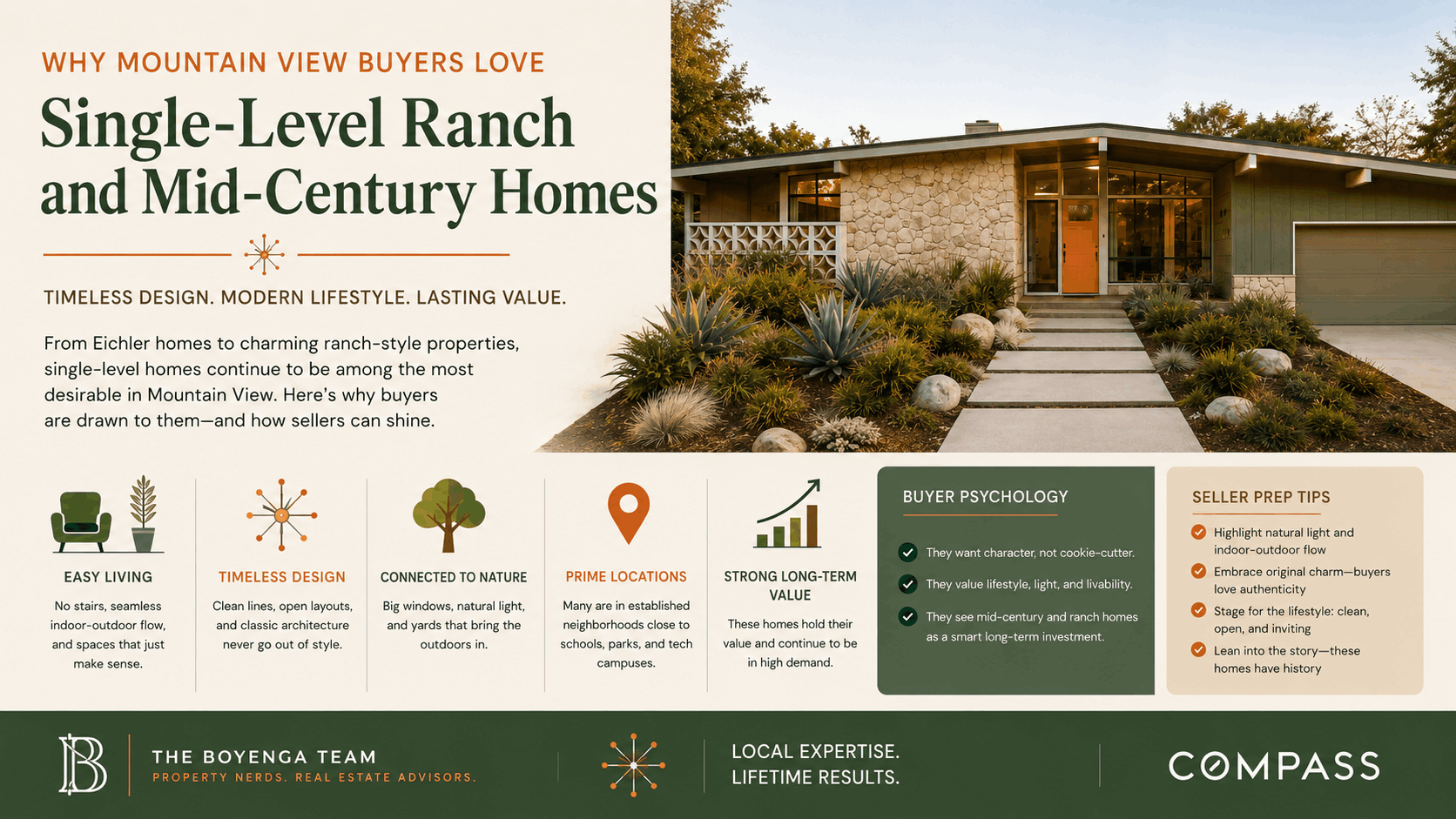
Mountain View buyers love single-level ranch and mid-century homes for a very Property Nerd reason:
They live better than they often photograph.
A one-story ranch may look simple from the curb. A mid-century home may look modest on paper. A classic Mountain View 1950s or 1960s home may not have soaring new-construction square footage, a dramatic formal entry, or a giant upstairs primary suite.
But once buyers step inside, the appeal becomes obvious.
Single-level living is easy.
The floor plans are flexible.
The yards are usually more connected to the home.
The indoor-outdoor lifestyle feels natural.
The architecture often has better light than expected.
The lots may offer future expansion potential.
The homes can work for families, downsizers, tech buyers, remodel buyers, and design lovers at the same time.
That is why Mountain View ranch homes and Mountain View mid-century homes continue to attract serious buyer attention.
At the Boyenga Team, we call these homes “quiet assets.” They do not always scream luxury online, but the right buyer recognizes their value immediately. A single-level Mountain View home in Cuesta Park, Waverly Park, Monta Loma, Rex Manor, Shoreline West, Old Mountain View, or another established neighborhood can offer exactly what modern Silicon Valley buyers want: livability, light, land, location, and future optionality.
The trick for sellers is making that value obvious before buyers mentally discount the home as “dated.”
This Property Nerd guide explains why Mountain View buyers love ranch and mid-century homes, what they notice first, and how sellers should prepare these properties before going to market.
The Property Nerd Thesis: One-Level Homes Solve Modern Buyer Problems
Single-level ranch and mid-century homes have a special kind of staying power because they solve everyday problems.
They are easy to move through. They are less formal. They often connect bedrooms, living spaces, patios, and backyards in a way that feels intuitive. They can work for young families, older buyers, multigenerational households, remote workers, and design-forward buyers who want something more relaxed than a tall, vertical townhome.
This is especially relevant in Mountain View, where buyers often compare very different property types: older single-family homes, Eichlers, Mackays, Mardells, townhomes, condos, downtown properties, Whisman Station homes, The Crossings townhomes, and newer infill development.
A three-level townhome may offer newer finishes and less maintenance. But a single-level ranch may offer better yard connection, fewer stairs, more expansion flexibility, and a calmer daily rhythm.
A larger two-story remodel may offer more square footage. But a mid-century home may offer better light, stronger indoor-outdoor flow, and a more architectural experience.
A dated ranch may not look perfect today. But it may sit on a valuable lot in a neighborhood buyers love.
That is the Mountain View buyer psychology sellers need to understand. Buyers are not only asking, “Is this home updated?” They are asking, “Can this home work for our life now and become even better over time?”
Why Single-Level Living Feels So Good
Single-level homes have a broad buyer pool because they are physically and emotionally easy.
There are no stairs between the kitchen and bedrooms. Kids can move between the house and yard more naturally. Pets have easier access outside. Guests do not have to navigate multiple levels. Older buyers and downsizers can imagine staying longer. Parents can keep an eye on the backyard from the main living space. A home office can sit quietly away from the main gathering area without feeling disconnected.
In Silicon Valley, where many buyers have intense work lives, ease matters.
A home that reduces friction has value.
That is why a modest single-level home can generate strong demand if the floor plan feels intuitive, the light is good, the yard is usable, and the neighborhood fits the buyer’s commute and lifestyle.
The Boyenga Team sees this often: buyers may say they want more square footage, but what they really want is better-functioning square footage. A 1,600-square-foot single-level ranch with great flow can feel more livable than a larger home with chopped-up rooms, awkward stairs, or poor outdoor connection.
The Property Nerd rule is simple: usable layout beats theoretical square footage.
Why Ranch Homes Still Work in Mountain View
The ranch home became popular because it matched the postwar California lifestyle: single-level living, attached garages, casual family rooms, broad lots, patios, and direct connections to the backyard. In Mountain View, many ranch homes were built during the city’s postwar growth years, when the area was transitioning from agricultural roots into a suburban and eventually technology-driven city.
Today’s buyers still respond to the same core idea.
A Mountain View ranch home often feels practical. It may have a simple roofline, a wide footprint, a backyard-facing living area, and a layout that can be updated without completely reinventing the structure. For buyers who want a home they can remodel over time, ranch homes can be especially appealing because the underlying format is understandable.
That matters to families. It matters to tech buyers. It matters to remodel-minded buyers. It matters to downsizers.
The seller mistake is assuming “ranch” means ordinary. In the right Mountain View neighborhood, a ranch home can be the perfect platform for modern living. Paint, floors, lighting, landscaping, staging, and better indoor-outdoor presentation can completely change how buyers perceive the property.
Why Mid-Century Homes Have a Different Buyer Energy
Mid-century homes have a more design-driven buyer pool.
A ranch buyer may be looking for function. A mid-century buyer may be looking for feeling.
They want natural light, clean lines, open living areas, beam structure, glass, courtyard moments, and a sense that the house was designed around the way California should feel. In Mountain View, that mid-century energy is especially strong in Monta Loma, where the neighborhood’s history includes Eichler, Mackay, and Mardell homes.
The Monta Loma Neighborhood Association notes that Eichler was active in the neighborhood in 1954, building more than 200 homes in the Fairview tract, and that John Mackay followed in 1955–56 with more than 200 three-bedroom, two-bath “flattop” contemporaries. The same neighborhood research identifies Mardell Building Company as the builder of Mardell Manor, adding another layer to Monta Loma’s mid-century housing story.
That history matters because buyers searching for Mountain View mid-century homes are often looking for more than a roof over their heads. They are looking for an architectural identity.
They want a home with soul.
Monta Loma: The Mid-Century Nerd Center of Mountain View
Monta Loma is the neighborhood that best explains Mountain View’s mid-century appeal.
It is not just “the Eichler neighborhood,” although Eichler is the name many buyers recognize first. It is more accurately a mid-century modern ecosystem shaped by multiple builders, including Eichler, Mackay, and Mardell. That mix gives Monta Loma its visual rhythm: low-slung homes, glass, simple lines, indoor-outdoor living, compact floor plans, and a strong sense of postwar California modernism.
Eichler Network has also described Monta Loma as a neighborhood with a strong community identity, where residents have formed clubs and neighborhood traditions around the area’s shared character.
That neighborhood identity gives sellers an advantage if they know how to use it.
A Monta Loma home should not be marketed like a generic old ranch. If it is an Eichler, the marketing should say so accurately. If it is a Mackay or Mardell, that story should be respected too. If the home has mid-century design language but has been altered, the listing should explain the opportunity clearly.
Architecture buyers care about accuracy. They notice whether the home has original details, whether the remodel respects the structure, whether the glass and light still work, and whether the home feels authentically mid-century or merely “updated.”
The Boyenga Team’s Property Nerd approach is to decode that history and translate it into buyer demand.
The Indoor-Outdoor Advantage
One of the biggest reasons buyers love single-level ranch and mid-century homes is the yard connection.
Modern buyers say they want indoor-outdoor living, but many older Mountain View homes were already built around that idea. Sliding doors, patios, garden views, atriums, courtyards, and single-level access create a natural relationship between house and yard.
That is extremely valuable in a city where lot utility can make or break buyer interest.
A backyard is not just a backyard anymore. It can be a play zone, garden, outdoor dining room, dog area, wellness space, future ADU site, office studio location, or long-term expansion opportunity.
Ranch and mid-century homes often make that outdoor potential easier to understand because the main living areas are on the same level as the yard. Buyers can picture dinner outside, kids moving in and out, a future deck, a garden, or a detached studio without having to mentally connect multiple levels.
For sellers, this means the yard should not be an afterthought. It should be part of the main story.
If the yard is overgrown, buyers may see maintenance. If the yard is cleaned, staged, and visually connected to the interior, buyers see lifestyle.
Why Tech Buyers Like These Homes
Tech buyers in Mountain View often care about commute logic, work-from-home space, EV readiness, internet setup, bike storage, and proximity to major employers. But they also care about decompression.
A single-level ranch or mid-century home can feel calmer than a vertical townhome or dense urban condo. It may offer a yard, a quiet office, better privacy, and a physical separation from the intensity of work.
Mountain View’s transportation network also supports the broader appeal. The city is served by VTA bus and light rail, Caltrain, MVgo shuttles, and the Mountain View Community Shuttle, according to the City of Mountain View. MVgo also describes its service as connecting commuters with the Mountain View Transit Center and locations around Mountain View during weekday commute hours.
That commute ecosystem matters because Mountain View buyers are often optimizing for flexibility. A buyer may work at Google today, take meetings in Palo Alto, move to a startup in Sunnyvale, commute to San Francisco occasionally, or work from home several days a week.
A single-level home with a real office, good light, yard access, garage function, and Silicon Valley commute optionality can be very compelling.
Why Family Buyers Like These Homes
Family buyers often love ranch and mid-century homes because they are easier to live in.
A single-level layout can simplify mornings, bedtime, playtime, and hosting. The yard feels more accessible. Parents can more easily watch children from the kitchen or living space. Bedrooms are usually easier to reach. Outdoor areas can become part of daily family life instead of a separate zone that must be managed.
This is especially powerful in neighborhoods like Cuesta Park and Waverly Park, where many buyers are already looking for a family-oriented single-family environment.
Cuesta Park itself is a major lifestyle anchor. The City of Mountain View lists amenities at Cuesta Park including BBQ facilities, bocce ball, fitness equipment, picnic tables, playground, restrooms, tennis courts, volleyball courts, a walking path, and an off-leash dog area.
That matters because buyers are not only buying the home. They are buying the rhythm around the home.
A ranch home near parks, schools, commute routes, and everyday amenities can feel incredibly useful. It may not have the flash of new construction, but it may support family life better than a taller, denser, newer property.
Why Downsizers Like Single-Level Homes
Downsizers are an important buyer pool for Mountain View ranch homes.
Some downsizers are coming from larger homes in Los Altos, Palo Alto, Sunnyvale, Saratoga, or Mountain View itself. They may want less maintenance, but they do not always want a condo or townhome. They may still want a garden, guest space, garage, privacy, and a neighborhood feel.
A single-level home can be a perfect fit because it offers independence without the vertical complexity of stairs. A downsizer may care deeply about a primary suite on the main level, easy yard access, a manageable footprint, and proximity to services.
For sellers, this buyer should not be ignored. A ranch home staged only for young families may miss the downsizer audience. A home staged only as a remodel opportunity may miss buyers who want to live there comfortably now.
The best marketing shows flexibility.
Why Remodel Buyers Love Ranch Homes
Ranch homes are often attractive remodel candidates because they can be easier to understand structurally and spatially than more idiosyncratic properties.
A buyer can imagine opening walls, reworking the kitchen, adding a primary suite, expanding toward the rear, improving indoor-outdoor flow, or creating a more modern facade. The wide footprint can provide a clear foundation for reinvention.
Of course, every property is different. Buyers still need to verify feasibility with architects, contractors, engineers, and the city. Setbacks, trees, lot coverage, drainage, utilities, prior additions, roof structure, and budget all matter.
But from a buyer psychology standpoint, ranch homes offer something valuable: a visible path.
The buyer can see what the home is and imagine what it could become.
For sellers, that future path should be part of the marketing, but it should not be overpromised. The smart approach is to highlight potential while encouraging buyer due diligence.
Why Mid-Century Buyers Think Differently
Mid-century buyers are often more design-sensitive than conventional buyers.
They may care less about a giant primary closet and more about whether the original beam lines are intact. They may care less about brand-new generic flooring and more about whether the flooring supports the architecture. They may prefer an older kitchen with character over a cheap remodel that fights the style. They may be more excited by original paneling, a courtyard, or period lighting than by trendy finishes.
This is where sellers need to be careful.
Do not erase the very thing the buyer might love.
A generic pre-sale remodel can hurt a mid-century home if it removes original details, blocks glass, adds overly traditional finishes, or makes the home feel like every other flip. A better strategy is usually to clean, brighten, stage, document, and selectively refresh.
The Boyenga Team helps sellers identify what should be preserved, what should be improved, and what should be left alone for the next owner.
What Buyers Notice First
Buyers notice the single-level flow almost immediately.
They notice whether the entry feels open or cramped. They notice whether the living room connects to the backyard. They notice natural light. They notice ceiling height. They notice whether the kitchen is isolated or connected. They notice bedroom placement. They notice whether there is a real office or flex space. They notice whether the yard is usable. They notice whether the home feels private.
In mid-century homes, buyers also notice the architecture. They notice the roofline, windows, beams, wood ceilings, paneling, atrium, fireplace, and whether the remodel respects the original design language.
Then they start calculating.
How much work does it need?
Can we live here now?
Could we remodel over time?
Is the lot worth the investment?
Is the home priced for condition?
Would future buyers love this same layout?
Does the neighborhood justify the project?
The seller’s job is to reduce friction in that mental calculation.
The Dated Home Problem: Dated Is Not the Same as Unmarketable
Many Mountain View ranch and mid-century homes are dated. That is not automatically bad.
Dated can mean opportunity.
Dated can mean original character.
Dated can mean the buyer gets to choose the next chapter.
Dated can mean the seller should not waste money guessing the buyer’s taste.
The problem is when dated feels neglected.
Buyers can handle old. They struggle with dark, dirty, cluttered, poorly lit, poorly disclosed, or confusing.
A dated ranch with clean windows, fresh paint, refinished floors, trimmed landscaping, and great staging can feel full of potential. A dated ranch with heavy drapes, stained carpet, overgrown plants, and poor photography can feel like a problem.
Same house. Different buyer psychology.
That is why seller prep matters so much.
Seller Prep: Make the Home Feel Easy to Understand
The smartest seller prep for a Mountain View ranch or mid-century home is usually not a full remodel.
It is strategic translation.
The home needs to tell buyers what it is. It might be a move-in-ready single-level home. It might be a light remodel opportunity. It might be a major expansion candidate. It might be a mid-century preservation opportunity. It might be a land-value play. It might appeal to families, tech buyers, downsizers, design buyers, and remodelers all at once.
The preparation should make that story clear.
Fresh paint can make the home feel cleaner and brighter. Refinished floors can add warmth and continuity. Updated lighting can help buyers see the space. Clean windows can transform the natural light. Landscaping can reveal the lot. Staging can explain how the floor plan lives. Inspections can reduce uncertainty.
The goal is not to make the home pretend to be new.
The goal is to make buyers understand why it is valuable.
Paint, Light, and Flooring: The Big Three
For dated ranch and mid-century homes, the first three seller-prep questions are often paint, light, and flooring.
Paint can neutralize personal color choices and make the home feel larger. Light can change everything, especially in older homes that have heavy window coverings, old fixtures, or landscaping blocking the windows. Flooring can either unify the house or make it feel chopped up.
A home with mismatched carpet, old vinyl, and scuffed hardwood may feel tired even if the layout is strong. Refinishing hardwood or replacing distracting flooring can help buyers focus on the home’s potential rather than its age.
For mid-century homes, the flooring choice should respect the architecture. Generic trendy flooring can flatten the character. Warm, simple, compatible materials often work better.
The Boyenga Team’s prep philosophy is practical: choose updates that improve buyer perception without erasing the home’s identity.
Landscaping: Reveal the Lot
Many older Mountain View homes have mature landscaping, which can be a blessing or a curse.
Mature trees and shrubs can create privacy. But overgrown landscaping can block light, hide the home, reduce curb appeal, make yards feel smaller, and create buyer concerns about maintenance.
A seller should look at the yard through the buyer’s eyes.
Does the home feel welcoming from the street? Does the backyard feel usable? Is there a patio? Is the side yard cluttered? Are trees blocking windows? Is there room to dine outside? Does the yard suggest future expansion, ADU potential, garden space, or play space?
For ranch and mid-century homes, the lot is often one of the biggest value drivers. Sellers should not let the landscaping hide it.
A clean, simple landscape refresh can make a major difference.
Staging: Show the Single-Level Lifestyle
Staging a ranch or mid-century home should be about lifestyle clarity.
For a family buyer, staging should show where people gather, where kids play, where homework happens, where guests stay, and how the yard connects.
For a tech buyer, staging should show a real home office, strong work-from-home function, and outdoor space for breaks.
For a downsizer, staging should show comfort, simplicity, and easy living.
For a design buyer, especially in a mid-century home, staging should respect the architecture. Low-profile furniture, warm textures, clean lines, and simple art usually work better than bulky traditional pieces.
The Boyenga Team often uses staging to answer buyer questions before they ask them.
Can this home work for us?
Can we host here?
Can we work here?
Can we relax here?
Can we grow here?
Can we make it our own?
Good staging makes the answer feel like yes.
Inspections and Disclosures: Confidence Creates Better Offers
Older homes often come with older systems.
That is normal. Buyers expect it.
What buyers do not like is uncertainty.
Pre-sale inspections can be especially valuable for Mountain View ranch and mid-century homes because buyers may have questions about roof, foundation, drainage, plumbing, electrical, HVAC, sewer, pest issues, additions, permits, and prior remodels.
For Eichler and mid-century homes, disclosures may also need to address radiant heat, slab foundations, roof type, atrium drainage, glass, and original systems.
A transparent seller can still sell as-is. In fact, many buyers are comfortable with as-is when they understand what they are buying.
The Boyenga Team helps sellers organize inspections and disclosures so buyers can focus on value instead of fear.
What Not to Over-Remodel Before Selling
This is where the Property Nerds get protective of seller net proceeds.
Do not automatically remodel the kitchen. Do not automatically remodel the bathrooms. Do not automatically install trendy flooring. Do not automatically remove original mid-century features. Do not automatically build an ADU. Do not automatically over-landscape. Do not spend six months trying to make the home into something the buyer may undo.
In many Mountain View cases, buyers would rather purchase the right home at the right price and customize it themselves.
A seller-funded remodel can become the remodeling penalty if the buyer dislikes the finishes, plans a larger project, or values the land and location more than the new backsplash.
The better question is always: will this improvement actually change buyer behavior?
If the answer is yes, it may be worth doing.
If the answer is no, it may be money spent for no strategic return.
Neighborhood Context Changes the Strategy
A ranch home in Cuesta Park should not be marketed the same way as a ranch home in Rex Manor.
A mid-century home in Monta Loma should not be marketed like a generic Mountain View home.
A Waverly Park single-level home may sell on lot size, privacy, and premium residential feel.
A Cuesta Park home may sell on parks, family lifestyle, Los Altos proximity, and daily convenience.
A Monta Loma home may sell on Eichler, Mackay, Mardell, mid-century architecture, and Google/North Bayshore access.
A Shoreline West home may sell on downtown proximity, charm, and walkability.
A Rex Manor home may sell on commute access, practical value, and remodel potential.
The Boyenga Team builds listing strategy around the neighborhood’s buyer psychology, not just the home’s square footage.
How the Boyenga Team Positions Mountain View Ranch and Mid-Century Homes
The Boyenga Team positions these homes around the buyer pools most likely to care.
For families, we emphasize single-level flow, yard connection, parks, schools, storage, and daily livability.
For tech buyers, we emphasize commute geometry, home office function, EV readiness, garage utility, and Silicon Valley access.
For downsizers, we emphasize ease, comfort, privacy, and one-level living.
For design buyers, we emphasize architecture, light, original features, indoor-outdoor flow, and mid-century identity.
For remodel buyers, we emphasize lot value, future potential, and the opportunity to create something special.
The best marketing does not force the home into one narrow category. It helps multiple buyer pools recognize why the property is worth competing for.
Final Property Nerd Takeaway
Mountain View buyers love single-level ranch and mid-century homes because they offer something that newer or more vertical homes often cannot: ease, flexibility, light, land connection, architectural personality, and future optionality.
A great ranch home lives better than it may look on paper.
A great mid-century home feels more current than its age suggests.
A great single-level Mountain View home can appeal to families, tech buyers, downsizers, remodelers, and design lovers at the same time.
For sellers, the key is not to over-remodel. The key is to prepare strategically, preserve what matters, improve what creates confidence, and market the home with the right story.
At the Boyenga Team, we bring a Property Nerd and Next Gen Agent approach to Mountain View homes for sale — especially ranch, Eichler, Mackay, Mardell, and mid-century properties where the details matter.
Because in Mountain View, the value is not always in making the home look brand new.
Sometimes the value is in helping buyers see why the original idea still works.
The Boyenga Team
Mountain View, Ranch, Mid-Century & Silicon Valley Real Estate Experts
Compass
Website: www.BoyengaTeam.com
Email: homes@boyenga.com