

Blog > Where Tech Buyers Are Moving in Silicon Valley: Palo Alto, Los Altos, Mountain View, and Sunnyvale
Where Tech Buyers Are Moving in Silicon Valley: Palo Alto, Los Altos, Mountain View, and Sunnyvale
by
A Property Nerd’s Strategic Guide to Tech Buyer Migration, Employer Proximity, School Districts, Lifestyle Fit, and Long-Term Value
Tech buyers in Silicon Valley do not move randomly. They move according to a sophisticated internal algorithm: commute friction, school confidence, employer proximity, lifestyle preference, price sensitivity, housing stock, lot utility, resale confidence, and the emotional feeling of whether a city matches the way they actually live. For buyers comparing Palo Alto, Los Altos, Mountain View, and Sunnyvale, the question is not simply which city is “best.” The better question is which city solves the right problem.
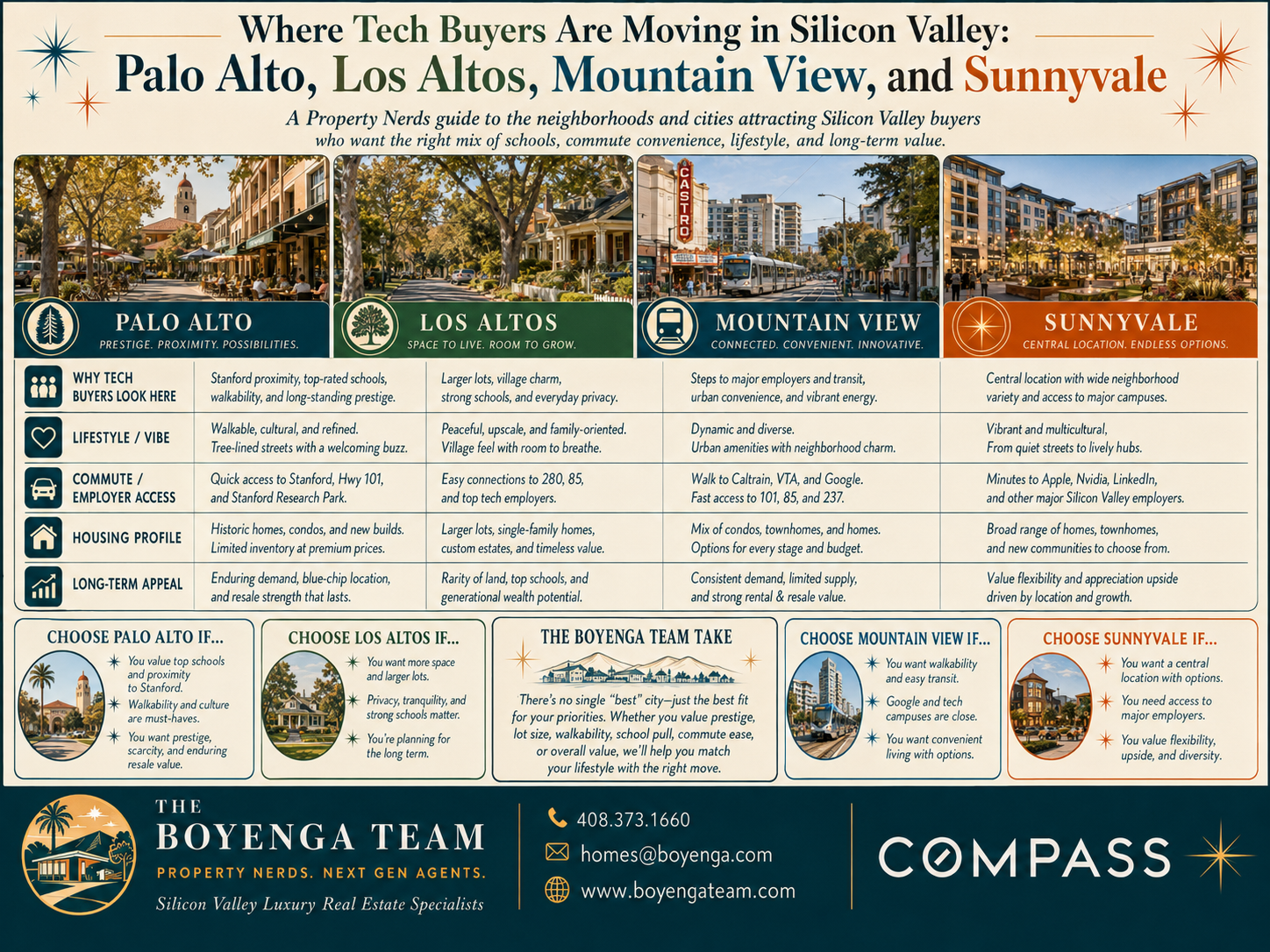
Palo Alto, Los Altos, Mountain View, and Sunnyvale form one of the most important residential corridors in Silicon Valley real estate. They sit near Stanford, Apple, Google, Nvidia, Meta, LinkedIn, Amazon, Intuit, and hundreds of venture-backed startups. Yet each city attracts a different kind of tech buyer. Palo Alto pulls buyers who want Stanford energy, prestige, global recognition, and intellectual proximity. Los Altos attracts buyers who want larger lots, privacy, quiet residential streets, and a more estate-style lifestyle. Mountain View appeals to buyers who want Google convenience, walkability, Caltrain access, downtown restaurants, and daily efficiency. Sunnyvale attracts buyers who want value, commute flexibility, school-pocket strategy, Eichler neighborhoods, and access to multiple employer nodes.
From a Property Nerd perspective, this is not a lifestyle fluff piece. This is market segmentation. Tech buyers are sorting themselves into micro-markets based on how they value time, land, schools, walkability, price per square foot, and future liquidity. In Silicon Valley, those preferences are not abstract. They determine which homes receive multiple offers, which homes sit, which streets outperform, and which neighborhoods continue to compound value over time.
Palo Alto remains the prestige market. The City of Palo Alto describes itself as the “Birthplace of Silicon Valley” and highlights Stanford University, nearly 100,000 jobs, parks, libraries, and extensive walking and biking trails as part of its identity. That combination explains why Palo Alto continues to carry a level of global recognition that few American residential markets can match.
Tech buyers drawn to Palo Alto are often buying more than a house. They are buying proximity to Stanford, Stanford Research Park, University Avenue, California Avenue, Caltrain, venture capital offices, medical institutions, academic networks, and one of the most recognizable innovation ecosystems in the world. Palo Alto feels like a market where intellectual capital and real estate capital overlap. For a buyer who wants an address that instantly communicates Silicon Valley status, Palo Alto is often the default.
The Palo Alto buyer profile tends to value prestige, institutional access, school confidence, walkability, and resale liquidity. These buyers may accept a smaller lot, older home, or higher price per square foot because the location premium is so powerful. They are often looking at neighborhoods such as Old Palo Alto, Professorville, Crescent Park, Community Center, Southgate, College Terrace, Midtown, Barron Park, and Greenmeadow. Each pocket has a different feel, but the common thread is that Palo Alto’s name does real economic work.
Palo Alto’s school story is one of its strongest demand drivers, but it must still be verified at the address level. Palo Alto Unified School District states that school assignment is based on the location of the family residence within a school boundary, and PAUSD also directs users to its School Finder to determine whether a residence is within district boundaries. For buyers, that means Palo Alto’s school brand is powerful, but assumptions are not enough.
Los Altos attracts a different kind of tech buyer. These buyers still want Silicon Valley access, but they do not necessarily want to feel plugged into Silicon Valley every minute of the day. Los Altos is the privacy, land, and luxury-residential market. It appeals to buyers who want larger lots, quieter streets, mature trees, outdoor living, pool potential, ADU flexibility, and a home that feels like a retreat from the intensity of the workday.
The Los Altos buyer profile often includes tech executives, founders, senior engineers, investors, and move-up buyers who want a more residential experience without giving up access to Apple, Google, Nvidia, Stanford, Meta, LinkedIn, and the broader South Bay employment ecosystem. The city’s real estate value is built around scarcity: land, privacy, school demand, and neighborhood consistency. The City of Los Altos lists parks such as Grant Park, Shoup Park, Heritage Oaks Park, Rosita Park, Hillview Park, Redwood Grove, McKenzie Park, and Marymeade Park, reinforcing the city’s quieter residential lifestyle.
Los Altos is especially attractive for buyers who want more house-and-land utility than Palo Alto or Mountain View may offer at similar lifestyle expectations. In Los Altos, the lot often carries as much strategic value as the structure. A dated home on a strong street with good lot utility can be a very valuable asset because buyers see future expansion, outdoor living, guest space, and estate potential. This is why Los Altos often functions as a long-term land play rather than simply a finished-house play.
The school conversation in Los Altos is highly important and more nuanced than many buyers realize. The City of Los Altos lists multiple school districts serving residents, including Los Altos School District, Cupertino Union School District, Santa Clara County Office of Education, Mountain View Los Altos High School District, and Fremont Union High School District depending on grade level and exact address. That makes Los Altos a classic address-verification market. A buyer should never assume school assignment from the city name alone.
Mountain View is where tech convenience becomes lifestyle. For many buyers, Mountain View is the cleanest answer to the question: “How do we make daily life easier?” Google’s official Visitor Experience is located at the Gradient Canopy office in Mountain View, and the company’s presence continues to define the city’s identity for many tech buyers.
Mountain View attracts buyers who want to live close to Google, downtown Castro Street, Caltrain, Stevens Creek Trail, Shoreline, Intuit, LinkedIn-adjacent corridors, and a more walkable urban-suburban environment. These buyers often prioritize shorter commutes, restaurants, transit, biking, and practical daily mobility over larger lots or old-school luxury prestige. The city’s Castro Street pedestrian mall, established by ordinance in 2022, reinforces Mountain View’s role as one of Silicon Valley’s most active walkable downtown districts.
The Mountain View buyer profile is often highly practical. They may be engineers, product leaders, startup employees, AI professionals, Google employees, hybrid workers, or buyers who want access to both the Peninsula and South Bay without paying Palo Alto or Los Altos pricing. Mountain View also offers more housing diversity than Palo Alto or Los Altos, with condos, townhomes, Eichlers, mid-century homes, ranch homes, downtown-adjacent properties, newer construction, and single-family neighborhoods.
Mountain View’s school story is strong but address-sensitive. Mountain View Whisman School District directs residents to use SchoolLocator and boundary maps to verify address-specific assignments, and Mountain View Los Altos High School District describes both Mountain View High and Los Altos High as ranking in the top 2% nationally according to U.S. News & World Report. For tech buyers relocating into the area, that combination of school opportunity and location convenience can be very compelling, but it requires careful boundary review.
Sunnyvale is the most flexible of the four markets. It is often misunderstood as merely the “value alternative,” but that undersells the city’s strategic strength. Sunnyvale is a diversified Silicon Valley access market. It works for buyers commuting to Apple, Google, LinkedIn, Nvidia, Amazon, Santa Clara, Mountain View, Cupertino, Palo Alto, and San Jose. It offers school-pocket opportunities, Eichler neighborhoods, downtown growth, Caltrain access, and a broad housing spectrum.
Sunnyvale tech buyers are often optimizing for optionality. One household may have one person commuting to Apple and another to Google. Another may want access to Nvidia in Santa Clara, LinkedIn in Sunnyvale or Mountain View, and startups scattered across the South Bay. Nvidia’s official contact page lists its headquarters at 2788 San Tomas Expressway in Santa Clara, Apple lists its Apple Park Visitor Center in Cupertino, and Google’s Mountain View presence is a major anchor just west of Sunnyvale.
That commute flexibility is a major reason Sunnyvale continues to attract tech buyers. Sunnyvale does not have to win on prestige alone. It wins on utility. It offers many buyers a more attainable price point than Palo Alto or Los Altos while still placing them in the core employment corridor. For households balancing budget, school path, commute, home condition, and future resale, Sunnyvale can be one of the smartest real estate plays in Silicon Valley.
Sunnyvale’s downtown growth story also matters. The City of Sunnyvale notes that many new projects are underway downtown, with a majority in the CityLine project, which includes office, residential, and commercial space. That ongoing investment gives Sunnyvale a lifestyle and value catalyst that appeals to buyers who want a city with upward momentum.
Sunnyvale’s school story is very address-sensitive. Sunnyvale School District lists schools including Cherry Chase Elementary, Cumberland Elementary, Columbia Middle, Sunnyvale Middle, Bishop, Ellis, Fairwood, Lakewood, San Miguel, and Vargas. That variety creates both opportunity and complexity. A Sunnyvale home in one school pocket can have a dramatically different resale story than a similar home elsewhere in the city.
Current market data shows how these cities separate into different pricing tiers. Redfin’s three-month data ending May 2026 showed Palo Alto with a median sale price of approximately $3.6 million, Los Altos around $4.25 million, Mountain View around $1.94 million, and Sunnyvale around $1.79 million. These figures move constantly and citywide medians can be distorted by housing mix, but they show the structural pattern: Palo Alto and Los Altos command premium pricing, while Mountain View and Sunnyvale often offer more flexible value equations.
For tech buyers, the choice often comes down to what they are really buying. Palo Alto buyers are often buying identity, Stanford proximity, PAUSD demand, walkability, and luxury resale liquidity. Los Altos buyers are often buying land, privacy, quiet streets, school-driven demand, and long-term residential prestige. Mountain View buyers are often buying Google convenience, downtown walkability, Caltrain, and daily-life efficiency. Sunnyvale buyers are often buying value, commute flexibility, school-pocket strategy, and long-term access to multiple tech corridors.
The employer map is essential. Buyers connected to Stanford, Sand Hill Road, downtown Palo Alto, Menlo Park, Meta, or the broader Peninsula may lean Palo Alto. Meta’s Menlo Park campus includes its East Campus at 1 Hacker Way, and Palo Alto’s location can be a logical fit for buyers balancing Stanford, Meta, and Peninsula access.
Buyers connected to Apple, Google, Nvidia, LinkedIn, or South Bay employers may evaluate Los Altos, Mountain View, and Sunnyvale differently depending on their school priorities and tolerance for commute friction. Apple Park anchors Cupertino, Google anchors Mountain View, Nvidia anchors Santa Clara, and Sunnyvale sits in the middle of that employment triangle.
The Property Nerd move is to go beyond miles on a map. A smart buyer evaluates actual commute routes, school drop-off, morning bottlenecks, return-trip timing, Caltrain access, bike routes, shuttle corridors, parking, and how often they actually need to be in the office. A home that looks slightly farther away may live better if the route is cleaner. A home that looks close may perform worse if the daily friction is high.
Housing stock also drives buyer migration. Palo Alto buyers may prioritize historic homes, Craftsman architecture, Spanish-style homes, mid-century modern properties, Eichlers, or luxury rebuilds near Stanford and downtown. Los Altos buyers often prioritize ranch homes, expanded ranches, custom estates, larger lots, and homes with outdoor living potential. Mountain View buyers may gravitate toward Eichlers, mid-century homes, downtown townhomes, ranch homes, and efficient single-family properties near Google or Caltrain. Sunnyvale buyers may focus on Fairbrae Eichlers, Cherry Chase homes, Cumberland South, Birdland, Raynor Park, Las Palmas, Ortega Park, Downtown Sunnyvale, CityLine-adjacent homes, and West Sunnyvale pockets.
The AI boom is also reshaping buyer psychology. Recent Bay Area reporting has linked renewed high-end housing demand to AI-driven wealth creation, especially among high-earning technology professionals. While much of that reporting focuses on San Francisco, the same logic matters for Silicon Valley: tech compensation, equity liquidity, IPO expectations, and hiring cycles can rapidly change buyer urgency, especially in neighborhoods with strong commute access and prestige value.
For sellers, this means marketing should not be generic. A Palo Alto listing should speak to Stanford energy, school confidence, historic neighborhood character, walkability, and global resale demand. A Los Altos listing should emphasize lot size, privacy, outdoor living, school path, architectural potential, and long-term land scarcity. A Mountain View listing should lean into Google convenience, Caltrain, Castro Street, trails, bikeability, home-office function, and price-to-lifestyle efficiency. A Sunnyvale listing should emphasize tech commute flexibility, school pocket, value relative to neighboring cities, downtown growth, Eichler or mid-century design, and access to Apple, Google, Nvidia, and LinkedIn.
For buyers, the mistake is choosing a city based only on reputation. Palo Alto is not automatically the best choice if a buyer truly wants space and privacy. Los Altos is not automatically the best choice if a buyer wants walkability and transit. Mountain View is not a compromise if the buyer values convenience. Sunnyvale is not simply a cheaper alternative if the property sits in the right school and commute lane. Each city has a different investment thesis.
Smart-home readiness increasingly matters across all four cities. Tech buyers often value EV charging, solar, battery backup, heat pump HVAC, induction cooking, strong Wi-Fi, smart thermostats, leak detection, smart irrigation, advanced security, flexible home offices, ADU potential, and efficient floor plans. These features matter because tech buyers are not only purchasing square footage. They are buying a home operating system.
ADUs and flexible space are especially important in Silicon Valley relocation decisions. A detached office, guest unit, rental-flexible ADU, or multigenerational layout can change the way a property lives and resells. In Palo Alto, flexible space can support Stanford affiliates, visiting guests, or hybrid professionals. In Los Altos, it can support estate-style living and long-term household flexibility. In Mountain View, it can support hybrid work near Google. In Sunnyvale, it can support both practical affordability and future optionality.
The long-term value thesis differs by city. Palo Alto is likely to remain powerful because of Stanford, PAUSD, global name recognition, historic neighborhoods, and extreme land scarcity. Los Altos is likely to remain powerful because of larger lots, privacy, school demand, and premium residential identity. Mountain View is likely to remain powerful because of Google, Caltrain, downtown walkability, trails, and tech employment proximity. Sunnyvale is likely to remain powerful because of centrality, price flexibility, multiple employer corridors, strong school pockets, downtown redevelopment, and housing diversity.
At the Boyenga Team at Compass, we view tech buyer migration as a pattern-recognition exercise. Eric and Janelle Boyenga, known as Silicon Valley Property Nerds and Next Gen Agents, help buyers and sellers understand the hidden variables that drive value: school boundaries, commute routes, employer proximity, neighborhood psychology, lot utility, architectural style, remodel risk, smart-home readiness, ADU feasibility, Compass technology, private inventory, buyer demand, and future resale positioning.
Compass gives the Boyenga Team a technology-forward platform that fits how Silicon Valley buyers make decisions. In a market shaped by data, private exclusives, digital marketing, buyer behavior, pricing intelligence, and rapid micro-market shifts, tools matter. But interpretation matters more. Data shows what happened. Local expertise explains why it happened, who wanted the home, and how that information should shape the next move.
The final takeaway is simple. Tech buyers are moving to Palo Alto for Stanford energy, prestige, schools, and global resale confidence. They are moving to Los Altos for bigger lots, privacy, quiet streets, and long-term land value. They are moving to Mountain View for Google convenience, walkability, transit, and efficient daily life. They are moving to Sunnyvale for value, flexibility, school-pocket opportunity, and access to multiple tech employers.
Palo Alto, Los Altos, Mountain View, and Sunnyvale are not interchangeable. They are four different answers to the same Silicon Valley question: how do you want your home to support your work, your lifestyle, your family priorities, your financial strategy, and your long-term resale value?
The Boyenga Team at Compass represents buyers and sellers throughout Silicon Valley with a focus on luxury homes, Eichler and mid-century modern properties, school-driven moves, estate homes, trust sales, relocation strategy, and high-value residential positioning. Known as Property Nerds and Next Gen Agents, Eric and Janelle Boyenga combine data, design, technology, negotiation, and local market intelligence to help clients make smarter real estate decisions in Palo Alto, Los Altos, Mountain View, Sunnyvale, Cupertino, Menlo Park, Saratoga, Los Gatos, and the greater Silicon Valley market. For expert guidance, contact the Boyenga Team at Compass at homes@boyenga.com or visit www.BoyengaTeam.com.