

Blog > What Trustees Should Know Before Selling a Silicon Valley Property
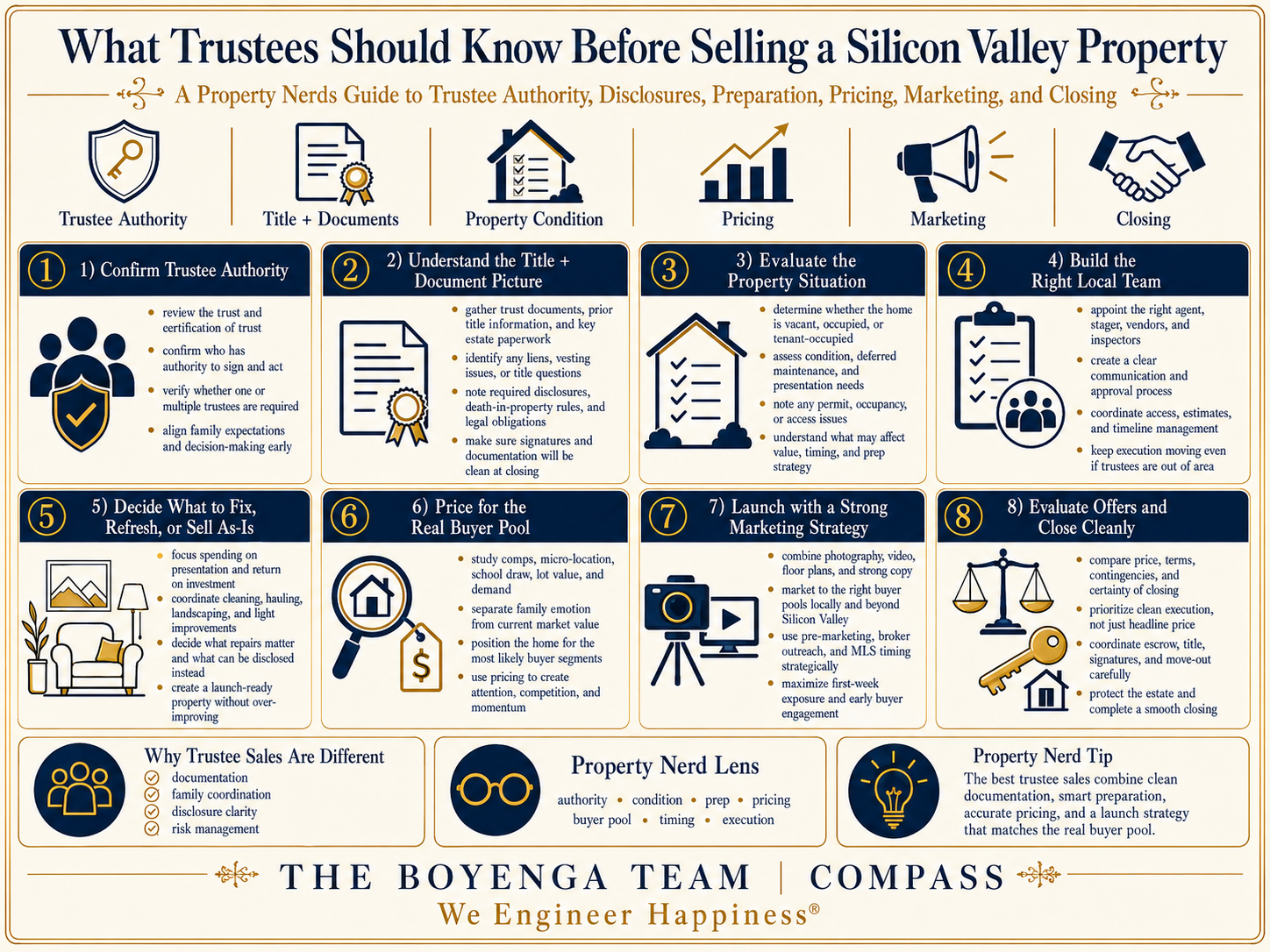
Selling a Silicon Valley property as a trustee is not the same as selling your own home. You are not just making a real estate decision. You are managing a trust asset, communicating with beneficiaries, coordinating legal and tax details, protecting the property, and trying to make smart market decisions in one of the most competitive real estate regions in the country.
Whether the property is in Palo Alto, Los Altos, Menlo Park, Atherton, Mountain View, Sunnyvale, Cupertino, Saratoga, Los Gatos, San Jose, or anywhere across Silicon Valley, trustees need a clear strategy before going to market.
The Boyenga Team at Compass helps trustees approach this process with structure, local expertise, and a Property Nerds level of detail. The goal is simple: protect the asset, reduce risk, prepare the property intelligently, and maximize the outcome for the trust.
1. Confirm Authority Before Making Real Estate Decisions
Before signing a listing agreement, accepting an offer, or authorizing major work, the trustee should confirm that they have legal authority to sell the property.
This usually means reviewing the trust document, confirming who the current trustee or successor trustee is, determining whether there are co-trustees, and verifying how documents must be signed. California Probate Code generally gives trustees the power to acquire or dispose of property unless restricted by the trust terms, but the trust document and legal circumstances matter. Trustees should confirm authority with their attorney and title company before moving forward.
This is especially important when there are multiple trustees, family disagreements, outdated trust documents, deceased trustees, or unclear vesting on title.
2. Understand the Trustee’s Fiduciary Duty
A trustee is not acting as a typical homeowner. A trustee has a fiduciary responsibility to administer the trust in the interest of the beneficiaries. California Probate Code Section 16002 states that a trustee has a duty to administer the trust solely in the interest of the beneficiaries.
In real estate terms, that means trustees should make decisions that are reasonable, documented, and aligned with the trust’s goals. Pricing, repairs, timing, vendor costs, and offer selection should be based on strategy and evidence—not pressure, emotion, or convenience.
For Silicon Valley properties, this matters because a small strategic mistake can mean a significant difference in final value.
3. Get the Trust, Title, and Escrow Details Organized Early
Trustee sales can slow down when documentation is incomplete. Before launching the property, trustees should coordinate with escrow, title, and legal counsel to confirm what documents will be needed.
Common items may include the certification of trust, death certificate if applicable, trustee identification, trust excerpts or full trust documents if requested by title, vesting information, loan payoff details, property tax information, and any documents confirming authority to sell.
Beneficiaries may also have rights to receive trust information and hold trustees accountable for wrongful acts or omissions affecting their interests. The Santa Clara County Superior Court notes that beneficiaries may have rights to receive notice, copies of the trust, accountings, and information about their interests.
The earlier the paperwork is handled, the less likely the sale is to hit a surprise during escrow.
4. Decide Whether to Sell As-Is or Prepare the Property
Trustees often ask whether they should sell the home exactly as it sits or invest in preparation. The answer depends on the property, condition, timing, budget, and buyer pool.
In Silicon Valley, “as-is” does not have to mean “under-presented.” A home can be sold as-is while still being cleaned, staged, landscaped, photographed beautifully, and marketed strategically.
The highest-return preparation often includes:
Fresh paint
Flooring touch-ups or refinishing
Landscape cleanup
Deep cleaning
Window washing
Hauling and decluttering
Updated lighting
Minor repairs
Staging
Pre-sale inspections
Major remodeling is not always recommended. In many trustee sales, the better approach is to do enough to help buyers see the property’s potential without over-spending trust funds on improvements the next buyer may change anyway.
The Boyenga Team’s approach is to do as little as possible, but not so little that the property is shortchanged.
5. Protect the Property Before It Goes on the Market
If the home is vacant or the trustee lives out of area, asset protection becomes a priority. Vacant homes can develop issues quickly: leaks, pest activity, landscape decline, mail buildup, security concerns, pool problems, roof leaks, or insurance complications.
Before marketing begins, trustees should make sure the property is secure, utilities are stable, insurance is active, mail is managed, access is controlled, and urgent maintenance issues are addressed.
The Boyenga Team often helps trustees coordinate local vendors, property access, cleanup, inspections, landscape refreshes, staging, and preparation so the trustee does not have to manage every detail from another city.
6. Know What Buyers Care About in Silicon Valley
Silicon Valley buyers are not all looking for the same thing. A trustee selling a home in Los Altos may attract school-focused family buyers, remodel buyers, and builders. A Palo Alto property may appeal to Stanford, tech, and long-term land-value buyers. A Cupertino home may receive attention because of school demand and proximity to Apple. A Mountain View or Sunnyvale home may attract buyers focused on Google, LinkedIn, Nvidia, Apple, and commute efficiency. Saratoga, Los Gatos, and Monte Sereno homes may appeal to buyers looking for privacy, lifestyle, architecture, and larger lots.
The marketing should be built around the property’s true value drivers, such as:
School boundaries
Lot size and usability
Architecture
Privacy
Natural light
Expansion potential
ADU potential
Commute location
Neighborhood identity
Walkability
Indoor-outdoor living
Luxury lifestyle
Long-term resale strength
This is where local expertise matters. A trust property should not be marketed generically. It should be positioned to the right buyer pools.
7. Use Pre-Sale Inspections to Reduce Uncertainty
Trustees may have limited knowledge of the property’s history, especially if they never lived in the home. Pre-sale inspections can help create transparency and reduce buyer uncertainty.
Depending on the home, useful inspections may include a home inspection, termite inspection, roof inspection, sewer inspection, chimney inspection, pool inspection, HVAC review, foundation review, or permit research.
The goal is not to make the home perfect. The goal is to understand the condition before buyers do. In a high-value Silicon Valley sale, information creates confidence. Buyers are more likely to write strong offers when they understand what they are buying.
8. Be Thoughtful About Disclosures
Trustee disclosure obligations can be different from a traditional owner-occupied sale, but trustees should not assume they are exempt from everything. California trust-property disclosure rules can be nuanced, and exemptions may depend on the situation. Some legal commentary notes that California trust sales may be exempt from certain statutory transfer disclosure requirements under Civil Code Section 1102.2(d), but that the exemption is not absolute.
The safest practical approach is to disclose known material facts, provide available reports, and coordinate with the agent, attorney, and escrow team. Trustees should not guess. They should document what they know, clarify what they do not know, and rely on the correct professionals.
9. Understand Tax and Withholding Issues Before Closing
Trustees should consult a CPA or tax advisor before selling, especially if the property has appreciated significantly, was inherited, or will involve beneficiary distributions.
California real estate withholding may apply when California real property is sold by a trust unless the trust qualifies for an exemption on Form 593, according to the California Franchise Tax Board.
Important tax topics may include basis, step-up in basis, capital gains, trust income tax treatment, real estate withholding, beneficiary allocations, and timing of distributions. These are not agent-level decisions, but they can affect the trustee’s process and net proceeds.
10. Price Based on Strategy, Not Emotion
Trustees often receive price opinions from beneficiaries, neighbors, online estimates, and old memories of what the home “should be worth.” In Silicon Valley, the correct pricing strategy requires a deeper analysis.
A proper valuation should consider:
Recent comparable sales
Active competition
Pending sales
Condition
Lot size
School district
Architecture
Remodel potential
Builder demand
Buyer pool
Market timing
Interest-rate environment
Luxury buyer activity
Neighborhood microtrends
Overpricing can cause the home to sit and become stale. Underpricing without a strategy can leave money on the table. The goal is to create urgency while protecting value.
The Boyenga Team uses a data-driven, market-specific approach to help trustees understand where the property fits and how buyers are likely to respond.
11. Manage Beneficiary Communication Carefully
A trustee sale can become stressful when beneficiaries disagree. Some may want to sell quickly. Others may want to spend money on improvements. Some may be emotionally attached to the home. Others may be focused only on net proceeds.
Clear communication helps reduce conflict.
Trustees should consider documenting major decisions, sharing market data, explaining repair recommendations, getting written estimates, and clarifying the reasoning behind pricing and offer decisions.
A strong real estate advisor can help translate the process into objective categories: required, recommended, optional, and not recommended.
12. Choose the Right Listing Strategy
Not every trustee sale should launch the same way. Some properties benefit from quiet pre-market exposure. Others should go directly to the MLS. Some should be marketed as luxury homes. Others should be positioned as remodel opportunities, estate lots, Eichlers, builder properties, or school-driven family homes.
With Compass tools, the Boyenga Team can help evaluate different launch options, including private exposure, Coming Soon strategy, full MLS marketing, broker outreach, digital campaigns, property websites, video, social media, and targeted buyer promotion.
The right strategy depends on the trust’s goals, the home’s condition, the local market, and the most likely buyer profile.
13. Evaluate Offers Beyond Price
The highest offer is not always the best offer. Trustees should evaluate both price and terms.
Important offer factors include:
Purchase price
Deposit amount
Financing strength
Appraisal contingency
Loan contingency
Property contingency
Inspection requests
Closing timeline
Rent-back or possession terms
Buyer reliability
Proof of funds
Escrow risk
As-is language
Likelihood of closing
In a trustee sale, certainty matters. A slightly lower but cleaner offer may sometimes be better than a higher offer with more risk.
14. Work With a Team That Understands Trustee Sales
A trustee sale requires more than a sign, photos, and a lockbox. It requires organization, discretion, vendor coordination, pricing discipline, document awareness, buyer strategy, and steady communication.
The Boyenga Team at Compass brings a Silicon Valley-specific approach to trustee sales, luxury homes, inherited properties, trust assets, estate preparation, and out-of-area seller coordination.
As the Property Nerds and Next Gen Agents, Eric and Janelle Boyenga combine local market expertise, Compass technology, property preparation strategy, and high-level marketing to help trustees make informed decisions from start to finish.
Final Thought
Before selling a Silicon Valley property as a trustee, get organized, confirm authority, protect the property, understand the tax and disclosure landscape, evaluate preparation carefully, and choose a local team that knows how to position the home correctly.
The best trustee sales are not rushed. They are planned.
With the right strategy, a trust property can be prepared, marketed, and sold in a way that protects the asset, supports the trustee’s responsibility, and creates the strongest possible result for the beneficiaries.