

Blog > What Makes a Silicon Valley Luxury Home Feel Current in 2026?
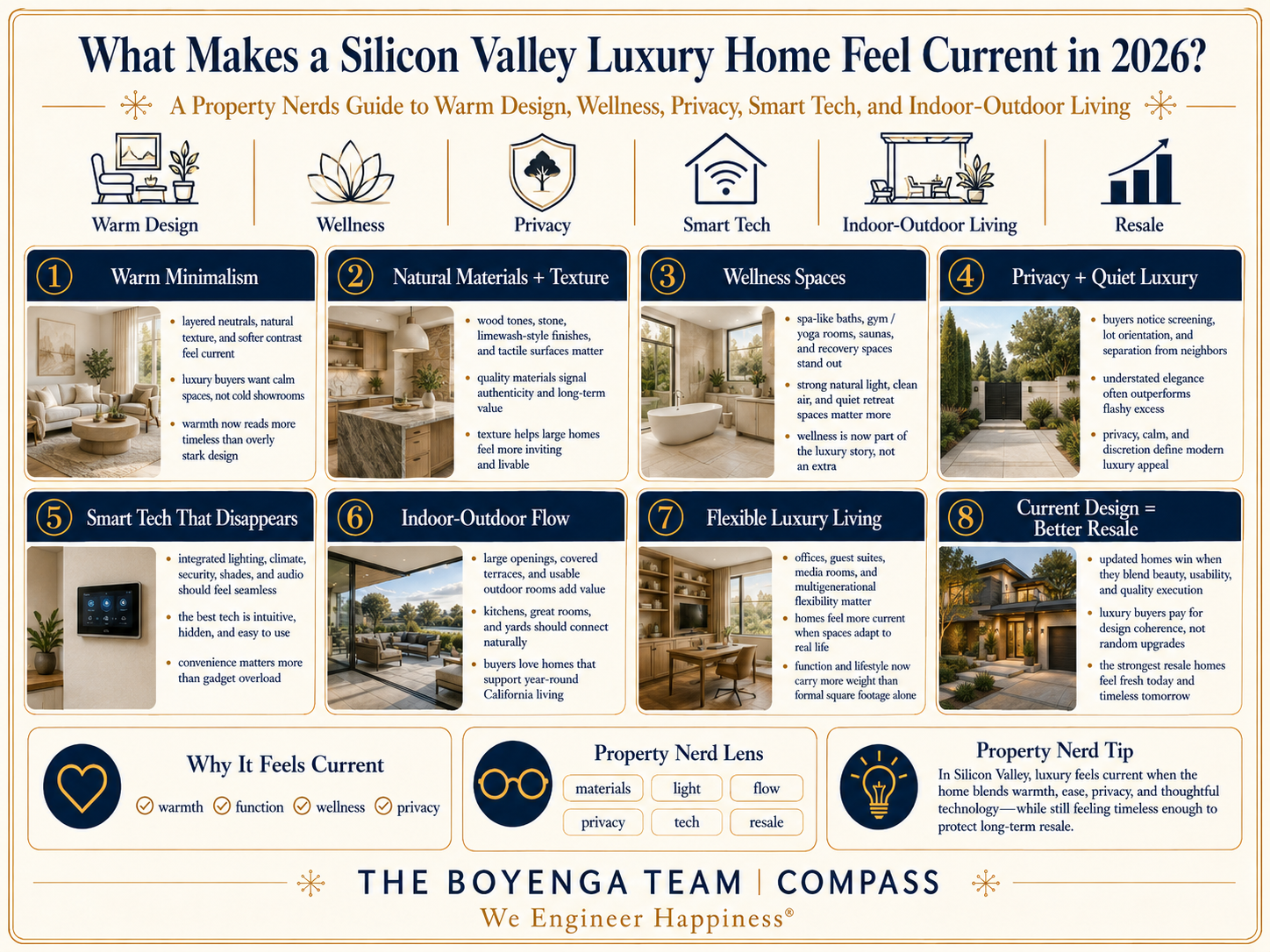
Luxury in Silicon Valley has changed.
It is no longer just about square footage, white marble, oversized islands, dramatic staircases, or brand-name appliances. Those things can still matter, but they are not enough by themselves.
In 2026, the most compelling luxury homes feel calmer, warmer, smarter, healthier, more private, and more deeply connected to the way people actually live.
Silicon Valley luxury buyers are still highly analytical. They notice price, lot size, school path, commute, privacy, architecture, condition, systems, and resale. But they are also increasingly sensitive to feeling. They want the home to feel current without feeling trendy. Elevated without feeling cold. Designed without feeling over-designed. Modern without feeling sterile. Comfortable without feeling casual. Technological without feeling complicated.
The best homes in 2026 do not scream luxury.
They whisper confidence.
That is where the Boyenga Team’s Property Nerds approach becomes especially important. A luxury home should not simply be staged to look expensive. It should be positioned to feel relevant to today’s buyer psychology: wellness, flexibility, privacy, sustainability, warmth, natural light, indoor-outdoor living, quiet technology, and long-term livability.
The smartest seller question is not, “Does this home look high-end?”
The better question is:
Does this home feel current to the buyer who is most likely to pay a premium for it?
Current Luxury Feels Warm, Not Cold
For years, Silicon Valley luxury leaned heavily into bright white kitchens, gray floors, polished surfaces, stark contrast, and showroom minimalism.
In 2026, that look can feel dated when it goes too far.
Today’s luxury buyer still wants clean design, but they also want warmth. They want natural materials, softer palettes, layered textures, warm woods, stone with movement, limewash or plaster-like finishes, organic shapes, softer lighting, and interiors that feel human.
The shift is subtle but important.
A current luxury home does not need to be beige or boring. But it should feel livable. The best interiors have depth: wood, stone, fabric, metal, glass, greenery, art, texture, and light all working together.
Buyers want spaces that photograph beautifully but also feel good at 7:00 a.m. on a Tuesday.
The Property Nerds read: In 2026, cold perfection is less compelling than warm precision.
The Kitchen Is Becoming Quieter
The luxury kitchen is still one of the first things buyers judge, but the ideal kitchen has changed.
The overly busy open kitchen is giving way to a quieter, more integrated kitchen. Buyers still want function, but they do not want visual chaos. They want the kitchen to support daily life and entertaining without feeling like a commercial prep zone in the middle of the living room.
That means buyers are responding to:
Panel-ready appliances.
Hidden storage.
Appliance garages.
Clean cabinet lines.
Sculleries or prep kitchens where space allows.
Walk-in pantries.
Large but practical islands.
Integrated lighting.
Warm natural materials.
Stone continuity.
Beautiful but durable surfaces.
The best kitchens in 2026 do not just say, “Look at me.”
They say, “Living here will be easy.”
For Silicon Valley buyers who entertain, work from home, host family, manage busy school schedules, or cook frequently, the kitchen needs to be both elegant and deeply functional.
The Property Nerds read: The new luxury kitchen is calm, concealed, hardworking, and beautifully edited.
Wellness Is No Longer a Bonus
Wellness has moved from luxury extra to buyer expectation.
Silicon Valley buyers are often living intense lives. They may work in technology, venture capital, medicine, startups, design, law, finance, education, or executive leadership. Many are managing high-stress schedules, hybrid work, children, travel, aging parents, and demanding careers.
They want homes that help them recover.
That means a current luxury home may emphasize:
Natural light.
Fresh air.
Improved indoor air quality.
Quiet bedrooms.
Spa-like bathrooms.
Sauna or cold plunge potential.
Fitness or yoga space.
Meditation or reading zones.
Acoustic comfort.
Biophilic design.
Calming materials.
Views of greenery.
Private outdoor areas.
Wellness does not have to mean a full home gym or resort-level spa. Sometimes it is simply a primary suite that feels calm, a bathroom that feels restorative, or a garden view that changes the mood of the house.
The Property Nerds read: In 2026, luxury buyers are not just buying a home that looks good. They are buying a home that helps them feel better.
Natural Light Is Still the Ultimate Luxury Finish
No finish compensates for a dark home.
Luxury buyers notice light immediately. They notice whether the rooms feel bright, whether the windows are placed well, whether the home feels open, and whether the light changes throughout the day.
In Silicon Valley, natural light is especially powerful because it supports almost every buyer category: luxury buyers, family buyers, tech buyers, downsizers, architecture buyers, and wellness-focused buyers.
A current luxury home should maximize light without sacrificing privacy. That is the balance.
Buyers want:
Large windows.
Well-placed skylights.
Glass doors to the yard.
Clerestory windows where appropriate.
Lighter interior surfaces.
Layered lighting for evening.
Window coverings that feel tailored.
Landscape screening that protects privacy without blocking light.
The Property Nerds read: Light is not just aesthetic. It changes buyer emotion.
Privacy Feels More Valuable Than Ever
Privacy is one of the strongest luxury signals in Silicon Valley.
Buyers want to feel protected from neighbors, traffic, noise, and visual exposure. They want quiet bedrooms, private outdoor spaces, shielded pools, discreet entries, and yards that feel like extensions of the home rather than exposed spaces.
Privacy matters in Los Altos Hills, Atherton, Portola Valley, Saratoga, Monte Sereno, and Los Gatos estate properties. But it also matters in Palo Alto, Los Altos, Menlo Park, Mountain View, Sunnyvale, and Cupertino, where density, two-story neighboring homes, and smaller lot patterns can make privacy feel rare.
In 2026, luxury buyers are not just paying for square footage.
They are paying for calm.
The Property Nerds read: Privacy is emotional square footage.
Indoor-Outdoor Living Needs to Feel Intentional
Silicon Valley buyers have always loved indoor-outdoor living, but in 2026, they expect outdoor spaces to function like real rooms.
A lawn alone is not enough. A patio alone is not enough. A pool alone is not enough.
The best outdoor spaces feel planned.
They may include:
Outdoor dining.
Covered patios.
Modular or built-in outdoor kitchens.
Fire features.
Lighting.
Heaters.
Pool and spa zones.
Lounge areas.
Garden rooms.
Play lawns.
Privacy hedges.
Outdoor audio.
Landscape layers.
Direct kitchen or family room access.
Outdoor living should not feel like an afterthought. It should feel connected to the architecture and the way the buyer will live.
For luxury buyers, the backyard is often where the emotional decision happens. They imagine dinner parties, family weekends, morning coffee, children playing, guests visiting, or quiet evenings after work.
The Property Nerds read: A current luxury yard is not just landscaped. It is programmed.
Smart Home Technology Should Be Invisible
Silicon Valley buyers expect technology, but they do not want a home that feels like a control room.
The best smart home systems in 2026 are integrated, intuitive, and quiet. Buyers like convenience, but they dislike complexity. They want lighting, security, climate, shades, audio, EV charging, solar, batteries, networking, and cameras to work smoothly without making the home feel over-automated or hard to operate.
The luxury signal is not having the most gadgets.
The luxury signal is ease.
A current smart home should feel:
Secure.
Simple.
Well-networked.
Private.
Reliable.
Professionally installed.
Easy to control.
Not visually intrusive.
This matters especially in Silicon Valley because buyers are tech-literate. They know the difference between thoughtful integration and a pile of consumer devices.
The Property Nerds read: In a tech market, bad technology dates a home faster than no technology.
Energy, Comfort, and Resilience Matter
Luxury buyers are increasingly aware of operating costs, comfort, insurance, climate, and resilience.
In 2026, a current luxury home may benefit from:
Solar.
Battery backup.
EV charging.
Efficient HVAC.
Heat pumps where appropriate.
Better insulation.
High-performance windows.
Smart thermostats.
Water-efficient landscaping.
Fire-conscious landscape planning in hillside areas.
Drainage improvements.
Updated electrical systems.
These features may not always photograph like a kitchen island, but they affect buyer confidence.
A luxury buyer may love the finishes, but they still want to understand how the home performs. Is it comfortable? Is it efficient? Is it resilient? Is it insurable? Is the electrical system ready for modern living? Are the systems aligned with the price?
The Property Nerds read: In 2026, luxury is not just what buyers see. It is what they trust.
The Primary Suite Should Feel Like a Retreat
The primary suite has become one of the most important emotional spaces in a luxury home.
Buyers want more than a large bedroom and a pretty bathroom. They want a private retreat that feels separate, calm, and restorative.
A current primary suite may include:
Good natural light.
Privacy from neighbors.
A calm sleeping area.
Layered lighting.
A spa-like bath.
A generous shower.
A soaking tub when space supports it.
Natural stone or warm tile.
Thoughtful storage.
Walk-in closets.
Garden access or views.
Acoustic separation.
A feeling of quiet.
The primary bath should feel elevated but not overly flashy. Buyers are moving away from cold, echoing bathrooms and toward spaces that feel warm, textural, and wellness-oriented.
The Property Nerds read: The primary suite should lower the buyer’s blood pressure.
Flexible Rooms Are More Valuable Than Formal Rooms
The way people use homes has changed.
Luxury buyers still appreciate dining rooms, living rooms, and guest rooms, but flexibility has become more important. A current luxury home should adapt to how people actually live.
Buyers may want:
Two home offices.
A homework zone.
A guest suite.
A gym.
A media room.
A playroom.
A hobby room.
A wellness room.
A music room.
A multigenerational suite.
A private space for a live-in caregiver or long-term guest.
The best floor plans do not force one use. They offer options.
This is especially important in Silicon Valley, where hybrid work, startup schedules, multigenerational needs, and visiting family are common.
The Property Nerds read: Flexibility is the new formal luxury.
The Home Office Must Feel Permanent, Not Improvised
In 2026, a luxury home without a credible office story can feel incomplete.
The office does not need to be enormous, but it needs to feel intentional. Buyers want a room that supports real work: privacy, good light, doors that close, strong internet, built-ins or storage, good acoustics, and an attractive video-call background.
A desk in a hallway is not the same as a home office.
For executive buyers, founders, engineers, investors, physicians, attorneys, designers, and remote professionals, the office may be one of the most important rooms in the home.
The Property Nerds read: A current luxury home needs to respect work-from-home as a permanent lifestyle, not a temporary workaround.
Materials Need to Feel Real
Luxury buyers notice material authenticity.
They can feel the difference between real wood and cheap imitation. Natural stone and printed surfaces. Solid hardware and lightweight hardware. Custom cabinetry and generic boxes. Thoughtful tile and random trend chasing.
In 2026, the homes that feel most current often use materials that age well:
Wood.
Stone.
Linen.
Wool.
Plaster-like finishes.
Textured tile.
Warm metals.
Leather.
Natural fiber rugs.
Quality millwork.
Architectural lighting.
The goal is not to make everything expensive. The goal is to make everything feel considered.
The Property Nerds read: Current luxury is less about shine and more about substance.
White-and-Gray Remodels Are Starting to Feel Tired
Many homes remodeled in the past decade leaned heavily into white cabinets, gray floors, cool marble, black hardware, and bright white walls.
That look can still work when executed beautifully, but buyers are becoming more sensitive to homes that feel flat, cold, or formulaic.
A current luxury home in 2026 often feels warmer and more layered. It may use creamy whites, taupe, mushroom, olive, clay, walnut, oak, natural stone, soft black, bronze, unlacquered brass, or textured neutrals.
The goal is not to chase a color trend. The goal is to create a home that feels timeless, calm, and rich.
The Property Nerds read: Buyers are moving from sterile luxury to soulful luxury.
Architecture Matters More Than Trend
A home feels current when the design respects the architecture.
An Eichler should not look like a farmhouse.
A Spanish home should not be stripped of warmth.
A Craftsman should not be flattened into a generic modern box.
A modern estate should not be cluttered with unrelated finishes.
A ranch home should not be forced into a style that ignores its lines.
The most current luxury homes have design coherence. The exterior, interior, landscaping, staging, lighting, and photography all tell the same story.
Buyers may not always be able to explain why a home feels wrong, but they feel it when a remodel fights the architecture.
The Property Nerds read: A home feels current when it knows what it is.
The Best Luxury Homes Feel Edited
Luxury buyers do not want clutter.
They want editing.
This does not mean the home should feel empty or cold. It means every space should have purpose. Every room should be understandable. Every surface should breathe. Every view should be considered.
A current luxury home feels curated, not crowded.
That matters for staging too. Overstaging can make a home feel dated. Understaging can make it feel unfinished. The best staging creates warmth, scale, lifestyle, and clarity without competing with the home.
The Property Nerds read: Editing is one of the most underrated luxury upgrades.
The Exterior Needs to Match the Interior
A luxury home can lose momentum if the exterior feels dated, tired, or disconnected from the interior.
Buyers notice:
Paint color.
Roof condition.
Windows.
Front door.
Lighting.
Garage doors.
Hardscape.
Driveway condition.
Landscape health.
Entry sequence.
Outdoor privacy.
Architectural consistency.
In 2026, current exteriors often feel clean, warm, and grounded. They may use natural wood accents, updated lighting, simplified landscaping, softer contrasts, and more intentional outdoor living.
The goal is curb appeal with restraint.
The Property Nerds read: The exterior sets the buyer’s expectation before the first room does.
Current Does Not Mean Trendy
This is the most important point.
A luxury home does not feel current because it uses every 2026 trend.
It feels current because it understands how people want to live now.
A current home is:
Bright.
Calm.
Private.
Warm.
Healthy.
Flexible.
Efficient.
Connected to the outdoors.
Technologically easy.
Architecturally coherent.
Emotionally livable.
Well-documented.
Beautiful without trying too hard.
Trendy homes can age quickly. Current homes feel relevant because they solve real buyer needs.
The Property Nerds read: Timeless beats trendy, but dated is not timeless.
What Feels Dated to Luxury Buyers in 2026
Luxury buyers may hesitate when they see:
Cold gray flooring.
Overly glossy finishes.
Generic flip design.
Harsh lighting.
Cluttered open kitchens.
Poor storage.
Tiny home offices.
Underwhelming outdoor spaces.
Disconnected yards.
Dark interiors.
Overly formal rooms with no modern use.
Complicated smart systems.
Unclear energy performance.
Uninspiring primary suites.
Poor privacy.
No wellness story.
No indoor-outdoor connection.
Staging that feels too generic.
Some of these issues can be improved before sale. Others need to be addressed through pricing and positioning.
The key is knowing what the buyer pool will actually notice.
What Sellers Should Consider Before Listing a Luxury Home in 2026
Not every luxury home needs a remodel before sale.
In many cases, the smarter strategy is a targeted refresh.
Sellers may consider:
Warmer paint.
Updated lighting.
Landscape editing.
Outdoor staging.
Window cleaning.
Decluttering.
Hardware updates.
Minor fixture changes.
Fresh rugs and textiles.
Cabinet touch-ups.
Spa-like bathroom presentation.
Office staging.
Improved photography.
Systems documentation.
Energy and smart-home feature summaries.
Inspection preparation.
The goal is to help the home feel current without overspending on improvements the buyer may redo.
For some homes, a full transformation may be appropriate. For others, restraint is smarter. The answer depends on the buyer pool, architecture, price point, location, and condition.
The Property Nerds read: Pre-sale luxury updates should be strategic, not decorative panic.
How This Plays Out by Market
Palo Alto
In Palo Alto, current luxury often means architecture, light, privacy, Stanford access, and timeless presentation. Buyers may accept older homes if the location is exceptional, but they still expect clarity, condition awareness, and a strong design story.
Old Palo Alto, Crescent Park, Professorville, Community Center, and South Palo Alto Eichler pockets each require different positioning.
Los Altos
In Los Altos, current luxury often means quiet streets, family function, usable yards, indoor-outdoor living, warm modern finishes, and Village or commute access.
A Los Altos luxury home should feel livable, not overly formal. Buyers want quality, but they also want daily ease.
Los Altos Hills
In Los Altos Hills, current luxury is about land, privacy, views, arrival, outdoor living, systems, and estate potential. A dated interior can sometimes be overcome by extraordinary land, but the property still needs to feel intentional and well cared for.
Menlo Park and Atherton
In Menlo Park and Atherton, current luxury often means privacy, scale, Sand Hill or Stanford access, family function, mature landscaping, and strong design coherence.
Atherton buyers may expect estate-level finishes, but they also value privacy and land above trend.
Saratoga and Los Gatos
In Saratoga and Los Gatos, current luxury often blends schools, privacy, lifestyle, trails, Village access, foothill beauty, and warm indoor-outdoor living.
Homes that feel too cold can miss the emotional buyer. Homes that feel too dated need a clearer refresh or opportunity story.
Monte Sereno and Portola Valley
In Monte Sereno and Portola Valley, current luxury is quiet, private, natural, and understated. Buyers respond to homes that feel connected to the land, not overdecorated.
Architecture, views, natural materials, and landscape integration matter deeply.
The Property Nerds Bottom Line
A Silicon Valley luxury home feels current in 2026 when it reflects how today’s buyers actually want to live.
Not colder. Warmer.
Not flashier. More intentional.
Not more complicated. Easier.
Not more staged. More livable.
Not just bigger. Better connected.
Not just smarter. More intuitive.
Not just remodeled. More coherent.
Not just expensive. More meaningful.
The luxury homes that feel most current combine:
Natural light.
Warm materials.
Privacy.
Wellness.
Indoor-outdoor living.
Flexible rooms.
Quiet technology.
Energy confidence.
Architectural integrity.
A calm kitchen.
A retreat-like primary suite.
Thoughtful outdoor spaces.
Clear systems documentation.
A strong neighborhood story.
The smartest sellers do not chase every trend. They identify what their buyer pool values most and prepare the home accordingly.
That is the Property Nerds approach.
Thinking About Selling a Luxury Home in Silicon Valley in 2026?
The Boyenga Team at Compass helps luxury sellers prepare, position, and launch homes with a Property Nerds approach — blending buyer-pool analysis, pricing strategy, design insight, staging, inspections, architecture awareness, neighborhood storytelling, and market timing.
Whether you are selling in Palo Alto, Los Altos, Los Altos Hills, Menlo Park, Atherton, Saratoga, Los Gatos, Monte Sereno, Portola Valley, Mountain View, Sunnyvale, or San Jose, Eric and Janelle Boyenga can help you understand what luxury buyers will notice, what feels current, what feels dated, and where preparation will actually pay off.
Because in Silicon Valley luxury real estate, current does not mean trendy.
Current means relevant.