

Blog > What Luxury Buyers Notice First in Silicon Valley Homes
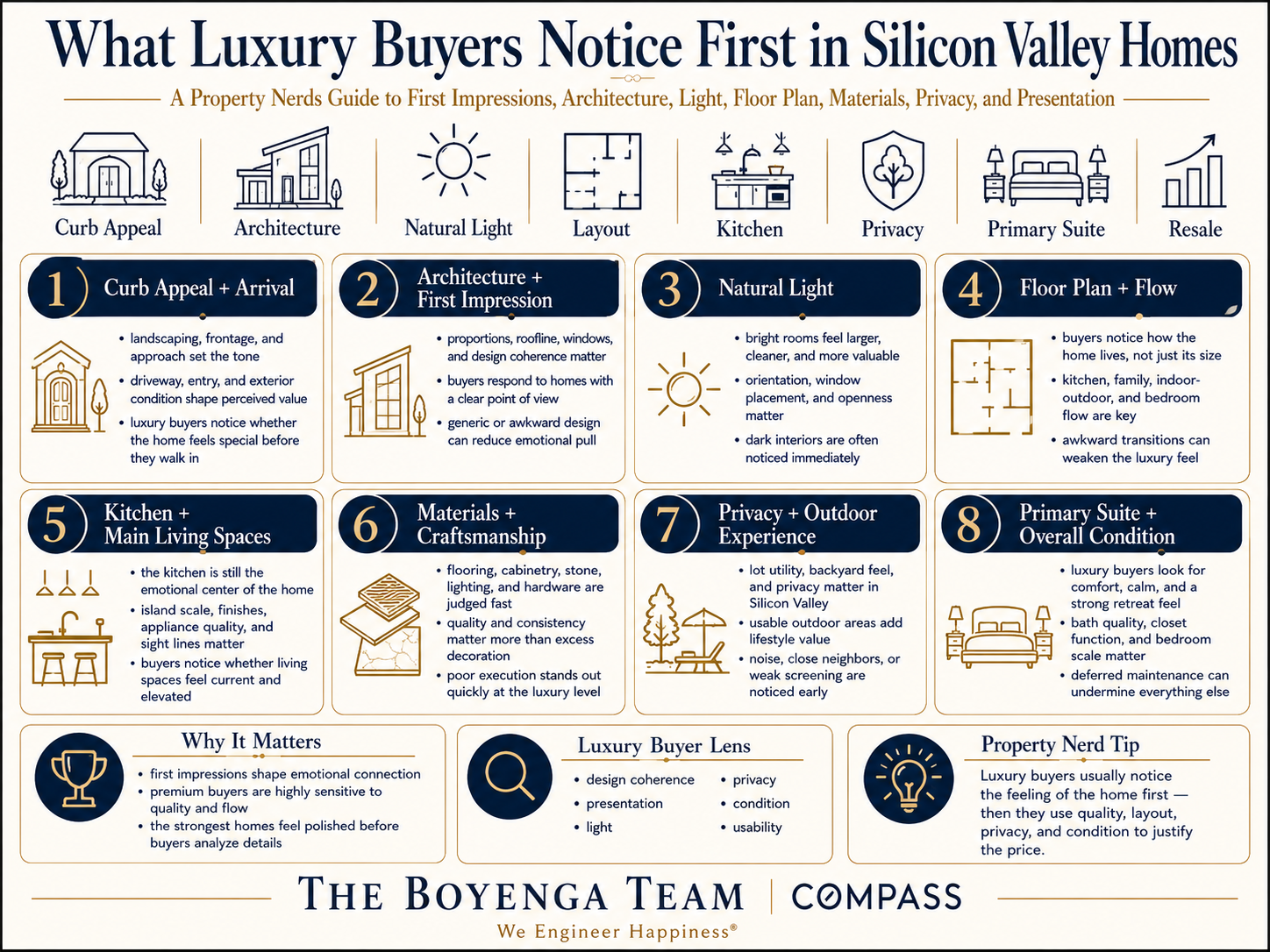
Luxury buyers in Silicon Valley do not walk into a home and simply ask, “Is it nice?”
They are reading the property immediately.
They notice the approach. The street. The landscaping. The privacy. The light. The ceiling height. The floor plan. The quality of the finishes. The way the home connects to the yard. The condition of the systems. The smell. The sound. The view. The scale. The architecture. The way the home feels compared with everything else they have seen.
In Silicon Valley luxury real estate, buyers are not just buying bedrooms and bathrooms. They are buying confidence, lifestyle, status, ease, privacy, and long-term resale strength.
That is why first impressions matter so much.
A luxury buyer may be comparing a Palo Alto estate, a Los Altos rebuild, a Saratoga property, a Los Gatos hillside home, a Menlo Park luxury residence, a Monte Sereno estate, a Portola Valley retreat, or a Los Altos Hills view property. Each market is different, but luxury buyers tend to notice the same core things first.
For the Boyenga Team, this is where the Property Nerds approach matters. Preparing a luxury home is not about making it look expensive. It is about making every important detail feel intentional, elevated, and easy for the buyer to understand.
1. The Arrival Experience
Luxury buyers start judging the home before they enter.
They notice the street. They notice whether neighboring homes support the value. They notice road noise, privacy, parking, gates, landscaping, driveway condition, and whether the property has a sense of arrival.
The entry experience should feel calm, clean, and controlled. The landscaping should be edited. The front door should feel substantial. The path should feel intentional. The home should not feel like it is apologizing before the buyer steps inside.
In estate markets like Los Altos Hills, Atherton, Portola Valley, Saratoga, Monte Sereno, and Los Gatos, arrival is especially important. Buyers expect privacy, scale, and a feeling that the property has presence.
The Property Nerds read: Luxury buyers want the home to feel important before they open the door.
2. Light and Volume
The first interior reaction is often about light.
Luxury buyers notice whether the home feels bright, open, and balanced. They notice ceiling height, window placement, skylights, sight lines, and whether the home feels emotionally uplifting or dark and heavy.
Even expensive homes can feel underwhelming if they are dim, chopped up, or visually crowded.
Natural light is one of the most powerful luxury signals because it makes the home feel healthier, more spacious, and more connected to the outdoors. In Silicon Valley, where buyers often work long hours and value indoor-outdoor living, light can be a major emotional driver.
The Property Nerds read: Light sells before finishes do.
3. Privacy
Luxury buyers notice privacy quickly.
They look out windows and ask: can neighbors see in? Is the backyard private? Does the primary suite feel protected? Is the pool exposed? Is the outdoor dining area visible from another house? Is there road noise? Does the landscaping create screening without making the home feel dark?
Privacy is one of the major reasons buyers pay a premium in places like Atherton, Los Altos Hills, Portola Valley, Monte Sereno, Saratoga, and certain Los Gatos and Menlo Park pockets.
But privacy matters in more suburban neighborhoods too. A Los Altos or Palo Alto luxury buyer may still value a backyard that feels quiet, shielded, and usable.
The Property Nerds read: Luxury buyers pay for privacy because privacy makes the home feel calm, rare, and emotionally safe.
4. Floor Plan Logic
Luxury buyers notice whether the home makes sense.
They may not say it immediately, but they are reading flow. They notice whether the kitchen connects to the family room. Whether the dining room feels usable. Whether the office is in the right place. Whether bedrooms are properly separated. Whether the primary suite feels luxurious. Whether guests have privacy. Whether indoor-outdoor access feels natural.
A large home with a bad floor plan can feel less valuable than a smaller home with excellent flow.
Luxury buyers often want spaces that support modern life: home offices, guest suites, wellness areas, media rooms, mudrooms, indoor-outdoor entertaining, storage, and flexible family zones.
The Property Nerds read: Square footage matters, but flow determines whether buyers believe the square footage is useful.
5. Kitchen Quality
The kitchen is still one of the first places luxury buyers judge.
They notice cabinet quality, appliance brands, counter materials, island size, lighting, storage, prep space, pantry function, and whether the kitchen supports entertaining.
But buyers also notice when a kitchen feels dated, over-designed, too trendy, or disconnected from the rest of the home.
A luxury kitchen should feel both beautiful and functional. It should not feel like a showroom that no one can cook in. It should support daily life, entertaining, family routines, and visual connection to the yard or main living space.
The Property Nerds read: Luxury buyers want the kitchen to feel current, but not disposable.
6. Indoor-Outdoor Connection
Silicon Valley luxury buyers love indoor-outdoor living.
They notice how the home connects to the yard, patio, pool, garden, deck, courtyard, or view. They notice whether doors open naturally, whether outdoor spaces are staged, whether the yard feels usable, and whether the landscaping supports the lifestyle.
A beautiful backyard that feels disconnected from the house loses power. A smaller outdoor space that is highly usable can feel more valuable than a larger yard with no purpose.
In Los Gatos, Saratoga, Los Altos, Menlo Park, Palo Alto, and Sunnyvale luxury homes, the best indoor-outdoor connection often comes from a kitchen, family room, or great room that opens directly to entertaining space.
In estate markets, buyers may also notice pool placement, guest house access, sport courts, outdoor kitchens, fire pits, lawn areas, view terraces, and garden privacy.
The Property Nerds read: Luxury buyers want outdoor space they can imagine using immediately.
7. The Primary Suite
Luxury buyers expect the primary suite to feel like a retreat.
They notice bedroom scale, natural light, privacy, views, closet space, bathroom quality, shower size, tub placement, materials, lighting, and whether the suite feels separated from the rest of the home.
A primary suite that feels cramped, dark, exposed, or poorly designed can weaken the entire luxury impression.
The strongest primary suites feel calm, private, and elevated. They do not need to be flashy, but they need to feel intentional.
The Property Nerds read: The primary suite should make buyers exhale.
8. Materials and Finish Quality
Luxury buyers notice finish quality quickly.
They may not know every brand or material, but they can feel the difference between thoughtful quality and surface-level updating.
They notice flooring, cabinetry, counters, tile, lighting, hardware, doors, windows, built-ins, trim, stone, wood, and paint quality. They also notice consistency. A home with one beautifully remodeled room and several neglected areas can feel uneven.
Luxury does not have to mean ornate. In Silicon Valley, many buyers prefer clean, warm, modern, timeless design. But the materials should feel substantial and cohesive.
The Property Nerds read: Luxury buyers do not just notice what is new. They notice what feels well chosen.
9. Architecture and Authenticity
Luxury buyers notice whether the home has a point of view.
Is it a modern estate? A classic Palo Alto home? A Los Gatos historic property? A Los Altos custom family home? A Portola Valley retreat? A Saratoga estate? An Eichler or mid-century modern home?
The strongest luxury homes have architectural consistency. The exterior, interior, landscaping, staging, and marketing should all tell the same story.
Buyers can feel when a remodel fights the architecture. A generic flip-style remodel in a character home can feel wrong. A cold modern interior inside a warm ranch home may feel disconnected. An Eichler with generic finishes may lose the magic that made buyers interested in the first place.
The Property Nerds read: Luxury buyers want authenticity. They want the home to know what it is.
10. Condition and Systems Confidence
Luxury buyers may love beauty, but they still care about condition.
They notice signs of deferred maintenance. Roof age. Window quality. HVAC. Electrical. Plumbing. Drainage. Foundation. Sewer. Pool equipment. Retaining walls. Decks. Smart home systems. Solar. Battery backup. EV charging. Fire-hardening. Insurance issues.
In luxury markets, buyers expect clarity. They may be willing to take on work, but they want to understand it.
A beautiful home with vague disclosures or obvious maintenance issues can lose momentum. A home with clear inspections and transparent documentation can feel easier to buy.
The Property Nerds read: Luxury buyers pay more when beauty and confidence show up together.
11. The Lot
In Silicon Valley, the lot can matter as much as the house.
Luxury buyers notice whether the land is flat, usable, private, sunny, quiet, and well proportioned. They notice slope, driveway, views, trees, drainage, road exposure, pool placement, guest parking, and expansion potential.
In Los Altos Hills, Portola Valley, Atherton, Saratoga, and Monte Sereno, land quality can be the main value driver. In Palo Alto, Menlo Park, Los Altos, and Los Gatos, lot size and usability can determine whether a home feels like a true luxury property or simply an expensive house.
The Property Nerds read: A great lot gives a luxury home long-term strength.
12. Noise and Calm
Luxury buyers notice sound.
Road noise, freeway hum, neighbors, pool equipment, HVAC, school noise, construction activity, and general street energy all affect how the home feels.
A home can be beautifully remodeled, but if it does not feel calm, buyers may hesitate.
Silicon Valley buyers often live high-pressure lives. They want home to feel like a retreat. Calm is part of luxury.
The Property Nerds read: Quiet is a luxury feature.
13. Storage and Utility Spaces
Luxury buyers notice whether the home works behind the scenes.
They look for closet space, pantry space, garage storage, laundry function, mudroom areas, linen storage, wine storage, utility rooms, and flexible spaces for family life.
A beautiful home with poor storage can feel less practical. This is especially true for families relocating from larger homes or buyers comparing luxury properties across multiple markets.
The Property Nerds read: Luxury is not just what guests see. It is also how easy the home is to live in.
14. Technology and Modern Comfort
Luxury buyers expect modern comfort.
They may look for smart lighting, security systems, cameras, EV charging, solar, battery backup, high-speed networking, whole-house audio, climate control, modern HVAC, water filtration, and efficient systems.
But technology should be integrated, not overwhelming. Buyers do not want a confusing system they cannot operate.
The Property Nerds read: Smart home features should make the home feel easier, not more complicated.
15. The Neighborhood Story
Luxury buyers are not only buying the property. They are buying the neighborhood.
They notice whether the location supports the price. Is it Old Palo Alto, Crescent Park, North Los Altos, Los Altos Hills, Central Menlo, Atherton, Saratoga, Los Gatos, Monte Sereno, or Portola Valley? Is it walkable? Private? Near Stanford? Near Apple? Near Google? Near top schools? Near trails? Near a Village?
The neighborhood story needs to be obvious.
A luxury home in Los Altos should not be marketed the same way as a Los Altos Hills estate. A Saratoga property should not be positioned the same way as a Los Gatos Village home. A Menlo Park home near Sand Hill Road needs a different strategy than a Monte Sereno quiet-luxury property.
The Property Nerds read: Luxury buyers pay for the home and the market logic behind it.
What Luxury Buyers Notice Online First
Before they ever visit, luxury buyers notice the digital presentation.
They notice photography, video, floor plan, copy, property website, aerials, lifestyle images, and how clearly the listing communicates value.
They notice whether the home looks dark or bright. Whether rooms feel coherent. Whether the yard is shown well. Whether the privacy is obvious. Whether the floor plan is easy to understand. Whether the marketing feels elevated or generic.
Luxury buyers often decide whether a home is worth seeing based on the online presentation.
The Property Nerds read: The first showing happens on a screen.
Common Luxury Seller Mistakes
Luxury sellers often lose value when they assume buyers will overlook issues because the home is expensive.
They usually will not.
Common mistakes include:
Overpricing based on emotional value.
Skipping inspections.
Ignoring road noise or privacy concerns.
Using generic staging.
Choosing trendy but cold finishes.
Leaving landscaping tired.
Failing to explain the lot.
Not showing the floor plan clearly.
Under-marketing the neighborhood story.
Making the home feel too personal.
Failing to prep lighting, windows, and outdoor spaces.
Launching before the home is truly ready.
Luxury buyers may be wealthy, but they are not careless. They are often highly analytical and comparison-driven.
The Boyenga Team Luxury Transformation Approach
The Boyenga Team prepares luxury homes by first identifying the buyer pool.
Is the buyer a family looking for schools and convenience?
A tech executive seeking privacy?
A Stanford or Sand Hill Road buyer?
An Apple or Google commuter?
A design-focused buyer?
A downsizer wanting walkability?
An estate buyer looking for land and privacy?
A remodel buyer looking for potential?
Once the buyer pool is clear, the preparation becomes more strategic.
The home may need landscaping, paint, lighting, staging, repairs, inspections, disclosure clarity, design editing, floor plan storytelling, or a more elevated media package. But the goal is never random beautification. The goal is market alignment.
Every room should support the story.
Every photo should support the value.
Every disclosure should reduce uncertainty.
Every improvement should help the right buyer say yes.
That is the Boyenga Team’s Property Nerds approach to luxury preparation.
The Property Nerds Bottom Line
Luxury buyers in Silicon Valley notice more than finishes.
They notice arrival.
They notice light.
They notice privacy.
They notice architecture.
They notice floor plan.
They notice the kitchen.
They notice the primary suite.
They notice indoor-outdoor flow.
They notice the lot.
They notice noise.
They notice condition.
They notice the neighborhood story.
They notice whether the home feels easy to buy and hard to replace.
The strongest luxury homes do not just look expensive. They feel thoughtful, calm, confident, and aligned with their market.
For sellers, that means preparation should be strategic. The goal is not to impress everyone. The goal is to deeply resonate with the right buyer pool.
In Silicon Valley luxury real estate, the details matter because buyers are paying for more than a home. They are paying for a better version of daily life.
Thinking About Selling a Luxury Home in Silicon Valley?
The Boyenga Team at Compass helps luxury sellers prepare, position, and launch homes with a Property Nerds approach — blending pricing strategy, design insight, buyer-pool analysis, estate-property expertise, inspection awareness, staging strategy, marketing, and neighborhood storytelling.
Whether you are selling in Palo Alto, Los Altos, Los Altos Hills, Menlo Park, Atherton, Saratoga, Los Gatos, Monte Sereno, Portola Valley, Mountain View, Sunnyvale, or San Jose, Eric and Janelle Boyenga can help you understand what luxury buyers will notice first — and how to make those first impressions count.
Because in Silicon Valley luxury real estate, the right presentation can change the way buyers see everything.