

Blog > What Eichler Buyers Actually Pay For: Architecture, Originality, Condition, and Neighborhood Scarcity
What Eichler Buyers Actually Pay For: Architecture, Originality, Condition, and Neighborhood Scarcity
by
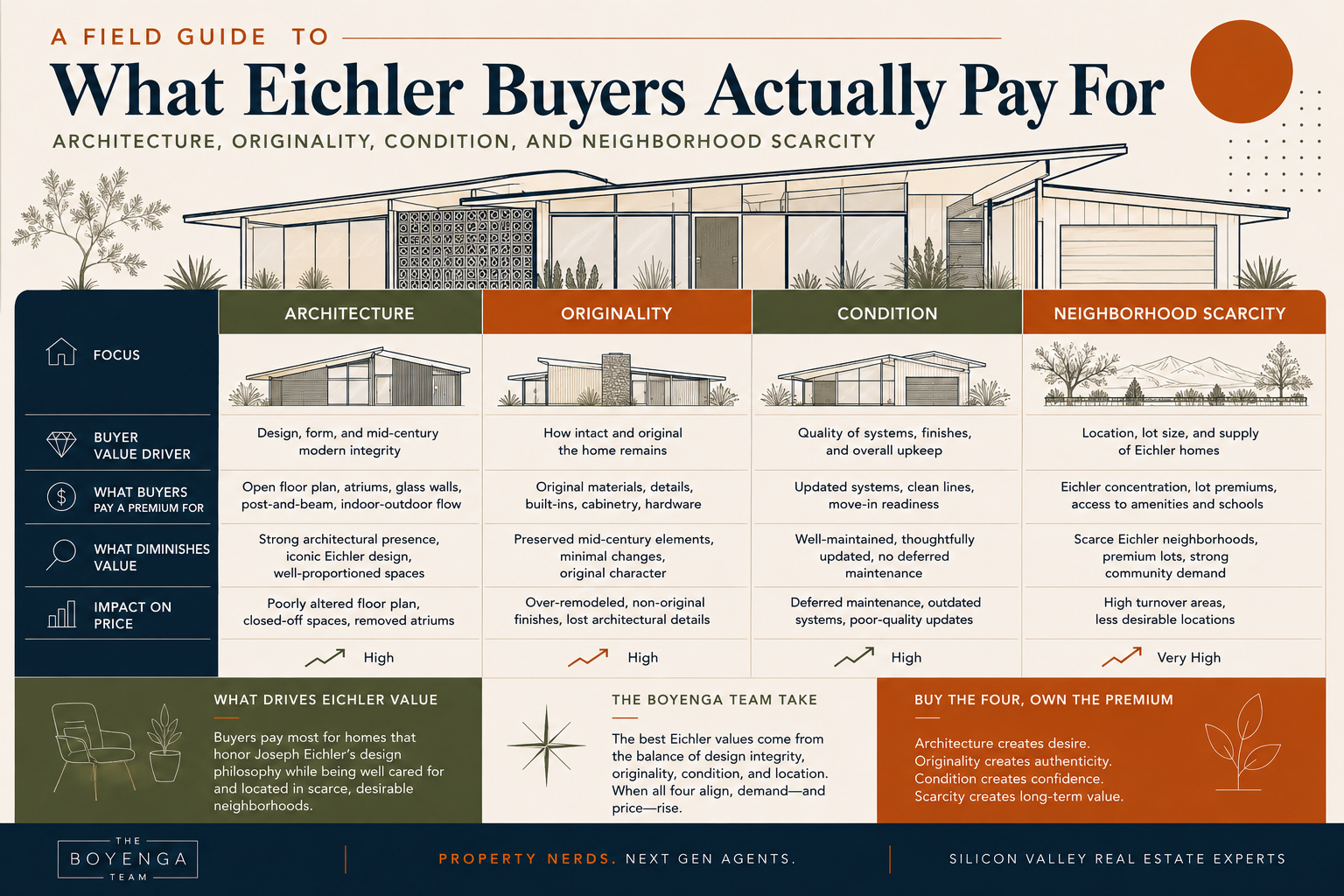 Walk through an Eichler neighborhood during an open house weekend and you'll inevitably hear the same question: Why did that one sell for hundreds of thousands more than this one?
At first glance, the answer can be difficult to see. Two homes may share the same floor plan, occupy similar-sized lots, and have been built within months of one another. Yet one attracts multiple offers while the other lingers on the market. The difference is rarely explained by square footage alone.
Eichler buyers are purchasing something more nuanced than a collection of rooms. They are buying architecture, authenticity, neighborhood identity, and a lifestyle that has become increasingly difficult to replicate. Understanding how those elements interact is what separates simply buying an Eichler from buying the right Eichler.
As with every niche market, architectural appreciation only tells part of the story. Long-term ownership is ultimately influenced by the broader forces shaping Silicon Valley real estate, from neighborhood demand to buyer preferences and future resale. Those market dynamics are explored in greater depth through the Boyenga Team's Silicon Valley neighborhood guides at https://boyengarealestateteam.com.
The Architecture Gets Buyers Through the Door
Joseph Eichler's greatest contribution wasn't a particular floor plan or roofline—it was a philosophy.
His homes rejected many of the conventions of post-war suburbia. Instead of formal rooms separated by walls, Eichler embraced openness. Instead of treating windows as simple openings, he transformed them into entire walls of glass. Atriums became outdoor living rooms, ceilings celebrated exposed structure, and gardens became part of the home's daily experience.
Those qualities continue attracting buyers more than half a century later because they still feel remarkably contemporary.
Unlike many architectural trends that become dated, good modernism ages gracefully. Light, proportion, and thoughtful spatial relationships remain timeless.
Yet architecture alone rarely determines value.
Originality Has Become Increasingly Rare
Perhaps the single most misunderstood aspect of the Eichler market is the value buyers place on originality.
Many assume updated homes always command the highest prices. In reality, preservation often carries its own premium.
Original mahogany paneling, globe lighting, tongue-and-groove ceilings, Philippine mahogany walls, period cabinetry, concrete slab flooring, and authentic architectural details have become increasingly difficult—and expensive—to replace. Once removed, they are rarely recreated with the same craftsmanship or materials.
For architecture enthusiasts, originality represents authenticity.
For future buyers, it often represents scarcity.
That doesn't mean untouched homes always outperform renovated ones. Rather, buyers tend to reward homes that respect the architect's original vision.
Renovation Matters—But So Does Restraint
The most successful Eichler renovations rarely announce themselves.
Instead, they feel as though they could have existed from the beginning.
Modern kitchens integrate seamlessly with original architecture. Energy-efficient glazing preserves the home's visual rhythm. Mechanical systems are updated without disrupting exposed beams or ceiling lines. Contemporary conveniences coexist with mid-century character rather than replacing it.
By contrast, renovations that compartmentalize spaces, lower ceilings, obscure structural elements, or replace warm natural materials with generic finishes often diminish what makes an Eichler distinctive.
Buyers aren't simply paying for newer finishes.
They're paying for architectural integrity.
Neighborhood Matters More Than Many Buyers Realize
One of the defining characteristics of Eichler ownership is that the home extends beyond the property line.
Entire neighborhoods were designed around a common architectural language. Rooflines align. Streetscapes remain cohesive. Mature landscaping reinforces the original vision. Even decades later, many communities retain a remarkable sense of continuity.
That consistency influences buyer perception in powerful ways.
A beautifully restored Eichler surrounded by similarly cared-for homes often commands stronger long-term demand than an equally impressive property in a neighborhood where architectural character has gradually disappeared.
Buyers researching neighborhood histories, architectural variations, and individual communities can explore detailed resources through the Boyenga Team's dedicated Bay Area Eichler Homes website:
https://bayareaeichlerhomes.com
Scarcity Creates Long-Term Value
Unlike new construction, Eichler neighborhoods cannot be replicated.
Their supply is effectively fixed.
That simple reality shapes long-term pricing.
Many owners remain in these homes for decades, creating exceptionally limited inventory. When these properties become available, buyers frequently compete not because the homes are larger or newer, but because opportunities to purchase are so infrequent.
Scarcity also exists on a more granular level.
Corner lots, original atriums, larger floor plans, favorable orientations, exceptional landscaping, and architecturally significant models each appeal to different buyers. As inventory becomes more limited, these subtle distinctions become increasingly meaningful.
Buyers Are Purchasing an Experience
One of the most fascinating aspects of the Eichler market is that many of the qualities buyers value cannot be measured.
Morning light entering through clerestory windows.
The quiet transition between an atrium and the living room.
Daily life moving freely between indoor and outdoor spaces.
The warmth of exposed wood overhead.
The feeling of living with nature rather than simply beside it.
These experiences rarely appear on listing sheets, yet they consistently influence purchasing decisions.
Architecture creates emotional attachment in ways that statistics alone cannot explain.
Why Two Nearly Identical Eichlers Can Sell for Very Different Prices
Price differences between seemingly similar homes often reflect a combination of factors rather than a single explanation.
School district boundaries may influence buyer demand across many types of buyers. A thoughtfully restored home often attracts a different buyer than one requiring significant architectural rehabilitation. Lot orientation affects natural light and privacy. Neighborhood reputation influences competition. Even proximity to parks, commute corridors, and community amenities can subtly shape value.
The market ultimately rewards homes where architecture, location, condition, and neighborhood all reinforce one another.
Understanding those relationships helps buyers evaluate value beyond superficial comparisons.
For buyers interested in exploring modern architecture beyond Eichler neighborhoods, https://midmodhomes.com offers additional resources dedicated to mid-century and contemporary homes throughout the Bay Area.
Looking Beyond the Price Per Square Foot
Traditional real estate metrics often struggle to explain Eichler pricing.
Price per square foot treats homes as interchangeable commodities. Eichlers rarely are.
Architectural pedigree, neighborhood continuity, restoration quality, historical authenticity, and buyer emotion all contribute to values that conventional statistics cannot fully capture.
That is why experienced buyers often spend more time understanding the context surrounding a home than comparing it to a spreadsheet of recent sales.
The Boyenga Team regularly explores these deeper market dynamics through the Property Nerds Blog, where architecture, buyer psychology, and Silicon Valley real estate intersect.
Read more at https://www.boyengateam.com/blog.
The Property Nerd Take
The strongest Eichler investments are rarely defined by a single feature. They emerge where thoughtful architecture, careful stewardship, neighborhood character, and enduring scarcity intersect. Originality matters because it preserves authenticity. Renovations matter when they enhance rather than erase design. Neighborhoods matter because architecture is experienced collectively, not just individually.
Ultimately, Eichler buyers aren't paying for a floor plan—they're investing in one of Silicon Valley's most enduring architectural communities. Homes that remain faithful to that vision continue attracting discerning buyers decade after decade.
keep exploring · property nerd guides
Thinking about a move in Silicon Valley?
The Boyenga Team at Compass has helped clients buy and sell more than 2,520 homes since 1996. Start with a guide, a search, or a conversation.
Search Silicon Valley homesWhat’s my home worth?
Talk to a Property Nerd: (408) 373-1660 · (650) 383-8606
city guides Palo Alto · Los Altos · Menlo Park · Cupertino · Sunnyvale · Los Gatos · San Jose