

Blog > West San Jose vs. Cupertino: Where Does Your Silicon Valley Housing Dollar Go Further?
West San Jose vs. Cupertino: Where Does Your Silicon Valley Housing Dollar Go Further?
by
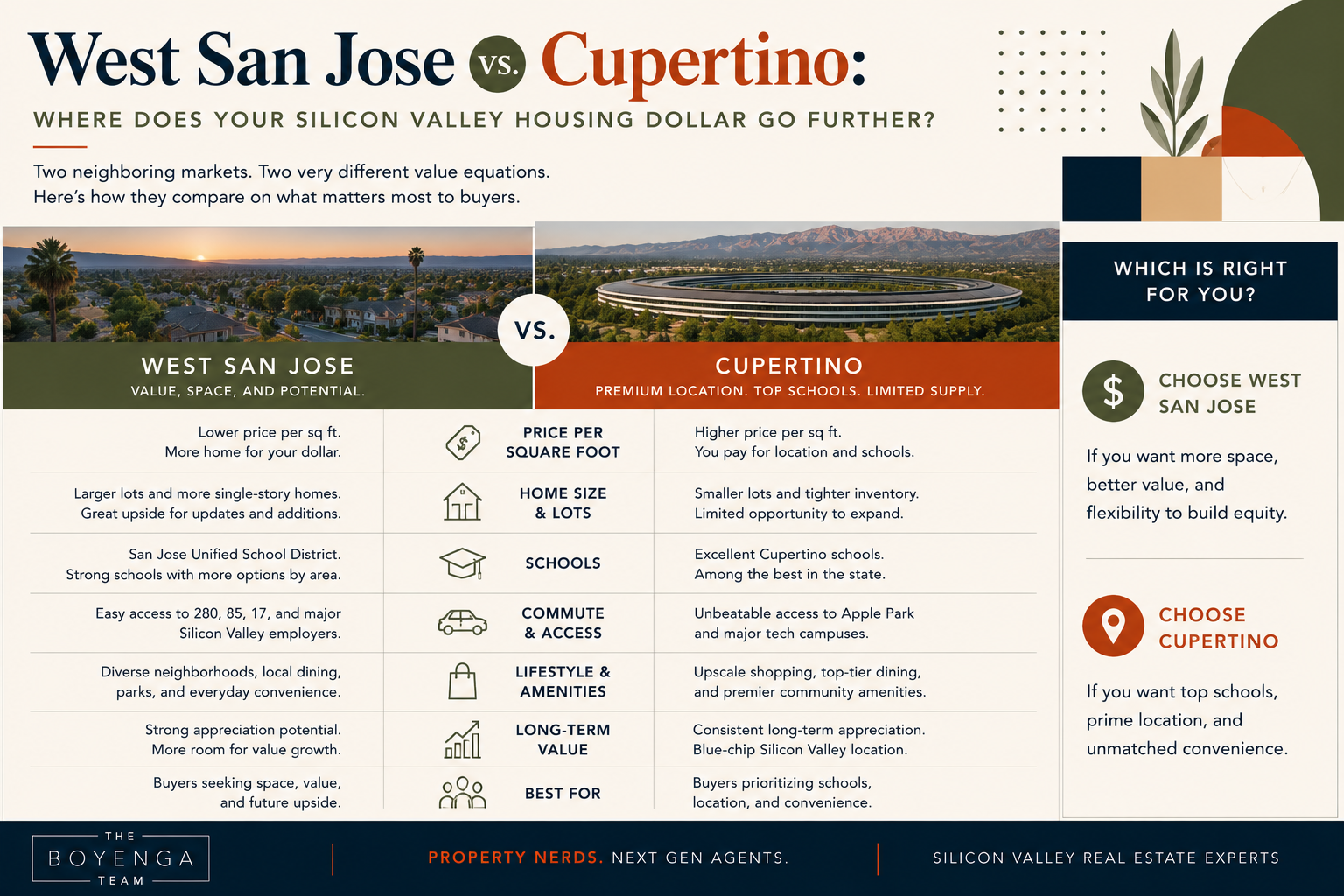 Few real estate comparisons in Silicon Valley generate more debate than West San Jose versus Cupertino.
On a map, the two markets often appear almost interchangeable. Many neighborhoods are separated by only a few streets. Residents shop at the same grocery stores, dine at the same restaurants, and share similar commute patterns. Yet home prices frequently differ by hundreds of thousands of dollars.
The obvious explanation is schools.
The complete explanation is much more nuanced.
School districts certainly influence pricing, but so do city identity, buyer psychology, municipal services, neighborhood perception, future buyer pools, and the premium attached to a Cupertino address. Buyers aren't simply purchasing square footage—they're purchasing an ownership experience, and the market consistently prices those experiences differently.
For buyers deciding where their housing dollar delivers the greatest long-term value, understanding those differences is often more important than comparing price per square foot alone.
The Boyenga Team regularly explores these neighborhood dynamics throughout Silicon Valley at https://boyengarealestateteam.com, helping buyers understand why neighboring communities can behave like entirely different housing markets.
Geography Doesn't Always Define the Market
One of the first surprises for buyers is how little physical distance explains pricing.
Many West San Jose neighborhoods sit immediately adjacent to Cupertino. Residents may share parks, shopping centers, restaurants, and even commute along the same streets each morning. To someone unfamiliar with the area, it can be difficult to understand why values diverge so dramatically.
The answer lies in market identity.
Cupertino has developed an international reputation built around its school district, proximity to Apple Park, and a relatively limited housing supply. That reputation attracts relocating buyers, many of whom begin their Silicon Valley search with Cupertino already fixed in mind.
West San Jose competes differently.
Rather than relying on a single defining characteristic, it offers flexibility. Buyers often discover larger homes, more diverse housing stock, and opportunities to purchase within established neighborhoods while remaining close to many of the same employment centers.
Cupertino Sells Confidence
Buyers entering Cupertino rarely describe their purchase as simply buying a house.
They're buying certainty.
The city's school districts draw steady buyer interest. Apple Park has reinforced Cupertino's global visibility. The community maintains a remarkably stable residential character, and inventory remains consistently constrained.
These factors combine to create one of Silicon Valley's strongest long-term buyer pools.
That confidence supports pricing even during periods when the broader market slows. Buyers view Cupertino as a location likely to remain in demand regardless of changing market conditions, making them more willing to compete aggressively for limited inventory.
The premium attached to Cupertino reflects that confidence as much as any measurable characteristic of the homes themselves.
West San Jose Offers Flexibility
West San Jose approaches value from a different direction.
Rather than commanding a premium based primarily on city identity, many neighborhoods compete by offering more housing for the same budget.
Buyers frequently discover larger lots, more interior space, and greater opportunities for remodeling or expansion than similarly priced homes in Cupertino. The housing stock also tends to be more varied, ranging from classic ranch homes and Eichlers to newer infill development and thoughtfully renovated residences.
For buyers focused on maximizing purchasing power, that flexibility becomes increasingly attractive.
Rather than paying primarily for an address, they are often investing more directly in the property itself.
Schools Matter—But They Aren't the Whole Story
School districts remain one of the largest pricing differentiators between these markets, but reducing the comparison to schools alone oversimplifies buyer behavior.
Many West San Jose neighborhoods feed into school districts that draw strong buyer interest, and some overlap with attendance areas that surprise buyers expecting a clear distinction between the two communities.
At the same time, Cupertino's name recognition extends beyond local attendance maps. Relocating buyers often begin with Cupertino because the name is already familiar.
That familiarity expands the buyer pool.
An expanded buyer pool strengthens long-term liquidity.
Liquidity supports value.
The relationship is circular rather than linear.
Price Per Square Foot Can Be Misleading
Many buyers compare West San Jose and Cupertino using price per square foot.
While useful, the metric rarely tells the complete story.
West San Jose often delivers more land, larger homes, and greater renovation potential for the same overall budget. Cupertino, by contrast, frequently commands higher prices despite smaller lots because buyers place extraordinary value on location, schools, and perceived long-term stability.
Neither market is necessarily overpriced or underpriced.
Each simply allocates value differently.
Understanding where that value resides helps buyers decide which ownership equation better aligns with their priorities.
Commute Advantage Is Nearly Equal
Unlike many Silicon Valley comparisons, commute convenience rarely becomes the deciding factor.
Both communities offer outstanding access to Apple, NVIDIA, Google, Santa Clara, Sunnyvale, and much of the western employment corridor. Highways 280 and 85, along with major arterial roads, make daily transportation remarkably similar for many residents.
That parity shifts attention toward lifestyle.
If commuting is largely equivalent, buyers begin evaluating schools, neighborhood character, housing quality, and long-term appreciation more closely.
Two Different Buyer Profiles
The contrast becomes clearest when considering who purchases in each community.
Cupertino frequently attracts buyers who prioritize educational reputation above nearly every other factor. Many view the city's premium as an investment in both lifestyle and future resale confidence.
West San Jose appeals to buyers seeking balance.
They want proximity to the same employment centers, access to strong neighborhoods, and excellent long-term appreciation, but they also value additional living space, larger lots, or greater flexibility for renovations.
Neither approach is more rational.
Each reflects different priorities.
Where Does the Better Value Exist?
The answer depends entirely on how value is defined.
If value means maximizing home size, lot dimensions, renovation potential, and overall purchasing power, West San Jose often provides compelling opportunities.
If value means minimizing perceived long-term risk while purchasing into one of Silicon Valley's strongest educational and residential brands, Cupertino continues justifying its premium for many buyers.
Both strategies have historically performed well.
The key is recognizing that buyers aren't purchasing the same product in two different cities.
They're purchasing different ownership experiences.
The Boyenga Team regularly explores these neighborhood relationships through the Property Nerds Blog, where buyer psychology, housing economics, and Silicon Valley market dynamics come together to help buyers make more informed long-term decisions.
Read more at https://www.boyengateam.com/blog.
Buyers interested in distinctive architecture throughout these communities—including Eichler neighborhoods and other notable mid-century modern homes—can also explore https://bayareaeichlerhomes.com and https://midmodhomes.com.
The Property Nerd Take
West San Jose and Cupertino demonstrate one of Silicon Valley's most important real estate principles: neighboring communities don't necessarily compete on the same terms. Cupertino commands a premium because buyers consistently reward certainty, schools, and global reputation. West San Jose competes by offering flexibility, space, and stronger purchasing power while maintaining access to many of the same advantages.
The better investment isn't determined by which market is less expensive. It's determined by understanding what your housing dollar is actually buying—and whether that aligns with the life you want to build over the next decade.
keep exploring · property nerd guides
San Jose homes, neighborhoods & schools in one guide
Live listings, recent sales, ZIP codes, school districts and commute notes for San Jose, from the Property Nerds® of the Boyenga Team at Compass.
Open the San Jose guideWhat’s my home worth?
Talk to a Property Nerd: (408) 373-1660 · (650) 383-8606
city guides Palo Alto · Los Altos · Menlo Park · Cupertino · Sunnyvale · Los Gatos