

Blog > The Remodeling Penalty: Why Un-Updated Homes Are Getting Hit Harder in Today’s Market
The Remodeling Penalty: Why Un-Updated Homes Are Getting Hit Harder in Today’s Market
by
 What’s up, Property Nerds and next-gen agents?
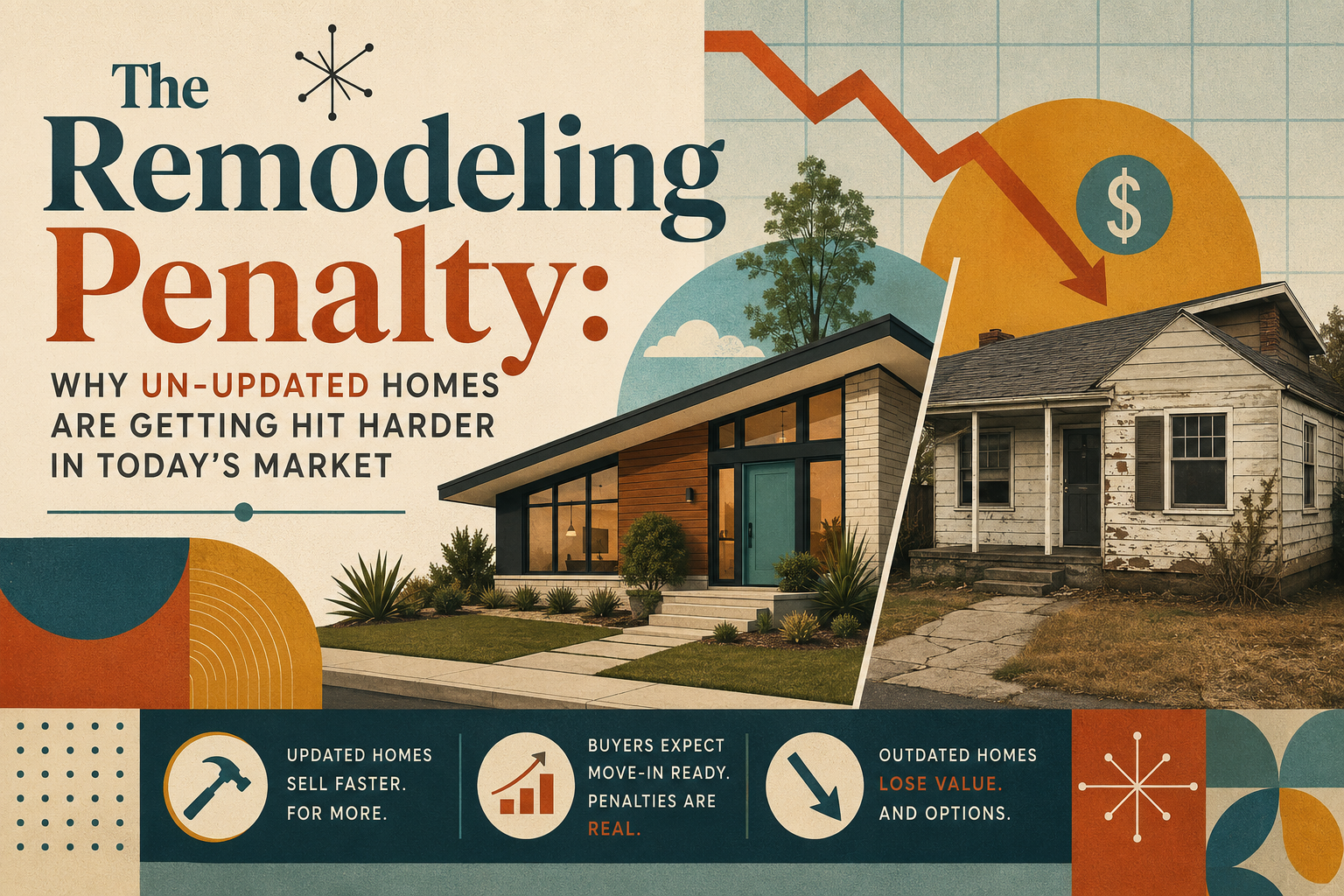
There is a fascinating micro-trend showing up in some of our tracked Silicon Valley neighborhoods, and it is one of those quiet market shifts that can completely change how a home should be priced, prepared, marketed, and negotiated. We are calling it The Remodeling Penalty.
The idea is simple but powerful. Buyers are not just paying more for remodeled homes. They are increasingly penalizing homes that are not remodeled. That distinction matters because it changes the entire pricing conversation. In the past, an original-condition home could often be marketed as an opportunity. Today, in many cases, buyers are viewing that same home as a project, a risk, and a logistical burden.
Historically, in many established Silicon Valley neighborhoods, active single-family inventory was a mix of original homes, lightly updated properties, partial remodels, and fully turnkey homes. A fully remodeled home might have represented roughly 25% of active inventory during a typical market cycle. That meant remodeled homes were the premium outliers. Buyers expected to pay more for them, but there was still a healthy pool of buyers willing to take on a home that needed work.
Now, in certain tracked neighborhoods, fully remodeled single-family homes are making up nearly 70% of active inventory. That is not a minor change. That is a full market remix. When the active competition becomes heavily weighted toward polished, move-in-ready, design-forward homes, older and less updated properties do not just look “dated.” They look riskier, more expensive, slower, and more stressful.
This is the new remodeling penalty.
The remodeling penalty is the pricing discount buyers apply to homes that need visible updating, major improvements, or full-scale renovation. But this is not the same old “dated kitchen equals lower price” conversation. Today’s penalty is deeper because buyers are not only calculating the cost of the work. They are calculating the friction.
They are thinking about permits, contractors, timelines, inspections, city requirements, design decisions, material costs, insurance questions, HOA rules, energy upgrades, electrical panels, plumbing surprises, and the emotional exhaustion of managing a project after closing. Buyers are not simply asking, “How much will it cost to remodel this house?” They are asking, “Do I even want this problem?”
That is the shift.
In a balanced market, an original-condition home can be a huge opportunity. Buyers can imagine customizing the floor plan, selecting their own finishes, opening walls, improving indoor-outdoor flow, adding skylights, building a dream kitchen, or creating a home that reflects their personal taste. There will always be buyers who love that process. The challenge is that there are fewer of them when the market is flooded with turnkey alternatives.
When nearly 70% of competing inventory is already fully remodeled, buyer psychology changes. The un-updated home is no longer competing mostly against other projects. It is competing against finished products. That creates a wider value gap and a much tougher first impression.
A buyer walking through six homes on a weekend may see four or five properties with new kitchens, new bathrooms, wide-plank floors, designer lighting, fresh paint, upgraded landscaping, professional staging, clean inspections, and polished photography. Then they walk into an original home with old carpet, dark cabinets, dated bathrooms, tired landscaping, popcorn ceilings, fluorescent lighting, and maybe a roof, sewer, or electrical question.
That buyer does not usually say, “Amazing, I found an opportunity.” More often, they say, “This is a lot.”
And in today’s market, “a lot” usually translates into a larger discount.
The next-gen agent insight is that the penalty is not purely cosmetic. Buyers are increasingly rejecting the logistics of modern remodeling. In Silicon Valley, even a “simple” remodel can quickly become a complicated matrix of city planning, permit review, structural engineering, energy requirements, inspections, contractor scheduling, and cost creep. What used to feel like a manageable renovation can now feel like a second job.
Many buyers are already stretched by high home prices, elevated monthly payments, property taxes, insurance, and the emotional intensity of buying in a competitive market. After all of that, the idea of spending another year managing construction feels overwhelming. For many dual-income tech households, time is the scarcest asset. They may have the money to remodel, but they do not have the bandwidth.
That is a huge behavioral shift. The modern buyer often wants a finished kitchen, updated bathrooms, good lighting, functional storage, clean flooring, fresh landscaping, reliable systems, and a move-in-ready experience. They do not always need the home to be ultra-luxury, but they do want it to feel manageable. The more complicated the project feels, the more aggressive the buyer becomes on price.
This is why fully remodeled inventory changes everything. When remodeled homes were only about a quarter of the market, they acted like premium outliers. Buyers saw them as special, and they understood they had to pay a premium for convenience. But there was still plenty of room for homes that needed work. Original homes had a natural buyer pool: contractors, flippers, architects, design-driven families, value seekers, and buyers willing to trade effort for location.
When remodeled homes dominate active inventory, the market resets around turnkey expectations. The remodeled home is no longer the exception. It becomes the benchmark.
That means a dated home has to justify itself much more clearly. It needs to be priced as a true opportunity, not as if buyers will casually overlook the work. This is where sellers can get into trouble. A seller may look at a remodeled comparable and think, “My home is the same size, same school district, same neighborhood, and same lot size, so I should be close to that number.”
But buyers are doing a very different calculation. They are subtracting for the actual cost of improvements, the uncertainty of final costs, the time required to complete the work, the inconvenience of living through construction, the risk of permit delays, the possibility of hidden defects, the fatigue of making hundreds of design decisions, and the opportunity cost of not buying a finished home.
This is why the discount can feel larger than the actual construction budget. A $250,000 remodel may create a $350,000 to $500,000 pricing gap because buyers are pricing in risk, friction, and uncertainty. That is the remodeling penalty in action.
One of the biggest reasons this penalty has intensified is permitting. In many Silicon Valley cities, remodeling is no longer viewed by buyers as a quick cosmetic refresh. Depending on the scope, buyers may worry about plan checks, structural review, energy compliance, electrical upgrades, plumbing changes, roof or drainage issues, tree protection, school impact fees, historical review, HOA approvals, and inspection sequencing. Even when the work is straightforward, the perception often is not.
A buyer may walk into an older home and immediately wonder whether the city will require upgrades if they open walls. They may wonder if moving the kitchen will trigger plumbing, electrical, or structural complications. They may question whether the foundation is sound, whether the roof needs replacement, whether the electrical panel can support future upgrades, whether insurance will flag older systems, or whether the remodel will take six months, twelve months, or longer.
Once buyers start asking those questions, they usually start lowering their offer price.
The old buyer math was simple: purchase price plus remodel budget equals total investment. The new buyer math is more layered. It is purchase price plus remodel budget, plus permit risk, contractor risk, timeline risk, hidden-condition risk, financing pressure, lifestyle disruption, and emotional fatigue. That final piece is critical because buyers are not always making purely financial decisions. They are making life-capacity decisions.
A young family may love the neighborhood but not want to spend two years remodeling. A tech executive may have the income but not the schedule to manage contractors. A downsizer may want simplicity, not construction. A relocation buyer may need to move in immediately. A luxury buyer may expect design cohesion and system reliability from day one.
So when a home needs too much work, many buyers do not make a low offer. They simply move on. That creates fewer offers, longer days on market, and more pressure to reduce price.
One of the most common seller assumptions is that buyers will see the same potential the seller sees. Sometimes they do. But potential has a price. And in a market filled with remodeled alternatives, buyers will not pay a turnkey-adjacent price for a project house.
A home may have an incredible lot, a great floor plan, beautiful trees, prime schools, and a fabulous neighborhood. But if the interiors feel tired, the systems are unknown, and the buyer believes they are walking into a six-figure or seven-figure improvement plan, the offer will reflect that. The phrase “the buyer can just remodel it” is becoming dangerous because the buyer response is increasingly, “Yes, but not at that price.”
For sellers and agents, it helps to think about homes in three categories. The first category is the fully remodeled home. These homes set the visual benchmark. They have updated kitchens, bathrooms, flooring, lighting, paint, landscaping, and often major systems. They photograph well, show well, and reduce buyer anxiety. These homes are usually best positioned to capture emotional premiums, multiple offers, and faster decisions.
The second category is the clean, lightly updated home. These homes may not be fully remodeled, but they feel fresh, livable, and cared for. They may have new paint, updated lighting, refinished floors, improved landscaping, clean windows, professional staging, and a few smart cosmetic upgrades. This is often the sweet spot for sellers who do not want to do a full remodel but still want to avoid the deepest remodeling penalty.
A home does not always need to be transformed. Sometimes it needs to be clarified.
The third category is the true project home. These are properties with dated interiors, deferred maintenance, older systems, older flooring, old kitchens and baths, possible roof or sewer issues, and little visual polish. These homes can still sell well, especially in great locations, but they must be priced with the buyer’s risk calculation in mind. Trying to price a true project home too close to turnkey inventory can backfire quickly.
The good news for sellers is that a massive remodel is not always necessary to protect value. The smartest strategy is often targeted preparation. That means identifying the improvements that reduce buyer anxiety and improve first impressions without overcapitalizing.
Fresh interior paint, flooring improvements, updated lighting, cabinet hardware, landscape cleanup, deep cleaning, window washing, garage organization, minor repairs, updated appliances, bathroom refreshes, professional staging, and pre-listing inspections can all help shift buyer perception. These improvements may not make a home fully remodeled, but they can move the property out of the scary-project category and into the livable-opportunity category. That distinction can be worth real money.
Staging also becomes more important in a remodeling-penalty market. Staging is not just furniture. It is buyer translation. When a home is dated or partially updated, buyers often struggle to understand how the space can live. Staging helps them see scale, flow, light, purpose, and lifestyle.
In a market where buyers are already overwhelmed by renovation concerns, staging can soften the perceived project load. It can communicate that the home is livable, the floor plan works, the rooms have purpose, and the project is not as intimidating as it first appeared. The goal is not to hide condition. The goal is to help buyers understand the home’s best version.
For buyers, the remodeling penalty can create opportunity. If a large portion of the buyer pool is avoiding projects, then well-located but un-updated homes may offer a pathway into neighborhoods that would otherwise be out of reach. This is especially true for buyers with patience, vision, contractor relationships, or a willingness to remodel in phases.
The key is to separate cosmetic fear from structural reality. A dated kitchen is one thing. A failing foundation, problematic drainage, major roof issues, unpermitted additions, obsolete systems, or serious insurance concerns are something else entirely. Smart buyers should look beyond surface finishes and study lot quality, floor plan potential, natural light, structural integrity, roof condition, sewer condition, electrical capacity, heating and cooling systems, expansion potential, permit history, neighborhood upside, school boundaries, and long-term resale demand.
Sometimes the best purchase is not the prettiest home. It is the home with the best underlying real estate. That is where Property Nerds get excited.
For agents, this trend is a reminder that pricing off surface-level comps is not enough. In this market, you cannot simply pull three comparable sales, adjust for square footage, and call it a strategy. Condition has become a market force.
A remodeled comp is not the same as an original-condition comp just because it has the same bedroom count, lot size, and school district. Agents need to study what percentage of active inventory is remodeled, how many turnkey homes are competing today, how long project homes are sitting, whether buyers are writing on fixers or avoiding them, how much price separation exists between remodeled and un-remodeled sales, and what objections are repeatedly showing up at open houses.
This is the difference between old-school pricing and next-gen advisory. A true market advisor is not just reporting comps. They are interpreting buyer behavior.
In the luxury segment, the remodeling penalty can become even more severe. Luxury buyers often expect a home to deliver an elevated experience immediately. They are not just buying square footage. They are buying architecture, finishes, privacy, lighting, landscape design, wellness features, entertaining spaces, and emotional ease.
When luxury buyers see a home that needs major updating, they may not view it as a discount opportunity. They may view it as a lifestyle delay. That is especially true for relocation buyers, executives, international buyers, and families making school-timed moves.
At the upper end, turnkey homes can carry a convenience premium because they remove decision fatigue. A beautifully prepared home says move in, host dinner, start school, work from home, enjoy the yard, use the outdoor kitchen, and live your life. An un-updated luxury home says hire the architect, interview contractors, wait for drawings, submit permits, make selections, budget for surprises, live in temporary housing, and delay your lifestyle.
That is a very different buyer proposition.
The bottom line is that condition is no longer a minor detail. It has become one of the defining forces in today’s micro-market pricing. When fully remodeled homes represent nearly 70% of active inventory in tracked neighborhoods, the market’s visual standard changes. Buyers become less forgiving. The discount for un-updated homes widens. The perceived cost of renovation increases. And the logistical pain of permitting becomes part of the offer calculation.
For sellers, the lesson is clear: preparation and pricing must be brutally honest. For buyers, the opportunity is real: overlooked project homes may offer hidden upside if the buyer understands the risk. For agents, the mandate is obvious: stop treating condition like a footnote. It is now a core pricing variable.
The remodeling penalty is not just about cabinets, countertops, and tile. It is about time, risk, complexity, and buyer psychology.
And in Silicon Valley real estate, psychology moves markets.
How the Boyenga Team Helps Sellers Navigate the Remodeling Penalty
At the Boyenga Team at Compass, Eric and Janelle Boyenga help clients make smarter real estate decisions by blending neighborhood intelligence, design strategy, pricing analytics, and hands-on preparation guidance.
As Silicon Valley luxury home experts, the Boyenga Team understands that not every home needs a full remodel before going to market. The key is knowing which improvements matter, which ones do not, and how buyers are currently reacting to condition in each micro-neighborhood.
For some sellers, the right move is a full preparation plan with paint, flooring, landscaping, staging, inspections, and targeted updates. For others, the smarter move is strategic pricing, transparent disclosures, and positioning the property as a rare opportunity for customization.
Eric and Janelle work to represent their clients with a data-driven, design-aware, and deeply local approach. Their goal is not just to list a home. It is to engineer the strongest possible market position before buyers ever walk through the door.
Because in a remodeling-penalty market, the best results do not happen by accident.
They happen when strategy shows up before the sign goes in the yard.