

Blog > The Remodeling Penalty: Why Some Renovations Do Not Pay Off
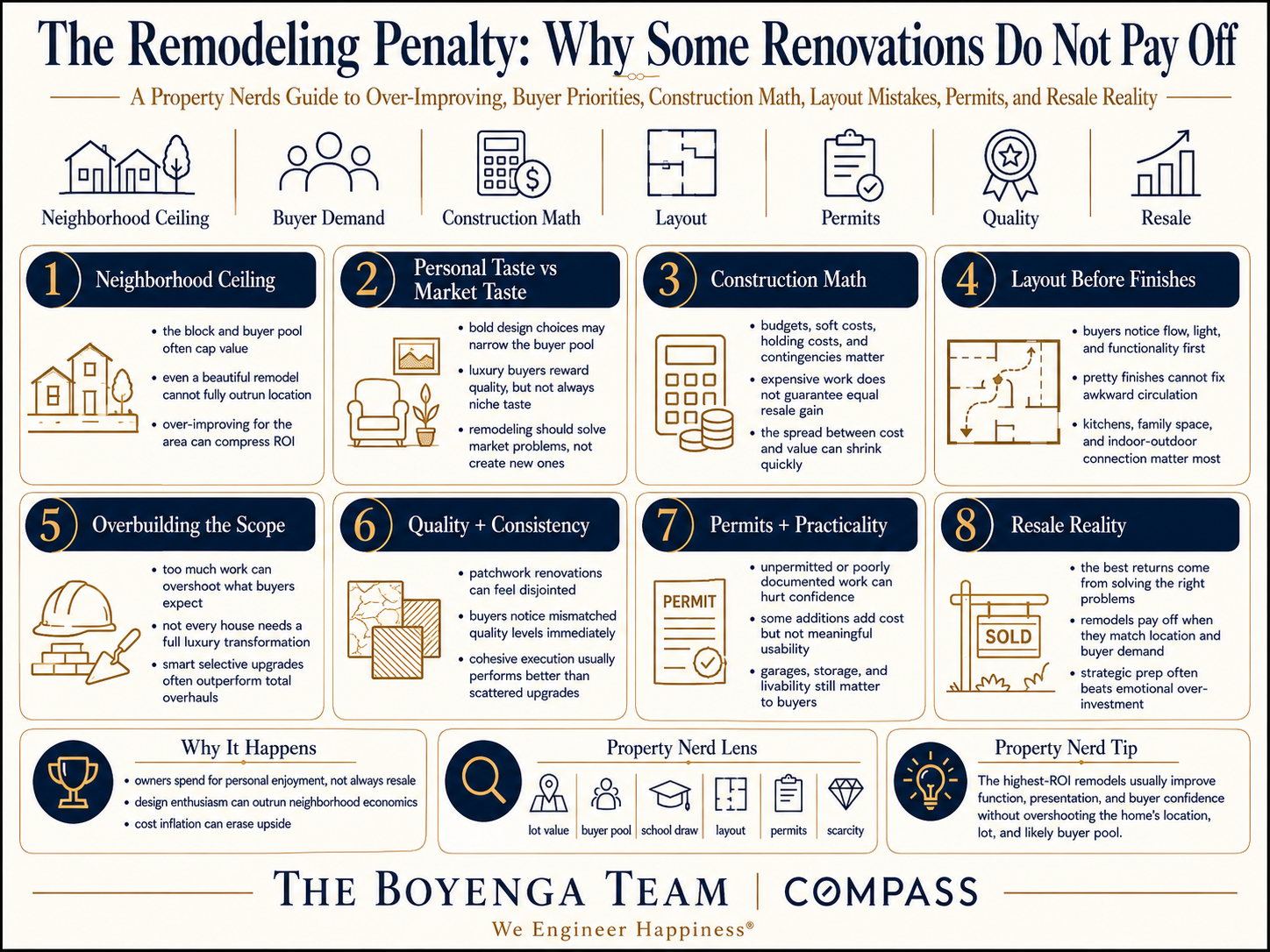
In Silicon Valley real estate, remodeling can create enormous value.
It can make a dated home feel current. It can turn an awkward floor plan into something buyers understand. It can brighten dark rooms, improve indoor-outdoor flow, refresh tired finishes, and help a home photograph beautifully. In the right neighborhood, on the right lot, with the right buyer pool, a smart remodel can absolutely increase demand.
But not all remodeling pays off.
Some renovations create value. Others simply cost money.
That is what we call the remodeling penalty.
The remodeling penalty happens when a seller spends money on improvements that the market does not fully reward. Sometimes the work is too personal. Sometimes it is too expensive for the neighborhood. Sometimes it fights the architecture. Sometimes it ignores the real buyer pool. Sometimes the home should have been marketed as a remodel or rebuild opportunity instead of being partially improved. And sometimes the seller makes the house nicer, but not valuable enough to justify the cost, time, and risk.
In Silicon Valley, where construction costs are high and buyers are very comparison-driven, the remodeling penalty can be expensive.
That is why the Property Nerds of the Boyenga Team do not start with the question, “What should we remodel?”
We start with a better question:
Will the next buyer pay more for this improvement than it costs to complete?
If the answer is no, the smarter strategy may be to clean, disclose, stage, price, and market the home differently.
What Is the Remodeling Penalty?
The remodeling penalty is the gap between what a seller spends on improvements and what buyers actually pay back for those improvements.
For example, a seller might spend $150,000 on a kitchen and bath refresh, but buyers may only value it at $75,000 because they do not love the finishes, plan to remodel anyway, or see the home as a future rebuild.
Or a seller might spend $300,000 improving an older home, but the best buyer for the property may have preferred the home untouched because they wanted to design their own project.
Or a seller might complete a trendy renovation that photographs well but feels too generic for a special architectural home, like an Eichler, mid-century modern property, historic bungalow, or custom estate.
The work may be “nice.” It may even be well done. But if the buyer does not pay for it, the seller absorbs the penalty.
Why Renovations Do Not Always Pay Off in Silicon Valley
Silicon Valley is unusual because the land, location, schools, commute, and buyer pool often matter more than the finishes.
A dated home in Old Palo Alto may still have huge demand because of the location, schools, Stanford access, and lot value. A modest ranch in Rancho Rinconada may attract buyers because of Apple proximity and rebuild potential. An original Eichler in Monta Loma may be more compelling to design buyers if it has been preserved rather than generically remodeled. A Los Altos Hills estate may be valued more for land, privacy, and views than for an outdated kitchen.
That means sellers should be careful before assuming a renovation will produce a dollar-for-dollar return.
Buyers in Silicon Valley are sophisticated. They ask:
Is the lot good?
Is the street quiet?
Is the school path strong?
Is the commute logical?
Is the floor plan functional?
Is the home priced correctly?
Was the remodel done with permits?
Are the systems updated?
Does the style match the architecture?
Will I want to redo this anyway?
If a renovation does not answer those questions, it may not move the value enough.
The Most Common Remodeling Penalties
1. The “Almost Remodeled” Penalty
This happens when a seller updates part of the home, but not enough to make it feel move-in ready.
Maybe the kitchen is new, but the bathrooms are dated. Maybe the floors are replaced, but the windows, lighting, and paint still feel tired. Maybe the primary bath is updated, but the old electrical panel, roof, and HVAC remain concerns.
Buyers then see the home as neither fully turnkey nor fully original. That can be a difficult middle position.
They may think, “This is nicer, but I still have to spend a lot.”
The Property Nerds read: If the remodel does not move the home into a clearly better buyer category, the seller may not get paid for it.
2. The Taste-Specific Penalty
Personal taste can be expensive.
Bold tile, unusual cabinet colors, dramatic fixtures, trendy flooring, overly specific wallpaper, high-contrast finishes, or very custom design choices may appeal to the seller but narrow the buyer pool.
A buyer may respect the cost but still think, “I would not have chosen this.”
In that case, the renovation becomes a discount, not a premium.
The Property Nerds read: Before selling, design should be broad enough to attract the target buyer pool, but not so generic that the home loses character.
3. The Wrong-Buyer Penalty
This is one of the biggest mistakes sellers make.
They remodel for the buyer they imagine, not the buyer who is actually most likely to buy.
A family buyer may care about layout, storage, yard visibility, and bedroom count more than luxury tile. A builder may care about lot size, setbacks, and zoning more than a refreshed kitchen. An Eichler buyer may care about architectural integrity more than new white shaker cabinets. A luxury buyer may care about privacy, light, and scale more than cosmetic updates.
When the remodel does not match the buyer pool, money gets wasted.
The Property Nerds read: The right renovation depends on who the buyer is.
4. The Architecture-Erasure Penalty
Some homes have architectural value that should not be erased.
Eichlers, mid-century modern homes, historic bungalows, Spanish Revival homes, Craftsman homes, and custom estates often need design-sensitive preparation.
A generic remodel can strip away the very thing that made the home special. Removing original wood paneling, flattening ceiling lines, closing off glass, replacing warm materials with cold gray finishes, or adding trend-driven elements can make a unique home feel ordinary.
The Property Nerds read: If the architecture is part of the value, the remodel should enhance it, not fight it.
5. The Overbuilt-for-the-Neighborhood Penalty
A seller can over-improve a home beyond what the neighborhood supports.
This happens when the renovation quality or cost exceeds the likely resale ceiling. The home may be beautiful, but buyers will compare it to nearby alternatives. If the neighborhood buyer pool is not willing to pay for that level of finish, the seller may not recover the investment.
This is especially important in ranch-home neighborhoods, condo/townhome markets, and areas where buyers are still price-sensitive.
The Property Nerds read: The neighborhood sets the ceiling. The remodel has to respect it.
6. The Road-Exposure Penalty
A major remodel cannot fully fix a compromised location.
If the home is on a busy road, backs to noise, has difficult access, or lacks privacy, buyers will still discount it. Spending heavily on finishes may not overcome those location issues.
A seller may be better off doing targeted preparation and pricing strategically rather than trying to remodel their way out of a location challenge.
The Property Nerds read: You can improve the house, but you cannot remodel the street.
7. The Lot-Utility Penalty
In Silicon Valley, lot utility is a major value driver.
A large but awkward lot may not be as valuable as a smaller but highly usable lot. A remodel that ignores the yard, indoor-outdoor connection, driveway, pool placement, privacy, or expansion potential may miss the real value issue.
For family buyers, the yard needs to work. For luxury buyers, the land needs to feel intentional. For rebuild buyers, the lot needs to support future value.
The Property Nerds read: A remodel should strengthen the relationship between the house and the land.
8. The Permit and Systems Penalty
Cosmetic upgrades can look great, but buyers still care about what is behind the walls.
If a home has a new kitchen but old plumbing, aging electrical, poor drainage, an old roof, questionable permits, or foundation concerns, buyers may discount the remodel.
In some cases, buyers become more skeptical because the visible work looks new, but the underlying systems do not match.
The Property Nerds read: Surface beauty does not replace systems confidence.
9. The Timing Penalty
Some renovations take too long.
A seller may miss a stronger market window because the project drags on. Carrying costs, vendor delays, permit delays, and decision fatigue can reduce the final benefit.
In a changing market, timing can matter as much as condition. Sometimes a 15-day transformation is smarter than a 6-month remodel.
The Property Nerds read: The best improvement is not always the biggest one. It is the one that gets the home to market at the right time with the right story.
10. The Buyer-Redo Penalty
This happens when buyers plan to remodel anyway.
If the likely buyer will tear out the kitchen, redesign the baths, expand the footprint, or rebuild the home, a seller may not get paid for pre-sale renovations.
This is especially common in high-land-value neighborhoods like Palo Alto, Los Altos, Los Altos Hills, Menlo Park, Saratoga, Portola Valley, and certain Cupertino or Sunnyvale pockets.
The Property Nerds read: Do not spend heavily on improvements the buyer is likely to remove.
When Remodeling Does Pay Off
The remodeling penalty does not mean sellers should never improve a home.
Some improvements can create strong returns, especially when they remove buyer friction or help the home reach the right buyer category.
Remodeling may pay off when:
The home has good bones but feels dated.
The floor plan is functional.
The lot and street are strong.
The neighborhood supports the finished value.
The improvement is broad-appeal and design-appropriate.
The work can be completed quickly and professionally.
The buyer pool wants move-in ready condition.
The disclosures and systems support confidence.
The improvements help the home photograph and show better.
The cost is controlled.
High-impact improvements often include paint, lighting, refinished floors, landscaping, cleaning, minor repairs, staging, fixture updates, hardware, curb appeal, and selective kitchen or bath refreshes.
Major remodels can also pay off, but only when the math is clear.
Remodel, Refresh, or Sell As-Is?
Before spending money, sellers should decide which category the home belongs in.
Sell As-Is With Strategic Presentation
Best when the likely buyer is a remodeler, builder, investor, or design-minded buyer who wants control.
Light Refresh
Best when the home has good bones and needs paint, floors, lighting, cleaning, landscaping, and staging.
Targeted Updates
Best when a few specific improvements will remove obvious buyer objections.
Full Transformation
Best when the home can move into a much stronger buyer category with a focused preparation plan.
Major Remodel
Best when the seller has enough time, budget, and market support to justify the investment.
Rebuild / Land-Value Strategy
Best when the land is more valuable than the current structure.
The Property Nerds read: The right category determines the right spending.
Examples of Where the Remodeling Penalty Shows Up
A Cupertino ranch home near Apple may not need a full remodel if buyers are likely to expand or rebuild.
A Palo Alto Eichler may lose value if the remodel erases original mid-century character.
A Los Altos Hills estate may need landscaping and property-story clarity more than a cosmetic kitchen refresh.
A Menlo Park cottage near Allied Arts may benefit from charm-sensitive updates, but not a generic luxury remodel.
A Sunnyvale home in a family neighborhood may benefit from paint, floors, staging, and yard cleanup more than expensive custom finishes.
A Willow Glen character home may need restoration-minded prep, not a cold modern makeover.
A Campbell townhome may need HOA clarity, staging, and cosmetic polish more than major upgrades.
A Saratoga estate may need privacy, landscaping, and systems confidence more than trendy interiors.
The Property Nerds read: Every neighborhood has a different buyer pool. Every buyer pool values different improvements.
How the Boyenga Team Helps Sellers Avoid the Remodeling Penalty
The Boyenga Team’s approach begins with buyer-pool analysis.
Before recommending improvements, Eric and Janelle look at who is most likely to buy the home and why. They study the neighborhood, comps, school path, lot, condition, architecture, street, market timing, and likely objections.
Then they help sellers decide:
What should be fixed?
What should be refreshed?
What should be left alone?
What should be disclosed?
What should be staged?
What should be marketed as opportunity?
What would be a waste of money?
What will buyers actually pay for?
This is where the Property Nerds process creates value. The goal is not to spend the most. The goal is to spend intelligently.
Sometimes that means a full transformation. Sometimes it means a targeted 15-day prep plan. Sometimes it means selling as-is with strong inspections, floor plans, and lot-value marketing. Sometimes it means preserving architecture instead of modernizing it. Sometimes it means telling the truth: the buyer will remodel anyway, so do not overspend.
The Property Nerds Bottom Line
Renovations do not automatically create value.
The right renovation can help a Silicon Valley home sell faster and stronger. The wrong renovation can waste money, delay the launch, narrow the buyer pool, or erase what made the property special.
The smartest sellers do not ask, “What should we remodel?”
They ask:
Who is the most likely buyer?
What will they value?
What will they remove?
What will increase confidence?
What will improve the first impression?
What will photograph better?
What will support the price?
What will not pay off?
That is how you avoid the remodeling penalty.
In Silicon Valley real estate, the goal is not to make every home perfect. The goal is to position the home so the right buyer understands the opportunity and feels confident acting on it.
Thinking About Selling Before You Remodel?
Before you spend money preparing your home for market, talk strategy.
The Boyenga Team at Compass helps sellers avoid the remodeling penalty with a Property Nerds approach — blending pricing strategy, buyer-pool analysis, design insight, inspection awareness, preparation planning, staging, disclosure strategy, and market positioning.
Whether you are selling a dated ranch home, an Eichler, a trust property, a luxury estate, a remodel candidate, or a potential rebuild, Eric and Janelle Boyenga can help you decide what to do, what not to do, and where the market will actually reward your investment.
Because in Silicon Valley real estate, smart preparation is not about spending more.
It is about knowing what buyers will pay for.