

Blog > The Over-Improvement Trap: When a Silicon Valley Renovation Reduces a Seller's Return
The Over-Improvement Trap: When a Silicon Valley Renovation Reduces a Seller's Return
by
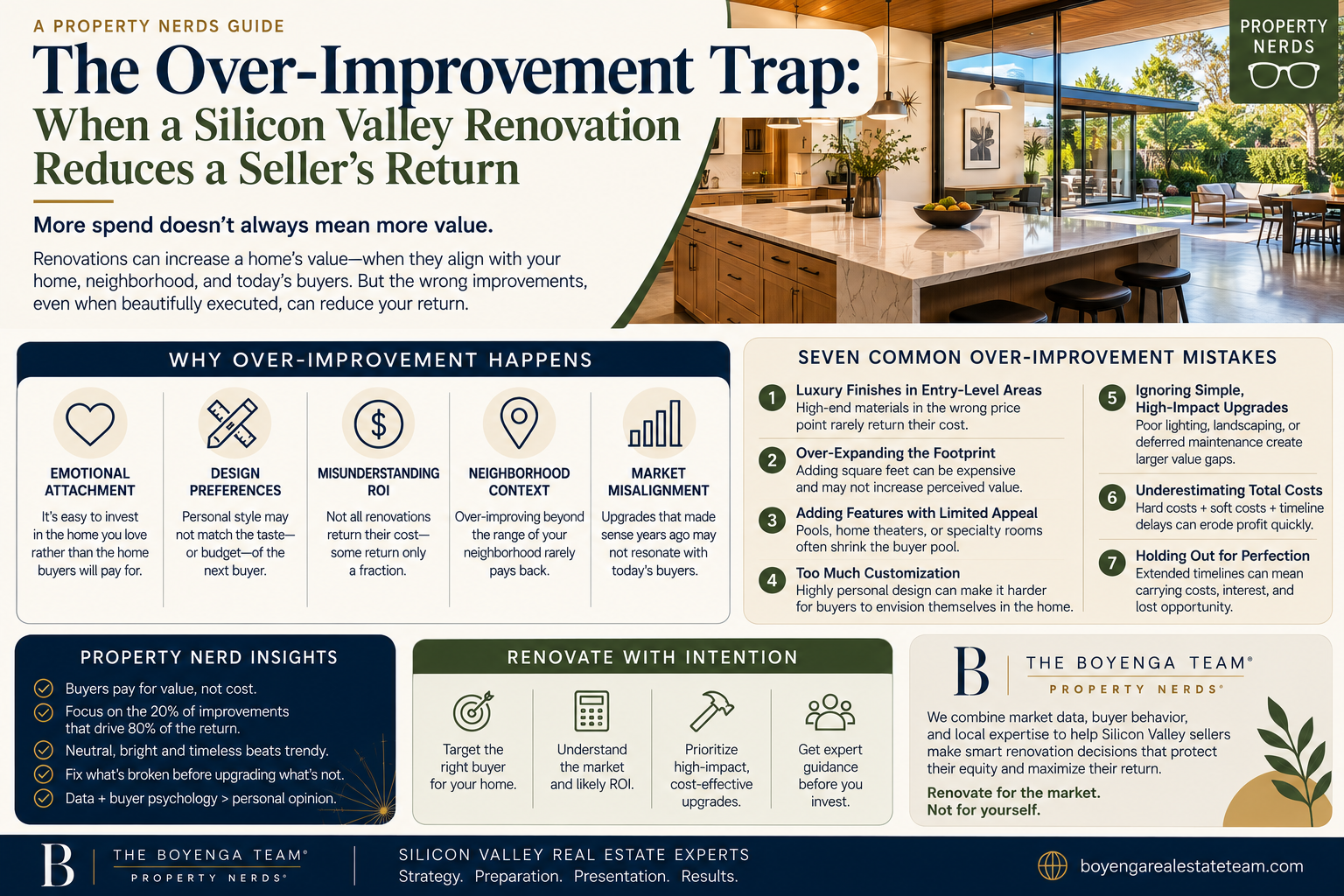
Few decisions generate more debate before selling a home than whether to renovate. Some homeowners believe every room should be updated before listing. Others avoid making any improvements at all. The reality lies somewhere in the middle.
In Silicon Valley, buyers are often willing to pay a premium for well-prepared homes—but they don't necessarily reward every dollar a seller spends. In fact, some of the largest renovation budgets produce surprisingly modest returns, while relatively inexpensive improvements can dramatically increase buyer interest.
The challenge isn't deciding whether to renovate. It's knowing where renovation creates value—and where it quietly erodes it.
Buyers Pay for Value, Not Cost
One of the biggest misconceptions in residential real estate is that renovation cost equals market value.
A seller may invest $300,000 in a remodel, but buyers don't reimburse renovation invoices. They evaluate the finished home against competing properties, neighborhood expectations, and their own preferences.
The market determines value—not the construction budget.
This distinction becomes especially important in Silicon Valley, where neighborhoods often have well-established pricing ceilings.
Every Neighborhood Has a Renovation Ceiling
Luxury finishes can absolutely increase value—but only when they align with the surrounding market.
Installing custom European cabinetry, imported stone, or designer fixtures in a neighborhood where buyers prioritize location over interior finishes may produce little measurable return.
Likewise, dramatically expanding a home beyond the expectations of the neighborhood can narrow the buyer pool instead of increasing it.
The goal isn't building the nicest house possible.
It's building the most competitive house for that specific market.
Renovating for Yourself Is Different Than Renovating to Sell
When homeowners renovate for long-term enjoyment, personal taste should absolutely guide decisions.
Preparing a home for sale is different.
Future buyers aren't evaluating whether the renovation reflects your preferences—they're deciding whether they can imagine themselves living there.
Highly personalized design choices often reduce broad buyer appeal.
Examples include:
- Highly customized built-ins
- Specialty entertainment rooms
- Bold color palettes
- Extremely contemporary finishes in traditional neighborhoods
- Luxury upgrades with limited everyday use
Timeless design generally attracts more buyers than highly individualized design.
The Highest Return Often Comes From Smaller Projects
One of the most surprising lessons we've learned is that the largest renovations rarely produce the highest return on investment.
Instead, buyers consistently respond to improvements that make a home feel brighter, cleaner, newer, and better maintained.
These often include:
- Fresh interior paint
- Updated lighting
- Landscaping improvements
- Flooring refinishing
- Minor kitchen updates
- Modern hardware and fixtures
- Professional staging
These improvements don't necessarily transform the home—but they transform the buyer's perception of it.
Architecture Should Guide Renovation
Not every home benefits from the same design approach.
Mid-century homes, Eichlers, Craftsman residences, ranch homes, and contemporary architecture each attract different buyers with different expectations.
Renovations that respect the home's architectural character often outperform renovations that attempt to completely reinvent it.
For homeowners considering improvements to mid-century properties, Bay Area Eichler Homes offers additional insights into preserving architectural integrity while maximizing buyer appeal.
https://bayareaeichlerhomes.com
Opportunity Cost Matters Too
Over-improvement isn't measured only by construction costs.
Lengthy renovation timelines introduce carrying costs, changing market conditions, additional permitting, financing expenses, and delayed opportunities to list during favorable selling seasons.
Sometimes the highest return comes from listing three months earlier—not from completing three additional months of renovation.
Preparation should always be evaluated through both financial return and timing.
Think Like Your Buyer
One of the most effective ways to avoid over-improving is to stop thinking like the homeowner and start thinking like the buyer.
Ask questions such as:
- What will buyers notice first?
- Which improvements build confidence?
- Which updates simply reflect my personal preferences?
- Will this project expand the buyer pool—or narrow it?
- Does this investment make the home more competitive compared to nearby listings?
These questions often produce better renovation decisions than focusing exclusively on construction costs.
The Property Nerd Take
The best renovation strategy isn't the biggest renovation strategy.
Successful sellers invest where buyers place value, preserve the character that makes a home distinctive, and avoid improvements that exceed neighborhood expectations.
At the Boyenga Team, we evaluate every recommendation through three lenses: buyer psychology, neighborhood context, and return on investment. That approach helps sellers protect equity while creating homes that stand out for the right reasons.
Because in Silicon Valley, the smartest renovation isn't always the most expensive one.
For additional seller insights, visit the Property Nerds Blog, explore Boyenga Real Estate Team, or browse Mid Mod Homes and Bay Area Eichler Homes for architecture-specific guidance and market expertise.
keep exploring · property nerd guides
Thinking about a move in Silicon Valley?
The Boyenga Team at Compass has helped clients buy and sell more than 2,520 homes since 1996. Start with a guide, a search, or a conversation.
Search Silicon Valley homesWhat’s my home worth?
Talk to a Property Nerd: (408) 373-1660 · (650) 383-8606 · How we sell homes
city guides Palo Alto · Los Altos · Menlo Park · Cupertino · Sunnyvale · Los Gatos · San José