
Blog > The Invisible Lot Line: Why Buyer Demand Can Change From One Silicon Valley Block to the Next
The Invisible Lot Line: Why Buyer Demand Can Change From One Silicon Valley Block to the Next
by
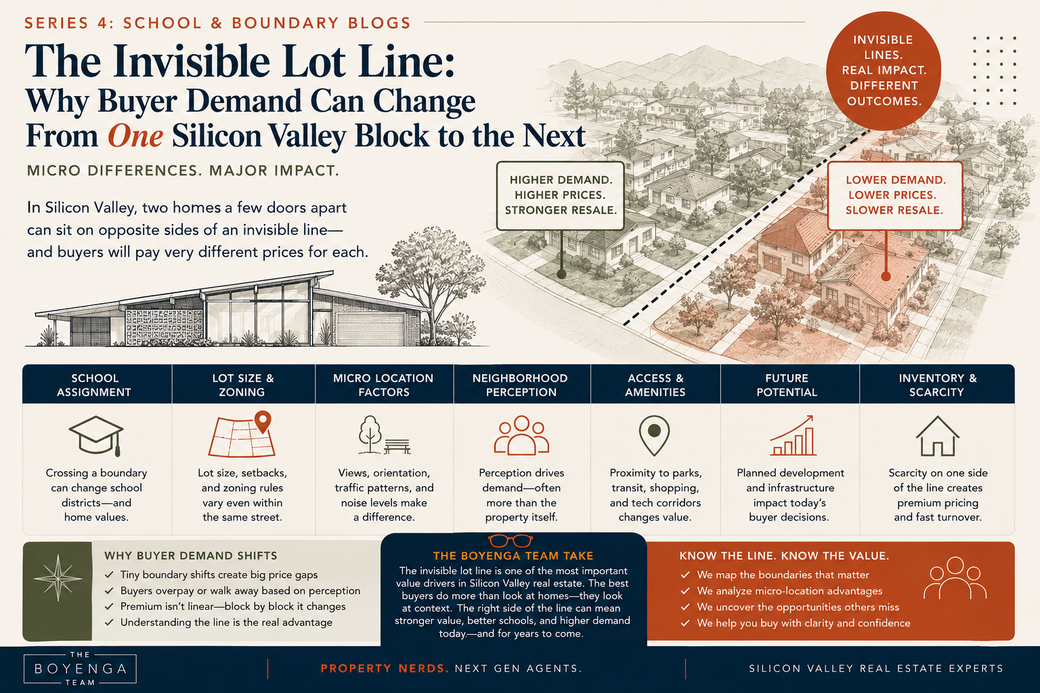
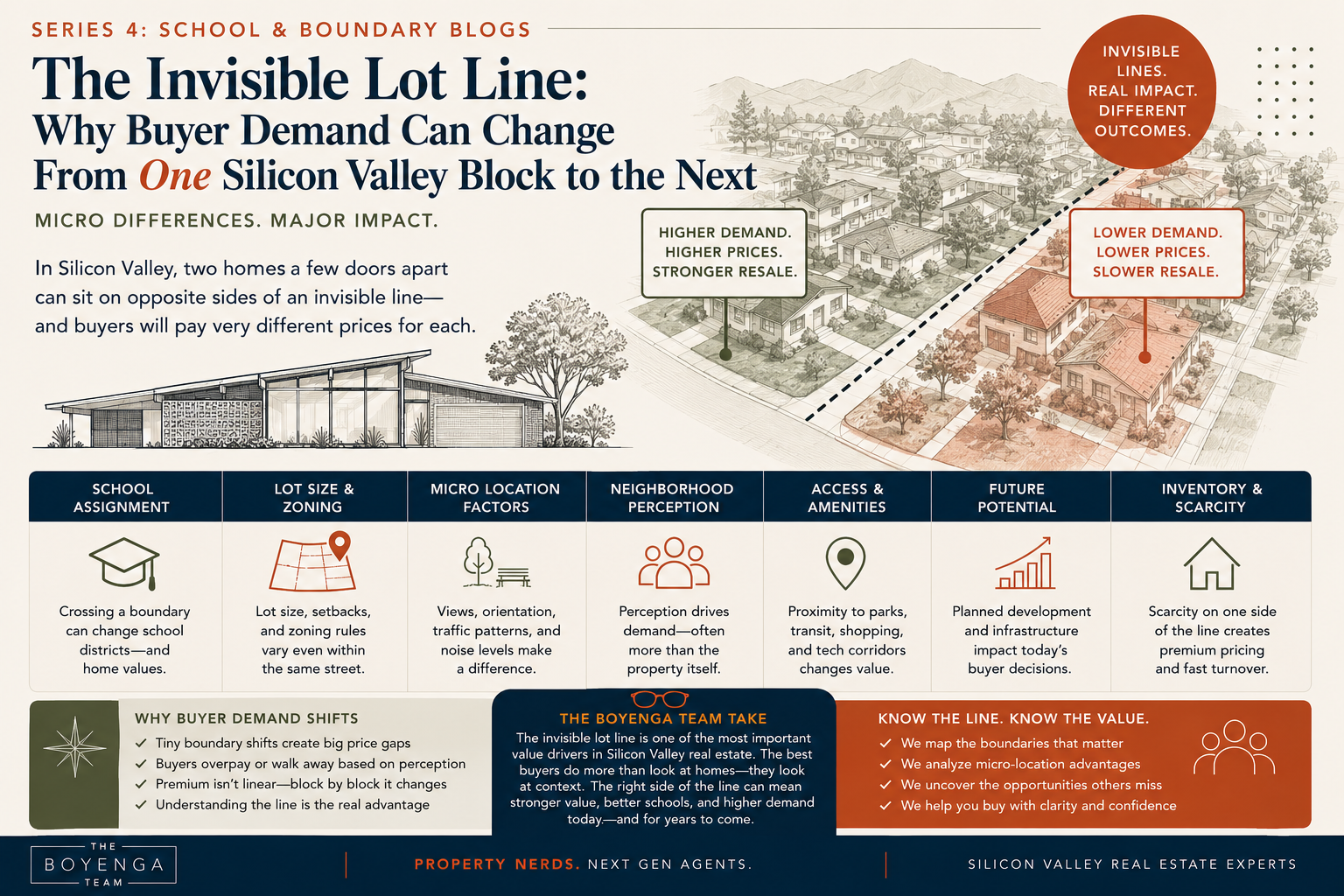 Micro Differences. Major Impact.
Walk two streets over in Silicon Valley and the homes may look nearly identical. They may have been built during the same decade, offer similar square footage, and even share comparable lot sizes. Yet one neighborhood consistently commands higher prices, receives stronger buyer competition, and sells more quickly than another only a block away.
That difference often comes down to what we call the invisible lot line.
In Silicon Valley real estate, value is influenced as much by context as by the home itself. School assignments, neighborhood perception, micro-location, lot characteristics, future development, and even which side of a street a property sits on can dramatically change buyer demand. These subtle differences rarely appear in online valuation tools, yet they influence pricing every day.
Understanding these invisible boundaries is one of the biggest advantages buyers and sellers can have.
School Boundaries Are Often the First Invisible Line
School assignments remain one of Silicon Valley's strongest value drivers.
A home located within one attendance boundary may command a significant premium over a nearly identical property just across the street. Buyers relocating to the area often begin their search with school districts rather than neighborhoods, creating concentrated demand in certain attendance zones.
Importantly, these premiums are rarely linear. The value difference between two neighboring homes may exceed the difference between homes located miles apart simply because they feed into different schools.
Buyers should never assume that a city name automatically determines school assignment. Attendance boundaries should always be verified before purchasing.
Lot Size and Zoning Create Long-Term Optionality
Two homes may appear similar today while offering very different opportunities tomorrow.
Lot width, setbacks, zoning regulations, easements, and allowable floor area ratios influence what owners may eventually build, remodel, or expand. Buyers increasingly evaluate these future possibilities, even if they have no immediate renovation plans.
A property with greater flexibility often commands stronger demand because buyers recognize its long-term potential.
The home itself may be identical.
The land beneath it may not be.
Micro-Location Matters More Than Most Buyers Realize
Real estate professionals often say that location matters.
Property Nerds know that micro-location matters even more.
Within the same neighborhood, buyers respond differently to homes depending on traffic patterns, orientation, noise, views, proximity to parks, walkability, nearby commercial uses, and even how a home sits on its lot.
A quiet interior street may command stronger demand than a nearby collector road. Homes backing to open space often outperform homes backing to commercial property. Corner lots appeal to some buyers while discouraging others.
These small details influence perceived value long before buyers begin comparing finishes or floor plans.
Buyer Perception Creates Its Own Premium
Real estate markets are driven by emotion as much as data.
Neighborhood reputation often develops over decades through owner occupancy, architectural consistency, landscaping, community involvement, and pride of ownership. Buyers don't simply evaluate an individual property—they evaluate the surrounding environment.
When buyers perceive a neighborhood as stable and well-maintained, competition increases. That perception becomes part of the home's value, even though it never appears on a property disclosure.
Sometimes perception itself becomes the invisible lot line.
Access and Amenities Influence Everyday Living
Convenience remains one of Silicon Valley's most consistent value drivers.
Buyers routinely pay premiums for homes located closer to parks, downtown districts, Caltrain stations, schools, hiking trails, or major employment centers. Even relatively small changes in accessibility can influence long-term demand.
The closer a home aligns with a buyer's daily lifestyle, the more valuable it becomes.
This is why neighborhoods only blocks apart can develop very different pricing trajectories over time.
Future Potential Also Shapes Today's Value
Sophisticated buyers aren't purchasing only what exists today—they're investing in what a neighborhood may become.
Infrastructure improvements, commercial redevelopment, transportation investments, rezoning discussions, and neighborhood revitalization all influence buyer confidence long before construction begins.
Understanding these future catalysts often explains why some neighborhoods appreciate more rapidly than others despite having similar housing stock.
The Property Nerd Take
The invisible lot line is one of Silicon Valley real estate's most important concepts because it reminds us that value extends beyond the home itself.
Buyers don't purchase square footage alone. They purchase school assignments, neighborhood identity, future opportunity, convenience, architecture, and lifestyle. Sellers who understand these hidden drivers position their homes more effectively, while buyers who recognize them make more informed long-term investments.
The homes may look nearly identical.
The market rarely treats them that way.
For more Silicon Valley market insights, neighborhood analysis, and architecture guides, explore the Property Nerds Blog, Boyenga Real Estate Team, Mid Mod Homes, and Bay Area Eichler Homes.
keep exploring · property nerd guides
Thinking about a move in Silicon Valley?
The Boyenga Team at Compass has helped clients buy and sell more than 2,520 homes since 1996. Start with a guide, a search, or a conversation.
Search Silicon Valley homesWhat’s my home worth?
Talk to a Property Nerd: (408) 373-1660 · (650) 383-8606
city guides Palo Alto · Los Altos · Menlo Park · Cupertino · Sunnyvale · Los Gatos · San Jose