

Blog > The Crossings vs. Whisman Station: Townhome Living Near Transit and Tech
The Crossings vs. Whisman Station: Townhome Living Near Transit and Tech
by
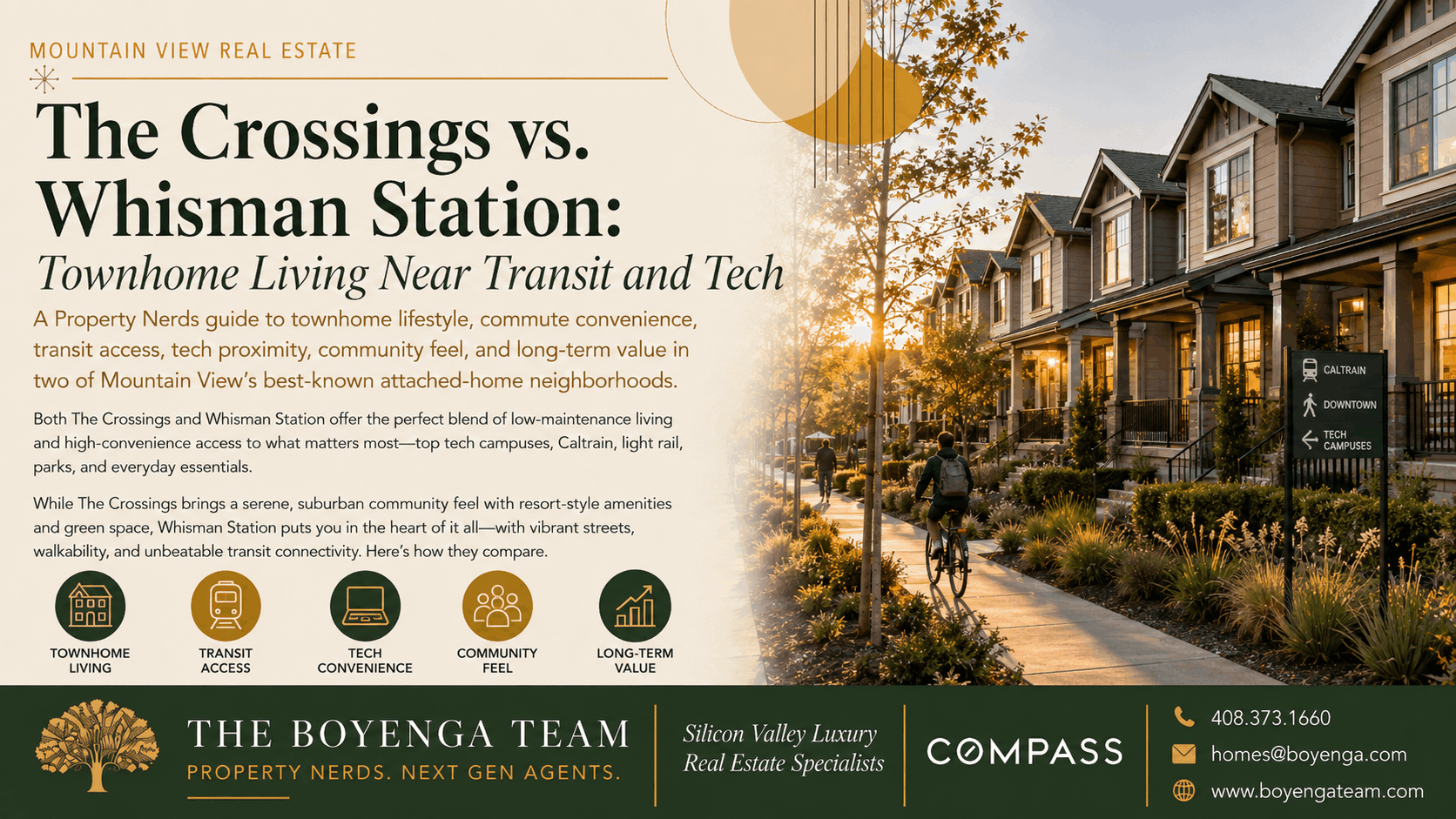
Mountain View townhome buyers are not just buying walls, bedrooms, and garage spaces.
They are buying a mobility system.
That is the Property Nerd way to understand The Crossings and Whisman Station, two of Mountain View’s most important transit-oriented neighborhoods. Both appeal to buyers who want a lower-maintenance Silicon Valley lifestyle close to tech employers, transit, shopping, parks, and commute routes. Both are strong options for buyers who do not necessarily want the responsibility of a traditional single-family home in Cuesta Park, Waverly Park, Monta Loma, or Old Mountain View.
But they are not the same.
The Crossings is the San Antonio / Caltrain / shopping-and-Palo-Alto-access story.
Whisman Station is the VTA light rail / East Mountain View / tech-campus-connectivity story.
Both are smart. Both are convenient. Both can be excellent choices. The better fit depends on how the buyer actually lives.
At the Boyenga Team, we look at these communities through a Property Nerd and Next Gen Agent lens: transit access, HOA structure, floor plan, parking, work-from-home function, resale demand, tech commute logic, school pathway, outdoor space, rental appeal, and long-term Silicon Valley livability.
This guide breaks down The Crossings Mountain View, Whisman Station homes, and the broader Mountain View townhomes market for buyers and sellers who want to understand the details behind the lifestyle.
The Property Nerd Thesis: These Are Two Different Transit-Oriented Lifestyles
The Crossings and Whisman Station both work because they solve a common Silicon Valley problem: how to live near jobs, transit, shopping, and daily amenities without maintaining a large single-family property.
But the way they solve that problem is different.
The Crossings sits in the San Antonio area, close to the San Antonio Caltrain station, San Antonio Center, Palo Alto, Los Altos, El Camino Real, and major road connections. The community’s own site describes it as a 1994 development with 540 homes, including single-family residences, row homes, and condominiums, and notes that it was recognized with the American Planning Association’s Outstanding Planning Award in 2002.
Whisman Station, by contrast, is more connected to the VTA light rail network, East Mountain View, downtown Mountain View access, Stevens Creek Trail, and tech-employment corridors around Whisman, Middlefield, North Bayshore, and nearby offices. VTA identifies Whisman Station as a light rail station on the Orange Line, with wheelchair boarding, parking, and bike locker facilities.
That is the big picture.
The Crossings feels like a Caltrain-adjacent, San Antonio lifestyle community.
Whisman Station feels like a light-rail-oriented, tech-commuter townhome village.
The Crossings: San Antonio Convenience, Caltrain Access, and Urban-Suburban Ease
The Crossings is one of Mountain View’s best-known planned communities because it was built around transit-oriented planning before that became a standard real estate buzzword.
The EPA’s smart growth case study describes The Crossings as a compact, mixed-housing community with single-family bungalows, smaller cottages, townhouses, and condominium apartments. The same case study notes that the original retail site was reclassified for residential use, and that community design meetings helped shape the final plan.
That history matters because The Crossings was not just another townhouse project dropped next to train tracks. It was part of a broader planning idea: compact homes, walkability, transportation choice, and a less car-dependent lifestyle in a high-cost Silicon Valley location.
For buyers, The Crossings often feels highly practical. You are near San Antonio Caltrain, San Antonio Center, grocery shopping, restaurants, retail, entertainment, Palo Alto access, Los Altos access, and major roads. Caltrain lists San Antonio Station at 190 Showers Drive in Mountain View and identifies station amenities including accessibility, bike information, parking, ticket vending machines, and recycling.
The Crossings buyer is often saying: “I want Mountain View convenience, but I also want quick access toward Palo Alto, Los Altos, Caltrain, shopping, and daily life.”
That is the value stack.
Why Buyers Like The Crossings
The Crossings appeals to buyers who want convenience without feeling fully urban. It has a planned-neighborhood rhythm, with a mix of housing types and internal streets that feel more residential than a typical condo complex.
The location is the headline. The Crossings’ own neighborhood site describes it as bordered by Palo Alto and Los Altos, adjacent to Landsby, and located in the greater San Antonio area. It also highlights nearby San Antonio Shopping Center access and notes that the neighborhood is across from the San Antonio Caltrain station with access to Highways 85, 101, and 280.
That makes the neighborhood especially attractive for buyers who commute in different directions. One person may work in Palo Alto. Another may commute to Mountain View, Sunnyvale, San Francisco, or San Jose by Caltrain. A family may want access to both Los Altos and Mountain View amenities. A downsizer may want shopping, restaurants, and transit without maintaining a large yard.
For sellers, this is the story that needs to be told clearly. The Crossings is not only “a townhome community.” It is a location-efficiency play.
The Crossings Buyer Profile
The Crossings often attracts buyers who want a lower-friction Silicon Valley lifestyle. They may be tech professionals, Stanford-adjacent commuters, Palo Alto workers, San Francisco Caltrain users, buyers moving out of apartments, downsizers, relocation buyers, or families who want a more connected daily routine.
These buyers care about floor plan, parking, storage, HOA health, outdoor space, noise exposure, and how easy it is to get to work, groceries, dinner, school, transit, and weekend activities.
The strongest Crossings homes often make life feel simple. A good floor plan, usable outdoor space, garage parking, natural light, and easy walking access can dramatically improve buyer response.
The Property Nerd question is not just, “Is it close to Caltrain?”
The better question is: “Does this home make a car-light or lower-friction Silicon Valley lifestyle actually work?”
Whisman Station: Light Rail, Tech Access, and Townhome Village Living
Whisman Station has a different personality.
Where The Crossings is anchored by San Antonio and Caltrain, Whisman Station is anchored by VTA light rail and East Mountain View connectivity. The VTA page for Whisman Station identifies the station as part of the Orange Line, with station parking, bike lockers, and wheelchair boarding.
Whisman Station tends to appeal to buyers who want modern townhome living, tech access, green space, and a planned-community environment. Local neighborhood research describes Whisman Station as a transit-oriented development that emerged around the former GTE Sylvania campus, with more than 500 townhomes, condominiums, and apartments completed in phases.
The history gives the neighborhood a very Silicon Valley arc: industrial and technology land transformed into housing near transit.
That transformation is part of Mountain View’s broader evolution. Mountain View is not just a city of single-family neighborhoods. It is also a city trying to organize housing, jobs, transit, and tech growth into more efficient living patterns.
Whisman Station is one of the clearest examples of that.
Why Buyers Like Whisman Station
Whisman Station buyers often want a townhome lifestyle that feels convenient, connected, and relatively lower-maintenance. They may value being close to VTA light rail, Stevens Creek Trail, downtown Mountain View, tech campuses, Central Expressway, Highway 237, Highway 101, and the broader East Whisman / North Bayshore employment map.
Mountain View’s city transportation page notes that the city is served by VTA bus and light rail, Caltrain, MVgo shuttles, and the Mountain View Community Shuttle. It also notes that MVgo provides free shuttle connections from the Mountain View Transit Center to North Bayshore, East Whisman, San Antonio, and downtown Mountain View during commute hours.
That matters for Whisman Station buyers because the neighborhood is part of a larger mobility ecosystem. A buyer may use VTA light rail occasionally, drive most days, bike to work, use a shuttle connection, or simply value the fact that transit and tech access are built into the location.
The strongest Whisman Station homes often appeal to buyers who want the structure of a planned community: townhome layout, garage function, community green space, HOA-maintained areas, and a neighborhood feel that is more organized than scattered infill development.
The Whisman Station Buyer Profile
Whisman Station often attracts tech professionals, first-time townhome buyers, move-up condo buyers, relocation buyers, hybrid workers, and buyers who want access to downtown Mountain View without living directly in downtown Mountain View.
These buyers tend to care about commute flexibility, home office space, garage utility, EV charging potential, HOA quality, floor plan efficiency, private outdoor space, and proximity to parks or trails.
They may be less focused on having a large private yard and more focused on whether the home supports modern Silicon Valley life: work from home, commute when needed, access tech employers, store bikes, charge vehicles, and maintain a manageable lifestyle.
For sellers, Whisman Station should be marketed around efficient living, not just square footage.
The Crossings vs. Whisman Station: The Real Difference
The Crossings and Whisman Station are both transit-oriented, but the transit story is different.
The Crossings is more Caltrain-oriented. It is powerful for buyers who want access up and down the Peninsula, especially toward Palo Alto, San Francisco, San Jose, and other Caltrain-served employment centers. It also benefits from San Antonio Center and the ability to move easily between Mountain View, Palo Alto, and Los Altos.
Whisman Station is more VTA-light-rail and East Mountain View oriented. It is powerful for buyers who want access toward Mountain View’s tech corridors, downtown Mountain View, Middlefield, Moffett, North Bayshore, Stevens Creek Trail, and nearby employers.
That means the right choice depends on the buyer’s actual commute.
A buyer working in Palo Alto or San Francisco may see The Crossings as more intuitive.
A buyer working around East Whisman, North Bayshore, downtown Mountain View, Sunnyvale, or nearby tech campuses may see Whisman Station as more convenient.
A buyer who wants shopping and restaurants nearby may lean toward The Crossings.
A buyer who wants a townhome village feel near VTA and green space may lean toward Whisman Station.
Neither answer is universally better. The best answer is lifestyle-specific.
Townhome Living: What Buyers Should Study
Townhomes are not simpler just because they are lower-maintenance than single-family homes. They come with their own Property Nerd checklist.
Buyers should study the HOA, reserves, dues, insurance structure, rental rules, maintenance responsibilities, exterior obligations, roof responsibility, common area condition, parking rules, guest parking, pet policies, EV charging rules, architectural restrictions, and any upcoming assessments.
They should also evaluate the actual floor plan. Many Mountain View townhomes have vertical layouts, which can be great for separation but challenging for buyers who dislike stairs. A three-level townhome may feel spacious on paper but less convenient for a buyer with small children, aging parents, pets, or mobility concerns. A two-car garage may be a major value feature, but only if it actually works for cars, bikes, storage, tools, and EV charging.
In The Crossings and Whisman Station, the strongest units are often the ones that solve daily-life friction. Good light, functional stairs, real storage, private outdoor space, a usable kitchen, a true office zone, a garage that works, and a quieter location within the community can all influence value.
The buyer should not just ask, “How many square feet?”
The buyer should ask, “How does this floor plan live on a Tuesday morning?”
What Tech Buyers Notice
Tech buyers in Mountain View often think in systems.
They notice the commute. They notice the home office. They notice the garage. They notice EV charging potential. They notice whether there is space for bikes, scooters, or gear. They notice smart-home infrastructure. They notice whether the Wi-Fi setup will be easy. They notice whether the floor plan works for calls and hybrid work.
The Crossings may appeal to tech buyers who want Caltrain and San Antonio access.
Whisman Station may appeal to tech buyers who want VTA, East Mountain View, and campus convenience.
But in both communities, the home itself still has to perform. A townhome near transit but without a good workspace may lose a buyer who works from home three days a week. A home with great location but poor storage may feel less practical. A home with a garage that cannot support EV charging or bike storage may feel less current to today’s tech buyer.
Sellers should make these features visible. Stage the office. Clean the garage. Organize storage. Document smart-home features. Explain EV charging if it exists. Make the commute story clear.
What Family Buyers Notice
Family buyers may look at The Crossings and Whisman Station differently than tech-only buyers.
They care about school pathways, bedroom placement, stairs, play space, parks, storage, noise, guest parking, stroller logistics, nearby shopping, safety, and whether the home can support family life without a big backyard.
School assignments are address-specific and should always be verified directly with the appropriate district. Mountain View Whisman School District provides a SchoolLocator and boundary map resources for address-based lookup, and notes that current boundaries went into effect in the 2019–20 school year.
For family buyers, The Crossings may feel appealing because of shopping access, San Antonio convenience, and the planned-neighborhood atmosphere. Whisman Station may feel appealing because of green spaces, community layout, trails, and access to transit and downtown.
The key is that a townhome must be family-legible. Buyers need to see where kids sleep, where homework happens, where guests stay, where bikes go, where groceries enter, and where the family gathers.
A good listing makes that obvious.
What Sellers Should Know in The Crossings
If you are selling in The Crossings, the marketing should lean into the San Antonio lifestyle.
The story should not be only “townhome near Caltrain.” It should be about access: Caltrain, San Antonio Center, Palo Alto, Los Altos, Mountain View, retail, dining, everyday services, and major commute routes. The EPA case study highlights The Crossings as a smart-growth example with transportation choices and a comfortable walking environment, which reinforces the community’s broader planning appeal.
For sellers, preparation should emphasize ease. Make the home feel bright, organized, low-maintenance, and move-in ready. Show the garage as a real asset. Stage any flex space as an office or guest area. Make outdoor areas feel usable. If the unit is in a quieter interior location, highlight that. If it has better light, privacy, or parking than competing units, make that clear.
The buyer should immediately understand why this specific Crossings home is easier to live in than the competition.
What Sellers Should Know in Whisman Station
If you are selling in Whisman Station, the marketing should emphasize efficient tech-connected living.
The story should include VTA light rail access, community feel, townhome functionality, parks or green spaces where relevant, commute options, work-from-home function, and access to downtown Mountain View and major tech corridors.
Whisman Station buyers often respond to modern convenience. That means the home should be staged to show how it works for hybrid work, tech commuting, storage, and low-maintenance living. If the home has an office nook, a true bedroom-level laundry, a two-car garage, EV charger, upgraded systems, or a more private position within the community, those details should not be buried.
The buyer should see a home that supports Silicon Valley life without creating too much maintenance.
The HOA Factor: The Property Nerd Due Diligence Layer
For condos and townhomes, the HOA is part of the property.
Buyers should review HOA documents carefully, including budgets, reserves, meeting minutes, insurance, rules, rental restrictions, litigation disclosures, architectural rules, maintenance responsibilities, and any pending or recent assessments.
Sellers should prepare those documents early. A well-organized HOA package can improve buyer confidence. A missing or confusing HOA package can slow momentum and create unnecessary friction.
In a competitive Mountain View townhome market, buyers are often moving fast. The cleaner the documentation, the easier it is for them to write with confidence.
For sellers, documentation is not paperwork. It is marketing support.
Noise, Parking, and Micro-Location Inside the Community
The Crossings and Whisman Station both require micro-location analysis inside the neighborhood.
A unit near transit may have excellent convenience but more noise. A unit set deeper inside the community may feel quieter but less directly walkable. A unit facing a greenbelt may feel more private. A unit near guest parking may be more convenient for visitors. A unit facing a busy internal street may trade differently from one on a calmer lane.
Buyers should walk the community at different times of day. They should listen for train, light rail, road, and neighbor noise. They should check parking patterns. They should understand where guests park, where deliveries arrive, where trash and recycling are located, and how the garage functions.
Sellers should know their home’s micro-location advantage and market it.
In townhome communities, the neighborhood is not just the development. It is the exact location within the development.
Resale Value: Why These Communities Stay Relevant
The Crossings and Whisman Station remain relevant because they solve durable Silicon Valley problems.
Buyers still want lower-maintenance homes. They still want access to tech employers. They still want transit options. They still want commute flexibility. They still want homes that support hybrid work. They still want walkable or semi-walkable access to daily amenities. They still want a manageable alternative to single-family prices.
The Crossings has the San Antonio / Caltrain / Palo Alto-Los Altos access story.
Whisman Station has the VTA / East Mountain View / tech-connectivity story.
Those stories are easy for future buyers to understand. That is good for resale.
But resale still depends on condition, layout, HOA health, micro-location, parking, light, outdoor space, and pricing. A townhome in a great community can still underperform if it is poorly prepared, poorly photographed, or poorly positioned.
That is where the Boyenga Team’s Next Gen Agent strategy matters.
Which One Fits You Better?
Choose The Crossings if you want San Antonio convenience, Caltrain access, shopping, restaurants, Palo Alto and Los Altos proximity, and a more West Mountain View / San Antonio lifestyle.
Choose Whisman Station if you want VTA light rail access, townhome village living, East Mountain View tech connectivity, access toward downtown Mountain View, and a commute-oriented lifestyle close to major employment corridors.
Choose The Crossings if your life revolves around Caltrain, San Antonio Center, Palo Alto, and Los Altos.
Choose Whisman Station if your life revolves around light rail, East Whisman, tech campuses, downtown Mountain View, and a lower-maintenance townhome routine.
The right answer is not about which community is “better.”
It is about which community solves your life better.
How the Boyenga Team Helps Buyers Compare Mountain View Townhomes
The Boyenga Team helps buyers look beyond the listing photos.
We look at how the floor plan lives, how the commute works, how the HOA is structured, how the garage functions, whether the outdoor space is useful, how much natural light the home gets, whether the unit has privacy, whether the school pathway should be verified, and how future buyers are likely to view the property.
For The Crossings, we analyze the San Antonio lifestyle premium.
For Whisman Station, we analyze the tech-transit convenience premium.
For both, we ask the same Property Nerd question: “What will make this home easy or difficult to resell later?”
That question can save buyers from overpaying for the wrong layout or undervaluing a better micro-location.
How the Boyenga Team Helps Sellers Position Mountain View Townhomes
For sellers, the Boyenga Team builds the marketing around the buyer pool.
A Crossings listing should make the San Antonio, Caltrain, shopping, and Palo Alto / Los Altos access story obvious.
A Whisman Station listing should make the VTA, tech commute, townhome function, and low-maintenance lifestyle story obvious.
We use Compass-powered marketing, professional photography, floor plans, digital-first listing strategy, neighborhood SEO, staging guidance, buyer-pool targeting, and Property Nerd copywriting to make the home feel specific rather than generic.
Because “Mountain View townhome” is not enough.
The buyer needs to know why this townhome, in this community, in this location, is the right fit.
Final Property Nerd Takeaway
The Crossings and Whisman Station are two of Mountain View’s most important townhome and transit-oriented communities, but they serve different buyer lifestyles.
The Crossings is about San Antonio convenience, Caltrain access, shopping, Palo Alto and Los Altos proximity, and a planned-community feel near one of Mountain View’s strongest lifestyle hubs.
Whisman Station is about VTA light rail, East Mountain View tech connectivity, townhome village living, and efficient access to Silicon Valley employment corridors.
Both communities appeal to tech buyers, relocation buyers, downsizers, townhome buyers, and families seeking a lower-maintenance Mountain View lifestyle.
The key is understanding the details: transit type, HOA, floor plan, parking, garage function, outdoor space, noise, privacy, school verification, commute logic, and resale demand.
At the Boyenga Team, we help buyers and sellers decode those details with a Property Nerd and Next Gen Agent approach.
Because in Mountain View, the best townhome is not just near transit.
It is the one that makes Silicon Valley life work better.
The Boyenga Team
Mountain View & Silicon Valley Real Estate Experts
Compass
Website: www.BoyengaTeam.com
Email: homes@boyenga.com