

Blog > Sunnyvale vs. Mountain View: Which Market Gives Buyers More Value?
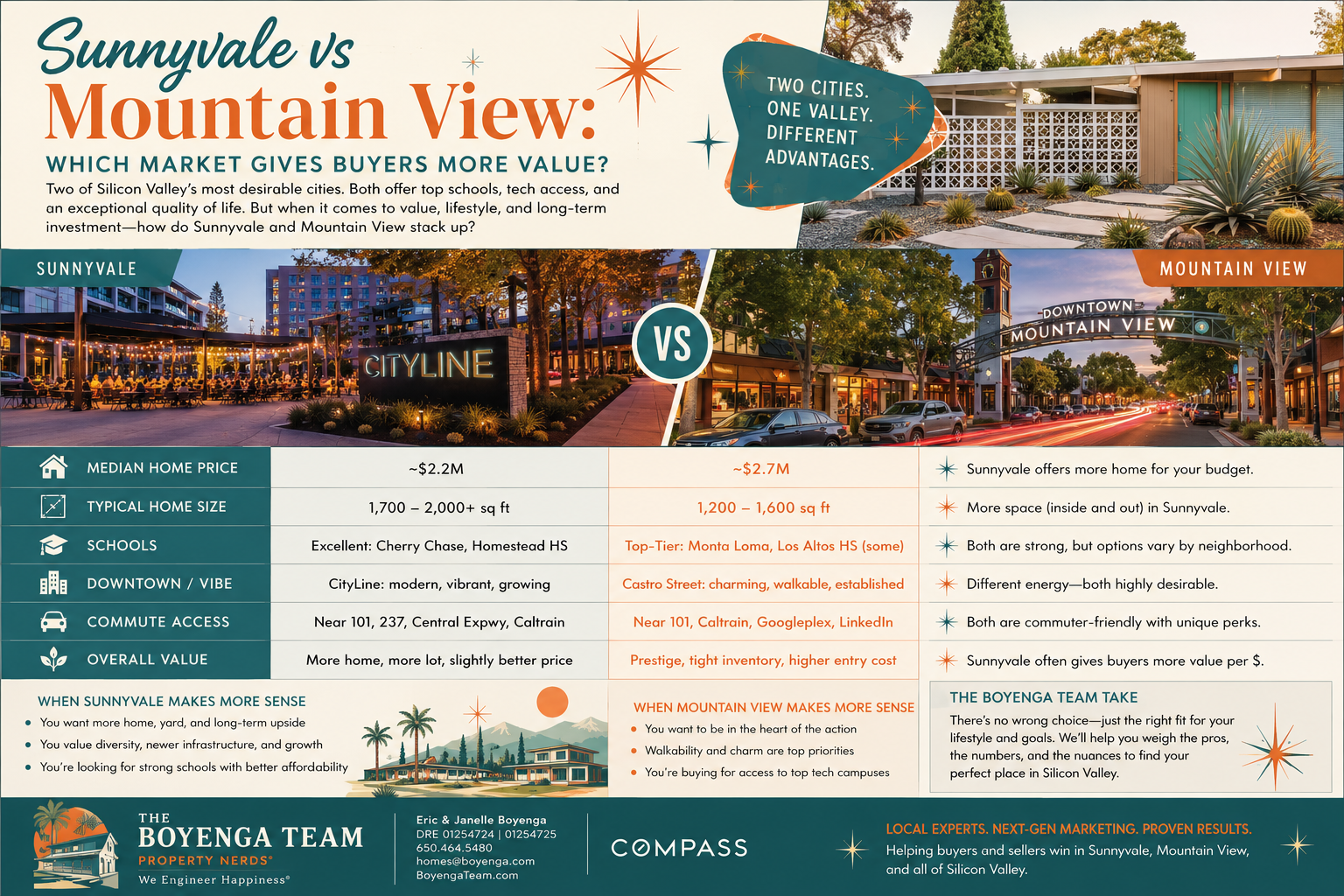
In Silicon Valley real estate, “value” does not mean cheap.
Nothing about Sunnyvale or Mountain View is cheap.
The better Property Nerd question is this: which market gives buyers more usable value for the way they actually live?
That means schools, commute, housing type, lot size, walkability, tech proximity, remodel potential, lifestyle, long-term resale, and the emotional math of what a buyer actually gets for the money.
Sunnyvale and Mountain View sit right next to each other in the Silicon Valley buyer imagination, but they do not solve the same real estate problem. Mountain View often offers stronger downtown identity, Google gravity, Caltrain/Castro Street lifestyle, Monta Loma Eichler energy, and a more recognizable tech-location brand. Sunnyvale often offers broader housing variety, more school-path diversity, deeper single-family inventory in some pockets, Apple/Google/Nvidia commute optionality, and price flexibility across multiple ZIP codes.
That is why Sunnyvale vs Mountain View is one of the most useful comparison topics for Silicon Valley home buyers.
At the Boyenga Team, we compare these markets through a Property Nerd lens: not just price, but the entire value stack behind the home. For broader city-level research, buyers can start with the Boyenga Sunnyvale real estate page and the Boyenga Team’s Mountain View neighborhood and seller resources on BoyengaTeam.com.
The short Property Nerd answer: Mountain View often wins on walkability, Google-centric lifestyle, downtown identity, and certain premium micro-locations. Sunnyvale often wins on range, relative value, neighborhood variety, and long-term flexibility for buyers who want schools, yards, tech commutes, or more ways to enter the market.
The longer answer is where it gets interesting.
The Big Picture: Two Neighboring Markets, Two Different Buyer Stories
Mountain View and Sunnyvale are both Silicon Valley powerhouse markets, but they pull buyers for different reasons.
Mountain View has a tighter, more concentrated identity. Buyers often associate it with Google, downtown Castro Street, Caltrain, Shoreline, Old Mountain View, Cuesta Park, Waverly Park, Monta Loma Eichlers, Whisman Station, and The Crossings. It feels like a city where downtown lifestyle and tech proximity are central to the story.
Sunnyvale is broader and more internally varied. It has Cherry Chase, Cumberland-area school pockets, Birdland, Raynor Park, Fairbrae Eichlers, Ortega Park, Las Palmas, Heritage District, Ponderosa, Lakewood Village, and north-side tech-access neighborhoods. It stretches across multiple commute patterns and school district combinations, which gives buyers more ways to win if they understand the micro-markets.
That is the first big lesson.
Citywide averages are not strategy.
Micro-location is strategy.
For Sunnyvale research, link readers to Boyenga’s Sunnyvale community page. For Mountain View-specific seller strategy, link to the Boyenga Team article on selling a Mountain View home to tech and family buyers. That creates a clean internal path from this comparison blog into city-specific content.
The Property Nerd Definition of “Value”
Most buyers think value means getting the most square footage for the lowest price.
That is not wrong, but it is incomplete.
In Silicon Valley, value is more layered. A smaller home in Old Mountain View may deliver more lifestyle value than a larger home in a less walkable location. A dated Sunnyvale ranch in a strong school path may offer more long-term optionality than a newer attached home with limited outdoor space. A Monta Loma Eichler may have less square footage but more architectural demand. A Lakewood Village property may offer tech commute value at a lower entry point. A Cherry Chase home may command a premium because the family-buyer pool is deep.
The Boyenga Team value framework looks at the full stack:
What does the home solve today?
What can it become later?
Who will want it next?
Does the commute work for more than one job?
Does the school path broaden demand?
Is the lot usable?
Is the floor plan livable?
Does the neighborhood have identity?
Is the premium real, or just a label?
That is how buyers should compare Mountain View vs Sunnyvale real estate.
Tech Proximity: Mountain View Has Google Gravity, Sunnyvale Has Employer Diversity
Mountain View has one of the clearest tech-location brands in Silicon Valley because of Google. Buyers who want proximity to Google, North Bayshore, Castro Street, Caltrain, Shoreline, and downtown Mountain View often gravitate there first.
Mountain View also benefits from being close to Palo Alto, Stanford, Los Altos, Sunnyvale, and the Peninsula startup ecosystem. For many buyers, Mountain View feels like a high-efficiency tech base.
For buyers focused on the Google side of the map, link naturally to the Boyenga Team’s article on best neighborhoods near Google in Mountain View. That page already reinforces the Boyenga Team’s Google-area Property Nerd positioning.
Sunnyvale’s tech story is different. It is less centered on one brand and more distributed across a broader employment base. Sunnyvale buyers may be commuting toward Apple, Google, Nvidia in Santa Clara, LinkedIn, Amazon, Intuitive, Meta, Cupertino, Mountain View, Palo Alto, Santa Clara, San Jose, or hybrid roles across the region.
The Property Nerd takeaway: Mountain View may win for buyers with a Google/downtown Mountain View-centered life. Sunnyvale may win for buyers who want commute optionality across Apple, Google, Nvidia, Santa Clara, Cupertino, Mountain View, and broader South Bay tech.
Commute Geometry: The Real Value Test
The commute question is not “which city is closer to tech?”
Both are close.
The better question is: which commute geometry matches your household?
Mountain View can be excellent for buyers commuting to Google, Intuit, LinkedIn, Microsoft, Palo Alto, Stanford, Menlo Park, and Caltrain-accessible destinations. Old Mountain View, Shoreline West, Whisman Station, The Crossings, and Monta Loma each offer a different version of commute convenience.
Sunnyvale can be excellent for buyers commuting to Apple, Google, Nvidia, LinkedIn, Amazon, Intuitive Surgical, Santa Clara tech campuses, Cupertino, Mountain View, or San Jose. Cherry Chase, Birdland, Raynor Park, Ortega Park, Fairbrae, Ponderosa, Heritage District, and Lakewood Village each serve different commute patterns.
The household matters.
If one person works at Google and the other works at Apple, Sunnyvale may offer a more balanced commute.
If one person works at Google and the other uses Caltrain north, Mountain View may be stronger.
If one person works at Nvidia and another works in Cupertino, Sunnyvale may be more flexible.
If a buyer values walking to downtown after work, Mountain View may win.
If a buyer wants a single-family home with yard and multiple employer options, Sunnyvale may win.
This is why the Boyenga Team talks about commute geometry instead of commute distance. Mileage is not enough. Traffic lights, freeway access, school drop-off, bike routes, Caltrain, employer shuttles, and hybrid-work patterns all matter.
Schools: Sunnyvale Has More Boundary Complexity; Mountain View Has Its Own Micro-Paths
School-driven buyers need to be careful in both cities.
Mountain View school assignments are address-specific, and Mountain View buyers often compare Cuesta Park, Waverly Park, Old Mountain View, Shoreline West, Monta Loma, and other micro-pockets based on school path, commute, parks, and lifestyle.
Sunnyvale is even more complex because different addresses may involve Sunnyvale School District, Cupertino Union School District, Fremont Union High School District, Santa Clara Unified School District, or other combinations depending on the exact location. This is why Sunnyvale buyers frequently compare Cherry Chase, Cumberland-area homes, Ortega Park, Fairbrae, Birdland, Raynor Park, and 94087 pockets with extreme school-boundary sensitivity.
The Property Nerd rule is the same in both cities: never buy based on a school assumption. Verify the exact address directly through the relevant district tools before writing an offer.
For value, the distinction is this:
Mountain View school demand often concentrates around specific neighborhoods and lifestyle factors such as Cuesta Park, Waverly Park, Old Mountain View, and certain school paths.
Sunnyvale school demand can create sharp value differences across micro-pockets like Cherry Chase, Cumberland-area neighborhoods, Ortega Park, Fairbrae, and parts of 94087.
If a buyer is school-focused, Sunnyvale can offer more boundary combinations and potentially more ways to find value — but it also requires more due diligence.
For internal linking, this section should point readers to Sunnyvale school-boundary content on Boyenga.com or BoyengaRealEstateTeam.com once that companion article is published.
Housing Stock: Sunnyvale Has More Variety; Mountain View Has Stronger Lifestyle Clusters
Mountain View and Sunnyvale both offer diverse housing, but the pattern feels different.
Mountain View has strong lifestyle clusters. Old Mountain View and Shoreline West are walkability-driven. Cuesta Park and Waverly Park are family-neighborhood plays. Monta Loma is a mid-century and Eichler/Mackay/Mardell architecture play. Whisman Station and The Crossings are transit-oriented townhome plays. Each neighborhood has a clear buyer psychology.
Sunnyvale has more spread and more product variety across a larger map. Buyers can pursue school-focused ranch homes in Cherry Chase or Cumberland-area pockets, Apple-area demand in Birdland and Raynor Park, Eichlers in Fairbrae and other mid-century tracts, downtown energy in the Heritage District, park lifestyle in Las Palmas and Ortega Park, relative value in Ponderosa, or north-side tech proximity in Lakewood Village.
The Property Nerd takeaway: Mountain View often gives buyers more concentrated lifestyle identity. Sunnyvale often gives buyers more ways to find the right trade-off.
That matters for value.
A buyer who wants one specific lifestyle may prefer Mountain View.
A buyer who wants to optimize budget, commute, schools, and home type may find more angles in Sunnyvale.
Single-Family Value: Sunnyvale Often Gives Buyers More Paths
For many Silicon Valley buyers, the real question is not citywide average price.
It is this: where can I buy a single-family home that works for my life?
Sunnyvale often gives buyers more single-family pathways than Mountain View because of its larger geography and broader neighborhood range. A buyer may look at Cherry Chase, Birdland, Raynor Park, Fairbrae, Ortega Park, Las Palmas, Ponderosa, Lakewood Village, or other pockets depending on budget and priorities.
Mountain View single-family homes in premium neighborhoods can be highly competitive, especially in Cuesta Park, Waverly Park, Old Mountain View, Shoreline West, and Monta Loma. Mountain View may have the stronger lifestyle identity in certain pockets, but the inventory can feel tighter and more location-specific.
This is where Sunnyvale can win on practical value.
A buyer may find a dated ranch with a usable yard and long-term remodel potential in Sunnyvale that would be harder to find at the same price point in a comparable Mountain View pocket.
But again, the answer depends on the property.
A great Mountain View home can absolutely be the better asset.
A compromised Sunnyvale home is not automatically a better deal.
Attached Homes: Mountain View May Win on Transit Lifestyle; Sunnyvale May Win on Range
For condos and townhomes, the comparison shifts.
Mountain View has strong transit-oriented options in Whisman Station, The Crossings, Old Mountain View, and downtown-adjacent areas. Buyers who want Caltrain, Castro Street, VTA light rail, Google access, or a lower-maintenance tech lifestyle may find Mountain View compelling.
Sunnyvale has downtown and CityLine momentum, Heritage District access, Caltrain, townhomes and condos near major employers, and more product range across different price points. Downtown Sunnyvale is becoming more lifestyle-driven as CityLine, Murphy Avenue, Caltrain access, retail, entertainment, and mixed-use development strengthen the urban-suburban story.
For this section, link to the Boyenga Team’s existing Sunnyvale Heritage District article: Exploring the Sunnyvale Heritage District. It supports the Downtown Sunnyvale / Heritage District angle and strengthens internal topical authority.
The Property Nerd distinction:
Mountain View attached homes may offer stronger Google/downtown Mountain View identity.
Sunnyvale attached homes may offer more variety, CityLine momentum, and access to multiple employer clusters.
For buyers, the best value depends on whether they want Castro Street/Mountain View identity or Downtown Sunnyvale/CityLine/employer-diversity value.
Walkability: Mountain View Still Has the Stronger Brand
Mountain View generally has the stronger walkability brand because of Castro Street and Old Mountain View.
Old Mountain View has a clear buyer story: downtown restaurants, cafes, Caltrain, walkability, and tech convenience. That identity is easy for buyers to understand, and easy for sellers to market.
Sunnyvale is catching up through Downtown Sunnyvale and CityLine, but the story is still evolving. CityLine, Murphy Avenue, Caltrain, Whole Foods, Target, AMC, restaurants, apartments, office space, and public plazas are changing Downtown Sunnyvale’s buyer appeal, but Mountain View’s downtown identity is more established.
The Property Nerd takeaway: Mountain View currently wins on established walkable identity. Sunnyvale may offer emerging walkability upside, especially around Downtown Sunnyvale and the Heritage District.
That can matter for long-term buyers. Some buyers prefer the proven brand. Others prefer the emerging value story.
Architecture: Mountain View Has Monta Loma Magic; Sunnyvale Has Eichler Scale
Architecture buyers should not ignore either city.
Mountain View has Monta Loma, one of the region’s most beloved mid-century modern pockets, with Eichler, Mackay, and Mardell homes creating a distinctive design neighborhood. Monta Loma buyers often care about atriums, glass, beams, indoor-outdoor living, and proximity to Google/North Bayshore.
Sunnyvale has one of the richest Eichler stories in Silicon Valley, including Fairbrae, Fairwood, Rancho Verde, Fairorchard, Parmer Place, Primewood, and other tracts. Sunnyvale can be an excellent city for buyers specifically searching for Eichler and mid-century homes.
This is where your specialty assets should carry the link equity. Link Mountain View architecture buyers to Mountain View Eichler Homes on EichlerHomesForSale.com, and link Sunnyvale architecture buyers to Sunnyvale Eichler Homes for Sale, Sunnyvale Eichler real estate information, and BayAreaEichlerHomes.com/Sunnyvale. Those pages are directly relevant to the Eichler/MCM comparison and reinforce the Boyenga Team’s mid-century authority.
The value comparison depends on the buyer.
If the buyer wants the Monta Loma lifestyle and Google proximity, Mountain View may win.
If the buyer wants a larger Sunnyvale Eichler ecosystem, Apple-area convenience, or a Fairbrae/Fairwood-style opportunity, Sunnyvale may win.
For sellers of architectural homes, the Boyenga Team would never market these like generic ranch properties. Eichler, Mackay, Mardell, and mid-century homes need architecture-aware prep, staging, photography, disclosures, and SEO.
Lot Value and Remodel Potential: Sunnyvale Often Feels More Flexible
Sunnyvale often gives buyers more ways to pursue lot value and remodel potential.
Many Sunnyvale neighborhoods include older ranch homes, single-level homes, and mid-century properties on usable lots. Buyers can find homes that are livable now but improveable over time. That is a powerful long-term value proposition, especially for buyers priced out of fully remodeled homes in Palo Alto, Los Altos, Cupertino, or premium Mountain View pockets.
Mountain View also has excellent remodel opportunities, especially in Waverly Park, Cuesta Park, Monta Loma, Shoreline West, and other single-family neighborhoods. But because Mountain View’s premium pockets are so tightly watched, buyers may face stronger competition for the most obvious opportunities.
Sunnyvale may offer more paths for buyers willing to do work.
But work must be underwritten carefully. A dated home is only a good opportunity if the purchase price, lot, remodel cost, neighborhood ceiling, and future resale story make sense.
This is a good place to internally link to a future or existing seller-prep article on BoyengaGroup.com or BoyengaRealEstateTeam.com once published.
Lifestyle: Mountain View Feels More Cohesive; Sunnyvale Feels More Strategic
This may be the most useful non-numeric comparison.
Mountain View often feels more cohesive. Buyers know what they are buying: Google, Castro Street, downtown, Caltrain, Shoreline, Cuesta Park, Waverly Park, Monta Loma, Whisman Station, The Crossings. The city has a strong identity that is easy to explain.
Sunnyvale feels more strategic. It is larger, more varied, and more micro-market dependent. A buyer can choose the school path, commute pattern, housing type, and lifestyle that fits. But because it is less singular, it requires more analysis.
That is why Sunnyvale can be the smarter value play for buyers who enjoy trade-off optimization.
Mountain View can be the stronger choice for buyers who want a more defined lifestyle brand.
The Property Nerd version: Mountain View is more legible. Sunnyvale is more flexible.
Which Market Gives More Value for Tech Buyers?
For tech buyers, the answer depends on employer and lifestyle.
Choose Mountain View if Google, Intuit, LinkedIn, Castro Street, Caltrain, Palo Alto access, and downtown Mountain View lifestyle are central to your life.
Choose Sunnyvale if your household needs access to multiple employers — Apple, Google, Nvidia, LinkedIn, Amazon, Intuitive, Santa Clara, Cupertino, Mountain View, or San Jose — and you want more neighborhood and property-type flexibility.
Mountain View may give the buyer a stronger single-employer or downtown-driven lifestyle.
Sunnyvale may give the buyer better commute optionality.
For hybrid workers, both can work well. The deciding factor may be home office, garage utility, EV charging, yard, and whether the neighborhood reduces daily friction.
Which Market Gives More Value for Families?
For families, Sunnyvale may offer more value pathways because it has more school-boundary combinations and a wider range of single-family neighborhoods.
Cherry Chase, Cumberland-area pockets, Birdland, Raynor Park, Ortega Park, Fairbrae, Las Palmas, and other areas can appeal to family buyers for different reasons. Some buyers prioritize school path. Others prioritize parks. Others prioritize commute. Others prioritize lot size and remodel potential.
Mountain View also has excellent family neighborhoods, especially Cuesta Park, Waverly Park, Shoreline West, Old Mountain View, and Monta Loma. But family buyers often face intense competition for homes that combine schools, commute, and single-family livability.
Sunnyvale may give families more ways to solve the puzzle.
Mountain View may give families a stronger premium lifestyle when the right home is available.
Which Market Gives More Value for Walkability Buyers?
Mountain View is usually the stronger answer for walkability buyers who want an established downtown lifestyle.
Old Mountain View and Castro Street have a clearer brand than Downtown Sunnyvale, though Downtown Sunnyvale and CityLine are changing that conversation.
Sunnyvale may become increasingly compelling for buyers who like emerging walkability and want to be near CityLine, Murphy Avenue, Caltrain, and a growing mixed-use core. But if the buyer wants the most established downtown walkability today, Mountain View likely wins.
The Property Nerd nuance: Mountain View may have stronger current walkability value; Sunnyvale may have stronger emerging walkability upside.
Which Market Gives More Value for Investors?
Investor value depends heavily on property type, financing, HOA rules, rental restrictions, expenses, and long-term strategy.
Mountain View can appeal because of Google, downtown, Caltrain, and strong renter demand from tech workers.
Sunnyvale can appeal because of employer diversity, Apple/Google/Nvidia access, downtown growth, and wider property variety.
The investor question is not “which city is better?”
It is: which property has the best rent-demand story, operating cost structure, liquidity, and resale path?
A Whisman Station townhome, Old Mountain View condo, Downtown Sunnyvale condo, Lakewood Village home, Heritage District property, or Sunnyvale Eichler will each underwrite differently.
The Boyenga Team would evaluate investor demand by micro-market, not city label.
Seller Strategy: How to Position a Sunnyvale Home Against Mountain View
If you are selling in Sunnyvale, Mountain View is often part of the buyer’s comparison set.
That means Sunnyvale sellers should be prepared to explain value.
A Sunnyvale listing should highlight what the buyer gets that may be harder or more expensive to find in Mountain View: school-path opportunity, Apple/Nvidia/Google commute flexibility, larger yard potential, single-family options, Eichler scale, Downtown Sunnyvale/CityLine momentum, or price relative to Mountain View premium pockets.
For example:
A Cherry Chase home should speak to school-focused buyers comparing Sunnyvale and Mountain View.
A Birdland or Raynor Park home should speak to buyers comparing Apple-area Sunnyvale value against Mountain View’s Google premium.
A Fairbrae Eichler should speak to buyers comparing Sunnyvale’s Eichler ecosystem against Monta Loma.
A Heritage District home should speak to buyers comparing Downtown Sunnyvale and Old Mountain View.
A Lakewood Village home should speak to buyers comparing north Sunnyvale tech access with Mountain View and Santa Clara alternatives.
This is how a seller turns comparison into leverage.
Link seller-focused readers to BoyengaTeam.com, Boyenga.com, and Boyenga Real Estate Team for conversion. BoyengaTeam.com describes Eric and Janelle Boyenga as Silicon Valley real estate experts, Compass founding partners, and Property Nerds with deep local market knowledge and strategic marketing.
Seller Strategy: How to Position a Mountain View Home Against Sunnyvale
If you are selling in Mountain View, Sunnyvale is also part of the buyer’s comparison set.
The Mountain View listing should explain why the premium is justified.
That may mean Google proximity, Castro Street, Caltrain, Old Mountain View walkability, Cuesta Park lifestyle, Waverly Park lot quality, Monta Loma architecture, Shoreline West charm, Whisman Station transit convenience, or The Crossings/San Antonio access.
Mountain View sellers should not rely only on the city name. They should make the lifestyle obvious.
If the home offers true downtown walkability, sell that.
If it offers a quiet Waverly Park lot, sell that.
If it offers Monta Loma mid-century magic, sell that.
If it offers transit-oriented convenience, sell that.
Mountain View buyers may be willing to pay more, but they still need to understand why the home is better than a Sunnyvale alternative.
Internal Link Map for This Article
Use these links naturally throughout the final web version:
Boyenga Team Home — primary brand link and general Silicon Valley authority.
Boyenga.com — main team/brand site and conversion destination.
Boyenga Sunnyvale — best city-specific link for Sunnyvale mentions.
Boyenga Real Estate Team — good seller/buyer strategy authority link.
Boyenga Group — good team/seller-prep/internal brand link, though the page returned an internal fetch error in my tool; the domain should still be used if it loads normally for your site.
Mountain View tech/family seller blog — relevant internal link for Mountain View seller positioning.
Best neighborhoods near Google in Mountain View — relevant for Google/North Bayshore mentions.
Sunnyvale Heritage District blog — relevant for Downtown Sunnyvale/Heritage District/CityLine mentions.
EichlerHomesForSale.com — primary Eichler authority asset.
Sunnyvale Eichler Homes Search — best link for Sunnyvale Eichler mentions.
Sunnyvale Eichler Information — best informational asset for Sunnyvale Eichler history/value.
Mountain View Eichler Information — best link for Monta Loma/Mountain View Eichler mentions.
Bay Area Eichler Homes — Sunnyvale — secondary Eichler link for Sunnyvale architecture buyers.
Bay Area Eichler Homes — broader Eichler platform link.
The Property Nerd Verdict
So, which market gives buyers more value?
Sunnyvale often gives more option value.
Mountain View often gives more identity value.
Sunnyvale offers more ways to optimize: schools, commute, tech access, neighborhoods, property types, lot opportunities, and relative pricing.
Mountain View offers a more concentrated lifestyle brand: Google, Castro Street, Caltrain, downtown, Monta Loma, Cuesta Park, Waverly Park, and a tighter tech-location story.
Choose Sunnyvale if you want more flexibility, more neighborhood choices, more employer-diverse commute options, and potentially more paths into single-family ownership.
Choose Mountain View if you want a stronger downtown identity, Google-centric location, established walkability, and highly recognizable lifestyle neighborhoods.
The best choice is not the city.
The best choice is the property that gives you the strongest value stack for your life.
Final Property Nerd Takeaway
Sunnyvale vs Mountain View is not a simple winner-takes-all comparison.
Mountain View may offer stronger lifestyle identity, downtown walkability, Google gravity, and recognizable micro-market appeal.
Sunnyvale may offer more strategic flexibility, school-path variety, tech commute optionality, housing range, and long-term value angles relative to more expensive Silicon Valley markets.
For buyers, the smartest move is to define value before shopping: schools, commute, lifestyle, lot, home condition, future potential, and resale. Then compare properties, not city stereotypes.
For sellers, the smartest move is to understand how buyers are cross-shopping the two markets and position the home accordingly.
At the Boyenga Team, we bring a Property Nerd and Next Gen Agent approach to Silicon Valley home buying — comparing not just prices, but the deeper value stack behind each neighborhood, street, lot, floor plan, commute, and buyer pool.
Because in Silicon Valley, value is not just what you pay.
It is what the property solves.
The Boyenga Team
Sunnyvale, Mountain View & Silicon Valley Real Estate Experts
Compass
BoyengaTeam.com
Boyenga.com
Boyenga Sunnyvale
BoyengaRealEstateTeam.com
BoyengaGroup.com
EichlerHomesForSale.com
BayAreaEichlerHomes.com
Email: homes@boyenga.com