

Blog > Sunnyvale vs. Cupertino: Schools, Commutes, Apple Proximity, and Long-Term Value
Sunnyvale vs. Cupertino: Schools, Commutes, Apple Proximity, and Long-Term Value
by
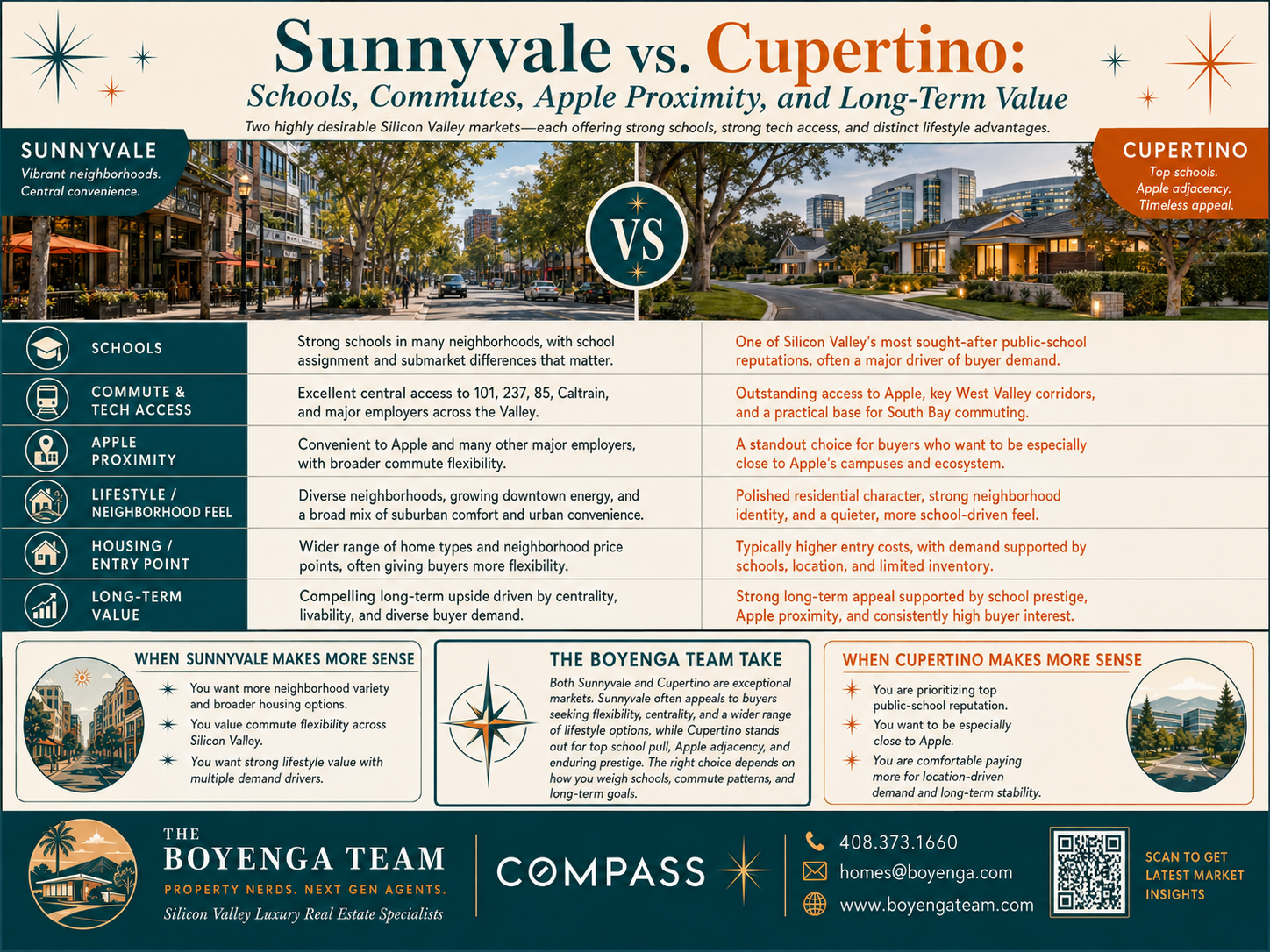
A Property Nerd’s Strategic Guide to Two Apple-Centric Silicon Valley Markets
For Silicon Valley buyers, the choice between Sunnyvale and Cupertino is often framed too simply. People say Cupertino has the schools and Apple. They say Sunnyvale has more value and more inventory. Both statements are partly true, but they do not go deep enough. From a Property Nerd perspective, Sunnyvale vs. Cupertino is really a strategy question about school districts, Apple commute efficiency, price elasticity, neighborhood identity, housing stock, and long-term resale demand.
Cupertino is the more globally recognized school-and-Apple market. It carries the psychological power of Apple Park, a strong education brand, and a premium residential identity that has attracted engineers, executives, founders, and international relocation buyers for decades. Sunnyvale is the more flexible, diversified, and value-layered market. It offers access to Apple, Google, LinkedIn, Nvidia, Meta, Amazon, and the broader South Bay tech ecosystem, while providing a wider range of neighborhoods, housing types, price points, and school district paths.
The simplest way to frame the comparison is this: Cupertino is the premium school-and-Apple identity market, while Sunnyvale is the strategic access-and-value market. Cupertino often appeals to buyers who want the strongest possible association with Apple proximity, Cupertino schools, and long-term school-driven demand. Sunnyvale often appeals to buyers who want great Silicon Valley access without committing every dollar to the Cupertino premium.
Current market data shows how different the two cities can feel financially. Redfin’s three-month data ending May 2026 showed Cupertino with a median sale price of approximately $3.23 million, a median price per square foot of about $1,340, and homes selling in around 10 days. Sunnyvale, by comparison, showed a median sale price of approximately $1.79 million, a median price per square foot of about $1,260, and homes selling in around 11 days. Both markets are highly competitive, but Cupertino’s higher median price reflects its school-driven and Apple-proximity premium, while Sunnyvale’s lower median price reflects a broader mix of condos, townhomes, starter single-family homes, Eichlers, ranch homes, and move-up properties.
That price gap is the heartbeat of this comparison. Cupertino buyers are often paying for certainty: school reputation, Apple adjacency, neighborhood prestige, and a deeply established resale story. Sunnyvale buyers are often paying for functionality: commute access, school optionality, downtown growth, more housing variety, and relative value within the Silicon Valley ecosystem.
Cupertino’s real estate identity is inseparable from Apple Park. The City of Cupertino describes Apple Park as a 175-acre site bounded by I-280, Wolfe Road, Homestead Road, and North Tantau Avenue, with the project including approximately 2.8 million square feet of office and research-and-development space. Apple also lists the Apple Park Visitor Center at 10600 North Tantau Avenue in Cupertino, reinforcing how visible Apple’s presence is in the city’s physical and cultural identity.
This matters because major corporate campuses create residential gravity. Buyers do not just want to live near work because it is convenient. They want to reduce friction. They want school drop-off to work. They want a commute that does not steal their evenings. They want their home purchase to align with the employment engine that supports future buyer demand. In Cupertino, Apple is not just nearby. It is part of the city’s valuation story.
Sunnyvale, however, should not be treated as secondary to Cupertino when it comes to Apple access. In many cases, Sunnyvale can be extremely practical for Apple employees, especially for those working around Apple Park, Mathilda, Wolfe, De Anza, Central Expressway, or other South Bay office clusters. Sunnyvale also has its own technology economy and sits near multiple major employment nodes. Media reports in 2025 noted Apple’s purchase of the Mathilda Commons campus in Sunnyvale and Cupertino Gateway, underscoring that Apple’s South Bay footprint extends beyond the ring-shaped Cupertino headquarters.
This is where the Property Nerd analysis gets more interesting. A Cupertino buyer may be buying the Apple brand adjacency. A Sunnyvale buyer may be buying the Apple commute without paying the full Cupertino identity premium. For some households, that difference can translate into a better floor plan, a larger home, a better yard, a lower mortgage, or more financial flexibility.
Schools are the other major force shaping the Sunnyvale vs. Cupertino decision. Cupertino’s school reputation is one of the strongest in Silicon Valley. The City of Cupertino states that most Cupertino children attend elementary and middle school in Cupertino Union School District, which it describes as the largest elementary school district in Northern California and one of the premier districts in the state. The city also notes that most Cupertino teenagers attend Fremont Union High School District, which includes five comprehensive high schools and serves Cupertino plus portions of five other cities.
For buyers, that school reputation creates demand density. Cupertino’s school brand attracts families who may be willing to sacrifice home size, remodel quality, or lot size in exchange for perceived academic strength and long-term resale demand. This is why Cupertino properties can remain intensely competitive even when the homes themselves are modest, dated, or in need of significant renovation.
Sunnyvale’s school story is more nuanced, and that nuance creates both opportunity and confusion. Sunnyvale includes multiple school district paths depending on the exact address. Many Sunnyvale homes are served by Sunnyvale School District for elementary and middle school, including schools such as Cherry Chase Elementary, Cumberland Elementary, Sunnyvale Middle, Columbia Middle, Vargas, Ellis, San Miguel, Lakewood, Fairwood, and Bishop. Other Sunnyvale addresses may fall into Cupertino Union School District or Santa Clara Unified, with high school assignments often involving Fremont Union or Santa Clara Unified depending on location. Sunnyvale School District lists Cherry Chase, Cumberland, Columbia Middle, Sunnyvale Middle, and other schools in its district, while Fremont Union High School District lists schools including Cupertino, Fremont, Homestead, Lynbrook, and Monta Vista.
This makes Sunnyvale a highly address-sensitive market. A buyer cannot simply say, “I want Sunnyvale schools.” That phrase is too broad. The real analysis is parcel by parcel. Is the home in Cherry Chase? Cumberland? Sunnyvale Middle? Homestead High? Fremont High? Cupertino Union? Santa Clara Unified? The school assignment can materially affect buyer demand, resale confidence, and pricing strategy.
Cupertino also requires verification, even though the city’s school brand is stronger and more consolidated in buyer perception. The City of Cupertino notes that most children attend Cupertino Union for elementary and middle school, but it also states that a section of northeast Cupertino is served by Santa Clara Unified for elementary, middle, and high school. That detail matters because buyers who assume every Cupertino address follows the same school path can make costly mistakes.
From a long-term value perspective, school districts function like invisible infrastructure. They are not visible in the kitchen photos. They do not appear in the bedroom count. But they shape buyer urgency. A strong school boundary can increase the number of future buyers who emotionally and financially justify the property. In Cupertino, the school premium is more citywide in perception. In Sunnyvale, the school premium is more neighborhood-specific and boundary-specific.
Sunnyvale’s strongest school-driven micro-markets often include neighborhoods such as Cherry Chase, Cumberland South, Birdland, Raynor Park, Las Palmas, Ortega Park, and parts of West Sunnyvale. These areas can attract buyers who want Sunnyvale pricing with school paths that compete very well across Silicon Valley. The key advantage is that buyers may find better value than Cupertino while still accessing strong school demand and convenient commute corridors.
Cupertino’s strongest school-driven micro-markets often include Monta Vista, Garden Gate, Jollyman, Portal, Seven Springs, Oak Valley, Rancho Rinconada, and areas feeding into high-demand Fremont Union High School District paths. In Cupertino, buyers are often looking not only at schools, but at the combination of schools plus Apple proximity plus established neighborhood identity.
Commute logic differs in each city. Cupertino is often the cleanest emotional answer for buyers focused on Apple Park. The commute story is simple, legible, and powerful. For Apple employees, founders, product leaders, engineers, and executives who want to be close to headquarters, Cupertino offers a direct lifestyle thesis. Living near Apple Park, De Anza Boulevard, Wolfe Road, Homestead Road, Stevens Creek Boulevard, or near the Cupertino-Sunnyvale border can make daily life easier.
Sunnyvale is often the broader employment-access play. It can work beautifully for Apple employees, but it also works for households with mixed commutes. One spouse may be going to Apple, another to Google, LinkedIn, Nvidia, Amazon, Meta, Stanford, or a startup in Mountain View, Palo Alto, Santa Clara, or San Jose. In that sense, Sunnyvale can be a more diversified commute hedge. It is not only an Apple commute market. It is a Silicon Valley mobility market.
Downtown lifestyle is another differentiator. Cupertino has improved its retail, dining, and mixed-use environment over time, but it still reads primarily as a suburban school-and-employer market. Sunnyvale has a stronger downtown transformation story. The City of Sunnyvale describes downtown as approximately 150 acres with Historic Murphy Avenue, Plaza del Sol, Redwood Square, and the CityLine project as key elements. The CityLine project is a 36-acre downtown site planned for mixed-use retail, dining, entertainment, residential, and office uses.
That matters for future value because walkability and downtown energy are increasingly important to Silicon Valley buyers. Sunnyvale’s Downtown and CityLine evolution gives the city a lifestyle catalyst that Cupertino does not replicate in quite the same way. For buyers who want restaurants, Caltrain access, mixed-use energy, and a more urban-suburban rhythm, Sunnyvale can feel more dynamic.
Cupertino’s lifestyle is quieter and more school-centered. It is about convenience to Apple, excellent public schools, De Anza College, neighborhood parks, mature residential areas, and a strong family-oriented culture. It is not trying to be Mountain View or Palo Alto. Its value is more focused. Cupertino buyers are often choosing consistency, academic reputation, and proximity to Apple over nightlife or downtown vibrancy.
Sunnyvale’s housing stock is more varied. Buyers can find Eichlers in Fairbrae and other mid-century pockets, classic ranch homes in Birdland and Raynor Park, family homes in Cherry Chase and Cumberland, condos and townhomes near downtown, Lakewood homes near North Sunnyvale employment, and larger West Sunnyvale homes closer to Cupertino and Los Altos influences. This range creates more entry points and more strategic options.
Cupertino’s housing stock is narrower but powerful. Buyers often see ranch homes, expanded ranches, custom homes, newer construction, townhomes, and high-value single-family properties tied closely to school and commute demand. Because Cupertino’s citywide brand is so strong, even dated homes can command premium pricing if the lot, location, and school path are strong.
For buyers, the Sunnyvale vs. Cupertino decision should not start with ego. It should start with use case. If a family’s highest priority is Cupertino school identity, Apple Park proximity, and long-term demand from school-focused buyers, Cupertino may justify the premium. If a family wants strong schools, good commute access, more housing flexibility, downtown energy, and a better price-to-function ratio, Sunnyvale may be the smarter strategy.
For sellers, the positioning strategy is different in each city. A Cupertino seller should usually lean into school strength, Apple proximity, neighborhood reputation, lot quality, and long-term scarcity. The marketing should make the buyer feel that the property is part of an elite Silicon Valley education-and-innovation corridor. A Sunnyvale seller should usually lean into commute versatility, school path, neighborhood identity, value relative to Cupertino, downtown access, tech proximity, and lifestyle flexibility. The marketing should make the buyer feel that they are getting a smart Silicon Valley asset with multiple demand drivers.
Long-term value in Cupertino is likely to remain tied to schools, Apple, limited supply, and global buyer recognition. Cupertino has a durable brand that travels well with relocation buyers, especially those focused on education and South Bay technology employment. Even when the broader market cools, the best Cupertino homes tend to benefit from a deep pool of buyers who understand why the location matters.
Long-term value in Sunnyvale is likely to remain tied to its central position in Silicon Valley. It touches multiple employment corridors, offers a variety of price points, benefits from downtown investment, and includes several highly desirable school-driven neighborhoods. Sunnyvale also has a larger and more diversified housing base, which can make it more liquid for different kinds of buyers at different life stages.
There are risks in both cities. In Cupertino, the most common mistake is overpaying for the name without fully analyzing the specific asset. A buyer can pay a premium for Cupertino but still end up with a compromised lot, a poor floor plan, significant deferred maintenance, or an address that does not match their assumed school path. In Sunnyvale, the most common mistake is underestimating how much micro-location matters. A home in one Sunnyvale pocket can have a very different resale story than a similar home across town.
The Property Nerd move is to evaluate the full stack: school assignment, commute route, lot utility, floor plan, remodel potential, street quality, noise, proximity to transit, access to Apple and other employers, neighborhood identity, future buyer pool, and resale narrative. In Silicon Valley, small differences in location can create very large differences in value.
Smart-home and future-proofing features matter in both markets. Buyers in Sunnyvale and Cupertino increasingly look for EV charging, solar, battery backup, heat pump HVAC, induction cooking, strong Wi-Fi, smart thermostats, leak detection, smart irrigation, advanced security, and functional home office space. Cupertino buyers often connect these features to Apple-style expectations around design, technology, and efficiency. Sunnyvale buyers often connect them to practical daily life, hybrid work, energy savings, and long-term flexibility.
ADU potential is another important long-term value lever. In Cupertino, an ADU can support multigenerational living, guest space, or additional flexibility for families who want to stay in a premium school district long-term. In Sunnyvale, ADUs can be especially strategic because the city has more varied lot patterns and buyer profiles, from family buyers to investors to multigenerational households. In both cities, the value depends on lot size, setbacks, access, utilities, trees, and whether the ADU actually enhances the way the property lives.
The final decision comes down to what the buyer is optimizing for. Cupertino is often the better fit for buyers who want maximum Apple identity, strong school branding, premium South Bay resale demand, and a quieter family-oriented lifestyle. Sunnyvale is often the better fit for buyers who want Apple commute convenience without the full Cupertino premium, broader tech access, more housing variety, downtown energy, and strong long-term value.
At the Boyenga Team at Compass, we view Sunnyvale vs. Cupertino as a strategic real estate decision, not a simple city comparison. Eric and Janelle Boyenga, known as Silicon Valley Property Nerds and Next Gen Agents, help clients evaluate the details that actually drive value: school boundaries, Apple commute patterns, lot utility, neighborhood identity, remodel risk, smart-home readiness, buyer psychology, Compass technology, and long-term resale positioning.
Compass gives the Boyenga Team a technology-forward platform that fits the Silicon Valley mindset. In a market shaped by data, private inventory, digital marketing, pricing intelligence, buyer behavior, and fast-moving micro-markets, the tools matter. But interpretation matters more. Data can tell you what sold. Experience tells you why it sold, who wanted it, and how that affects the next decision.
Sunnyvale and Cupertino are both powerful Silicon Valley markets. Cupertino offers school prestige and Apple gravity. Sunnyvale offers flexibility, access, and long-term value. The smart move is not to chase the city with the louder reputation. The smart move is to identify which market best fits your budget, commute, school goals, lifestyle, and future resale strategy.
The Boyenga Team at Compass represents buyers and sellers throughout Silicon Valley with a focus on luxury homes, Eichler and mid-century modern properties, school-driven moves, estate homes, trust sales, and high-value residential strategy. Known as Property Nerds and Next Gen Agents, Eric and Janelle Boyenga combine data, design, technology, negotiation, and local market intelligence to help clients make smarter real estate decisions in Sunnyvale, Cupertino, Palo Alto, Los Altos, Mountain View, Menlo Park, Saratoga, Los Gatos, and the greater Silicon Valley market. For expert guidance, contact the Boyenga Team at Compass at homes@boyenga.com or visit www.BoyengaTeam.com.