

Blog > Sunnyvale Neighborhoods Explained: A Property Nerds Guide to Schools, Commutes, and Home Values
Sunnyvale Neighborhoods Explained: A Property Nerds Guide to Schools, Commutes, and Home Values
by
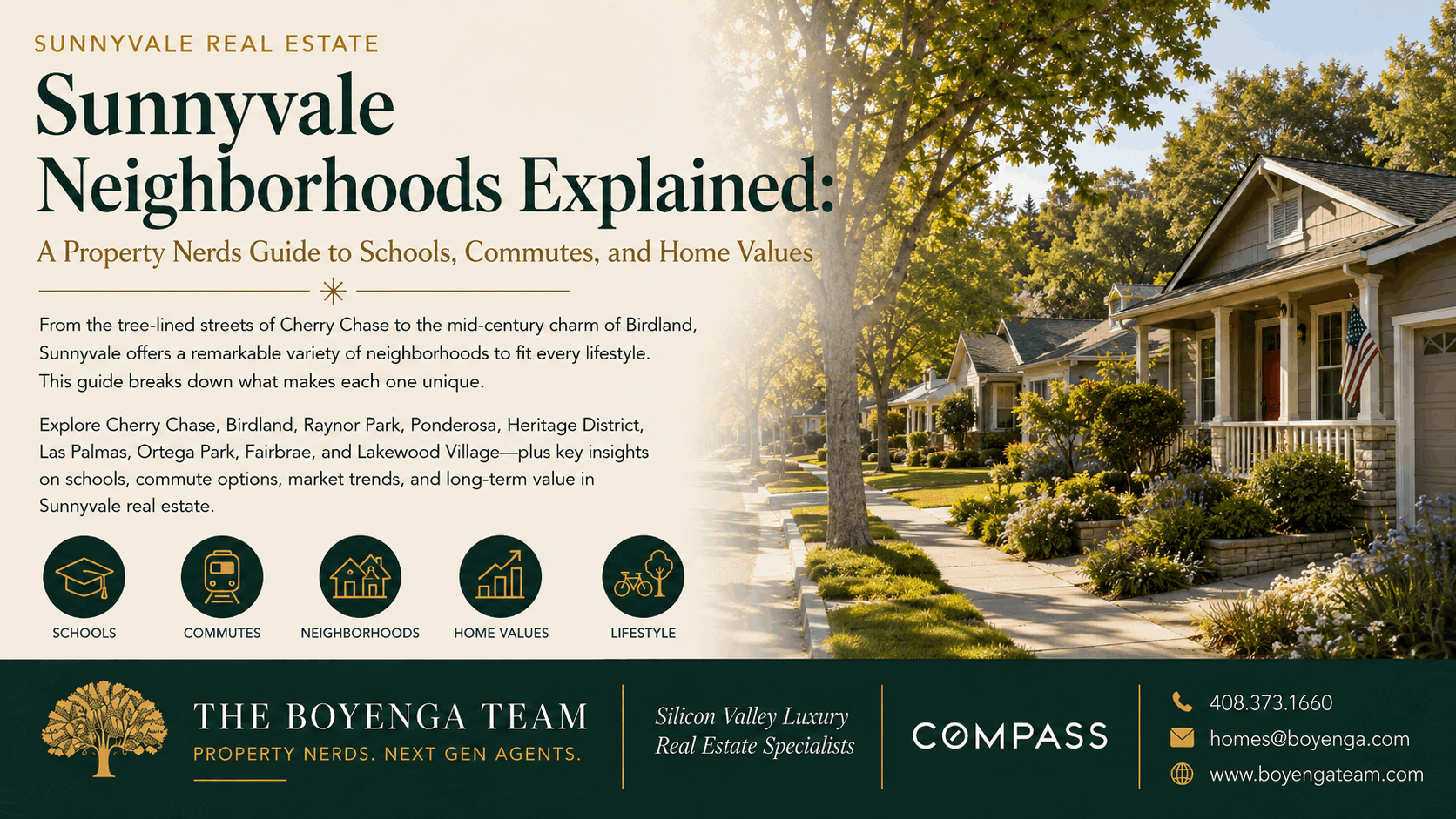
Sunnyvale is one of Silicon Valley’s most strategic real estate markets because it gives buyers something surprisingly hard to find: neighborhood living with serious tech access.
It is not Palo Alto.
It is not Los Altos.
It is not Cupertino.
It is not Mountain View.
Sunnyvale is its own thing — practical, park-rich, commute-friendly, school-driven, architecturally varied, and deeply tied to the tech economy. It has ranch homes, Eichlers, remodeled family homes, newer construction, townhomes, condos, downtown-adjacent homes, park-centered pockets, and north-side neighborhoods shaped by access to major employers.
That is why Sunnyvale real estate cannot be understood by ZIP code alone.
Cherry Chase is not Birdland.
Birdland is not Ponderosa.
Ponderosa is not Heritage District.
Heritage District is not Lakewood Village.
Las Palmas, Ortega Park, Fairbrae, Raynor Park, and Cherry Chase each attract buyers for different reasons.
The Property Nerd truth is simple: Sunnyvale is a micro-location market.
Two Sunnyvale homes with similar square footage can produce very different buyer demand depending on school pathway, commute route, lot utility, street quality, park access, remodel potential, proximity to Apple or Google, downtown access, and whether the home lives like a modern Silicon Valley family wants it to live.
At the Boyenga Team, we analyze Sunnyvale the way serious buyers and sellers actually experience it: by neighborhood, commute geometry, school-boundary verification, lot value, architecture, home condition, buyer pool, and resale story. This guide breaks down some of the most important Sunnyvale neighborhoods, including Cherry Chase, Birdland, Raynor Park, Ponderosa, Heritage District, Las Palmas, Ortega Park, Fairbrae, and Lakewood Village.
Why Sunnyvale Real Estate Is So Strategic
Sunnyvale sits in the heart of Silicon Valley’s employment map. The city’s own 2025 largest-employer data lists Google, Apple, Amazon, Intuitive Surgical, Lockheed Martin, Walmart, Meta, Synopsys, Applied Materials, Fortinet, Cepheid, Proofpoint, LinkedIn, Juniper Networks, CrowdStrike, JFrog, and others among major local employers. That employer base is one reason Sunnyvale buyers often think carefully about commute access, tech proximity, hybrid-work flexibility, and long-term resale demand.
From a real estate standpoint, Sunnyvale is a high-demand market, but the numbers vary by data source and housing type. Zillow reported an average Sunnyvale home value of approximately $2.115 million as of May 31, 2026, with homes going pending in a median of 12 days, while Realtor.com reported a Sunnyvale median listing price around $1.59 million and described the city as a seller’s market in May 2026, with homes selling at about a 105% sale-to-list ratio.
The Property Nerd takeaway: Sunnyvale is not cheap, but it can offer a wider range of property types and neighborhood choices than some neighboring luxury markets. Buyers can pursue school-focused single-family homes in west and south Sunnyvale, downtown walkability in the Heritage District, tech-proximity homes near Moffett Park and north Sunnyvale, park-centered neighborhoods like Las Palmas and Ortega Park, and relative-value opportunities in pockets such as Lakewood Village or Ponderosa.
The Property Nerd Framework for Comparing Sunnyvale Neighborhoods
Before choosing a Sunnyvale neighborhood, buyers should avoid the classic mistake: shopping by price and bedroom count alone.
The smarter question is: what is the value stack?
In Sunnyvale, the value stack usually includes school pathway, commute geometry, housing stock, lot size, lot usability, outdoor living, home condition, remodel potential, street quality, park access, and future resale demand. A home in Cherry Chase may command attention because of school-driven buyer demand and classic family-home appeal. A Birdland or Raynor Park home may attract buyers because of Apple proximity, larger-lot potential, and established residential streets. A Heritage District home may sell on downtown access and walkability. A Lakewood Village home may appeal to buyers prioritizing tech access, north-side convenience, and relative affordability.
The key is that each neighborhood solves a different buyer problem.
Sunnyvale also requires school-boundary precision. The Sunnyvale School District lists elementary and middle schools including Cherry Chase, Cumberland, Ellis, Fairwood, Lakewood, San Miguel, Vargas, Columbia Middle, and Sunnyvale Middle, and provides boundary resources for address-specific verification. Other Sunnyvale addresses may fall into Cupertino Union School District, Fremont Union High School District, or Santa Clara Unified School District boundaries, depending on the exact location. Cupertino Union’s locator describes its results as preliminary assignments based on CUSD boundaries, Fremont Union directs families to an address check tool for school-specific boundary confirmation, and Santa Clara Unified tells families to confirm district boundaries through its school locator.
Property Nerd rule: never buy a Sunnyvale home based on a school assumption. Verify the exact address directly with the applicable district before making an offer.
Cherry Chase: Classic West Sunnyvale Family Demand
Cherry Chase is one of Sunnyvale’s most recognizable family-oriented neighborhoods. It has the kind of residential rhythm many buyers imagine when they start searching for Sunnyvale homes for sale: tree-lined streets, single-family homes, established blocks, yards, quiet pockets, and a location that feels connected without being overly urban.
The housing stock in Cherry Chase is often classic Silicon Valley postwar suburbia: ranch homes, expanded homes, remodeled properties, and some newer custom rebuilds. Many homes were built during the 1950s and 1960s, which means buyers often find single-level layouts, usable lots, and floor plans that can be refreshed, expanded, or reimagined over time.
Cherry Chase buyers are usually not only buying the house. They are buying the neighborhood story.
They often value school-path appeal, access to Sunnyvale-Saratoga Road, Highway 85, El Camino Real, Homestead Road, nearby shopping, parks, and proximity to both Sunnyvale and Los Altos lifestyles. This is a neighborhood that tends to attract families who want a classic single-family environment but still need strong Silicon Valley access.
From a buyer psychology standpoint, Cherry Chase often competes with parts of Cupertino, Los Altos, Mountain View, and other west Sunnyvale pockets. Buyers may compare based on lot size, school pathway, commute to Apple or Google, and whether the home has enough yard and flexibility for long-term family living.
For sellers, Cherry Chase should be marketed around more than square footage. The right story emphasizes family functionality, school-boundary verification resources, single-level potential, lot usability, quiet streets, commute access, and the ability to own a classic Sunnyvale home in one of the city’s strongest family-demand pockets.
Best for: buyers who want a classic residential Sunnyvale neighborhood, school-driven demand, yards, ranch homes, and strong west-side commute options.
Property Nerd watch-outs: verify exact schools, evaluate street traffic, study remodel potential, check lot orientation, and understand whether the home is priced as move-in ready, cosmetic opportunity, expansion candidate, or land-value play.
Birdland: Apple-Area Energy, Bigger-Lot Psychology, and Remodel Upside
Birdland is one of Sunnyvale’s most talked-about residential pockets because it sits in a powerful part of the map. The neighborhood is known for bird-named streets and is closely associated with the Raynor Park area, Apple-area commute convenience, and strong buyer demand for single-family homes with remodel or rebuild potential.
The Birdland buyer is often very specific. They may work at Apple, commute toward Cupertino, Sunnyvale, Mountain View, Santa Clara, or Palo Alto, and want a home that gives them access to major job centers without giving up a residential neighborhood feel. They may also be looking for a larger lot, a classic ranch-style home, or a dated property they can transform.
This is where Birdland gets very Property Nerdish.
A dated Birdland ranch can be more valuable than it looks because buyers may see future optionality. The current home may be livable, but the land, street, school pathway, and proximity to major employers may be the real value drivers. Builders, remodel buyers, and move-up families may all look at the same property differently.
A family buyer may see a home near parks and schools.
A tech buyer may see commute compression.
A remodel buyer may see a floor plan they can open up.
A builder may see land value and neighborhood ceiling.
A long-term owner may see future resale strength.
That is why Birdland homes need nuanced pricing and marketing.
For sellers, the Boyenga Team would position Birdland around residential stability, Apple-area access, lot potential, Raynor Park proximity, single-family scarcity, and future buyer demand. The marketing should not oversell every older home as “move-in luxury,” but it also should not undersell the property as just a dated ranch. The better story is often: rare Sunnyvale land and lifestyle opportunity in a high-demand commute pocket.
Best for: buyers who want west Sunnyvale convenience, Apple-area access, established streets, single-family homes, and remodel or rebuild potential.
Property Nerd watch-outs: exact school boundaries matter, busy-street exposure can affect pricing, and older homes should be evaluated for roof, foundation, electrical, plumbing, drainage, sewer, and prior additions.
Raynor Park: Park-Centered Living With Strong West Sunnyvale Fundamentals
Raynor Park is often discussed alongside Birdland because the two are closely connected in buyer psychology. But Raynor Park has its own identity because the park itself becomes a major lifestyle anchor.
Raynor Park’s official city page describes it as an 11.9-acre park with dinosaur-themed play areas, picnic sites, a playground, horseshoe pits, basketball courts, reservable sports fields, and two ballfields. For families, that matters. Park access changes daily life. It gives children a place to play, parents a place to gather, dog walkers a routine, and the neighborhood a natural center of gravity.
The real estate around Raynor Park tends to attract buyers who want practical family living, west Sunnyvale access, and a location that feels residential without being disconnected. The neighborhood can include classic ranch homes, expanded homes, and newer rebuilds. Some buyers are looking for move-in ready properties, but many are also open to updating because the underlying location is strong.
From a Property Nerd standpoint, Raynor Park homes are about the fundamentals: land, location, schools, commute, and daily livability. This is not a neighborhood that sells primarily on nightlife or downtown energy. It sells on usable family life.
For sellers, the marketing should make that lifestyle obvious. A Raynor Park home should be presented with bright photography, clean yard staging, office/flex-room clarity, school-verification guidance, and a neighborhood story that connects park access with Apple, Cupertino, Sunnyvale, and broader Silicon Valley commute options.
Best for: buyers who want west Sunnyvale family living, park access, single-family homes, and strong commute flexibility.
Property Nerd watch-outs: buyers should evaluate parking, street position, school district assignment, condition of older systems, and whether the lot supports future expansion.
Ponderosa: Practical Sunnyvale Living With Commute Convenience
Ponderosa is one of Sunnyvale’s practical, centrally located neighborhoods that can appeal to buyers who want access, value, and everyday livability. It may not always have the same name recognition as Cherry Chase or Birdland, but that is part of why Property Nerds pay attention to it.
Ponderosa often attracts buyers who want to stay connected to El Camino Real, Lawrence Expressway, Central Expressway, major employers, shopping, restaurants, and daily services. It can appeal to tech workers, first-time single-family buyers, condo/townhome move-up buyers, investors, and families looking for a more approachable Sunnyvale entry point.
Realtor.com’s neighborhood data placed Ponderosa’s median listing price around $1.39 million in its May 2026 Sunnyvale market snapshot, lower than several higher-priced Sunnyvale areas included in the same table, though individual property value still depends heavily on housing type, condition, lot, school pathway, and micro-location.
Ponderosa’s buyer pool is often value-sensitive but practical. These buyers may be comparing Sunnyvale against Santa Clara, San Jose, Mountain View, and parts of East Sunnyvale. They want to know: Does the commute work? Is the home functional? Is there outdoor space? Are schools verified? Is there remodel upside? Is this a better long-term play than a newer townhome elsewhere?
For sellers, Ponderosa homes should be marketed around practicality, commute convenience, access to shopping and services, lot utility, and relative value within Sunnyvale. A dated home may still attract strong interest if it is clean, staged, priced correctly, and positioned as a smart Sunnyvale opportunity.
Best for: buyers who want practical Sunnyvale access, relative value, commute convenience, and a mix of condos, townhomes, and single-family opportunities.
Property Nerd watch-outs: compare exact property type carefully; condos, townhomes, duplex-style homes, and single-family homes trade differently. Also verify school pathways and understand parking, traffic, and HOA details where applicable.
Heritage District: Downtown Sunnyvale, Walkability, and Historic-Modern Energy
The Heritage District is Sunnyvale’s downtown-lifestyle neighborhood. It is the neighborhood for buyers who want walkability, Murphy Avenue energy, Caltrain access, restaurants, shopping, events, and a more urban-suburban rhythm.
This is not the same buyer psychology as Waverly Park in Mountain View or Cherry Chase in Sunnyvale. Heritage District buyers may trade lot size or privacy for lifestyle. They want to walk to dinner. They want to be near downtown. They may commute by Caltrain. They may want a condo, townhome, bungalow, cottage, or smaller single-family home that gives them daily convenience.
Downtown Sunnyvale is also changing. The City of Sunnyvale notes that many new downtown projects are underway, with the majority in the Cityline project, which includes office, residential, and commercial space. Cityline Sunnyvale describes itself as a downtown destination combining modern workspaces, amenities, and “all day, everyday” convenience.
That evolution matters for home values because downtown vitality can influence buyer demand. A Heritage District home may appeal to younger tech buyers, downsizers, investors, relocation buyers, and people who want a more walkable Silicon Valley lifestyle.
There is also a historic layer. Heritage Park Museum’s downtown exhibit notes that in the 1860s, the settlement was known as Murphy’s Station, and Main Street — now Murphy Avenue — was a dirt road leading to the railroad stop. That gives the Heritage District a different kind of identity than Sunnyvale’s postwar ranch neighborhoods. It blends old Sunnyvale, downtown redevelopment, transit access, and modern mixed-use energy.
For sellers, the marketing should be lifestyle-driven. Do not simply say “near downtown.” Explain the rhythm: Murphy Avenue, Cityline, Caltrain, restaurants, coffee, shopping, events, and the ability to live with less car dependence. The buyer is not just paying for the home; they are paying for the downtown routine.
Best for: buyers who want walkability, downtown energy, Caltrain access, restaurants, and a more urban Sunnyvale lifestyle.
Property Nerd watch-outs: evaluate noise, parking, density, lot size, HOA rules for condos/townhomes, and whether the home’s micro-location feels charming or too exposed.
Las Palmas: Park Lifestyle, Central Sunnyvale Comfort, and Broad Buyer Appeal
Las Palmas is one of Sunnyvale’s most lifestyle-friendly neighborhoods because Las Palmas Park is a true community anchor.
The city describes Las Palmas Park as a 24.3-acre Polynesian-themed park with palm trees around a pond, a tropical-island playground, picnic areas, a fenced dog park, reservable ballfield, reservable multi-use field, two playgrounds, and an adjacent tennis center with 16 tennis courts.
That park changes the real estate conversation.
A Las Palmas home can appeal to buyers who want central Sunnyvale convenience but also want greenery, recreation, dog-friendly amenities, playgrounds, tennis, and outdoor lifestyle nearby. It is not as downtown-focused as the Heritage District and not as west-side school/Apple-driven as Birdland or Cherry Chase. It is more of a central-lifestyle neighborhood.
Las Palmas buyers often include families, downsizers, park lovers, dog owners, and buyers who want access to both downtown Sunnyvale and broader Silicon Valley commute routes. Depending on the exact location, homes may include ranch-style properties, remodeled homes, townhomes, condos, and apartments nearby.
From a Property Nerd perspective, Las Palmas value often depends on the balance between park access, street quality, home condition, lot utility, and commute convenience. Homes close enough to enjoy the park but positioned away from heavier traffic or parking pressure may command different buyer responses than homes with more exposure.
For sellers, the marketing should make the park lifestyle visible. Professional photos should show indoor-outdoor flow, yard usability, and proximity to Las Palmas Park. If the home has a dog-friendly yard, a flexible office, or a patio that extends the living space, those details should be highlighted.
Best for: buyers who want park-centered living, central Sunnyvale access, dog-friendly amenities, tennis, outdoor recreation, and broad lifestyle appeal.
Property Nerd watch-outs: study parking, traffic near park activity, exact school district, noise, and whether the property feels private enough for the target buyer.
Ortega Park: School-Adjacent, Park-Focused, and West/South Sunnyvale Practical
Ortega Park is another Sunnyvale neighborhood where the park is central to the buyer story.
The city describes Ortega Park as an 18.16-acre Victorian-themed park with picnic sites, shuffleboard, horseshoe pits, tennis courts, basketball, a reservable gazebo, and adjacent school-site sports fields available when school is not in session.
This area often appeals to families because it offers a classic residential feel with a major park anchor. Depending on the exact address, buyers may also be paying close attention to Cupertino Union and Fremont Union High School District possibilities, but exact assignment must be verified directly with the district.
Ortega Park buyers often want family functionality, yard space, access to parks, and strong Silicon Valley commute logic. Many are comparing Sunnyvale with Cupertino, west San Jose, Santa Clara, and nearby neighborhoods around Apple, Wolfe Road, Homestead Road, and Lawrence Expressway.
The housing stock may include ranch homes, expanded homes, remodeled properties, and newer rebuilds. The strongest homes often combine quiet-street appeal, usable yards, updated interiors, and proximity to parks or schools.
For sellers, Ortega Park should be marketed as a family-lifestyle neighborhood with park access and commute convenience. If the home is dated, the opportunity story may be powerful. If it is remodeled, the marketing should show how it supports modern family life: kitchen flow, office space, yard, natural light, and storage.
Best for: buyers who want park access, family-oriented living, west/south Sunnyvale convenience, and access toward Cupertino, Apple, and major commute routes.
Property Nerd watch-outs: verify school boundaries carefully, evaluate street traffic near schools/parks, and understand whether the home is priced against Sunnyvale, Cupertino-adjacent, or broader west Valley competition.
Fairbrae: Quiet Residential Appeal and Classic Sunnyvale Function
Fairbrae is one of those Sunnyvale neighborhoods that can fly a little under the radar compared with Cherry Chase, Birdland, or Heritage District, but it can be very compelling for buyers who want a traditional residential setting.
Fairbrae tends to appeal to buyers who want quiet streets, practical single-family homes, and a neighborhood that feels stable and livable. The buyer is often thinking about schools, commute, lot size, home condition, and whether the property can work for a family over time.
The housing stock is typically more classic Sunnyvale: ranch homes, updated homes, and some larger remodels or rebuilds. Like many Sunnyvale pockets, the best homes are those where the floor plan, yard, street, and school/commute story all line up.
The Property Nerd angle is that Fairbrae may not have one giant headline amenity like Las Palmas Park or Heritage District downtown access, but it can win on fundamentals. Fundamentals neighborhoods are often underrated because they are not flashy. Buyers may not start their search saying “I need Fairbrae,” but they may fall in love with a specific Fairbrae home because the street is quiet, the lot works, the commute is manageable, and the home feels right.
For sellers, Fairbrae marketing should not be generic. The story should emphasize calm residential living, lot utility, school-verification resources, commute access, and long-term buyer demand for classic Sunnyvale single-family homes.
Best for: buyers who want a quieter residential pocket, practical single-family living, and classic Sunnyvale fundamentals.
Property Nerd watch-outs: compare micro-location carefully because Fairbrae value may vary based on street quality, lot size, condition, and exact school pathway.
Lakewood Village: North Sunnyvale Value, Tech Access, and Community Feel
Lakewood Village offers a different Sunnyvale story. It is north-side Sunnyvale, closer to Highway 101, Moffett Park, major tech campuses, Baylands access, and the broader north Sunnyvale employment engine.
This neighborhood can appeal to buyers who want tech proximity and relative value compared with some of Sunnyvale’s more expensive west and south neighborhoods. It may attract first-time single-family buyers, tech workers, investors, and families who prioritize commute and affordability more than a west-side school premium.
Lakewood Park is an important neighborhood anchor. The city lists Lakewood Park amenities including basketball, BBQ sites, event room, lighted facilities, playground, sports field, tennis court, water play area, reservable sites, restrooms, and picnic facilities.
Lakewood Village buyers often ask a different set of questions than Cherry Chase buyers. They may focus on access to Google, Apple, Amazon, Moffett Park, LinkedIn, Intuitive, and Highway 101. They may compare Lakewood against parts of Santa Clara, North San Jose, East Sunnyvale, and Mountain View. They may be willing to accept smaller homes or more modest finishes if the commute and price point work.
From a Property Nerd standpoint, Lakewood Village is about value, tech access, and north-side convenience. It is not the same prestige play as Cherry Chase or Birdland, but it may offer meaningful opportunity for buyers who understand the map.
For sellers, Lakewood Village should be marketed around commute convenience, tech proximity, park access, and relative affordability within Sunnyvale. A well-prepared Lakewood home can stand out when it feels clean, bright, functional, and easy to understand.
Best for: buyers who want north Sunnyvale access, tech commute convenience, park amenities, and a more approachable entry point into Sunnyvale single-family or attached-home ownership.
Property Nerd watch-outs: evaluate traffic, airplane noise considerations, school assignment, home condition, and how the property compares with nearby Santa Clara and Mountain View alternatives.
How Schools Shape Sunnyvale Home Values
Schools are one of the biggest reasons buyers compare Sunnyvale neighborhoods carefully, but the school map is not simple.
Sunnyvale includes multiple public school systems depending on the exact address. Some homes are in Sunnyvale School District for elementary/middle and Fremont Union High School District for high school. Some west or south Sunnyvale homes may involve Cupertino Union and Fremont Union. Some east Sunnyvale areas may involve Santa Clara Unified. Because of this, school assumptions can be expensive mistakes.
The Boyenga Team always encourages buyers to verify directly with the relevant district before making an offer. Listing portals, neighborhood names, and casual local shorthand can be wrong. School boundaries can be nuanced, and even one block can change buyer demand.
For sellers, school appeal should be marketed carefully and accurately. The home’s family-lifestyle story matters — parks, yards, bedroom layout, storage, walkability, commute, and school-verification resources — but school assignments should not be overstated or guaranteed.
The Property Nerd view: school boundaries can influence value, but they are only one layer. The strongest Sunnyvale family homes combine school-path appeal with quiet streets, usable lots, updated or updateable homes, park access, and commute convenience.
Commute Geometry: The Hidden Sunnyvale Value Driver
Sunnyvale buyers are often incredibly commute-aware.
They may be working at Apple, Google, Amazon, Meta, LinkedIn, Intuitive Surgical, Lockheed Martin, Synopsys, Applied Materials, Nvidia, Palo Alto startups, Santa Clara tech campuses, or hybrid roles that require flexibility. The city’s employer list reinforces why Sunnyvale buyers care so much about employment proximity and commute options.
But commute value is not just “close to work.”
It is geometry.
Cherry Chase and Ortega Park may work beautifully for buyers oriented toward Apple, Cupertino, Highway 85, and west Valley routes. Birdland and Raynor Park may be powerful for Apple-area access and central west Sunnyvale convenience. Ponderosa may appeal to buyers needing Lawrence Expressway, El Camino, Central Expressway, and north-south movement. Heritage District may appeal to Caltrain users and downtown lifestyle buyers. Lakewood Village may work for Moffett Park, 101, and north Sunnyvale tech commuters. Las Palmas and Fairbrae can offer balanced central access.
The Property Nerd question is not, “How far is this home from work?”
The better question is, “How does the commute actually live during your real weekday routine?”
That includes school drop-off, traffic lights, freeway access, bike routes, Caltrain, employer shuttles, and whether one household has two different commute directions.
How Buyers Should Choose a Sunnyvale Neighborhood
Choose Cherry Chase if you want a classic family neighborhood, established single-family homes, school-driven demand, and west Sunnyvale residential appeal.
Choose Birdland if you want Apple-area convenience, larger-lot psychology, remodel upside, and strong west Sunnyvale buyer demand.
Choose Raynor Park if you want park-centered living, family functionality, and a practical residential setting near major commute routes.
Choose Ponderosa if you want relative value, practical access, and a central Sunnyvale location with multiple housing types.
Choose Heritage District if you want downtown Sunnyvale walkability, Caltrain access, Murphy Avenue energy, and a more urban-suburban lifestyle.
Choose Las Palmas if you want a major park anchor, dog-friendly amenities, tennis, outdoor recreation, and central Sunnyvale convenience.
Choose Ortega Park if you want family-oriented living, park access, west/south Sunnyvale convenience, and strong commute access toward Cupertino and Apple.
Choose Fairbrae if you want quiet residential fundamentals and classic Sunnyvale single-family appeal without needing a headline amenity.
Choose Lakewood Village if you want north Sunnyvale tech access, relative value, park amenities, and proximity to major employers and Highway 101.
The best Sunnyvale neighborhood is not universally the most expensive one. It is the one that matches your actual life.
What Sellers Should Know About Sunnyvale Positioning
Sunnyvale sellers should not market every home the same way.
A Cherry Chase home should be positioned around family demand, school-path verification, ranch-home flexibility, and west Sunnyvale appeal.
A Birdland home should emphasize Apple-area access, lot value, remodel potential, and Raynor Park proximity.
A Heritage District property should sell walkability, downtown energy, Caltrain, and the evolving Cityline/Murphy Avenue lifestyle.
A Las Palmas home should highlight park lifestyle, tennis, dog park access, outdoor living, and central convenience.
A Lakewood Village home should tell the north Sunnyvale tech-access and relative-value story.
Generic Sunnyvale marketing is not enough because Sunnyvale buyers are analytical. They compare neighborhoods, school districts, commute routes, price points, and future resale. The Boyenga Team positions homes according to the buyer pool most likely to care.
That means staging the right rooms, highlighting the right commute, explaining the right lifestyle, and pricing based on the actual micro-market — not just citywide comps.
The Boyenga Team’s Property Nerd Approach to Sunnyvale
The Boyenga Team brings a Silicon Valley-wide lens to Sunnyvale real estate. That matters because Sunnyvale buyers often cross-shop Mountain View, Los Altos, Cupertino, Santa Clara, San Jose, Palo Alto, and even parts of Saratoga or Campbell depending on budget and commute.
We look at each Sunnyvale home through multiple layers: neighborhood identity, school-boundary verification, commute geometry, lot utility, home condition, remodel potential, architecture, outdoor living, buyer pool, pricing psychology, and resale narrative.
For buyers, that helps separate true value from surface value.
For sellers, that helps create stronger demand by explaining exactly why the property matters to the right buyer pool.
In Sunnyvale, the details are not small.
The details are the market.
Final Property Nerd Takeaway
Sunnyvale is one of Silicon Valley’s most practical and powerful real estate markets because it offers so many different ways to live.
Cherry Chase gives buyers classic family-neighborhood appeal. Birdland and Raynor Park offer west Sunnyvale fundamentals and Apple-area convenience. Ponderosa offers practical access and relative value. Heritage District offers downtown walkability and Caltrain lifestyle. Las Palmas and Ortega Park offer park-centered living. Fairbrae offers quiet residential fundamentals. Lakewood Village offers north Sunnyvale tech access and opportunity.
The right neighborhood depends on schools, commute, budget, property type, lot goals, lifestyle, and long-term resale strategy.
At the Boyenga Team, we help buyers and sellers decode Sunnyvale at the micro-market level with a Property Nerd and Next Gen Agent approach — because in Sunnyvale, buying or selling well is not about knowing the city.
It is about knowing the block, the buyer, the commute, the school path, and the story behind the value.
The Boyenga Team
Sunnyvale & Silicon Valley Real Estate Experts
Compass
Website: www.BoyengaTeam.com
Email: homes@boyenga.com