

Blog > Sunnyvale Eichlers: Why Fairbrae and Other Mid-Century Pockets Still Stand Out
Sunnyvale Eichlers: Why Fairbrae and Other Mid-Century Pockets Still Stand Out
by
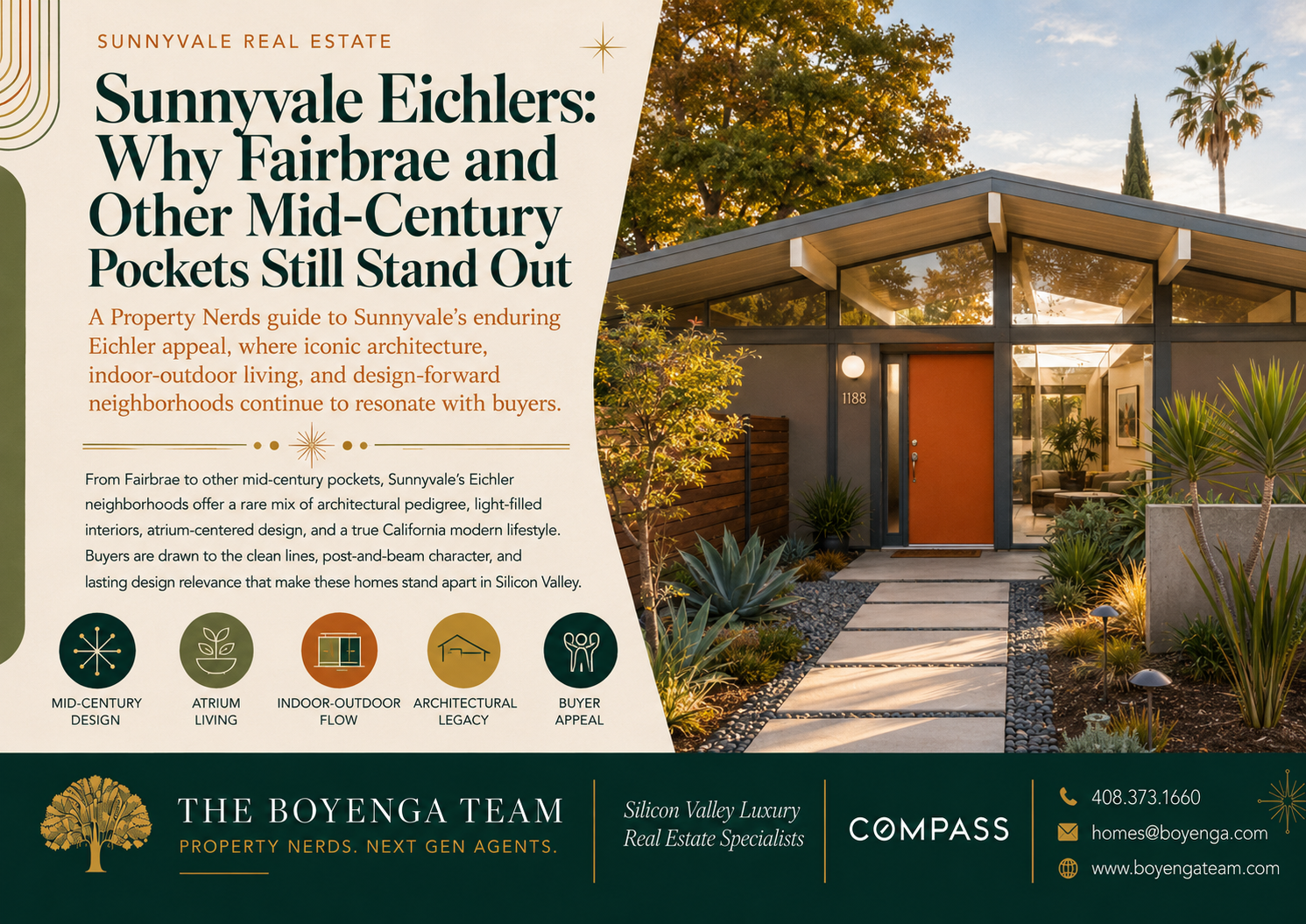
Sunnyvale has one of the most important Eichler stories in Silicon Valley.
Palo Alto may have the bigger Eichler count. San Mateo Highlands may have the dramatic hillside mystique. San Jose’s Fairglen has historic-register recognition. But Sunnyvale has something different: the origin story, the scale, the neighborhood variety, and the still-very-real buyer demand for homes that feel architecturally special without losing Silicon Valley practicality.
That is why Sunnyvale Eichler homes, Fairbrae Eichler homes, and mid-century homes in Sunnyvale continue to stand out.
A Sunnyvale Eichler is not just a house with glass walls and a flat roof. It is a piece of California modernism sitting inside one of the most strategic tech-location markets in the Bay Area. It offers indoor-outdoor living before that phrase became real estate marketing wallpaper. It offers single-level design before aging-in-place became a mainstream buyer priority. It offers natural light, atriums, radiant heat, post-and-beam structure, privacy-forward street presence, and a casual modern lifestyle that still feels current decades later.
At the Boyenga Team, this is exactly the kind of real estate we love to nerd out on.
We do not treat Eichlers like ordinary ranch homes. We look at builder history, tract identity, architectural integrity, roof systems, radiant heat, slab foundations, atriums, original features, design guidelines, staging choices, buyer psychology, and long-term resale demand. Because with Eichlers, the value is not only in the square footage. The value is in the design story.
The Property Nerd Thesis: Sunnyvale Eichlers Are Design Assets in a Tech-Driven Market
The simplest way to understand Sunnyvale Eichlers is this:
They are design assets sitting in a tech-driven, school-sensitive, commute-rich real estate market.
That combination is powerful.
A buyer may be drawn to an Eichler because of the architecture, but they still care about commute routes, schools, parks, lot utility, home condition, and future resale. A seller may own a beautiful mid-century home, but if it is marketed like a generic Sunnyvale house, the listing can miss the buyer who would have valued the architecture most.
That is the key seller lesson.
Sunnyvale Eichlers need a strategy that speaks to two buyer brains at once. The emotional brain responds to glass, light, atriums, beams, mahogany, courtyard living, and the California modernist dream. The analytical brain evaluates roofs, radiant heat, slab, drainage, electrical, plumbing, school path, commute, disclosure quality, remodel cost, and resale logic.
A great Eichler campaign sells both.
That is why the Boyenga Team’s Eichler platform matters. A standard listing can show an Eichler. A Property Nerd listing explains it.
Why Sunnyvale Matters in Eichler History
Sunnyvale is not a side note in Eichler history. It is one of the core chapters.
Sunnyvale Heritage Park Museum notes that more than 11,000 Eichler homes were built throughout California, mostly in the Bay Area, and that after Palo Alto, Sunnyvale has the second-largest population of Eichlers, totaling about 1,100 homes across sixteen tracts. The same source explains that Sunnyvale approved Eichler neighborhood guidelines to support preservation and neighborhood cohesiveness.
That is a huge number for one city. It means Eichler is not a niche curiosity in Sunnyvale. Eichler is part of the city’s residential DNA.
Eichler activity in Sunnyvale also spans multiple eras. The Sunnyvale Eichler Homes page on EichlerHomesForSale.com describes Sunnyvale as having approximately 1,100 Eichler homes across more than 16 tracts and notes that Eichler’s earliest Sunnyvale work began with Sunnyvale Manor I in 1949, followed by collaboration with Anshen & Allen for Sunnyvale Manor II in 1950.
That long timeline is why Sunnyvale Eichlers are not all the same. Some early homes look different from the classic atrium models buyers now associate with Eichler. Later tracts grew larger, more sophisticated, and more varied. For sellers, that matters because a Sunnyvale Eichler should not be marketed with one generic Eichler script. The tract, model, architect, systems, and condition all shape buyer response.
Fairbrae: The Sunnyvale Eichler Headliner
Fairbrae is one of Sunnyvale’s most important Eichler neighborhoods because it feels cohesive, recognizable, and deeply tied to the mid-century community lifestyle.
Fairbrae and Fairbrae Addition are two of the best-known Sunnyvale Eichler pockets. Buyers searching for a Fairbrae Eichler are often looking for more than an address. They want the low-slung rooflines, the atrium or courtyard experience, the single-level plan, the indoor-outdoor connection, and the feeling of living inside a preserved mid-century neighborhood.
That is the headline version.
The Property Nerd version is richer.
Fairbrae works because it combines architecture, repetition, community identity, and practical Sunnyvale location. Buyers driving through Fairbrae feel the horizontal streetscape, the relationship between homes and courtyards, and the way a concentration of similar homes creates a neighborhood identity that a one-off remodel cannot duplicate.
This is why Fairbrae still stands out. A single Eichler can be beautiful. A cohesive Eichler neighborhood creates a buyer emotion before the front door even opens.
Why Fairbrae Feels Different From a Generic Eichler Pocket
Fairbrae is not just a place where Eichlers happen to exist. It is a neighborhood where the Eichler pattern is readable.
The architecture repeats, but it is not boring. The homes use variations in roofline, garage placement, courtyard orientation, atrium models, and lot placement to create rhythm. Sunnyvale Heritage Park Museum notes that Eichler developments often used communal amenities such as pools, tennis courts, and community centers, including tennis courts in the Fairbrae tract, and that the look of individual homes could be varied through simple design changes such as changing entrance or garage placement or angling homes on lots.
That explains something buyers feel instinctively: Fairbrae is cohesive without feeling identical.
That balance is valuable.
For sellers, the Fairbrae story should be marketed as a neighborhood lifestyle, not just a home style. Buyers are responding to the mid-century architecture, but they are also responding to the streetscape, the community feel, the pool-and-tennis culture, the single-level environment, and the sense that they are buying into a preserved design neighborhood.
This is where a seller benefits from working with an Eichler-focused team, not just a general agent. The Boyenga Team understands how to position a Sunnyvale Eichler as architecture, lifestyle, and long-term Silicon Valley real estate all at once.
The Preservation Layer: Single-Story Identity and Design Guidelines
Eichler buyers are unusually sensitive to preservation because the architecture depends on privacy, light, and scale.
This is not just nostalgia. It is functional.
Eichlers often place large glass walls toward private outdoor spaces. That design works beautifully when neighboring homes remain low and privacy-conscious. It can feel vulnerable when a tall, out-of-scale structure looks into yards, living rooms, atriums, and bedrooms.
Sunnyvale’s preservation story reflects that reality. Heritage Park Museum explains that between 2015 and 2017, residents in multiple Eichler tracts petitioned Sunnyvale to rezone neighborhoods from low-density residential to low-density residential/single story, largely in response to concerns about two-story rebuilds affecting privacy, light, and neighborhood character.
For sellers, preservation is not an abstract planning issue. It can be part of the value story. Buyers want to know whether the neighborhood’s low-slung character is likely to remain intact, whether remodels nearby are sympathetic, and whether the community values the architecture.
That is why the Boyenga Eichler Homes platform is useful for both sellers and buyers. It gives the property a broader architectural context instead of reducing it to a square-footage comparison.
Other Sunnyvale Eichler Pockets That Matter
Fairbrae may be the headline, but it is not the whole Sunnyvale Eichler story.
Sunnyvale Eichlers are spread throughout the city, including well-known neighborhoods and micro-tracts such as Fairbrae, Fairwood, Rancho Verde, Fairorchard, Parmer Place, Primewood, Rancho Sans Souci, Midtown, and Fairpark. EichlerHomesForSale.com’s Sunnyvale Eichler resources describe the city’s Eichler inventory as spanning the full evolution of Eichler’s work, from early flat-roof models to later courtyard and atrium designs in tracts like Fairbrae, Fairwood, and Primewood.
Each pocket has a different buyer psychology.
Fairwood has a strong Apple-area commute angle. Rancho Verde benefits from adjacency to Fairbrae and a similar west Sunnyvale mid-century appeal. Fairorchard has its own larger-layout and southwest Sunnyvale story. Parmer Place, Primewood, Rancho Sans Souci, Midtown, and Fairpark may be smaller or more specialized pockets where rarity becomes part of the appeal.
A buyer may wait years for the right home in one of these micro-tracts, especially if the home has a great model, original details, strong updates, or an unusually good lot.
The key point for sellers: do not flatten all Sunnyvale Eichlers into one category. The tract matters.
Why Buyers Still Love the Eichler Layout
The reason Eichlers still attract buyers is not only historical. It is practical.
Eichlers solve modern lifestyle problems with mid-century design logic.
The single-level layout appeals to families, downsizers, and buyers who do not want stair-heavy living. The glass brings in light. The atrium creates privacy and drama. The post-and-beam structure creates visual openness. The yard connection supports outdoor dining, gardening, play, pets, and decompression. The floor plans often create a casual, informal rhythm that still feels more current than many traditional homes of the same age.
Today’s Silicon Valley buyer often wants exactly that: a home that supports work, family, wellness, privacy, and outdoor living without feeling overbuilt or generic.
That is why a Fairbrae Eichler with clean design, good light, working systems, and preserved character can create a buyer response that a larger conventional home may not.
The architecture creates emotion.
The location creates logic.
Together, they create demand.
For buyers actively searching, the Sunnyvale Eichler Homes search page and Bay Area Eichler Homes Sunnyvale page are natural next stops.
The Buyer Psychology: Eichler Buyers Are Specific
Eichler buyers are not always the largest buyer pool, but they are often one of the most passionate.
They notice details other buyers miss. They notice whether the atrium has been preserved. They notice whether original mahogany paneling remains. They notice whether the ceiling has been painted. They notice if the kitchen remodel feels compatible or if it fights the architecture. They notice the roofline. They notice whether the front facade is privacy-forward. They notice whether the yard actually functions as an outdoor room.
They also notice systems.
Roof. Radiant heat. Slab. Drainage. Electrical. Plumbing. Glass. Skylights. Siding. Pest. Permits. Additions. HVAC. Atrium drainage.
This is why Sunnyvale Eichler sellers need both beautiful marketing and strong disclosure preparation. The right buyer may fall in love quickly, but they still need enough information to write confidently.
The Boyenga Team’s Eichler approach is to sell the magic and prepare the mechanics.
The Seller’s Biggest Mistake: Treating an Eichler Like a Dated Ranch
A dated ranch and a dated Eichler are not the same thing.
A dated ranch may be marketed mostly around lot, location, and remodel potential. A dated Eichler may also have those things, but it has a fourth value driver: design integrity.
Original features may be value, not liability. A conventional seller might think old paneling should be removed. An Eichler buyer may see it as architectural character. A seller might think heavy staging will make the home feel luxurious. An Eichler buyer may want lower furniture and cleaner sightlines. A seller might install trendy finishes to “modernize” the home. A mid-century buyer may see those finishes as design noise.
This is where sellers can accidentally destroy value.
The Property Nerd rule is simple: before changing an Eichler, ask whether the likely buyer will see that change as an upgrade or an erasure.
That is why sellers should work with Eichler-aware advisors. The Boyenga Group and Boyenga Real Estate Team position architectural homes through buyer psychology, not generic MLS language.
Radiant Heat: Explain It, Do Not Hide It
Radiant heat is one of the classic Eichler features, especially in the more recognizable slab-era homes.
For many buyers, radiant heat is part of the Eichler experience. It keeps the architecture clean because there is no need for bulky visible ductwork. It supports quiet, even heating. It is historically connected to the design. Sunnyvale Heritage Park Museum also describes radiant-heated concrete floors as one of the typical Eichler design elements.
But radiant heat is also one of the first things serious buyers ask about.
Does it work? Has it been serviced? Is it original? Are there records? Has it been abandoned? Is there supplemental heat? Is there air conditioning? Are there known leaks? What does the boiler situation look like? Are there zones? Has anyone pressure-tested it?
Sellers should not wait for escrow to find out how buyers feel about radiant heat. Gather records early. If the system works, document it. If it has been repaired, show receipts. If it has been replaced or supplemented, explain clearly. If it does not work, disclose that and position the home accordingly.
An informed buyer is often far more comfortable than a buyer forced to guess.
Roofs: The Confidence Issue
Eichler roofs are a major seller-prep topic.
Low-slope and flat roof forms are central to the architecture, but they also mean buyers care about roof age, roof type, drainage, foam or membrane system, skylights, insulation, maintenance history, warranty, prior leaks, and visible staining.
A seller does not always need to replace a roof before listing. That can be expensive and may not be necessary. But the seller should know the roof story before going to market.
If the roof is newer, make it a confidence feature. If it has maintenance records, gather them. If it has issues, understand them before buyers do. A pre-sale roof inspection can be a smart move because it helps buyers separate normal maintenance from scary unknowns.
For Eichlers, the roof is not just another system. It is part of the design language. Buyers know that, and sellers should too.
Atriums, Courtyards, and the First Emotional Hit
The atrium may be the most powerful emotional feature in many Eichler homes.
A good atrium creates the moment. It gives the entry sequence drama. It brings light into the center of the home. It creates privacy. It makes the house feel larger than its square footage. It reminds buyers that they are not touring an ordinary home.
For sellers, the atrium should be treated like a primary room, not a leftover space.
Clean it. Stage it lightly. Improve plantings. Clear drainage. Add simple outdoor furniture where appropriate. Remove clutter. Make the glass sparkle. Let the buyer feel the inside-outside relationship immediately.
An unattractive atrium can make a buyer worry about maintenance.
A beautiful atrium can make the buyer fall in love before they even reach the living room.
Original Features: Preserve, Polish, or Reframe
Original Eichler features can create real market value when they are clean, intact, and presented properly.
Mahogany paneling, wood ceilings, original cabinetry, globe lights, sliding glass, exposed beams, courtyard entry, original siding patterns, and period-appropriate materials can all help the home feel authentic. But original does not automatically mean valuable. Condition matters. Light matters. Function matters. Buyer pool matters.
The Boyenga Team’s approach is to decide what belongs to the architecture and what belongs to deferred maintenance.
Preserve what gives the home soul.
Polish what can be made beautiful.
Reframe what buyers need help understanding.
Replace or repair what creates fear, distraction, or genuine functional problems.
This is a more nuanced strategy than simply “update everything.”
Staging a Sunnyvale Eichler
Staging an Eichler requires restraint.
The furniture should be lower, cleaner, and more architecture-aware. The staging should not block glass walls or atrium views. It should not turn the home into a generic luxury showroom. It should use warm textures, simple lines, mid-century-compatible forms, and enough softness to make the home feel livable.
The goal is to show how the home works today without hiding what makes it special.
For a Fairbrae Eichler, staging should emphasize the atrium or courtyard, the indoor-outdoor flow, the openness of the living space, the relationship to the yard, and the flexibility of bedrooms or office spaces. For a later, larger Sunnyvale Eichler, staging may also need to highlight gallery spaces, larger kitchens, expanded living areas, or more sophisticated floor plans.
Good staging helps buyers answer the question: can this architecture support our modern life?
The answer should feel obvious.
Photography: Do Not Shoot It Like a Regular House
Eichlers need architectural photography, not just real estate photography.
The photographer has to capture horizontal rooflines, glass, beams, atrium sightlines, indoor-outdoor transitions, garden views, ceiling texture, and the way the house reveals itself from the private front facade to the open rear living space.
Bad photography makes an Eichler look dark, flat, low, and dated.
Good photography makes it feel bright, calm, spacious, and rare.
Online presentation is especially important because mid-century buyers often search visually. They are scanning for rooflines, atriums, glass, post-and-beam details, and original features. If those are not visible in the first few images, the listing may miss the very buyer who would have cared most.
This is where Boyenga Team marketing is different. The goal is not simply to photograph rooms. The goal is to capture architecture, emotion, and buyer intent.
The Remodeling Penalty: Especially Real With Eichlers
The remodeling penalty is very real in Sunnyvale Eichler homes.
A seller may spend money on a kitchen remodel that looks “new” but not Eichler-appropriate. A seller may replace original materials with trendy finishes that age quickly. A seller may install heavy flooring that kills the light. A seller may remove original wood that buyers would have valued. A seller may enclose an atrium poorly or add partitions that weaken the indoor-outdoor experience.
The result is expensive but less desirable.
Eichler buyers often prefer thoughtful preservation and compatible updates over generic remodeling. If a seller is preparing for market, the smartest projects are usually those that create clarity, light, cleanliness, confidence, and design compatibility.
Paint touch-ups, glass cleaning, roof documentation, radiant heat clarity, landscape refresh, atrium staging, pest inspection, property inspection, floor-plan clarity, and architecture-aware staging can do more than a rushed remodel.
The goal is not to make the Eichler look like every other house.
The goal is to help buyers understand why it should not.
Fairbrae Seller Strategy
If you are selling a Fairbrae Eichler, the listing should lead with the neighborhood’s cohesive mid-century identity.
The marketing should explain the value of the Fairbrae and Fairbrae Addition setting, the architectural lineage, the courtyard or atrium model, the single-level lifestyle, the indoor-outdoor flow, and the buyer demand for preserved Sunnyvale Eichler pockets. It should also make the community-lifestyle story legible where relevant, because Fairbrae’s appeal is not only inside the walls.
The seller should be careful not to over-improve in a way that fights the tract’s character. If the home is original, frame it as an opportunity for preservation or thoughtful modernization. If it is updated, explain why the updates respect the architecture. If the roof or radiant heat has documentation, make that visible. If the atrium is special, make it the emotional centerpiece.
Fairbrae buyers know what they are looking for. The listing should meet them at that level.
For valuation, preparation, and launch strategy, link buyers and sellers directly to EichlerHomesForSale.com and the Sunnyvale Eichler Homes page. Those are the right internal destinations for buyers who are already searching by architecture, not just by city.
Fairwood, Rancho Verde, Fairorchard, Parmer Place, and Other Pocket Strategies
Each Sunnyvale Eichler pocket needs its own seller strategy.
Fairwood may need to emphasize Apple-area commute convenience and the appeal of living near major employment while still owning a design-forward single-family home.
Rancho Verde may need to emphasize its relationship to Fairbrae, west Sunnyvale fundamentals, and neighborhood cohesion.
Fairorchard may need to emphasize larger mid-century layouts, southwest Sunnyvale location, and the tract’s historical and Silicon Valley-design appeal.
Parmer Place, Primewood, Rancho Sans Souci, Midtown, and Fairpark may need to emphasize rarity. Smaller tracts can be powerful because inventory is so limited. A buyer who loves a specific model or micro-location may have very few chances to purchase.
The Boyenga Team’s job is to identify which value story matters most and build the campaign around that story.
What Buyers Should Watch For
Buyers should absolutely fall in love with Eichlers, but they should also do serious due diligence.
They should understand the roof system, radiant heat, slab, drainage, atrium condition, electrical, plumbing, windows, siding, pest findings, permits, and prior remodel work. They should also understand any applicable design guidelines, single-story overlays, or neighborhood preservation dynamics that may influence future improvements.
They should verify school boundaries directly with the appropriate district. They should evaluate commute routes at real times. They should understand whether the home is priced for condition, architecture, location, or a combination.
The right Eichler can be an incredible lifestyle asset. But it should be purchased with both romance and rigor.
That is the Property Nerd way.
Why the Boyenga Team Is Built for Sunnyvale Eichlers
The Boyenga Team brings a specialized Silicon Valley Eichler lens to the listing process.
We understand that a Sunnyvale Eichler is not a commodity. It is architecture, history, systems, neighborhood identity, and buyer psychology all wrapped into one property. We know how to talk about Fairbrae, Fairwood, Rancho Verde, Fairorchard, Parmer Place, Primewood, Midtown, and other mid-century pockets. We know why radiant heat records matter. We know why roof confidence matters. We know why staging should not block glass. We know why original features should not be casually erased. We know why a Fairbrae Eichler should not be photographed like a generic ranch home.
Most importantly, we understand the buyer.
A Sunnyvale Eichler buyer wants the magic, but they also want clarity. The Boyenga Team’s job is to deliver both.
Our Property Nerd and Next Gen Agent approach combines architectural storytelling, Compass-powered marketing, neighborhood SEO, disclosure organization, seller-prep strategy, design-aware staging guidance, buyer-pool targeting, and negotiation expertise.
You can also explore the broader Boyenga web ecosystem through BoyengaGroup.com, BoyengaRealEstateTeam.com, and BayAreaEichlerHomes.com, each of which supports the larger Silicon Valley and Eichler-focused brand story.
That is how an Eichler listing becomes more than a listing.
It becomes a launch.
Final Property Nerd Takeaway
Sunnyvale Eichlers still stand out because they offer something rare: authentic mid-century modern architecture inside one of Silicon Valley’s most practical, commute-rich, school-sensitive, and tech-connected markets.
Fairbrae stands out because of its cohesive Eichler identity, scale, community feel, and preservation story.
Fairwood, Rancho Verde, Fairorchard, Parmer Place, Primewood, Rancho Sans Souci, Midtown, Fairpark, and other Sunnyvale Eichler pockets stand out because each offers its own blend of rarity, architecture, commute, schools, and buyer demand.
For buyers, the lesson is to understand the tract, the model, the systems, and the future resale story.
For sellers, the lesson is to market the architecture with intelligence and care.
At the Boyenga Team, we believe Sunnyvale Eichlers deserve expert-level strategy because these homes are more than mid-century eye candy.
They are design history you can live in.
The Boyenga Team
Sunnyvale Eichler, Mid-Century & Silicon Valley Real Estate Experts
Compass
Boyenga.com
EichlerHomesForSale.com
BayAreaEichlerHomes.com
BoyengaGroup.com
BoyengaRealEstateTeam.com
Email: homes@boyenga.com