

Blog > Structural Cost & Construction Pressures: Why Building in Silicon Valley Is Repricing the Value of Existing Homes
Structural Cost & Construction Pressures: Why Building in Silicon Valley Is Repricing the Value of Existing Homes
by
 What’s up, Property Nerds and next-gen agents?
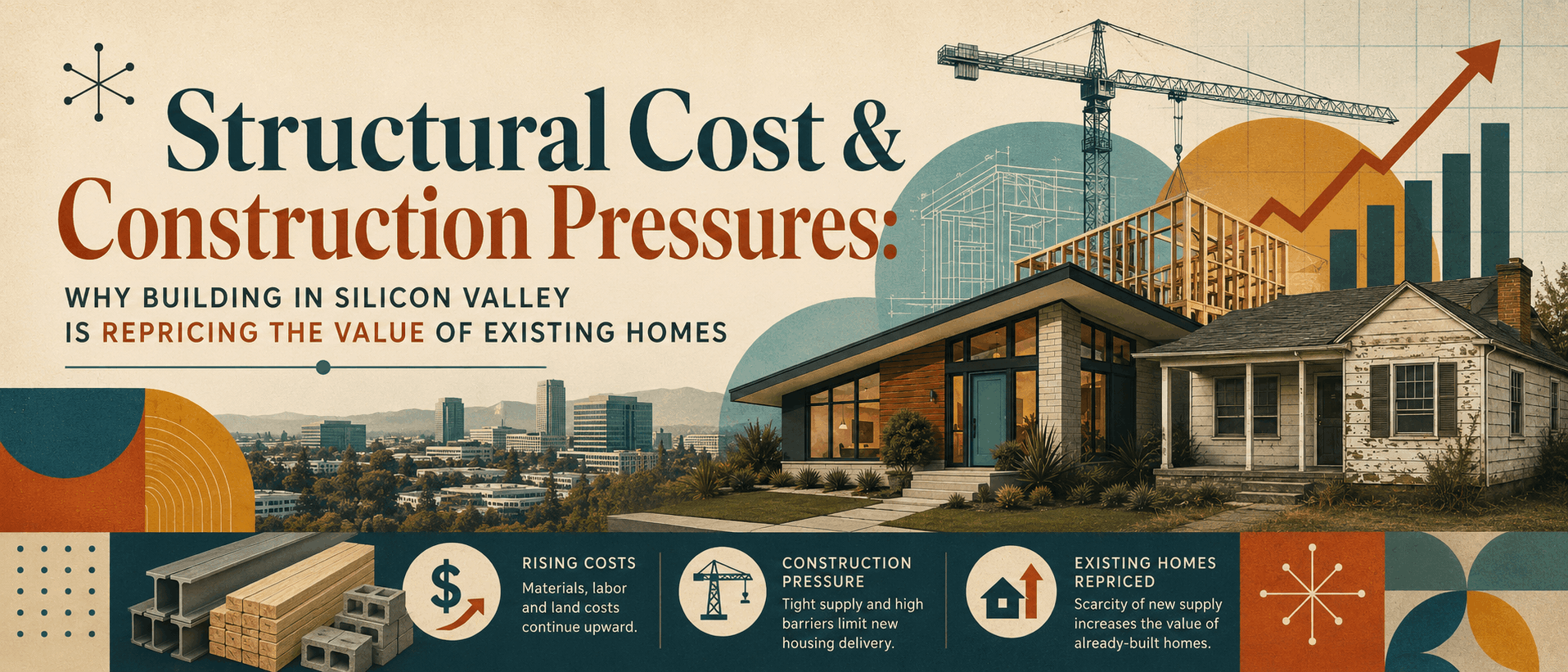
There is a major force reshaping Silicon Valley real estate right now, and it is not just mortgage rates, inventory levels, buyer psychology, or the latest neighborhood comp. It is the cost of construction itself. Building, expanding, and remodeling in the Valley is facing a new level of pressure, and those pressures are now showing up directly in property valuations.
Material inflation, labor shortages, permitting complexity, tariff premiums, copper volatility, insurance constraints, energy-code requirements, and the difficulty of getting quality contractors on schedule are all colliding at the same time. The result is a market where construction costs are no longer just a contractor problem. They are becoming a real estate pricing problem.
For years, Silicon Valley buyers were willing to purchase a dated home and “just remodel it.” That phrase used to sound simple. A buyer would find the right lot, the right school district, the right commute pattern, or the right neighborhood, then plan to update the home over time. Maybe they would redo the kitchen first, then the bathrooms, then the landscaping, and eventually an addition or larger reconfiguration.
Today, that equation is much more complicated. The new question is not simply, “Can this home be improved?” The new question is, “What will it actually cost, how long will it take, what will the city require, and how much risk am I taking on after closing?”
That is the structural cost squeeze. And in Silicon Valley, where land is already expensive and buyer expectations are extremely high, that squeeze has a direct impact on pricing.
Construction costs used to sit in the background of a real estate conversation. Buyers would tour a home, estimate what they wanted to change, and make an offer based on location, square footage, condition, and recent comparable sales. Now construction costs are moving into the foreground. When materials spike, the value of a remodeled home rises because the replacement cost becomes harder to replicate. When tariffs create price floors on lumber, steel, cabinetry, fixtures, and other building inputs, the cost of future improvement gets built into today’s buyer psychology.
When copper becomes volatile, buyers start thinking about rewiring, panel upgrades, EV charging, solar readiness, heat pumps, smart-home systems, and data-heavy modern living. In other words, the market is no longer just pricing the house in front of us. It is also pricing the future work required to make that house competitive.
That matters enormously in Silicon Valley because so many homes were built in the 1940s, 1950s, 1960s, and 1970s. Many of these properties sit on exceptional lots in exceptional neighborhoods, but they may still have older electrical systems, original plumbing, dated floor plans, aging roofs, old windows, older HVAC systems, or kitchens and bathrooms that no longer match modern expectations.
Those homes can still be incredible opportunities. But buyers are increasingly demanding a discount for the risk, cost, and uncertainty of bringing them forward.
One of the most important signals in the construction market is the renewed acceleration in input prices. National construction input pricing has shown sharp upward pressure, with construction material costs accelerating at a pace that brings back memories of the supply-chain shock era. That matters because even when year-over-year numbers look manageable on paper, sudden monthly spikes can change contractor bids quickly.
Contractors do not price based on what materials cost six months ago. They price based on what they believe it will cost to source labor, materials, delivery, subcontractors, insurance, and schedule certainty by the time the job is actually performed. This is why sellers, buyers, and agents need to be careful when casually estimating remodel budgets.
A kitchen that someone thought might cost $150,000 can become $225,000 once cabinets, stone, appliances, electrical, plumbing, lighting, flooring, walls, permits, labor, and contingency are included. A whole-house refresh that seemed like a cosmetic project can become a major six-figure commitment before anyone opens a wall.
This is the Property Nerd point: construction inflation does not have to double to change buyer behavior. It only has to become unpredictable. Unpredictability creates caution. Caution creates lower offers. Lower offers create valuation pressure on homes needing work.
Tariffs are another reason remodeling has become more expensive and less predictable. When imported building materials face tariffs, the market often develops price floors. Even domestic suppliers may price against the higher replacement-cost environment because the entire supply chain adjusts.
Softwood lumber and timber are especially important because they touch so many residential projects. Framing, repairs, additions, roof structures, fences, decks, ADUs, garage conversions, and structural modifications are all exposed to lumber pricing. When lumber carries a tariff premium, it does not just affect new construction. It affects remodels, additions, repairs, and even smaller pre-listing preparation projects.
Derivative wood products can also become more expensive, which matters for cabinets, vanities, built-ins, doors, trim, flooring components, and other finish packages. That is where buyers really feel it. The visible parts of a remodel — the kitchen, bathrooms, laundry room, closets, mudroom, and built-ins — are often where budgets start to balloon.
This is why the tariff premium is not abstract. It shows up in the bid. It shows up when the contractor says the cabinet package came in higher than expected. It shows up when the framing allowance needs to be revised. It shows up when a deck, fence, pergola, ADU, or addition costs more than the buyer assumed. It shows up when a seller thinks a buyer can simply “update the home later,” but the buyer sees a remodel budget that keeps expanding.
For steel-intensive builds or major structural overhauls, the issue becomes even more serious. Steel beams, moment frames, foundation reinforcement, retaining walls, hillside stabilization, seismic upgrades, and large-span open-concept designs can all be affected by embedded tariff and material premiums. In high-cost markets like Silicon Valley, even a seemingly modest per-square-foot surcharge can become a major budget item when applied across a full structural scope.
A $15 to $25 per square foot embedded cost increase may not sound dramatic in isolation. But on a 3,000-square-foot project, that can represent $45,000 to $75,000 of additional cost pressure before factoring in design, engineering, permit fees, contractor margin, and contingency. That changes the math.
Copper is another quiet but critical material in modern real estate. It is not as glamorous as marble slabs, European oak floors, or designer lighting, but it is everywhere behind the walls. Copper affects electrical wiring, plumbing, HVAC components, EV charging infrastructure, solar systems, battery backup systems, smart-home systems, data networks, high-performance appliances, and advanced mechanical systems.
In Silicon Valley, copper volatility matters more than in many markets because buyers increasingly expect homes to support a tech-forward lifestyle. Modern buyers want EV charging. They want solar readiness. They want heat pumps. They want upgraded panels. They want smart lighting. They want home offices with reliable connectivity. They want battery backup. They want energy efficiency. They want low-maintenance, future-ready systems.
That means copper volatility is not just a commercial construction story or a data center story. It is a residential valuation story. When copper costs rise sharply or swing unpredictably, contractors and electricians build that risk into bids. Even if the final number changes by the time the job is complete, buyers are not usually comforted by uncertainty. They see risk. And when buyers see risk, they adjust price.
This is especially relevant for older homes that may need panel upgrades, rewiring, EV charger readiness, solar preparation, new plumbing, or mechanical modernization. In a luxury market, buyers may not want to inherit a home that looks beautiful but lacks the systems needed for the next decade of living.
That is where structural cost pressure intersects with luxury expectations. A home does not only need to photograph well. It needs to perform well.
When construction becomes more expensive, unpredictable, and time-consuming, turnkey homes gain power. A fully remodeled home is no longer simply “prettier.” It represents cost certainty. It represents time savings. It represents fewer decisions. It represents reduced permit exposure. It represents immediate lifestyle.
That is why buyers are often willing to pay a premium for homes that have already absorbed the pain of construction. The seller took on the contractors. The seller lived through the dust. The seller made the selections. The seller managed the permits. The seller handled the inspections. The seller paid the cost overruns. The buyer gets to move in and enjoy the result.
That convenience premium is real, especially in Silicon Valley, where many buyers are busy, relocation-driven, school-calendar-sensitive, and already stretched by the cost of buying. Even affluent buyers may not want to manage a major remodel after closing. They may have the money, but they may not have the time, energy, or desire to turn their life into a construction project.
This is one of the reasons remodeled homes can outperform. They are not only selling finishes. They are selling relief.
On the flip side, homes needing work face a deeper pricing challenge. An un-updated home now carries more than the visible cost of old bathrooms, tired flooring, or a dated kitchen. It carries the possibility of hidden structural issues, inflated material costs, permit delays, contractor scarcity, labor escalation, and finish-package uncertainty.
Buyers are increasingly doing a mental remodel before writing an offer. They walk through a home and start adding numbers in their head: kitchen, bathrooms, flooring, paint, lighting, windows, roof, electrical, panel, plumbing, HVAC, landscaping, drainage, sewer, permits, design, contingency, and temporary housing.
Then they add the emotional tax. Will this take six months? Will it take eighteen months? Can we live here during construction? Can we find a contractor? What happens if the city requires additional upgrades? What happens if the walls reveal something unexpected? What happens if costs rise again?
That mental calculation can be brutal. This is why a seller cannot assume that buyers will simply subtract the exact cost of improvements. Buyers often subtract the cost of improvements plus risk, time, inconvenience, and uncertainty. That is the valuation penalty.
Silicon Valley remodeling is not just expensive because materials are expensive. It is expensive because the process is complicated. Every city has its own requirements, review timelines, planning rules, energy standards, tree protections, setback rules, drainage concerns, historic overlays, hillside requirements, and inspection sequencing.
In some neighborhoods, even straightforward projects can trigger questions about structural engineering, Title 24 compliance, electrical service, gas-to-electric transitions, water efficiency, stormwater, or neighborhood design constraints. For buyers, this creates anxiety.
A buyer may love a home’s location but hesitate because they do not know whether the remodel they imagine is actually practical. They may wonder if the city will allow expansion. They may wonder if an open-concept plan requires costly structural work. They may wonder if a garage conversion, ADU, second story, or kitchen relocation will become more complicated than expected.
This is where next-gen agents have to move beyond generic advice. The agent’s job is not to say, “You can remodel later.” The agent’s job is to help the client understand what kind of remodel may be realistic, what risks should be investigated, what due diligence matters, and how the likely construction pressure should influence price.
That is how real estate advisory evolves.
In the luxury segment, structural complexity can create a major dividing line between homes that feel premium and homes that feel expensive but unresolved. Luxury buyers may forgive a paint color. They may replace a light fixture. They may change wallpaper. But they are much less forgiving when a property needs major structural, mechanical, or systems work.
A dated luxury home with old systems can feel like a beautiful liability. A hillside property with drainage questions can feel risky. A large estate with outdated electrical and plumbing can feel overwhelming. A home with awkward structural limitations can feel like a project that will require architects, engineers, contractors, consultants, and years of decision-making.
Meanwhile, a fully realized luxury home with thoughtful systems, strong infrastructure, quality materials, modern lighting, indoor-outdoor flow, wellness amenities, and excellent design cohesion can feel like a safe harbor. That matters because high-end buyers are not just buying shelter. They are buying life efficiency, privacy, comfort, hosting capability, and emotional ease.
The more construction pressure rises, the more valuable that ease becomes.
For sellers, the message is clear: preparation strategy matters more than ever. Not every home needs a full remodel before market. In fact, over-remodeling before selling can be risky if the seller spends money in areas buyers do not value. The key is identifying which improvements reduce buyer anxiety and which improvements simply become expensive noise.
A smart pre-listing strategy should evaluate condition, competition, buyer expectations, and construction risk. Sometimes the right move is fresh paint, lighting, landscaping, flooring, repairs, cleaning, and staging. Sometimes it is worth addressing a known system issue before listing. Sometimes the best strategy is to disclose clearly, price appropriately, and position the property as an opportunity.
The worst strategy is pretending construction costs have not changed. If a home needs $300,000 of work, buyers may treat it like $450,000 or $600,000 of risk depending on the property, the neighborhood, and the scope. Sellers who understand this early can make better decisions. Sellers who ignore it may end up chasing the market with price reductions.
Preparation is no longer just about making a home look nice. It is about reducing perceived risk.
For buyers, structural cost pressure creates both challenge and opportunity. The challenge is obvious: remodeling is more expensive, more complex, and less predictable. Buyers need to be careful about assuming old budgets still apply. They should consult contractors, architects, engineers, inspectors, and local experts when evaluating a major project.
But the opportunity is also real. If many buyers are avoiding homes that need work, a patient and well-advised buyer may find value in a property others overlook. The key is knowing the difference between cosmetic updating and deep structural risk.
A dated kitchen may be manageable. A poor foundation, major drainage problem, failing roof structure, obsolete electrical system, or complicated unpermitted addition is a different conversation.
The best buyers in this environment are not necessarily the ones with the biggest budgets. They are the ones with the clearest understanding of risk. They know what they can handle. They know what they should avoid. They know when a discount is not enough. And they know when a property’s underlying land, location, architecture, and long-term potential justify the work.
That is Property Nerd territory.
For agents, this is where the job gets more technical. Surface-level comping is not enough. You cannot just compare square footage, lot size, bedroom count, and school district, then call it a pricing opinion. In today’s market, condition and construction exposure must be part of the valuation model.
A next-gen agent needs to understand how buyers are reacting to remodel risk in real time. They need to know whether turnkey homes are dominating active inventory. They need to track how un-updated homes are performing. They need to study which listings are sitting, which ones are reducing, and which ones still attract offers because the land or location is strong enough.
They also need to understand the language of construction well enough to help clients ask better questions. Not to replace contractors, architects, engineers, or attorneys, but to guide the conversation intelligently. What is cosmetic? What is structural? What is a system risk? What might trigger permits? What improvements matter most before listing? What buyer objections are likely? What condition issues could affect financing or insurance? What cost assumptions are outdated?
This is where real estate becomes advisory, not just sales.
The deeper story is that construction pressure is changing the relationship between existing homes and replacement cost. When building becomes harder, existing improved homes become more valuable. When remodeling becomes more expensive, homes that already have the right systems and finishes gain an advantage. When materials become volatile, buyers pay for certainty. When permitting feels uncertain, buyers pay for completion.
That does not mean every remodeled home is automatically worth a premium. Quality still matters. Design still matters. Layout still matters. Craftsmanship still matters. Permits, disclosures, systems, and neighborhood demand still matter.
But the broader direction is clear. The market is rewarding homes that reduce friction. The market is penalizing homes that create uncertainty. And construction cost pressure is one of the biggest reasons why.
Structural cost and construction pressures are now directly affecting Silicon Valley property valuations. Rapid material inflation, tariff premiums, lumber and steel exposure, copper volatility, labor scarcity, permit complexity, and buyer fatigue are all changing how the market prices homes that need work.
A remodel is no longer just a future design project. It is a financial, logistical, and emotional risk profile. For sellers, this means pricing and preparation must be more strategic. For buyers, it means due diligence matters more than ever. For agents, it means the old comp model is not enough.
The homes that win in this environment are the ones that either deliver move-in-ready confidence or are priced clearly enough to compensate buyers for the work ahead. There is still opportunity in project homes. There is still upside in great lots, great neighborhoods, and strong architecture. But the market is demanding a more honest conversation about what it costs to bring a home to modern standards.
In Silicon Valley real estate, construction pressure is no longer behind the scenes. It is part of the price.
How the Boyenga Team Helps Clients Navigate Construction-Driven Value
At the Boyenga Team at Compass, Eric and Janelle Boyenga help clients navigate these exact market shifts with a blend of neighborhood intelligence, pricing strategy, design awareness, and real-world preparation guidance.
As Silicon Valley luxury home experts, they understand that today’s buyers are not just comparing homes by square footage and location. They are evaluating condition, construction exposure, lifestyle convenience, permit risk, and long-term value. A home that looks like a deal on paper may become expensive once structural work, materials, labor, and timeline risk are fully understood. A home that appears premium may deserve that premium if it offers quality, certainty, and move-in-ready ease.
For sellers, Eric and Janelle help determine which improvements are worth making before going to market, which repairs may reduce buyer anxiety, and how to position a home honestly and powerfully against the current competition. For buyers, they help identify where the real opportunity lives, whether that means competing for a polished luxury home or recognizing the hidden upside in a well-located property that others may be discounting too aggressively.
The Boyenga Team’s approach is Property Nerdish, next-gen, and deeply local. It is about reading the market beneath the surface, understanding how construction pressures affect value, and helping clients make confident decisions in one of the most complex real estate markets in the country.
Because in Silicon Valley, great representation is not just about opening doors.
It is about understanding what is behind the walls.