

Blog > Should You Remodel Before Selling in Silicon Valley? A Property Nerds Guide to ROI, Buyer Psychology, Neighborhood Math, and Selling Strategy
Should You Remodel Before Selling in Silicon Valley? A Property Nerds Guide to ROI, Buyer Psychology, Neighborhood Math, and Selling Strategy
by
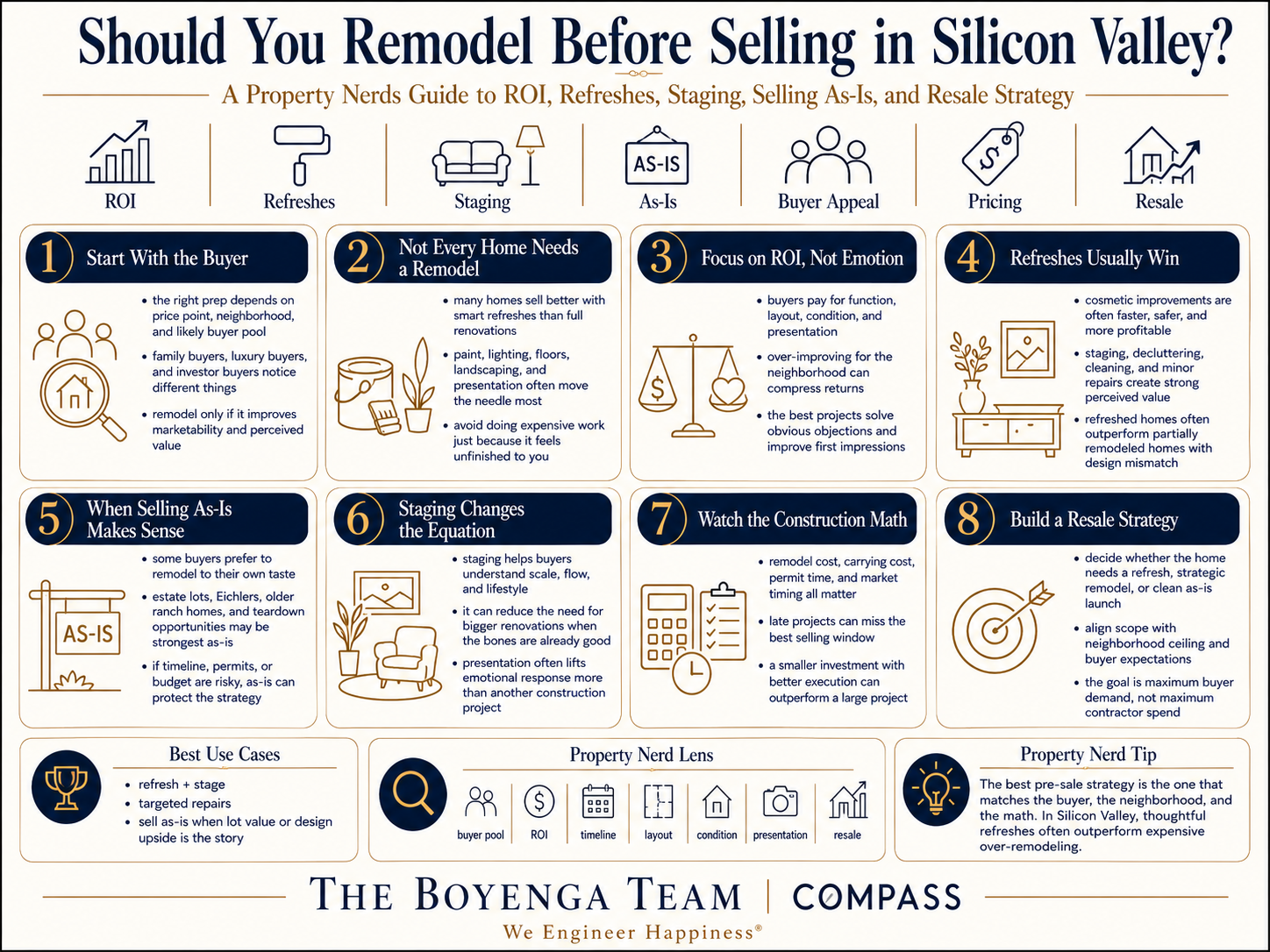
One of the most expensive questions a Silicon Valley homeowner can ask before selling is also one of the most common:
Should we remodel before we sell?
It sounds like a simple question. But in Silicon Valley real estate, it is almost never simple.
A remodel can absolutely create value. It can make a home feel brighter, fresher, more current, and easier for buyers to emotionally understand. It can help a property photograph better, show better, and compete more effectively against updated inventory. In the right neighborhood, with the right buyer pool, on the right lot, a smart pre-sale improvement plan can produce a stronger sale.
But a remodel can also become a very expensive mistake.
Some sellers spend money on improvements buyers do not value. Some remodel too much. Some remodel the wrong things. Some start projects that delay the launch and miss the best market window. Some choose finishes that narrow the buyer pool. Some erase architectural character that buyers would have paid a premium for. Some remodel a home that the future buyer plans to tear down anyway.
That is why the real question is not simply, “Should we remodel?”
The better question is:
What level of preparation will the market actually reward for this specific home, in this specific neighborhood, for this specific buyer pool?
That is the Property Nerds way to think about it.
The Boyenga Team looks at pre-sale remodeling as a strategy decision, not a design project. Before anyone chooses tile, flooring, paint, cabinets, appliances, or landscaping, the first step is to understand the market position of the home. Who is the likely buyer? What will they value? What will they remove? What will make them confident? What will make them hesitate? What will they pay for?
In Silicon Valley, that answer changes dramatically from neighborhood to neighborhood and property to property.
A dated Cupertino ranch near Apple Park is not the same as a Palo Alto Eichler. A Los Altos Hills estate is not the same as a Downtown Campbell bungalow. A Menlo Park cottage is not the same as a Saratoga family home. A Sunnyvale ranch in Cherry Chase is not the same as a Fairbrae Eichler. A Willow Glen character home is not the same as a West San Jose townhome.
The right strategy depends on the property’s value drivers.
Remodeling for Yourself vs. Remodeling for the Market
This is the first distinction sellers need to understand.
When you remodel for yourself, the goal is enjoyment. You choose the kitchen you love, the tile you love, the fixtures you love, the layout that fits your routine, and the finishes that make you happy. That is personal.
When you remodel before selling, the goal is return. The remodel is not for you. It is for the next buyer, the next appraiser, the next competing offer, and the future resale story.
That means the decision should be colder, more strategic, and more market-driven.
A seller may love the idea of a new kitchen, but if the likely buyer plans to reconfigure the entire back of the house, that kitchen may not get paid back. A seller may want to remodel bathrooms, but if the home still has an awkward floor plan, old systems, and a poor kitchen-to-yard connection, the bathroom remodel may not move the needle enough. A seller may want to modernize an Eichler, but if the updates erase the beams, paneling, atrium feel, or indoor-outdoor design, the remodel may reduce the home’s architectural appeal.
In other words, remodeling before selling is not about asking, “Would this look better?”
Of course it might.
The real question is:
Will the finished product create more buyer demand than the cost, time, and risk required to complete it?
The Property Nerds Pre-Sale Remodel Formula
The Boyenga Team evaluates pre-sale remodeling through a layered framework.
The remodel decision should consider:
Buyer pool: Who is most likely to buy the home?
Neighborhood ceiling: What do finished homes actually sell for nearby?
Lot utility: Does the land support the investment?
Street quality: Is the location strong enough to justify the spend?
School path: Does the school assignment support a deeper buyer pool?
Commute logic: Does the home solve a real Silicon Valley commute problem?
Architecture: Is the home generic, historic, Eichler, mid-century, ranch, estate, or custom?
Systems condition: Will buyers care more about roof, sewer, drainage, foundation, HVAC, electrical, or plumbing than finishes?
Timeline: Can the work be completed before the best listing window?
Design risk: Are the finish choices broad enough for the target buyer?
Resale story: Will the next buyer immediately understand why the improved home is worth more?
If the answer is yes, remodeling may make sense.
If the answer is unclear, a refresh may be safer.
If the answer is no, selling as-is with smart positioning may be the better move.
The Biggest Mistake: Remodeling Without Knowing the Buyer
Most pre-sale remodeling mistakes happen because sellers start with the house instead of the buyer.
They ask: what is outdated?
They should ask: what does the buyer care about?
A move-in-ready family buyer usually cares about clean finishes, functional bedrooms, good light, updated kitchens and baths, yard visibility, storage, safety, inspections, and an easy daily routine.
A builder may care almost entirely about lot size, zoning, setbacks, tree constraints, street quality, neighborhood resale ceiling, and whether the finished project can support a profitable new build.
An Eichler buyer may care about roof system, radiant heat, slab condition, atrium drainage, original paneling, beams, glass walls, and architectural integrity.
A luxury buyer may care about privacy, approach, light, ceiling height, kitchen quality, indoor-outdoor flow, primary suite, lot presence, landscaping, systems, and whether the home feels worthy of its price point.
A first-time buyer may care about affordability, inspection confidence, financing, HOA health if applicable, and whether the home feels manageable.
A downsizer may care about single-level living, low maintenance, walkability, storage, security, and whether the home feels easy.
If you remodel for the wrong buyer, you may spend money without increasing value.
That is the remodeling penalty.
What Is the Remodeling Penalty?
The remodeling penalty is the gap between what a seller spends and what the market actually pays back.
A seller may spend $100,000 and only receive $40,000 in additional value.
A seller may spend $250,000 and accidentally make the home less appealing to the highest-paying buyer.
A seller may spend months remodeling and miss the strongest selling season.
A seller may make the home nicer, but not nice enough to move it into the next buyer category.
The remodeling penalty is especially common in Silicon Valley because land value, neighborhood demand, school assignment, commute access, and lot utility can be more important than finishes.
A home can have a new kitchen and still be discounted for road noise.
A home can have updated bathrooms and still be limited by a poor floor plan.
A home can have expensive materials and still be rejected because the buyer wants to rebuild.
A home can be freshly remodeled and still lose to another home with a better lot, better street, better school path, or better architectural identity.
The Five Pre-Sale Paths
Most sellers think they have two choices: remodel or sell as-is.
There are actually five major paths.
1. Sell As-Is With Strategic Positioning
Selling as-is does not mean doing nothing.
It means acknowledging that the buyer will likely remodel, rebuild, or customize, and then marketing the property around its true value drivers.
This can be the best strategy when the value is in the land, location, school path, architecture, lot size, or future potential.
A strategic as-is plan may still include inspections, disclosures, cleaning, decluttering, floor plans, lot research, permit history, professional photography, and basic staging.
This approach often works well for older trust properties, original ranch homes, teardown candidates, estate lots, dated homes in rebuild markets, and properties where buyers want control.
The key is to make the opportunity clear.
A home should never feel neglected simply because it is being sold as-is. It should feel understandable.
2. Light Refresh
A light refresh is often the sweet spot in Silicon Valley.
This approach focuses on high-impact, lower-risk improvements that help the home show better without requiring major construction.
A light refresh may include paint, deep cleaning, window cleaning, landscaping, lighting, minor repairs, hardware updates, carpet replacement, floor refinishing, curb appeal, and staging.
This works well when the home has decent bones but feels tired.
The goal is to remove friction. Buyers should not be distracted by scuffed walls, dark rooms, dead landscaping, stained carpet, broken fixtures, or clutter.
A light refresh can be especially effective in neighborhoods where buyers value move-in condition but may still want to personalize over time.
3. Targeted Updates
Targeted updates go one step beyond a refresh.
This may include replacing a bathroom vanity, updating kitchen counters, changing appliances, refinishing cabinets, replacing old light fixtures, improving flooring continuity, or refreshing a dated fireplace.
Targeted updates work best when one or two obvious issues are dragging down buyer perception.
For example, if the home is otherwise clean and functional but the kitchen counters make the whole property feel 20 years older, a targeted kitchen refresh may help. If a bathroom is visibly worn and inexpensive to improve, it may be worth addressing.
But targeted updates should be limited and disciplined.
The danger is creating a partially remodeled home that still feels unfinished.
4. Full Pre-Sale Transformation
A full pre-sale transformation is more comprehensive than a refresh, but still not a full remodel.
This is the category where the Boyenga Team Transformation Process often comes in.
It may include coordinated painting, flooring, lighting, landscaping, repairs, deep cleaning, staging, exterior touch-ups, inspection preparation, photography, floor plans, and market positioning.
The goal is to transform buyer perception without overcommitting the seller to a long construction timeline.
This is ideal when the home can become much more compelling through presentation, but the seller does not need to redesign the entire property.
A full transformation can make a dated home feel fresh, a vacant home feel emotional, a trust property feel manageable, or a family home feel aspirational.
5. Major Remodel or Rebuild Strategy
A major remodel or rebuild before selling is the highest-risk option.
It can make sense, but only when the math is clear.
This path may be appropriate when the seller has time, capital, contractor access, design clarity, and a strong understanding of the resale ceiling. It may also make sense when the home is in a neighborhood where buyers heavily reward turnkey condition and there is limited competing inventory.
But this path can also be dangerous.
Permits can take time. Contractors can run late. Costs can escalate. The market can shift. Buyers may not love the finishes. The finished home may still be limited by the lot, street, or layout.
A major remodel before sale should be treated like an investment decision, not a wish list.
When Remodeling Before Selling Makes Sense
Remodeling before selling may make sense when several factors align.
The neighborhood must support the improved value.
The home must have good bones or a layout that can be improved efficiently.
The buyer pool must clearly prefer move-in-ready condition.
The timeline must be manageable.
The design choices must be broad enough to appeal to the target buyer.
The cost must be controlled.
The work must improve the home’s buyer category.
That last point is important.
If the remodel turns a dated home into a clearly move-in-ready home, it may pay off.
If it turns a dated home into a partially updated home that still needs major work, the return may be weak.
The remodel needs to change the buyer’s perception enough to matter.
When Selling As-Is May Be Smarter
Selling as-is may be smarter when the likely buyer is going to remodel or rebuild anyway.
This is common in high-land-value markets.
In Palo Alto, a buyer may purchase an older home for the lot, school path, and Stanford access.
In Los Altos, the buyer may care more about the lot and neighborhood than a seller-selected kitchen refresh.
In Menlo Park, a buyer may want to rebuild to match surrounding new construction.
In Cupertino’s Rancho Rinconada, some buyers may be evaluating expansion or rebuild potential.
In Los Altos Hills, Portola Valley, Atherton, Saratoga, and Monte Sereno, estate buyers may care more about land, privacy, views, and architecture than cosmetic updates.
In Eichler neighborhoods, a buyer may prefer an original home over a poorly remodeled one.
Selling as-is can also be smart when timing matters. If the market window is strong now, a long remodel could create more risk than reward.
The “Almost Remodeled” Problem
One of the most dangerous categories is the almost-remodeled home.
This is the home where the seller spent money, but not enough to make the property feel truly done.
The kitchen is updated, but the bathrooms are tired.
The floors are new, but the windows are old.
The paint is fresh, but the lighting is dated.
The staging is nice, but the landscaping is dead.
The counters are new, but the cabinets are old.
The home feels improved, but buyers still see a project.
This can create a strange buyer reaction. They do not value it as a fixer because the seller has already priced in improvements. But they do not value it as turnkey because they still see work.
The result can be a smaller buyer pool.
The Property Nerds rule is simple: if you cannot move the home clearly into a better category, be careful about spending too much.
The Architecture Question
Architecture matters more than many sellers realize.
Some homes should not be generically remodeled.
Eichlers, mid-century modern homes, Craftsman homes, Spanish Revival homes, historic bungalows, and custom estates all have buyer pools that care about authenticity.
A generic remodel can erase the very thing that made the home special.
For an Eichler, buyers may value beams, original paneling, atrium flow, radiant heat, glass walls, globe lights, and indoor-outdoor connection. A cold generic remodel can make the home feel less valuable to the right buyer.
For a Willow Glen or Rose Garden character home, buyers may value original details, porch presence, wood windows, proportions, and charm. Replacing everything with generic modern finishes can flatten the home’s personality.
For a Los Gatos historic home, charm may be the premium.
For a luxury estate, the architecture and setting need to feel aligned.
The question is not whether the home should be updated. It often should.
The question is whether the updates respect what buyers value about the home.
The Lot and Street Question
A remodel cannot fix every problem.
A beautiful kitchen does not erase road noise.
A new bathroom does not make a steep unusable lot more functional.
Expensive finishes do not create privacy if the backyard is fully exposed.
A new floor does not fix an awkward driveway.
A luxury remodel does not overcome a weak street in the same way a strong lot and quiet location can.
That is why the Boyenga Team looks at the lot and street before recommending major spending.
Is the street quiet?
Is the yard usable?
Is the home private?
Is there road noise?
Is the driveway functional?
Is the lot expandable?
Is the outdoor space connected to the house?
Is the home positioned well on the lot?
If the answers are weak, the seller may need a more careful strategy. Sometimes that means targeted preparation instead of major remodeling.
The Systems Question
Buyers care about beauty, but they also care about risk.
A home with new counters but an old roof may still worry buyers.
A freshly painted home with sewer, drainage, foundation, electrical, or HVAC issues may still create hesitation.
A luxury home with tired systems can feel expensive to own, even if the finishes look good.
In Silicon Valley, pre-sale inspections are often part of the strategy because they help sellers understand what buyers will discover. The goal is not to repair everything. The goal is to decide what should be fixed, what should be disclosed, and what should be priced into the strategy.
Buyers appreciate clarity.
A beautiful home with unclear condition can still feel risky. A dated home with transparent disclosures can sometimes feel easier to buy.
Neighborhood Examples
Palo Alto
In Palo Alto, remodeling before selling depends heavily on neighborhood and buyer pool.
Old Palo Alto, Crescent Park, Professorville, and College Terrace may reward thoughtful updates, but buyers may also value historic architecture, lot, Stanford access, and location more than seller-selected finishes.
Midtown, Palo Verde, Green Gables, Charleston Gardens, and South Palo Alto pockets may reward family-function improvements, especially kitchens, baths, light, flow, and yard usability.
Greenmeadow and Fairmeadow Eichlers require design-sensitive preparation. Generic remodeling can hurt.
Los Altos and Los Altos Hills
In Los Altos, remodels can pay off when they create a stronger family home with better flow, light, and outdoor connection. North Los Altos, Old Los Altos, South Los Altos, Grant Park, and Loyola can all reward thoughtful preparation.
In Los Altos Hills, the land is often the story. A dated estate may not need cosmetic remodeling as much as it needs landscaping, inspection clarity, privacy enhancement, and strong marketing around lot utility, views, and estate potential.
Cupertino and Sunnyvale
In Cupertino, school path and Apple proximity can create strong buyer demand. Rancho Rinconada, Garden Gate, Fairgrove, Portal, and Monta Vista all have different remodel logic. Some homes are family remodels. Others are rebuild or expansion opportunities.
In Sunnyvale, Birdland, Cherry Chase, Serra Park, Ponderosa, Fairbrae, and Fairorchard can reward updates, but the strategy depends on whether the buyer is school-focused, Apple-commute focused, design-focused, or value-focused.
Mountain View
Mountain View remodel logic often revolves around Google access, downtown lifestyle, parks, and architecture.
Cuesta Park and Waverly Park may reward family-friendly upgrades. Old Mountain View may reward charm and walkability. Monta Loma Eichlers need architectural sensitivity.
Menlo Park and Atherton
Menlo Park can reward remodels in Central Menlo, Allied Arts, West Menlo, and Sharon Heights when the buyer pool is clear and the lot supports the value.
Atherton is often more land-and-estate driven. A major remodel may make sense, but buyers at this level may want their own custom vision. In many cases, sellers should be careful about spending heavily unless the project truly elevates the estate.
Los Gatos and Saratoga
Los Gatos remodels should match the lifestyle. Almond Grove needs charm. Blossom Manor needs family function. Glen Ridge needs setting and architecture. La Rinconada needs luxury polish.
Saratoga remodels often revolve around schools, lot quality, privacy, and estate expectations. Saratoga Woods, Quito, Golden Triangle, Montalvo, Parker Ranch, and Glen Una all have different buyer pools.
Campbell, Willow Glen, and San Jose
Campbell often rewards smart cosmetic refreshes, staging, and lifestyle positioning around Downtown Campbell, the Pruneyard, and Los Gatos Creek Trail.
Willow Glen rewards charm preservation. Historic and character homes should not be stripped of personality.
Cambrian, Almaden, West San Jose, and Santa Clara ranch homes can reward practical family upgrades, especially when the location and lot are strong.
What Usually Pays Off Before Selling
Some improvements often make sense because they are lower-risk and high-impact.
Fresh paint can brighten the home and reduce visual noise.
Updated lighting can make the home feel more current.
Deep cleaning can build buyer trust.
Decluttering can reveal space and flow.
Landscaping cleanup can improve curb appeal immediately.
Window cleaning can dramatically improve light.
Minor repairs can remove easy objections.
Floor refinishing or carpet replacement can change buyer perception.
Staging can help buyers understand function.
Pre-sale inspections can reduce uncertainty.
Professional photography and floor plans can improve the first showing online.
These improvements rarely require the seller to guess the buyer’s personal design preferences. They make the home easier to see.
What Is Riskier Before Selling
Full kitchen remodels can be risky if buyers dislike the finishes or plan to rework the layout.
Full bathroom remodels can be risky if they are expensive but do not change the overall buyer category.
Major additions can be risky because of time, permitting, and cost.
Pools can be risky if the buyer pool does not value them.
Highly personal design choices can narrow demand.
Expensive luxury finishes can be risky in neighborhoods with price-sensitive buyers.
Generic remodeling can be risky in architectural homes.
Partial remodeling can create the “almost done” problem.
Major work near market launch can delay timing and create stress.
None of these are always wrong. But they require deeper analysis.
The Seller’s Decision Tree
Before remodeling, sellers should ask:
Is the home likely to be purchased by an owner-occupant, remodeler, builder, or investor?
Does the neighborhood reward move-in-ready condition?
Is the lot strong enough to support a major investment?
Is the street strong enough?
Does the school assignment deepen buyer demand?
Does the commute story support value?
Is the home architecturally special?
Are the systems strong enough to support cosmetic upgrades?
Will buyers pay for the finishes?
Will the project be completed on time?
Will the finished price exceed the cost and risk?
Would a light refresh create enough improvement?
Would staging and disclosures be smarter?
Should the home be marketed as an opportunity instead?
This decision tree is where many sellers benefit from expert guidance. The answer is rarely one-size-fits-all.
The Boyenga Team Transformation Process
The Boyenga Team helps sellers avoid overspending by starting with the market strategy.
The first step is identifying the buyer pool. The second step is identifying the home’s strongest value drivers. The third step is identifying the friction points that could reduce buyer confidence.
Only then does the team recommend what to do.
Sometimes the recommendation is a focused refresh.
Sometimes it is paint, floors, lighting, landscaping, staging, and inspections.
Sometimes it is a more comprehensive transformation.
Sometimes it is to leave the home largely as-is and market the lot, architecture, or remodel potential.
Sometimes it is to preserve original details rather than replace them.
Sometimes it is to spend money on the yard instead of the kitchen.
Sometimes it is to fix inspection issues instead of chasing cosmetic perfection.
That is the Property Nerds difference.
The goal is not to make every home look the same. The goal is to make each home speak clearly to the right buyer.
The Property Nerds Bottom Line
Should you remodel before selling in Silicon Valley?
Maybe.
But the better answer is: prepare strategically.
A full remodel may make sense if the home has strong fundamentals, the buyer pool wants move-in-ready condition, the work can be completed efficiently, and the neighborhood supports the finished value.
A light refresh may be better if the home needs polish but not a full renovation.
Targeted updates may make sense if one or two issues are hurting buyer perception.
Selling as-is may be smarter if the buyer will remodel, rebuild, or customize anyway.
The wrong remodel can waste money, delay the launch, narrow the buyer pool, and fail to increase the sale price enough to justify the effort.
The right preparation strategy can help buyers see the home clearly, trust the condition, understand the opportunity, and act with confidence.
In Silicon Valley real estate, smart preparation is not about doing everything.
It is about knowing what buyers will actually pay for.
Thinking About Selling Before You Remodel?
Before you spend money on a pre-sale remodel, talk strategy.
The Boyenga Team at Compass helps sellers evaluate whether to remodel, refresh, stage, disclose, or sell as-is using a Property Nerds approach — blending buyer-pool analysis, pricing strategy, design insight, inspection awareness, neighborhood knowledge, lot analysis, school and commute logic, and launch planning.
Whether you are selling a dated ranch home, an Eichler, a trust property, a luxury estate, a remodel candidate, or a possible rebuild, Eric and Janelle Boyenga can help you decide where the market will reward your investment — and where it will not.
Because in Silicon Valley real estate, the smartest sellers do not just prepare the home.
They prepare the strategy.