

Blog > Selling a Luxury Home While Out of Area: A Silicon Valley Trustee Guide
Selling a Luxury Home While Out of Area: A Silicon Valley Trustee Guide
by
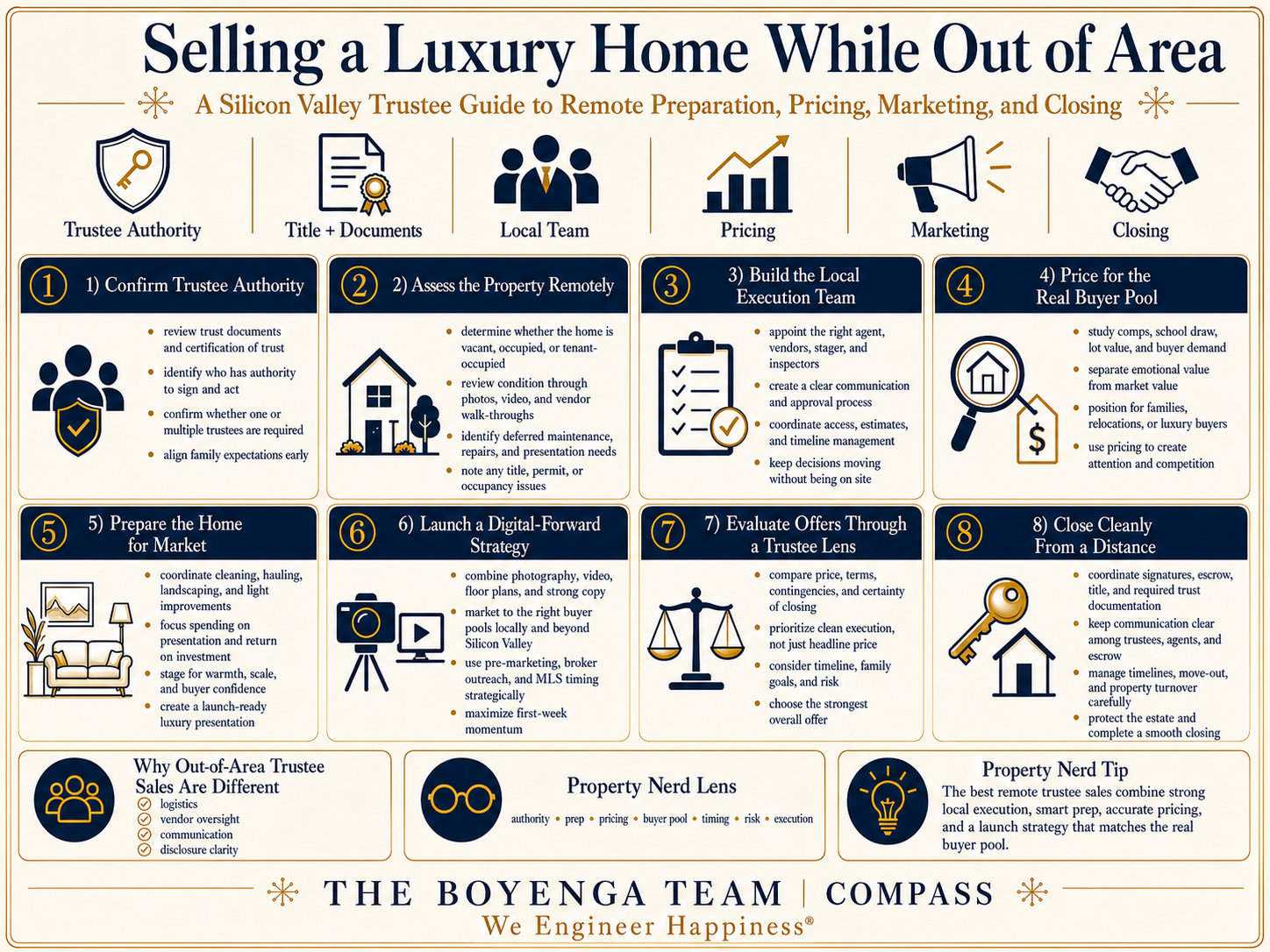
Selling a luxury home in Silicon Valley is already a high-stakes assignment. Selling one as a trustee while living out of the area adds another layer of complexity: distance, family communication, property preparation, legal documentation, vendor coordination, deferred maintenance, insurance, disclosure management, and the pressure to make smart decisions on behalf of beneficiaries.
For many trustees, the property is not just a house. It may be a longtime family home, a trust asset, a source of emotional attachment, or one of the largest financial assets in the estate. The goal is not simply to “get it sold.” The goal is to protect the asset, reduce risk, create a clear process, and position the property to attract the strongest buyer pool possible.
That is where the Boyenga Team at Compass brings a very specific advantage. As Silicon Valley real estate specialists known as the Property Nerds and Next Gen Agents, Eric and Janelle Boyenga help trustees manage the practical, emotional, and strategic parts of selling a luxury home from a distance. From trust-property preparation to vendor coordination, market positioning, disclosure strategy, Compass-powered marketing, and premium buyer targeting, the Boyenga Team creates a clear roadmap for trustees who cannot be local every day.
Why Out-of-Area Trustee Sales Require a Different Strategy
A standard home sale usually starts with a homeowner who knows the property, understands its history, and can make quick decisions about repairs, staging, disclosures, pricing, and timing. A trustee sale is different.
The trustee may live in another city, another state, or even another country. They may not know which vendors to call, what repairs are worth doing, what documents are needed, how to handle personal property, or how to communicate with beneficiaries who have different opinions. In luxury Silicon Valley markets like Palo Alto, Los Altos, Menlo Park, Atherton, Saratoga, Los Gatos, Cupertino, Sunnyvale, Mountain View, and San Jose, small decisions can materially affect buyer perception and final sale price.
A dated kitchen may be acceptable if the architecture, lot, school district, and location are exceptional. An old roof may become a negotiation issue if not investigated early. A poorly presented estate home may invite low offers from investors, while a carefully prepared version of the same home may appeal to end users, remodel buyers, builders, and luxury buyers at the same time.
This is why trustee sales need what we call property intelligence. It is not just selling. It is asset management, buyer psychology, local market strategy, risk reduction, and execution.
The Trustee’s First Job: Protect the Asset
Before thinking about paint colors, staging, or marketing, the first priority is preservation. A vacant or semi-vacant luxury home can quickly become vulnerable to leaks, break-ins, insurance issues, landscape decline, pest activity, pool problems, mail accumulation, and unnoticed maintenance failures.
For an out-of-area trustee, the first phase should include:
Securing the property, checking doors and windows, confirming utilities, reviewing insurance coverage, stopping visible deterioration, addressing urgent safety concerns, managing keys and access, documenting the property condition, and creating a vendor access plan.
This is where a strong local real estate team becomes essential. The Boyenga Team helps trustees identify what needs immediate attention and what can wait. Not every flaw needs to be fixed. Not every dated feature needs to be replaced. The key is knowing which issues could create legal, safety, lending, inspection, marketing, or pricing problems later.
A trustee does not need a remodel project. A trustee needs a smart property plan.
The Property Nerds Approach: Diagnose Before You Spend
One of the biggest mistakes trustees make is spending money in the wrong places. A family member may want to remodel the kitchen. A beneficiary may want to sell as-is immediately. A contractor may suggest a long list of upgrades. A neighbor may have an opinion about the price. None of those opinions are necessarily wrong, but they are incomplete without market context.
The Boyenga Team starts with a diagnostic approach.
What is the buyer pool?
Is this an end-user luxury home, a remodel opportunity, a builder property, an Eichler or mid-century asset, an estate-lot opportunity, a school-driven family home, or a location-driven land-value sale?
What is the highest-return preparation?
Fresh paint, flooring, landscaping, lighting, deep cleaning, window washing, minor repairs, inspections, and staging often outperform expensive renovations when the goal is speed, certainty, and return.
What should not be done?
Some improvements do not pay back. Over-remodeling can create delays, family disagreements, and unnecessary spending. In Silicon Valley, buyers often prefer to customize major design decisions themselves.
What needs to be disclosed or investigated?
Trustee sales often involve limited knowledge of the property. Pre-sale inspections, permit research, title review, HOA documents if applicable, and careful disclosure preparation can help reduce surprises.
This is the Property Nerds advantage: the Boyenga Team looks at the home like a data asset, a lifestyle product, and a buyer psychology puzzle all at once.
The Out-of-Area Challenge: Vendor Coordination
For trustees who live outside Silicon Valley, vendor management can become overwhelming. Someone has to meet painters, haulers, landscapers, cleaners, roofers, stagers, floor refinishers, handymen, inspectors, photographers, videographers, title representatives, city inspectors, and sometimes estate-sale or donation companies.
That is a lot to manage from another city.
The Boyenga Team regularly helps coordinate local preparation vendors so trustees do not have to fly in repeatedly or manage every detail alone. The goal is not to turn the trustee into a project manager. The goal is to provide a streamlined, transparent process with clear priorities and controlled spending.
Typical trustee-sale preparation may include:
Personal property removal
Donation and hauling coordination
Deep cleaning
Landscape cleanup
Tree trimming or curb appeal work
Paint touch-ups or full interior painting
Floor refinishing or flooring replacement
Minor electrical or plumbing repairs
Lighting updates
Window washing
Pool or spa servicing
Roof, termite, sewer, chimney, HVAC, and home inspections
Staging and photography
Pre-market buyer positioning
Disclosures and document organization
For luxury properties, presentation matters. Buyers are making an emotional and financial decision within seconds of seeing the home online or walking through the front door. Even when a home is being sold as-is, it should not feel neglected.
Should a Trustee Sell As-Is or Prepare the Home?
This is one of the most important questions.
The answer is: it depends on the property, the market, the buyer pool, and the likely return on preparation.
Selling as-is can make sense when the home is a clear teardown, has major structural issues, is tenant-occupied, requires extensive capital investment, or when the trust requires speed over price optimization. However, “as-is” should not mean “under-marketed” or “poorly presented.”
Preparation can make sense when modest improvements will expand the buyer pool. In Silicon Valley, this often means helping buyers see potential without forcing the trust into a full renovation.
Examples of high-impact, lower-risk preparation include:
Fresh neutral paint
Improved lighting
Clean landscaping
Refinished hardwood floors
New carpet in tired bedrooms
Updated cabinet hardware
Deep cleaning
Decluttering and hauling
Staging key rooms
Modern photography and video
Pre-inspections to reduce buyer uncertainty
The Boyenga Team’s philosophy is simple: do as little as possible, but not so little that the property is shortchanged. A luxury home should be prepared to meet the market, not over-improved for a buyer who may have a completely different vision.
Why Silicon Valley Trustee Sales Are Unique
Silicon Valley is not a normal real estate market. Buyer motivations are highly specific. A home may attract different buyer types depending on location, lot size, school district, architecture, commute access, zoning potential, and neighborhood identity.
A trustee selling in Palo Alto may be dealing with buyers focused on schools, Stanford proximity, tech access, and long-term land value. A Los Altos or Los Altos Hills trustee sale may draw luxury buyers, builders, and buyers seeking privacy or estate lots. A Cupertino trust property may receive attention because of school demand and proximity to Apple. A Mountain View or Sunnyvale property may attract Google, LinkedIn, Nvidia, Apple, and startup professionals who value commute efficiency and future upside. A Saratoga, Los Gatos, or Monte Sereno luxury home may attract buyers seeking privacy, lifestyle, acreage, architecture, and top-tier community feel.
The marketing strategy should reflect these differences.
A trust property should not be described generically. It should be positioned around the value drivers that matter most:
Lot utility
Privacy
School boundaries
Commute patterns
Architectural style
Expansion potential
Outdoor living
Natural light
Floor plan flexibility
ADU or multigenerational potential
Proximity to major employers
Neighborhood identity
Luxury lifestyle
Long-term resale strength
The Boyenga Team knows how to translate these details into buyer demand.
Family Communication: Reducing Stress Between Beneficiaries
Many trustee sales involve multiple beneficiaries, siblings, family members, or advisors. Everyone may want the same outcome, but they may have different ideas about how to get there.
One person may want the fastest sale. Another may want the highest price. Another may be emotionally attached to the home. Another may worry about spending trust money on preparation. Another may distrust the market, the vendors, or the timing.
A clear process helps.
The Boyenga Team can help trustees organize decisions into categories:
What is required?
What is recommended?
What is optional?
What is not worth doing?
What needs attorney or CPA input?
What will improve buyer confidence?
What will improve marketability?
What could delay the sale?
This helps trustees communicate with beneficiaries in a more objective way. Instead of debating opinions, the discussion becomes about strategy, risk, return, timing, and market evidence.
The Role of Pre-Sale Inspections
In trustee sales, pre-sale inspections can be especially valuable because the trustee may have limited knowledge of the home. Buyers understand that trustees often cannot answer every property-history question. However, buyers still want clarity.
Common pre-sale inspections may include:
Home inspection
Termite inspection
Roof inspection
Sewer lateral inspection
Chimney inspection
Pool inspection
HVAC inspection
Foundation or structural review if needed
Permit history research
HOA document review if applicable
The purpose is not to make the property perfect. The purpose is to reduce uncertainty. In Silicon Valley, informed buyers can move faster and write stronger offers when they understand the condition of the property upfront.
For luxury homes, transparency can be a competitive advantage. It helps serious buyers evaluate risk, reduces renegotiation pressure, and allows the seller to control the narrative before the property hits the open market.
Pricing a Trustee Sale Correctly
Pricing is where trustee sales can become emotionally and financially complicated. Online estimates may be inaccurate. Beneficiaries may remember a neighbor’s sale that is not truly comparable. A dated home may not perform like a remodeled home. A large lot may be worth more to one buyer pool than another. A property with expansion potential may need a different strategy than a turnkey luxury home.
The Boyenga Team evaluates pricing through multiple lenses:
Recent comparable sales
Current active competition
Pending sales and market velocity
Condition adjustments
Lot-size and usability adjustments
School and commute premiums
Architecture and design appeal
Builder demand
Remodel potential
Buyer pool depth
Luxury-market timing
Pre-market interest
Offer strategy
The goal is to avoid both underpricing and aspirational overpricing. Underpricing can leave money on the table if the buyer pool is thin. Overpricing can cause the home to sit, become stale, and attract discount-minded buyers.
The best pricing strategy creates urgency without sacrificing trust value.
Pre-Market vs Public MLS Strategy
For some luxury trustee sales, a pre-market phase can be useful. This may include private exposure, Compass network promotion, targeted agent outreach, select buyer previews, and confidential feedback before going fully public.
Pre-market strategy can help answer important questions:
Is the price aligned with buyer expectations?
Are buyers responding to the condition?
Is the home attracting end users, builders, or investors?
Should preparation be adjusted before MLS?
Are disclosures clear enough?
Is there an opportunity for an off-market sale?
However, not every home should stay private. Public MLS exposure often creates broader competition, more visibility, and a clearer sense of market value. The right strategy depends on the trust’s goals, timing, property type, and beneficiary expectations.
With Compass technology, digital marketing tools, agent networks, and local market intelligence, the Boyenga Team can help trustees decide whether a quiet launch, Private Exclusive, Coming Soon, or full MLS campaign makes the most sense.
Marketing a Luxury Trust Property
A luxury trustee sale should never feel like an afterthought. Even if the home is dated, vacant, or being sold by a trust, the marketing should feel intentional, polished, and strategic.
The Boyenga Team’s marketing may include:
Professional photography
Twilight or architectural photography when appropriate
Video storytelling
Aerial photography
Floor plans
Property website
Compass digital exposure
Social media campaigns
Email marketing
Agent-to-agent outreach
Luxury buyer targeting
Neighborhood storytelling
School and commute positioning
Architectural or lot-value messaging
Open house strategy
Broker tour strategy
Pre-market feedback loops
The best marketing does not just show rooms. It explains value.
For example, a dated ranch home in Los Altos may be marketed around lot size, schools, remodel potential, village access, and lifestyle. A mid-century home in Palo Alto may be positioned around architecture, indoor-outdoor flow, natural light, and design potential. A Saratoga estate may be marketed around privacy, grounds, luxury lifestyle, and proximity to Silicon Valley wealth centers.
This is where generic real estate marketing fails. Trustee properties need story, strategy, and buyer segmentation.
Disclosure Strategy for Trustees
Trustees often worry about disclosures because they may not have lived in the property or may not know its full history. This is common. The key is to be transparent, organized, and guided by the proper professionals.
A trustee should work closely with the real estate agent, attorney, title company, and escrow team to understand what documents are needed and how disclosures should be completed.
Important areas may include:
Trust documentation required by title
Authority of the trustee to sell
Property condition disclosures
Known repairs or defects
Death-on-property rules if applicable
Permits and improvements
Insurance claims if known
HOA documents if applicable
Tenant or occupancy issues
Personal property exclusions
Environmental, natural hazard, and local disclosures
Pre-sale inspection reports
The Boyenga Team helps organize the real estate side of the process so trustees can provide buyers with a clear, professional disclosure package. This does not replace legal advice, but it can make the sale process smoother and more defensible.
Working With Title, Escrow, Attorneys, and CPAs
Trust sales often require more coordination than traditional sales. Title may need trust documents, certification of trust, death certificate, trustee identification, vesting details, or other documentation. Escrow may need signatures from the authorized trustee. CPAs may need to advise on tax consequences, withholding, basis, and distribution issues. Attorneys may need to advise on trust authority, beneficiary communication, notices, or disputes.
Out-of-area trustees benefit from having a local real estate team that understands how to coordinate with these professionals early.
The Boyenga Team does not provide legal or tax advice, but we help trustees ask the right questions at the right time so issues do not surface late in escrow.
Smart trustee questions include:
Who has authority to sign?
Is the trust currently revocable or irrevocable?
Does the trustee have authority to sell?
Are there co-trustees?
Do all trustees need to sign?
Are any beneficiary notices required?
Are there tax withholding issues?
Is the property held in the trust correctly?
Are there liens, loans, or title issues?
Is the property occupied?
Are there personal property items excluded from the sale?
Are there insurance or maintenance concerns before closing?
The earlier these questions are addressed, the smoother the sale tends to be.
Handling Personal Property
Personal property is often one of the most emotional and time-consuming parts of a trustee sale. Family members may want items. Beneficiaries may disagree about what has value. The home may contain decades of belongings. Luxury properties may include art, furniture, wine, vehicles, tools, collectibles, documents, electronics, safes, jewelry, or family memorabilia.
The best approach is to separate personal property from real estate strategy.
A typical process may include:
Family review and item selection
Estate-sale consultation if appropriate
Donation plan
Hauling plan
Document shredding
Hazardous waste removal
Staging decision
Garage, attic, and storage cleanup
Final cleanout before photography
The home does not need to be empty immediately, but it does need to be photo-ready before launch. Buyers should see the property, not the burden of clearing it.
Occupied, Vacant, or Tenant-Occupied Trust Properties
Out-of-area trustee sales can involve different occupancy situations.
A vacant home may be easier to prepare and show, but it requires security, insurance attention, and regular checks.
An owner-occupied or family-occupied home may require careful communication, timelines, and expectations.
A tenant-occupied property adds legal and logistical complexity. Showing access, notice requirements, tenant rights, rent status, lease terms, relocation concerns, and buyer financing can all affect the strategy.
The Boyenga Team helps trustees evaluate the best path based on the property’s status and the trust’s goals. Sometimes it is better to sell vacant. Sometimes it is better to sell with tenants in place. Sometimes timing and legal guidance are critical before any marketing begins.
Luxury Buyer Psychology: What Buyers Notice First
Silicon Valley luxury buyers are sophisticated. They may be engineers, founders, executives, investors, physicians, attorneys, or multigenerational families making a major lifestyle decision. They notice details quickly.
They notice the driveway, landscaping, front door, natural light, ceiling height, flooring, kitchen flow, bedroom layout, privacy, noise, outdoor space, school district, commute, expansion potential, and whether the home feels cared for.
Even buyers planning a remodel are influenced by first impressions. A clean, well-lit, properly staged home can feel like an opportunity. A cluttered, dark, poorly maintained home can feel like a liability.
The Boyenga Team focuses on presentation that helps buyers understand the home’s best future. The goal is to show possibility without hiding reality.
The Remodel Math: When Improvements Pay Off
Not every improvement adds value. In trustee sales, the smartest projects are usually those that reduce friction, improve first impressions, and expand the buyer pool without creating major delays.
High-return preparation often includes:
Paint
Lighting
Landscape refresh
Flooring
Cleaning
Staging
Minor repairs
Inspection clarity
Curb appeal
Photography
Lower-return or higher-risk improvements may include:
Full kitchen remodels
Major bathroom remodels
Large additions
Highly personal design choices
Expensive custom finishes
Projects requiring permits and long timelines
Structural changes without clear buyer demand
Silicon Valley buyers often pay for location, land, schools, architecture, and future potential. The trick is to make the home feel approachable, not overdone.
How the Boyenga Team Helps Trustees From Start to Finish
The Boyenga Team’s trustee-sale process is designed to reduce stress and improve decision-making.
1. Initial Trustee Consultation
We discuss the trust’s goals, timeline, property condition, occupancy, beneficiary dynamics, and decision-making structure.
2. Property Walkthrough and Value Assessment
We evaluate the home through the lens of buyer demand, condition, location, lot value, architecture, schools, and market timing.
3. Preparation Plan
We identify what should be done, what should not be done, what is urgent, and what is optional.
4. Vendor Coordination
We help coordinate local vendors for cleaning, hauling, landscaping, painting, inspections, staging, photography, and repairs.
5. Disclosure and Document Organization
We help organize the real estate side of the disclosure process and coordinate with escrow, title, attorneys, and CPAs as needed.
6. Pricing Strategy
We create a pricing plan based on comparable sales, buyer pool, condition, competition, and market velocity.
7. Compass-Powered Marketing
We use Compass tools, digital campaigns, agent networks, professional media, and local storytelling to reach the right buyers.
8. Offer Strategy
We help compare price, terms, contingencies, financing strength, closing timelines, and buyer reliability.
9. Escrow Management
We help manage inspections, documents, deadlines, buyer requests, and closing coordination.
10. Post-Closing Support
We help trustees wrap up real estate-related loose ends so they can move forward with the trust administration process.
Why Compass Matters for Trustee Sales
Compass is a technology-forward brokerage, and that matters when selling a high-value Silicon Valley trust property. Trustees need organization, exposure, communication, marketing reach, and efficient execution.
Compass tools can support:
Private Exclusive marketing
Coming Soon strategy
Digital campaigns
Agent network exposure
Luxury marketing presentation
Data-driven pricing conversations
Buyer targeting
Property websites and media distribution
Market analytics
For out-of-area trustees, this tech-forward platform pairs well with the Boyenga Team’s local, hands-on approach. The combination is powerful: local expertise plus modern marketing infrastructure.
The Boyenga Team Difference
Eric and Janelle Boyenga are not just listing agents. They are Silicon Valley property strategists. Their team understands luxury homes, trust sales, family dynamics, preparation math, architecture, schools, buyer psychology, and the fast-moving nature of the Silicon Valley market.
Known as the Property Nerds and Next Gen Agents, the Boyenga Team brings a unique combination of data, design sense, vendor coordination, negotiation strategy, and market storytelling.
For trustees, that means:
Less guesswork
Less vendor chaos
Less beneficiary confusion
Less unnecessary spending
Better preparation decisions
Stronger buyer targeting
More polished marketing
More organized disclosures
Better offer evaluation
A smoother sale from a distance
Selling a luxury trust property is not just about putting a sign in the yard. It is about protecting the asset, honoring the responsibility, and creating the best possible outcome for the beneficiaries.
Final Thoughts: You Do Not Have to Be Local to Sell Well
Being an out-of-area trustee can feel overwhelming, but the right local team can make the process manageable. With a clear plan, trusted vendors, smart preparation, strategic pricing, and high-quality marketing, a Silicon Valley luxury home can be positioned beautifully even when the trustee lives elsewhere.
The most successful trustee sales are not rushed, random, or reactive. They are organized, transparent, and intentional.
If you are responsible for selling a luxury home, trust property, or inherited real estate in Silicon Valley, the Boyenga Team can help you understand your options, prepare the property intelligently, and create a strategy that protects the trust asset while maximizing market appeal.
The Property Nerds are ready to help you engineer the next move.