
Blog > The School-Boundary Premium Is Not a Straight Line: What Silicon Valley Buyers and Sellers Often Miscalculate
The School-Boundary Premium Is Not a Straight Line: What Silicon Valley Buyers and Sellers Often Miscalculate
by
 Silicon Valley buyers have long understood that school assignments influence home values. What many don't appreciate is how that influence actually works.
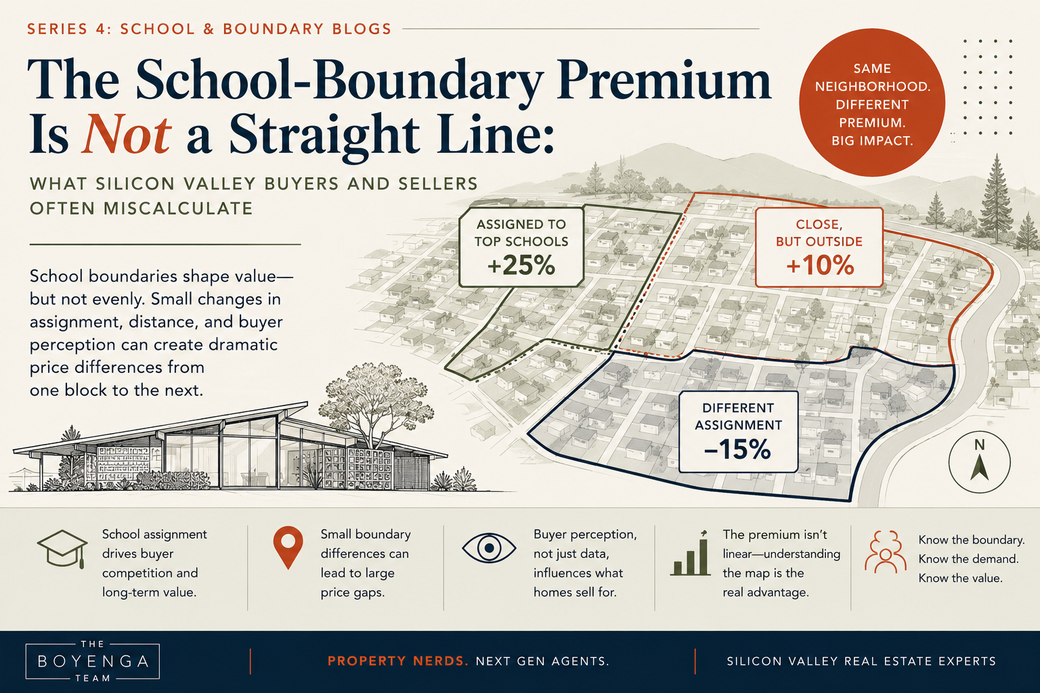
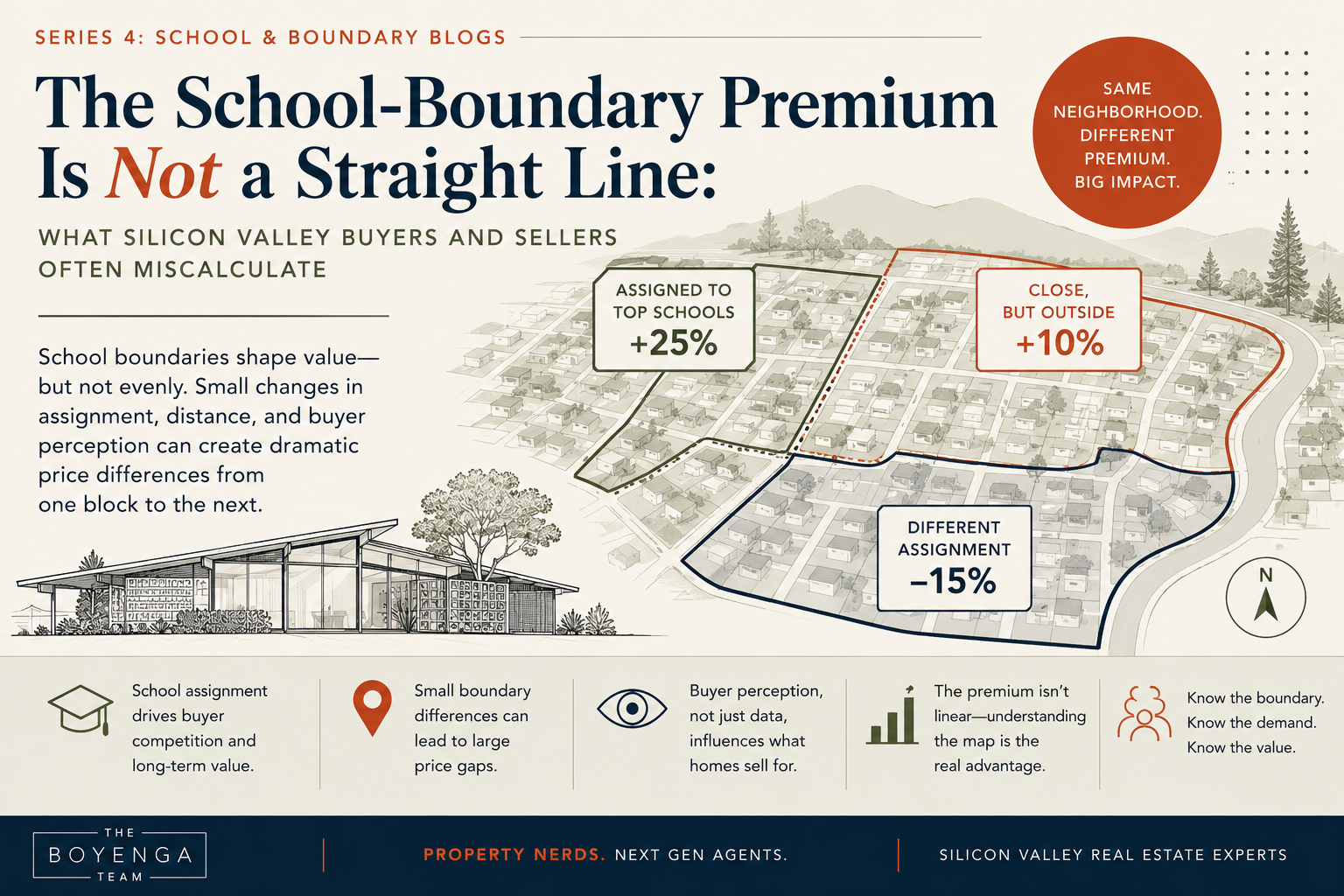
A common assumption is that school assignment produces a predictable pricing ladder. In reality, the relationship is rarely linear. A home assigned to one in-demand elementary school may command a meaningful premium over an otherwise identical home just a few blocks away, while the difference between two similarly in-demand schools may have little measurable impact at all.
The market doesn't simply respond to school assignments. It responds to buyer perception, inventory scarcity, neighborhood identity, commute patterns, and the confidence buyers have in making a long-term investment. School boundaries become one variable in a much larger equation.
For anyone buying or selling in Silicon Valley, understanding that equation is often the difference between recognizing hidden value and overlooking it entirely.
Many of these broader neighborhood dynamics are explored throughout the Boyenga Team's Silicon Valley market guides at https://boyengarealestateteam.com, where schools are considered alongside architecture, lifestyle, and long-term market performance rather than in isolation.
Boundaries Don't Move Markets—Buyer Behavior Does
It is tempting to reduce a school assignment to a single label.
Buyers frequently draw hard lines around specific attendance areas. Yet those lines rarely tell the complete story.
Markets respond to what buyers believe about a school just as much as the underlying data itself. Reputation develops over decades, reinforced through neighborhood conversations, alumni networks, community identity, and local expectations. Even when neighboring schools appear relatively similar, buyer demand can remain noticeably different because perception changes slowly.
This helps explain why some attendance boundaries carry remarkably durable pricing premiums while others fluctuate as enrollment patterns, inventory, and public perception evolve.
Boundaries Create Markets, Not Just School Assignments
School attendance maps quietly shape some of Silicon Valley's most competitive housing markets.
Unlike city limits, school boundaries often cut directly through established neighborhoods. Two homes may sit across the street from one another, share nearly identical architecture, and offer the same commute, parks, and amenities. Yet if they feed into different schools, they can attract different buyer pools from the moment they reach the market.
That difference affects nearly every buyer, not just those planning to use the schools.
Many buyers who don’t plan to use the schools willingly pay premiums for homes in high-demand attendance areas because they recognize future resale demand. They understand that the next buyer may value those assignments even more than they do today.
In this way, school boundaries influence liquidity as much as lifestyle.
Premiums Rarely Increase in Equal Steps
One of the biggest misconceptions in Silicon Valley real estate is that school premiums rise in equal steps from one attendance area to the next.
The market behaves much differently.
Moving into a high-demand attendance area may create a significant shift in buyer demand. Moving from one high-demand school to another often produces little measurable difference because buyers already view both as satisfying the same objective.
Likewise, the premium associated with a particular attendance area may be driven less by the school itself than by the scarcity of available homes within its boundaries.
Limited inventory amplifies competition.
Competition amplifies pricing.
The resulting premium reflects both education and economics.
The Boundary Line Buyers Never See
Some of the region's most valuable real estate distinctions are completely invisible.
A residential street may appear uniform, yet one side feeds into a different elementary school than the other, even when the homes were built by the same developer on similar lots. That is why each address should be checked with the district.
These differences become particularly noticeable during competitive markets, when buyers narrow their searches around specific school assignments and inventory becomes increasingly constrained.
To someone unfamiliar with the area, the pricing differences may seem irrational.
To local buyers, they often feel entirely logical.
Buyers Frequently Optimize for Optionality
Another misconception is that school boundaries matter only to buyers who plan to use the schools.
In practice, many buyers are purchasing flexibility.
A home in a high-demand attendance area expands the future buyer pool. It appeals to a broad range of buyers who recognize the long-term strength of neighborhood demand.
That optionality contributes to resale resilience.
Even owners who never personally use the schools benefit from the consistent demand those attendance areas generate.
Sellers Often Undervalue Their Position
School assignments create opportunities not only for buyers but also for sellers.
Owners sometimes assume neighboring homes establish appropriate pricing benchmarks without recognizing that subtle boundary differences may justify meaningful adjustments.
Conversely, sellers occasionally overestimate the value of a particular school assignment while overlooking other factors buyers weigh simultaneously, including commute access, neighborhood character, architectural quality, and overall condition.
The strongest pricing strategy considers the complete ownership equation rather than relying on school assignment alone.
Understanding the Context Matters
School boundaries are particularly nuanced across Silicon Valley because neighboring communities often organize assignments very differently.
Cupertino's attendance areas differ significantly from Palo Alto's. Los Altos presents another model entirely, while district boundaries throughout Mountain View, Sunnyvale, Saratoga, and San Jose introduce additional layers of complexity.
Buyers who understand these systems before beginning their search often discover opportunities that remain invisible to those filtering listings solely by city name or ZIP code.
The Boyenga Team regularly publishes neighborhood analysis, buyer education, and market research through the Property Nerds Blog, helping buyers understand how schools interact with broader market dynamics rather than treating them as standalone metrics.
Read more at https://www.boyengateam.com/blog.
Looking Beyond the School Assignment
While school assignments influence demand, they are only one part of a home's long-term value.
Architecture, neighborhood continuity, walkability, commute access, lot characteristics, and community identity all shape how buyers perceive a property over time. In many Silicon Valley neighborhoods, these factors reinforce one another rather than competing for importance.
Buyers interested in communities where architecture and schools intersect—particularly mid-century modern neighborhoods throughout the Peninsula and South Bay—can also explore additional resources through https://bayareaeichlerhomes.com and https://midmodhomes.com.
Understanding how those elements work together often provides a far clearer picture than any single ranking ever could.
The Property Nerd Take
School boundaries don't create value in isolation—they shape buyer behavior. The premium attached to a particular attendance area reflects perception, inventory, neighborhood identity, and long-term confidence as much as the schools themselves. That is why two homes separated by a single block can experience very different market dynamics despite appearing nearly identical.
For thoughtful buyers and sellers, the objective isn't simply to chase a particular school. It's to understand where demand is strongest, why buyers compete there, and how that demand is likely to evolve over time. In Silicon Valley, the smartest real estate decisions often begin not with the school itself, but with the market surrounding it.
keep exploring · property nerd guides
Every Silicon Valley school district, mapped by the Property Nerds
District boundaries, which high schools serve which neighborhoods, and how to check an address before you buy.
Open the schools guideWhat’s my home worth?
Talk to a Property Nerd: (408) 373-1660 · (650) 383-8606 · How we sell homes
city guides Palo Alto · Los Altos · Menlo Park · Cupertino · Sunnyvale · Los Gatos · San Jose