

Blog > Palo Alto vs. Mountain View: Stanford Energy or Google Convenience?
A Property Nerd’s Strategic Guide to Two of Silicon Valley’s Most Influential Real Estate Markets
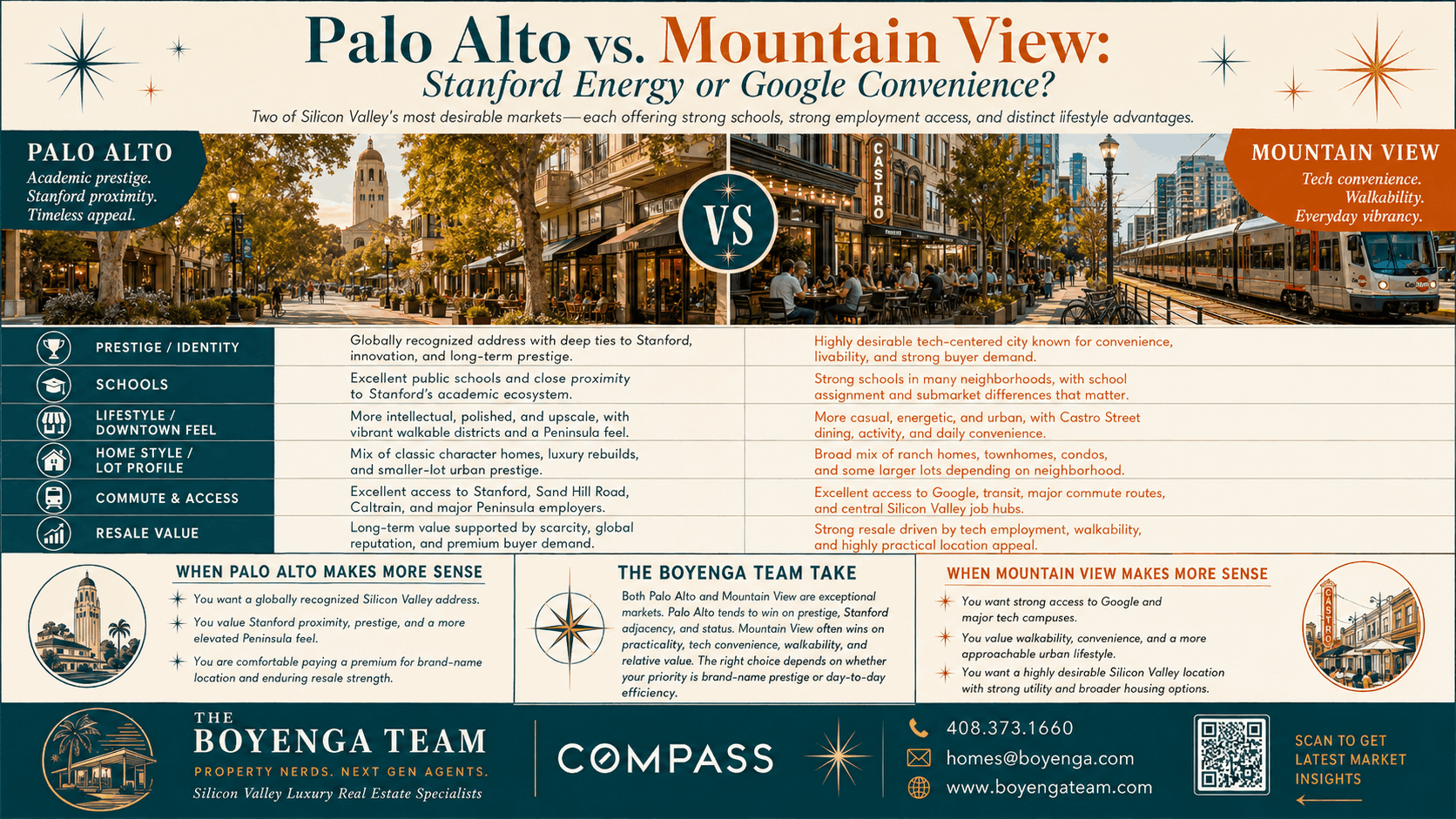
For Silicon Valley buyers, the decision between Palo Alto and Mountain View is not just about choosing a city. It is about choosing an operating system for daily life. Palo Alto offers Stanford energy, intellectual prestige, historic neighborhoods, elite school demand, venture capital proximity, and one of the most globally recognized addresses in technology culture. Mountain View offers Google convenience, downtown walkability, Caltrain access, bike-friendly living, relative value, and a more practical connection to the daily rhythm of Silicon Valley’s tech workforce.
At first glance, Palo Alto and Mountain View appear to be neighboring markets with similar buyer pools. Both attract engineers, founders, executives, academics, investors, physicians, startup employees, relocating families, and long-term Silicon Valley homeowners. Both benefit from proximity to major employers, excellent regional schools, limited land supply, and enormous household wealth. But from a Property Nerd perspective, these cities are fundamentally different real estate assets.
Palo Alto is an identity market. Buyers pay for the aura of Stanford, the gravitational pull of University Avenue, the prestige of Palo Alto Unified, the historical depth of neighborhoods like Old Palo Alto and Professorville, and the feeling of being near the intellectual center of Silicon Valley. The City of Palo Alto describes University Avenue as a focal point of downtown and notes that Palo Alto is widely known as the birthplace of Silicon Valley, which helps explain why the city carries such powerful name recognition among global buyers.
Mountain View is a functionality market. Buyers pay for proximity to Google, downtown Castro Street, Caltrain, trails, parks, restaurants, tech campuses, and a housing market that often feels more accessible than Palo Alto while still delivering serious Silicon Valley convenience. Google’s official visitor experience is located in Mountain View, and the city’s Castro Street pedestrian mall has become one of the most active walkable downtown environments on the Peninsula.
The cleanest way to frame the comparison is this: Palo Alto sells prestige and proximity to Stanford. Mountain View sells convenience and proximity to Google. Palo Alto often appeals to buyers who want institutional gravity, luxury resale liquidity, and a globally understood address. Mountain View often appeals to buyers who want a more connected daily lifestyle, faster access to tech campuses, and a stronger price-to-function equation.
Current market data reinforces the difference. Zillow reported Palo Alto’s average home value at approximately $3.68 million as of May 31, 2026, up 2.6% year over year. Mountain View’s average home value was approximately $2.02 million as of the same date, up 0.3% year over year. Redfin’s three-month data ending May 2026 showed Palo Alto’s median sale price around $3.6 million with a median price per square foot near $1,950, while Mountain View’s median sale price was about $1.94 million.
That price gap is not just about house size. It is about brand, school perception, neighborhood scarcity, Stanford proximity, buyer psychology, and long-term resale confidence. Palo Alto buyers often accept a higher price per square foot because the city carries a premium that is difficult to replicate. Mountain View buyers often see value in a different way: more practical affordability, more housing diversity, stronger transit access, and a location that functions beautifully for tech-centered daily life.
Palo Alto’s Stanford connection is one of the most important real estate value drivers in the region. Stanford is not simply a university nearby. It is an economic, intellectual, cultural, and emotional anchor. It brings professors, researchers, physicians, students, founders, visiting executives, venture capitalists, and global families into the Palo Alto orbit. The Stanford Visitor Center is located on the Stanford campus, and Stanford Research Park sits on 700 acres at the edge of campus with 10 million square feet of lab and office space.
That Stanford energy spills directly into Palo Alto real estate. Buyers are not just purchasing a home near a school or a shopping district. They are buying into an ecosystem where academia, medicine, venture capital, technology, and entrepreneurship overlap. A home near Stanford, Old Palo Alto, Professorville, Southgate, College Terrace, Crescent Park, or downtown Palo Alto often carries an emotional premium because the location feels connected to something larger than the house itself.
Mountain View’s Google connection works differently. Google is not just an employer in Mountain View. It is a daily-life engine. It affects commute patterns, rental demand, restaurant traffic, bike culture, corporate shuttle routes, and neighborhood desirability. For buyers searching for homes near Google, Mountain View offers a level of convenience that is hard to beat. Living near the Googleplex, Shoreline, North Whisman, Old Mountain View, Cuesta Park, Monta Loma, Rex Manor, or downtown Mountain View can materially reduce daily friction for technology professionals.
The Mountain View buyer is often asking a different question than the Palo Alto buyer. The Palo Alto buyer may ask, “Does this home give us access to the best long-term Silicon Valley address?” The Mountain View buyer may ask, “Does this home make our daily life easier?” Both are rational questions. They simply optimize for different outcomes.
Schools are central to the comparison. Palo Alto Unified School District remains one of the strongest brand drivers in Bay Area residential real estate. PAUSD states that school assignment is based on the location of the family residence within a school boundary, which is exactly why buyers must verify the address-level assignment before making assumptions.
Mountain View also has meaningful school strength, but the school conversation is more nuanced. Mountain View Whisman School District directs families to use SchoolLocator and boundary maps to verify address-specific assignments, and Mountain View Los Altos High School District states that both Los Altos High and Mountain View High rank in the top 2% nationally according to U.S. News & World Report.
The Property Nerd takeaway is that Palo Alto’s school premium is broader and more globally recognized, while Mountain View’s school premium is more micro-market specific. In Palo Alto, the city name itself often carries a school-driven prestige signal. In Mountain View, buyers need to be more precise about the neighborhood, elementary district, high school path, and exact boundary. That creates opportunity for smart buyers, but it also requires more due diligence.
Lifestyle is where the contrast becomes especially clear. Palo Alto has a more polished, academic, and established feel. University Avenue, California Avenue, Stanford Shopping Center, Stanford campus access, Caltrain, cafes, restaurants, and historic neighborhoods create a sophisticated urban-suburban rhythm. The Palo Alto Caltrain station sits at 95 University Avenue, anchoring downtown access and regional mobility.
Mountain View feels more casual, connected, and tech-forward. Castro Street gives the city one of the best restaurant and pedestrian environments in Silicon Valley, while the Mountain View Transit Center, Caltrain access, VTA connections, bike routes, and proximity to Google make the city highly functional for buyers who value mobility. The City of Mountain View adopted its Castro Street pedestrian mall ordinance in 2022, reinforcing downtown’s role as a walkable social and dining hub.
Palo Alto’s walkability is prestige walkability. It is about being near University Avenue, Stanford, cafes, bookstores, restaurants, Caltrain, and the intellectual energy of the city. Mountain View’s walkability is convenience walkability. It is about Castro Street, transit, restaurants, tech access, bike routes, and the ability to live a more car-light Silicon Valley lifestyle.
Housing stock is another major difference. Palo Alto offers historic homes, Craftsman properties, Spanish-style residences, mid-century modern homes, Eichlers, ranch homes, townhomes, luxury rebuilds, and architect-designed estates. Neighborhoods like Old Palo Alto, Professorville, Crescent Park, Community Center, Southgate, College Terrace, Barron Park, Midtown, and Greenmeadow each have distinct buyer psychology.
Mountain View has a wider range of price points and housing types. Buyers can find condos, townhomes, Eichlers, mid-century homes, older ranches, remodeled single-family homes, downtown-adjacent properties, and newer construction. Neighborhoods like Old Mountain View, Cuesta Park, Waverly Park, Monta Loma, Shoreline West, Rex Manor, Blossom Valley, St. Francis Acres, and North Whisman behave differently, which makes neighborhood-level interpretation essential.
Price per square foot often tells the story, but it does not tell the whole story. Palo Alto’s higher price per square foot reflects scarcity, prestige, schools, Stanford proximity, and global demand. Mountain View’s lower relative price per square foot often reflects a broader housing mix, but it can also create compelling value for buyers who want access to the same employment ecosystem without paying the full Palo Alto premium.
For buyers focused on homes near Stanford, Palo Alto is the cleaner emotional and logistical fit. The appeal is especially strong for Stanford faculty, physicians, researchers, venture capital professionals, graduate school families, international buyers, and executives who want the Palo Alto identity. A home in Palo Alto can function as both a residence and a long-term prestige asset.
For buyers focused on homes near Google, Mountain View is often the more practical answer. The appeal is especially strong for Google employees, startup workers, engineers, product leaders, AI professionals, hybrid workers, and buyers who want a downtown lifestyle close to work. A Mountain View home can function as a daily efficiency machine.
Resale value is strong in both cities, but the resale thesis differs. Palo Alto resale is often supported by global recognition, Stanford proximity, PAUSD demand, historic neighborhoods, and a deep pool of luxury buyers. Mountain View resale is supported by employer proximity, downtown walkability, Caltrain access, relative value, diverse housing options, and ongoing demand from technology workers.
The risk profile also differs. In Palo Alto, buyers can make expensive mistakes by overpaying for a compromised location simply because the address says Palo Alto. A noisy street, awkward lot, poor floor plan, older systems, or misunderstood remodel limitations can reduce future resale strength. In Mountain View, buyers can make mistakes by underestimating micro-location. A home near downtown, transit, trails, or a strong school path may deserve a very different valuation than a home that is more impacted by traffic, office adjacency, train noise, or future development.
From a seller’s perspective, the marketing strategy should reflect the city’s core buyer psychology. A Palo Alto listing should usually emphasize Stanford proximity, school confidence, architectural character, prestige, neighborhood history, walkability, and long-term liquidity. A Mountain View listing should usually emphasize Google convenience, commute efficiency, downtown access, flexible living, smart-home infrastructure, transit, bikeability, and value compared with Palo Alto.
Smart-home infrastructure matters in both markets. Buyers in Palo Alto and Mountain View often expect EV charging, solar, battery backup, heat pump HVAC, induction cooking, strong Wi-Fi, smart thermostats, leak detection, smart irrigation, advanced security, home office functionality, and energy-efficient systems. In Palo Alto, smart-home features often support luxury, comfort, and future-proofing. In Mountain View, they often support convenience, efficiency, and a tech-forward lifestyle.
The work-from-home shift has also changed the comparison. Palo Alto buyers may want a refined home office, guest suite, library, detached studio, or quiet architectural space. Mountain View buyers may prioritize functional floor plans, efficient work zones, fiber-level connectivity, garage conversions, ADUs, and flexible rooms that support hybrid schedules. Both markets reward homes that understand how Silicon Valley professionals actually live.
The final decision is not whether Palo Alto or Mountain View is better. The better question is what the buyer is optimizing for. Palo Alto is often the stronger fit for buyers who value Stanford energy, prestige, elite school perception, historic neighborhoods, institutional proximity, and luxury resale confidence. Mountain View is often the stronger fit for buyers who value Google convenience, downtown walkability, commute efficiency, relative value, transit access, and tech-centered daily life.
At the Boyenga Team at Compass, we view Palo Alto vs. Mountain View as a strategic lifestyle-and-investment decision. Eric and Janelle Boyenga, known as Silicon Valley Property Nerds and Next Gen Agents, help buyers and sellers understand the hidden variables that drive value: school boundaries, commute patterns, architecture, lot utility, neighborhood psychology, pricing strategy, buyer demand, Compass technology, private inventory, and long-term resale positioning.
Compass gives the Boyenga Team a technology-forward platform that fits the Silicon Valley mindset. In a market shaped by data, speed, digital marketing, private exclusives, buyer behavior, and pricing intelligence, real estate strategy needs to be as sophisticated as the buyers and sellers it serves. The tools matter, but interpretation matters more.
Palo Alto gives buyers Stanford energy. Mountain View gives buyers Google convenience. Both are powerful. Both are valuable. Both can be exceptional long-term choices. The winning move is understanding which city better supports your lifestyle, commute, school priorities, budget, home preferences, and future resale strategy.
The Boyenga Team at Compass represents buyers and sellers throughout Silicon Valley with a focus on luxury homes, Eichler and mid-century modern properties, school-driven moves, estate homes, trust sales, and high-value residential strategy. Known as Property Nerds and Next Gen Agents, Eric and Janelle Boyenga combine data, design, technology, negotiation, and local market intelligence to help clients make smarter real estate decisions in Palo Alto, Mountain View, Los Altos, Sunnyvale, Cupertino, Menlo Park, Saratoga, Los Gatos, and the greater Silicon Valley market. For expert guidance, contact the Boyenga Team at Compass at homes@boyenga.com or visit www.BoyengaTeam.com.