

Blog > Palo Alto vs Menlo Park: Where Should You Buy?
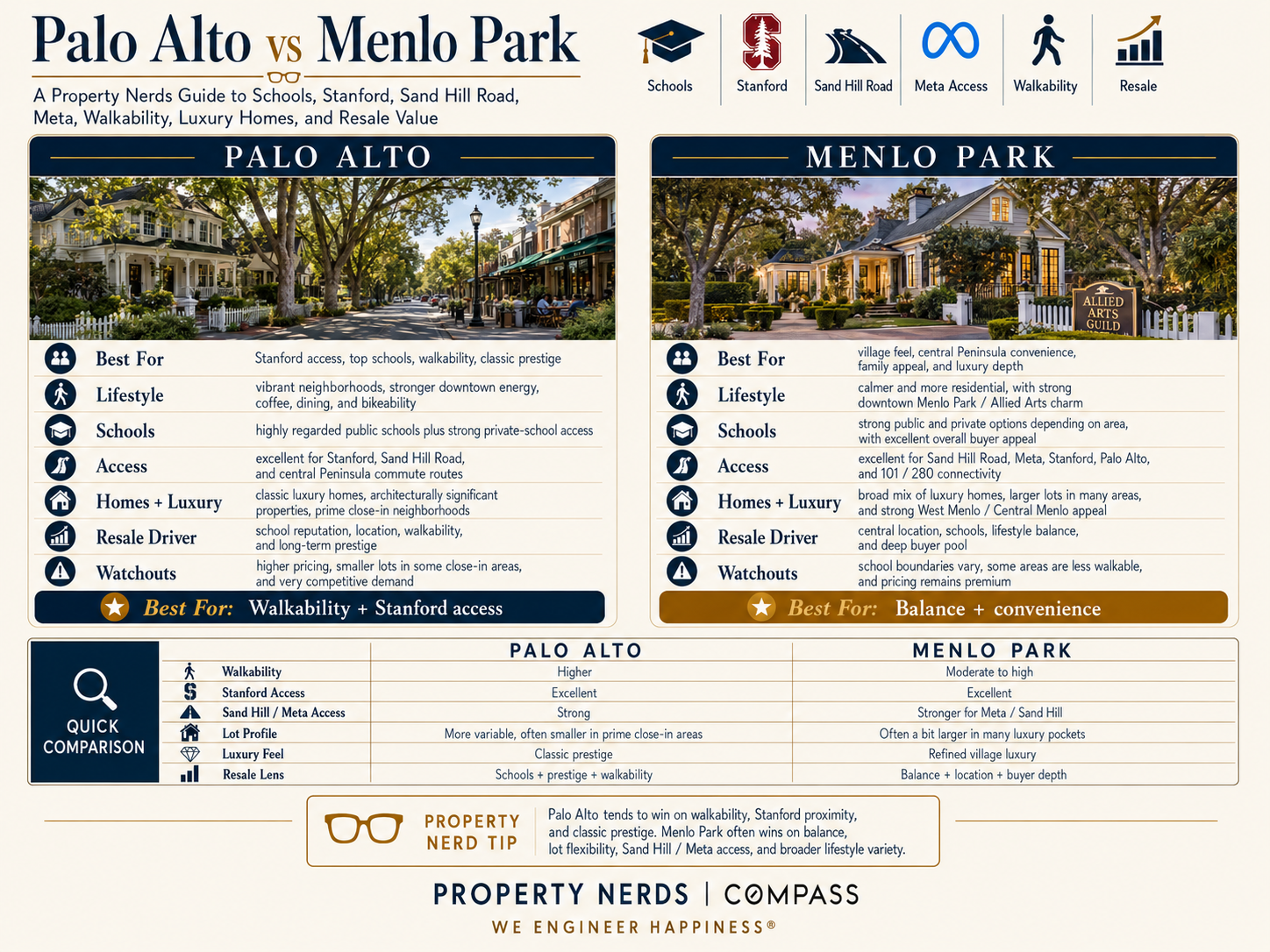
Palo Alto and Menlo Park are two of the most desirable real estate markets on the Peninsula. They sit side by side, share access to Stanford, Sand Hill Road, top schools, venture capital, major tech employers, Caltrain, and some of the strongest long-term buyer demand in Silicon Valley.
But they are not the same market.
Palo Alto is often about legacy prestige, Stanford proximity, top-tier schools, historic neighborhoods, downtown energy, and long-term scarcity.
Menlo Park is often about Peninsula convenience, Stanford and Sand Hill Road access, neighborhood charm, family living, Atherton adjacency, and a slightly more varied value map.
The smartest question is not, “Which city is better?”
The better question is:
Which market fits the way you actually want to live, commute, and hold value over time?
That is where the Property Nerds of the Boyenga Team look deeper. In Palo Alto and Menlo Park, the right choice is not just about price or zip code. It is about neighborhood identity, school path, lot utility, architecture, walkability, flood considerations, commute direction, future buyer pool, and long-term resale strength.
The Simple Difference
Choose Palo Alto if you want Stanford adjacency, highly recognized schools, global name recognition, historic prestige, stronger downtown energy, and one of Silicon Valley’s deepest luxury buyer pools.
Choose Menlo Park if you want excellent Peninsula access, a slightly more relaxed residential feel, Sand Hill Road convenience, Atherton proximity, charming neighborhoods, and more variation in price, lot size, and housing type.
That said, there is overlap.
Some Palo Alto neighborhoods feel quiet and residential. Some Menlo Park neighborhoods feel extremely prestigious and walkable. The right answer depends on the specific neighborhood and property.
Palo Alto: Best for Legacy Prestige, Stanford Access, Schools, and Walkability
Palo Alto is one of Silicon Valley’s most iconic markets. Buyers are drawn to Stanford University, Palo Alto schools, downtown Palo Alto, California Avenue, historic architecture, mature trees, and proximity to major tech and venture capital ecosystems.
Palo Alto has a very deep buyer pool because it appeals to many groups at once: Stanford-affiliated buyers, tech founders, executives, international buyers, families, investors, and luxury buyers seeking long-term stability.
Top Palo Alto neighborhoods include:
Old Palo Alto
Crescent Park
Professorville
Community Center
Downtown North
College Terrace
Southgate
Evergreen Park / California Avenue
Midtown
Green Gables / Duveneck-St. Francis
Greenmeadow
Fairmeadow
Palo Verde
Barron Park
Ventura
Palo Alto is especially strong for buyers who want a highly recognizable market with enduring demand. Even when the broader market cools, the best Palo Alto locations tend to retain strong buyer interest because the city has a unique blend of schools, Stanford, employment access, and scarcity.
The Property Nerds read: Palo Alto is the stronger choice for buyers who want legacy value, schools, Stanford access, and global neighborhood recognition.
Menlo Park: Best for Peninsula Access, Sand Hill Road, Charm, and Neighborhood Variety
Menlo Park is one of the Peninsula’s most strategic real estate markets. It sits between Palo Alto, Atherton, Redwood City, Stanford, Meta, and Sand Hill Road. Buyers like the mix of high-end residential neighborhoods, charming walkable pockets, strong schools by area, and practical commute access.
Menlo Park has more variation than Palo Alto. Central Menlo, Allied Arts, West Menlo, Sharon Heights, Menlo Oaks, The Willows, Belle Haven, and Suburban Park all serve different buyer profiles.
Top Menlo Park neighborhoods include:
Central Menlo
Allied Arts
West Menlo Park
Sharon Heights
Linfield Oaks
The Willows
Suburban Park
Lorelei Manor
Flood Triangle
Felton Gables
University Heights / Stanford Hills
Downtown Menlo Park
Belle Haven
Menlo Oaks
Vintage Oaks / Park Forest
Atherton-border pockets
Menlo Park can be especially compelling for buyers tied to Stanford, Sand Hill Road, Meta, Atherton, or Highway 280. Depending on neighborhood, it can offer walkability, privacy, larger lots, relative value, or a more relaxed residential feel than Palo Alto.
The Property Nerds read: Menlo Park is the stronger choice for buyers who want Peninsula flexibility, Sand Hill Road access, neighborhood variety, and multiple price/lifestyle lanes.
Schools: Strong Demand in Both, But Verify by Address
Both Palo Alto and Menlo Park are school-sensitive markets, but they work differently.
Palo Alto is widely known for school-driven buyer demand, and school identity is one of the major value drivers across the city. Many buyers choose Palo Alto because they want the Palo Alto school path and long-term resale strength connected to that demand.
Menlo Park also has very strong school-driven pockets, but school assignment can vary more dramatically by exact location. Central Menlo, West Menlo, Allied Arts, Sharon Heights, Suburban Park, Belle Haven, and other pockets may follow different school paths depending on the address.
Always verify school assignment by exact property address before buying or marketing a home.
The Property Nerds read: Palo Alto often has broader school-name recognition. Menlo Park can have excellent school-driven demand, but address-level verification is especially important.
Stanford Access
Both Palo Alto and Menlo Park are excellent for Stanford access, but they serve different Stanford buyer types.
Palo Alto is the most direct Stanford market. College Terrace, Southgate, Old Palo Alto, Professorville, Evergreen Park, California Avenue, Downtown North, and Community Center are especially strong for campus access.
Menlo Park is excellent for Stanford buyers who also want access to Sand Hill Road, downtown Menlo Park, Atherton, or Highway 280. Allied Arts, Central Menlo, West Menlo, Sharon Heights, Stanford Hills, and University Heights can be very strategic.
The Property Nerds read: Palo Alto is usually better for direct Stanford lifestyle. Menlo Park is often better for Stanford plus Sand Hill Road or Atherton/Peninsula access.
Sand Hill Road and Venture Capital Access
Menlo Park has a major advantage for Sand Hill Road access.
Buyers connected to venture capital, private equity, Stanford, or executive networks often look closely at Menlo Park, Atherton, Portola Valley, and Woodside because they offer efficient access to Sand Hill Road and Highway 280.
Palo Alto can still work beautifully, especially Old Palo Alto, Professorville, College Terrace, and Southgate. But if Sand Hill Road is part of the daily routine, Menlo Park often has the cleaner commute geometry.
The Property Nerds read: Menlo Park wins for Sand Hill Road convenience. Palo Alto wins if the buyer wants Stanford and downtown Palo Alto lifestyle more than the shortest Sand Hill route.
Meta and Tech Commutes
For Meta commuters, Menlo Park is usually the stronger and more direct choice. Belle Haven, The Willows, Central Menlo, Allied Arts, and Linfield Oaks can all serve different Meta-commute buyer profiles.
Palo Alto can still work well, especially for buyers who want schools, prestige, and Stanford access along with a Meta commute. Crescent Park, Downtown North, Community Center, Midtown, and Barron Park may appeal depending on route.
For Google and Mountain View commuters, Palo Alto can be very strong, especially Midtown, South Palo Alto, Greenmeadow, Fairmeadow, Charleston Gardens, and Palo Verde. Menlo Park can work for buyers who are balancing Google with Stanford, Meta, or Sand Hill Road.
The Property Nerds read: Menlo Park is usually stronger for Meta and Sand Hill. Palo Alto is often stronger for Stanford, Google/Mountain View access, and school-driven prestige.
Walkability and Downtown Lifestyle
Palo Alto offers two major walkable lifestyle anchors: University Avenue and California Avenue.
University Avenue delivers restaurants, cafes, shops, Caltrain, startup energy, and downtown Palo Alto prestige. California Avenue offers a more relaxed, local-feeling walkable district with restaurants, Caltrain, and Stanford access.
Menlo Park has downtown Menlo Park and Allied Arts, which offer a calmer, more boutique walkable lifestyle. Santa Cruz Avenue, downtown Menlo restaurants, shops, Caltrain, and Stanford Shopping Center access can be very appealing.
Palo Alto generally has more urban energy. Menlo Park often feels quieter and more residential.
The Property Nerds read: Palo Alto wins for stronger downtown energy. Menlo Park wins for quieter, boutique Peninsula walkability.
Architecture and Neighborhood Character
Palo Alto has some of the strongest architectural neighborhoods in Silicon Valley. Old Palo Alto, Professorville, Crescent Park, College Terrace, Greenmeadow, Fairmeadow, and Barron Park all have distinct architectural identities.
Buyers may find historic estates, Craftsman homes, Spanish Revival, Tudors, bungalows, Eichlers, mid-century modern homes, and organic creekside properties.
Menlo Park also has significant charm and variety. Allied Arts offers cottages and boutique character. Central Menlo and West Menlo offer classic Peninsula family homes and luxury rebuilds. Sharon Heights offers hillside homes and privacy. Menlo Oaks offers larger lots and mature trees. The Willows offers older homes and a more eclectic feel.
The Property Nerds read: Palo Alto often wins for architectural prestige and historic identity. Menlo Park wins for variety, charm, and quieter residential flexibility.
Lot Size and Outdoor Space
Menlo Park can sometimes offer more flexibility for buyers who want larger lots or more privacy, especially in Menlo Oaks, Sharon Heights, West Menlo, Atherton-border pockets, and select Central Menlo locations.
Palo Alto has premium lots in Old Palo Alto, Crescent Park, Community Center, and other high-end neighborhoods, but prices can be significantly higher and lots may vary widely.
South Palo Alto neighborhoods may offer practical ranch-style lots, while Barron Park can offer a more organic and larger-lot feel in some pockets.
The Property Nerds read: Menlo Park may offer more value variation for lot size. Palo Alto offers extremely strong lot value in its premier neighborhoods, but buyers pay heavily for it.
Flood, Creek, and Property Diligence
Both cities require careful property-level diligence.
Palo Alto buyers should watch for flood zones, creek proximity, older-home systems, tree restrictions, historic considerations, and drainage.
Menlo Park buyers should also watch for flood zones, creek influence, tree impacts, soil conditions, older systems, and neighborhood-by-neighborhood variation. Belle Haven, The Willows, Flood Triangle, Suburban Park, and creek-adjacent pockets require extra care.
The Property Nerds read: In both markets, due diligence matters. A great neighborhood does not erase flood, drainage, foundation, or insurance issues.
Price and Value
Palo Alto is generally more expensive and has stronger global name recognition. Buyers often pay a premium for Palo Alto schools, Stanford access, and long-term prestige.
Menlo Park can offer more variation. Central Menlo and Allied Arts can be very expensive, but other areas may offer relative value compared with Palo Alto, depending on schools, condition, and location. Belle Haven, The Willows, Suburban Park, and some condo/townhome markets can provide more accessible options.
The Property Nerds read: Palo Alto often costs more for brand and school depth. Menlo Park can offer more ways to match budget, lifestyle, and commute.
Resale Strength
Both markets can be excellent for resale, but they hold value for different reasons.
Palo Alto resale is often driven by:
Stanford proximity
Palo Alto schools
Historic prestige
Global name recognition
Downtown walkability
Tech and founder demand
Architectural scarcity
Long-term buyer depth
Menlo Park resale is often driven by:
Stanford and Sand Hill Road access
Downtown Menlo lifestyle
Atherton and Palo Alto adjacency
School-driven pockets
Meta commute access
Peninsula convenience
Lot and privacy variation
Neighborhood charm
The Property Nerds read: Palo Alto has broader brand power. Menlo Park has strong strategic value when the neighborhood, school path, and commute story are clear.
Which Is Better for Families?
Palo Alto may be better for families who prioritize:
Palo Alto schools
Stanford access
Walkability to University Avenue or California Avenue
Historic neighborhood identity
Long-term legacy value
Eichler or mid-century homes
Strong citywide buyer recognition
Menlo Park may be better for families who prioritize:
Sand Hill Road access
Downtown Menlo Park lifestyle
A quieter residential feel
Proximity to Atherton and Stanford Shopping Center
More neighborhood variety
Potentially more lot or privacy options
Meta or Peninsula commute access
The best choice depends on the family’s daily life. School drop-off, work commute, sports, parks, friends, and errands matter as much as prestige.
Which Is Better for Luxury Buyers?
Palo Alto luxury is often about legacy, architecture, schools, Stanford, and prestige. Old Palo Alto and Crescent Park are two of Silicon Valley’s strongest luxury neighborhoods.
Menlo Park luxury is often about Peninsula access, Central Menlo prestige, Allied Arts charm, Sharon Heights privacy, Menlo Oaks land, and Atherton adjacency.
The Property Nerds read: Palo Alto luxury is usually stronger for legacy and recognition. Menlo Park luxury can be stronger for privacy, Sand Hill Road access, and cross-market flexibility.
Which Is Better for Tech Commuters?
For Stanford, Google, and Palo Alto-area tech, Palo Alto can be extremely convenient.
For Meta, Sand Hill Road, Atherton, Redwood City, and Highway 280 access, Menlo Park may be stronger.
For dual-commute households, the answer depends heavily on the two destinations. Menlo Park may be better for Meta plus Stanford. Palo Alto may be better for Stanford plus Google. Both can work for Peninsula and South Bay commuting depending on neighborhood.
Quick Comparison
| Category | Palo Alto | Menlo Park |
|---|---|---|
| Best for | Stanford, schools, prestige, historic neighborhoods | Sand Hill Road, Meta, Peninsula access, neighborhood variety |
| Lifestyle | More globally recognized, more urban energy in places | Quieter, boutique, more varied by pocket |
| Walkability | Stronger around University Ave and California Ave | Strong around Downtown Menlo and Allied Arts |
| Luxury driver | Legacy prestige, Stanford, architecture | Privacy, access, Atherton adjacency, Sand Hill |
| Family driver | Schools, parks, long-term buyer depth | Schools by pocket, quieter streets, access |
| Commute strength | Stanford, Google, Palo Alto, Mountain View | Meta, Sand Hill, Stanford, 280, Atherton |
| Architecture | Historic, Eichler, legacy estates | Charming cottages, family homes, hillside/privacy pockets |
| Price profile | Usually higher brand premium | More varied value map |
| Resale driver | Name recognition, schools, Stanford, scarcity | Access, schools, Sand Hill, Meta, flexibility |
| Best buyer | Wants Palo Alto identity and long-term prestige | Wants Peninsula convenience and micro-market flexibility |
The Property Nerds Bottom Line
Palo Alto and Menlo Park are both exceptional markets, but they solve different problems.
Choose Palo Alto if you want:
Global name recognition
Palo Alto schools
Stanford proximity
Historic neighborhoods
University Avenue or California Avenue lifestyle
Eichler and mid-century options
Legacy resale strength
Deep luxury buyer demand
Choose Menlo Park if you want:
Sand Hill Road access
Meta commute convenience
Downtown Menlo Park lifestyle
Allied Arts charm
Central Menlo family demand
Sharon Heights privacy
Atherton adjacency
More neighborhood and price variation
The smartest buyers do not ask, “Which city is better?”
They ask:
Which neighborhood fits our daily life?
Which commute actually works?
Which school path matters to us?
Which lot has better long-term value?
Which home will future buyers understand?
Does this property’s value come from prestige, schools, walkability, Stanford, Sand Hill, Meta, privacy, or all of the above?
That is how you choose between Palo Alto and Menlo Park.
For sellers, the same logic matters. A Palo Alto home should often be positioned around schools, Stanford access, legacy value, architecture, and neighborhood identity. A Menlo Park home should be positioned around Peninsula access, Sand Hill Road, downtown lifestyle, school path, privacy, and future buyer pool.
Thinking About Buying or Selling in Palo Alto or Menlo Park?
The Boyenga Team at Compass helps clients compare Palo Alto and Menlo Park with a Property Nerds approach — blending neighborhood knowledge, pricing strategy, lot analysis, school and commute logic, design insight, preparation advice, inspection awareness, and buyer-behavior strategy.
Whether you are choosing between Old Palo Alto and Central Menlo, comparing Professorville and Allied Arts, evaluating a Midtown ranch versus a West Menlo family home, preparing a Crescent Park luxury property, or positioning a Menlo Park home near Stanford or Sand Hill Road, Eric and Janelle Boyenga can help you understand the neighborhood math before you make your move.
Palo Alto and Menlo Park are both premium Peninsula markets. The right answer depends on how you want to live — and which property tells the stronger future resale story.