

Blog > Two Caltrain Stops, Two Buyer Profiles: The Real Differences Between Palo Alto and Menlo Park
Two Caltrain Stops, Two Buyer Profiles: The Real Differences Between Palo Alto and Menlo Park
by
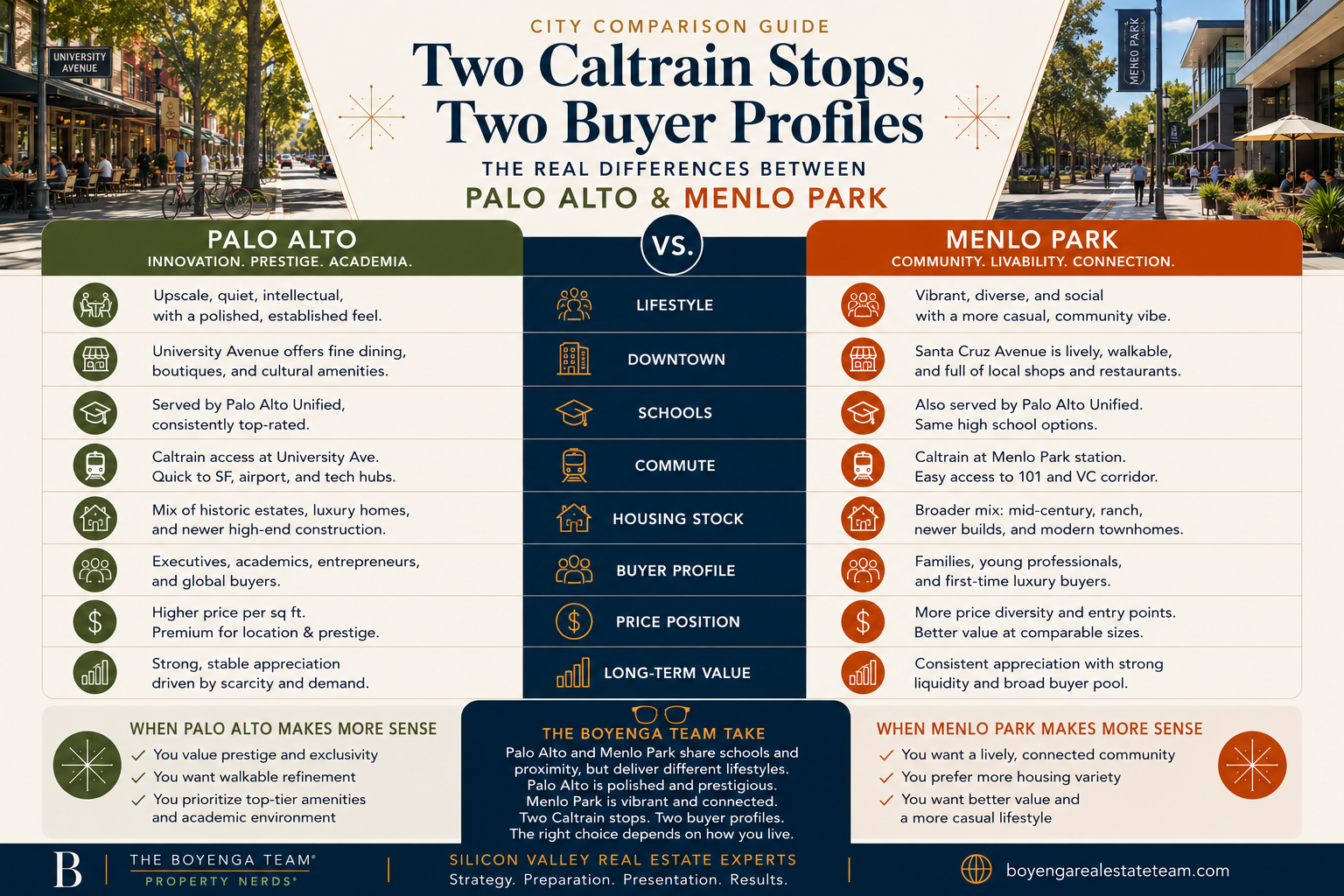
Why Two Neighboring Markets Attract Different Buyers
Palo Alto and Menlo Park sit only a few miles apart, share Caltrain service, and offer exceptional access to Stanford University and many of Silicon Valley's largest employers. To someone unfamiliar with the Peninsula, they can appear nearly interchangeable. Buyers who spend time in both communities quickly realize they're anything but.
While both cities draw strong buyer demand, they appeal to different lifestyles, budgets, and buyer priorities. One emphasizes academic influence, and global recognition. The other offers a slightly more relaxed, community-oriented environment with greater housing diversity and more attainable entry points into the luxury market.
For buyers deciding between the two, the question is less about which city is better and more about which ownership experience aligns with the way they want to live.
The Character of Each Downtown
Downtown Palo Alto revolves around University Avenue, one of the Peninsula's most recognizable commercial corridors. Upscale restaurants, boutique retail, Stanford University, venture capital firms, and technology companies create an atmosphere that feels polished, energetic, and internationally connected. The neighborhood attracts executives, entrepreneurs, academics, and buyers who value being at the center of Silicon Valley's innovation ecosystem.
A few Caltrain stops north, Downtown Menlo Park presents a different rhythm. Santa Cruz Avenue is highly walkable, but its atmosphere is more intimate and neighborhood-focused. Independent cafés, local restaurants, and community gathering spaces give the area a distinctly residential feel despite its proximity to major employers. Many buyers appreciate that Menlo Park offers similar convenience while feeling slightly less formal than its neighbor.
Housing Stock Tells Two Different Stories
Architecture reflects these differences.
Palo Alto offers an impressive collection of historic homes, luxury estates, modern custom residences, and architecturally significant neighborhoods. Inventory is limited, redevelopment opportunities are competitive, and many buyers enter the market specifically seeking the Palo Alto address.
Menlo Park offers greater variety. Buyers can choose from post-war ranch homes, mid-century neighborhoods, newer luxury construction, townhomes, and established single-family subdivisions. This broader housing mix creates more price points while still providing access to many of the same Peninsula amenities.
For buyers who enjoy modern architecture, Mid Mod Homes and Bay Area Eichler Homes provide additional resources highlighting many of the Peninsula's most distinctive mid-century neighborhoods.
https://bayareaeichlerhomes.com
Schools Matter—but They're Only Part of the Equation
In both cities, school attendance boundaries vary considerably depending on neighborhood.
In Palo Alto, school boundaries are a major focus for many buyers, particularly those relocating. Menlo Park neighborhoods are served by several different districts. Buyers should always verify school assignments rather than relying solely on city boundaries.
School assignment remains important to many buyers, but it's rarely the only factor influencing long-term value. Commute patterns, neighborhood character, architectural quality, and housing supply often play equally significant roles.
Commute and Connectivity
From a transportation standpoint, both cities perform exceptionally well.
Caltrain stations in each downtown provide convenient access to San Francisco and San Jose, while nearby Highway 101 and Interstate 280 connect residents throughout the Peninsula and Silicon Valley. Stanford University, Sand Hill Road, Meta, Google, and numerous venture capital firms remain easily accessible from either location.
For many buyers, the practical commute difference between Palo Alto and Menlo Park is measured in minutes rather than miles. Lifestyle often becomes the deciding factor.
Buyer Psychology Creates Different Markets
One of the most interesting distinctions between these cities is the motivation behind buyer demand.
Palo Alto often attracts buyers who place significant value on reputation, academic proximity, and long-term market stability. The city carries a global brand that extends well beyond Silicon Valley.
Menlo Park tends to appeal to buyers seeking many of the same Peninsula advantages while prioritizing flexibility, neighborhood character, and a broader range of housing options. Professionals and move-up buyers often find they can purchase different types of homes while remaining close to the same employment centers.
These differences create two healthy markets with distinct buyer pools rather than one market that is objectively stronger than the other.
Long-Term Value
Both communities have demonstrated remarkable long-term appreciation, supported by limited housing supply and proximity to major employment centers.
Palo Alto's strength lies in its global reputation and consistently high demand. Menlo Park benefits from a diverse buyer base, exceptional livability, and strong resale liquidity across multiple housing segments.
Each city has proven resilient across market cycles, though they appeal to different buyers for different reasons.
The Property Nerd Take
Palo Alto and Menlo Park may share a Caltrain line, but they solve different lifestyle equations.
Palo Alto rewards buyers seeking academic influence, and one of Silicon Valley's most recognized residential addresses. Menlo Park offers many of the same regional advantages while providing greater housing diversity and a more neighborhood-oriented atmosphere.
Choosing between them isn't simply a financial decision. It's a question of how you want your daily life to feel once you've arrived home.
For additional neighborhood comparisons, market analysis, and buyer guides, explore the Property Nerds Blog, Boyenga Real Estate Team, Mid Mod Homes, and Bay Area Eichler Homes.
keep exploring · property nerd guides
Palo Alto homes, neighborhoods & schools in one guide
Live listings, recent sales, ZIP codes, school districts and commute notes for Palo Alto, from the Property Nerds® of the Boyenga Team at Compass.
Open the Palo Alto guideWhat’s my home worth?
Talk to a Property Nerd: (408) 373-1660 · (650) 383-8606
city guides Los Altos · Menlo Park · Cupertino · Sunnyvale · Los Gatos · San Jose