

Blog > Palo Alto vs. Los Altos: Prestige, Schools, Lifestyle, and Resale Value
Palo Alto vs. Los Altos: Prestige, Schools, Lifestyle, and Resale Value
by
A Strategic Property Nerd Analysis of Two Silicon Valley Luxury Markets
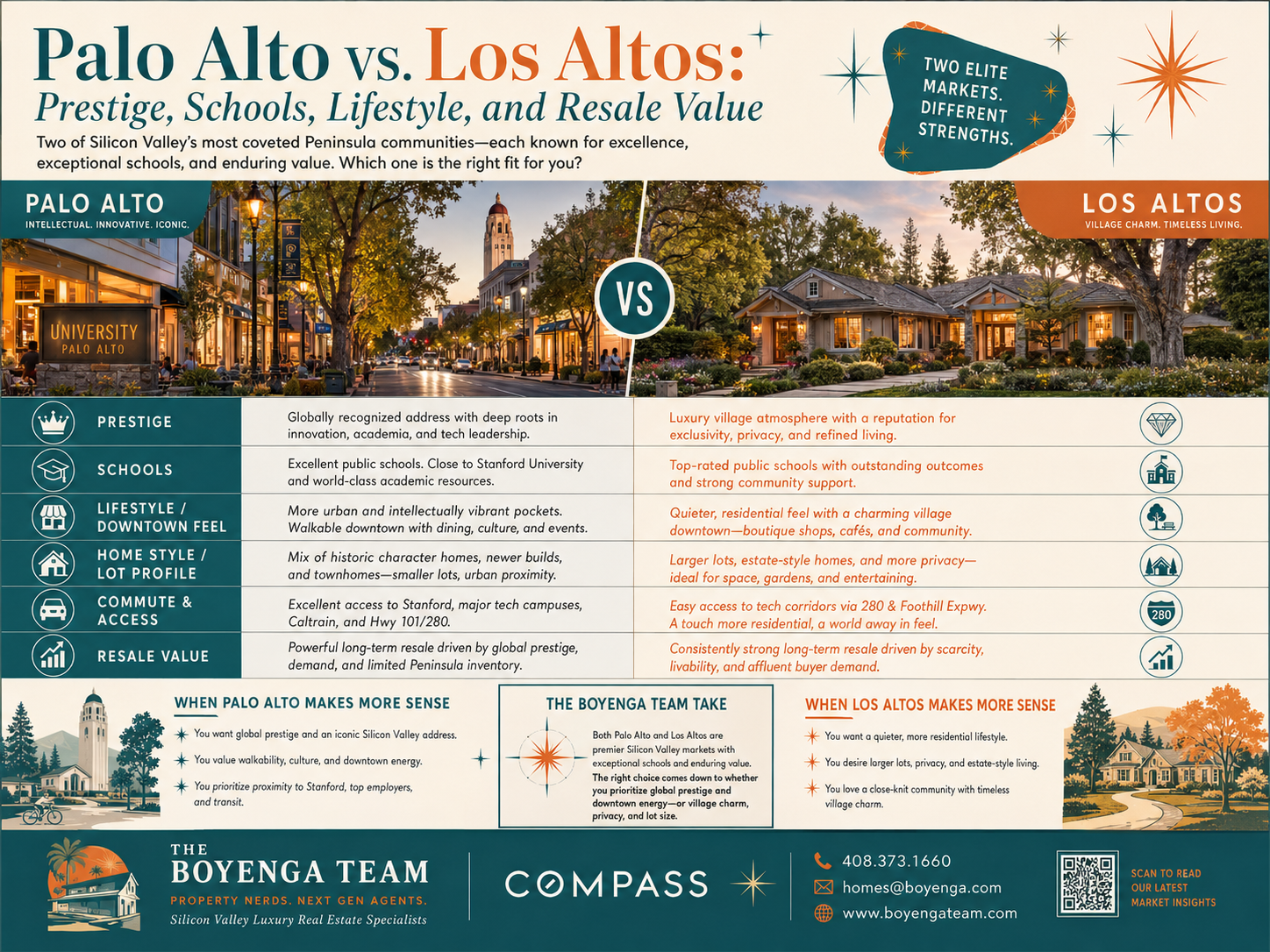
For many Silicon Valley luxury buyers, the decision between Palo Alto and Los Altos is not simply a choice between two beautiful communities. It is a decision between two different luxury real estate philosophies. Palo Alto represents institutional prestige, innovation access, walkability, Stanford proximity, and global recognition. Los Altos represents privacy, larger lots, quiet streets, village charm, family-oriented living, and estate-style flexibility. Both cities sit at the top of the Silicon Valley real estate hierarchy, but they attract buyers for very different reasons.
From a Property Nerd perspective, Palo Alto and Los Altos are not interchangeable. They are two distinct asset classes inside the same luxury ecosystem. Palo Alto is driven by intellectual capital, location scarcity, and innovation gravity. Los Altos is driven by land value, privacy, school demand, and lifestyle insulation. One feels connected to the pulse of Silicon Valley. The other feels like a retreat from it.
That distinction matters because sophisticated buyers are not just buying square footage. They are buying time, access, optionality, school positioning, long-term resale confidence, and emotional lifestyle fit. In Silicon Valley, where homes often trade for millions of dollars and buyers are making long-term strategic decisions, the difference between Palo Alto and Los Altos can shape not only daily life, but also future appreciation and resale liquidity.
Palo Alto’s core value proposition is access. It offers proximity to Stanford University, Stanford Research Park, University Avenue, California Avenue, Caltrain, venture capital offices, startup culture, medical institutions, and some of the most influential innovation networks in the world. Buyers are often attracted to Palo Alto because it gives them a sense of being near the center of the action. The city carries a global brand that is instantly understood by relocation buyers, technology executives, founders, academics, investors, and international families.
Los Altos’ core value proposition is insulation. It offers quiet residential streets, larger lots, mature trees, a village-style downtown, strong schools, and a more private luxury experience. Buyers are often attracted to Los Altos because it gives them breathing room. It is close to Apple, Google, Nvidia, LinkedIn, Stanford, Meta, and the broader Silicon Valley employment engine, but it feels less consumed by the intensity of the workday. For many executives and families, that separation is exactly the point.
The simplest way to frame the comparison is this: Palo Alto sells proximity and prestige, while Los Altos sells land and lifestyle. Palo Alto often commands a premium for its institutional identity and walkable urban-suburban fabric. Los Altos often commands a premium for its spaciousness, privacy, and residential quality of life. Both can be exceptional long-term investments, but the buyer should be clear about which type of scarcity they are purchasing.
Prestige functions differently in each city. Palo Alto has a more visible form of prestige. It is tied to Stanford, venture capital, startup mythology, historic neighborhoods, and the global story of Silicon Valley. When buyers from New York, London, Seattle, Boston, Singapore, Shanghai, or Bangalore hear “Palo Alto,” they immediately understand the significance. It is one of the few residential addresses in the world that carries both academic and entrepreneurial meaning.
Los Altos has a quieter form of prestige. It does not need to announce itself as loudly. Its appeal is more private, more residential, and often more understated. A Los Altos buyer may not be chasing the most recognizable address. They may be looking for a larger parcel, a calmer street, a pool-sized backyard, a stronger indoor-outdoor lifestyle, and a home that feels like a true retreat. In this way, Los Altos often appeals to buyers who already understand Silicon Valley and do not need the status signal of Palo Alto as much as they need the livability of Los Altos.
Schools are one of the most powerful value drivers in both markets. In Silicon Valley, school boundaries operate almost like invisible pricing infrastructure. A home’s assigned schools can dramatically influence buyer demand, future resale confidence, and emotional urgency. Even buyers without school-aged children often care about school districts because the next buyer may care deeply. Strong schools create a larger resale audience, and that larger audience helps support pricing over time.
Palo Alto benefits from the strength and reputation of Palo Alto Unified School District, which is one of the most recognized public school systems in California. For many buyers, the combination of PAUSD, Stanford proximity, and Palo Alto’s innovation ecosystem creates a compelling long-term ownership story. However, buyers should still verify specific school assignments, enrollment rules, and boundary details rather than relying on assumptions or listing language.
Los Altos is more nuanced from a school-boundary perspective. Depending on the exact address, a home may be served by Los Altos School District, Cupertino Union School District, Mountain View Los Altos High School District, Fremont Union High School District, or other related educational jurisdictions. This creates both opportunity and complexity. A buyer may say they want “Los Altos schools,” but that phrase is not specific enough. The actual value analysis depends on the exact parcel, district, high school assignment, and future resale audience.
This is where the Property Nerd lens becomes especially important. In both Palo Alto and Los Altos, buyers should not simply evaluate the house. They should evaluate the school boundary, commute pattern, neighborhood identity, lot utility, architectural quality, and likely future buyer profile. Two homes can look similar online and perform very differently in the market because one sits in a stronger resale lane.
Lifestyle is another major differentiator. Palo Alto offers a more urban-suburban experience. Buyers who love downtown restaurants, coffee shops, Caltrain access, bikeability, Stanford events, University Avenue energy, California Avenue charm, and proximity to research and venture capital often gravitate toward Palo Alto. It feels connected, dynamic, intellectual, and globally relevant. For many technology professionals, founders, and Stanford-affiliated buyers, Palo Alto feels like the center of gravity.
Los Altos offers a more village-oriented lifestyle. Downtown Los Altos is charming, polished, and community-centered. The residential streets feel quieter, the homes often sit on larger lots, and the overall pace feels calmer. Buyers who want privacy, backyard space, family functionality, mature landscaping, and a more relaxed daily rhythm often lean toward Los Altos. It is not detached from Silicon Valley, but it gives buyers a sense of separation from the speed of it.
Commute geography is one of the most underrated luxury metrics in Silicon Valley. For high-performing professionals, time is often more valuable than square footage. A home that saves 20 or 30 minutes a day can create hundreds of hours of annual lifestyle value. Palo Alto can be especially attractive for buyers connected to Stanford, Stanford Research Park, downtown Palo Alto, Menlo Park, venture capital, Meta, and the broader Peninsula corridor. Los Altos can be especially attractive for buyers connected to Apple, Google, Nvidia, LinkedIn, Mountain View, Sunnyvale, Cupertino, Santa Clara, and the broader South Bay technology ecosystem.
The commute decision is rarely just about distance. It is about route quality, school drop-off patterns, highway access, bike routes, Caltrain options, traffic bottlenecks, and daily friction. A buyer working at Apple Park may view Los Altos differently than a buyer working near Stanford. A Google employee may evaluate Palo Alto, Los Altos, Mountain View, and Sunnyvale through very different lifestyle and commute tradeoffs. A Meta executive may prioritize Palo Alto or Menlo Park for access, while still considering Los Altos for privacy and home quality. A Nvidia or AI-sector buyer may find Los Altos, Mountain View, Sunnyvale, Palo Alto, and Santa Clara all strategically relevant depending on budget and lifestyle goals.
Housing stock also tells an important story. Palo Alto offers historic homes, Craftsman properties, Spanish-style residences, mid-century modern homes, Eichlers, ranch homes, townhomes, and high-end new construction. Neighborhoods such as Old Palo Alto, Professorville, Crescent Park, Community Center, Southgate, College Terrace, Midtown, Barron Park, and Greenmeadow each attract different buyer profiles. Some buyers want historic charm and walkability. Others want mid-century architecture. Others want Stanford access or a more practical family neighborhood.
Los Altos tends to offer a stronger single-family residential feel, with ranch homes, expanded ranches, custom homes, new construction, estate-style properties, and larger parcels. Neighborhoods such as North Los Altos, Old Los Altos, Country Club, Loyola Corners, South Los Altos, Highlands, and Grant Park-adjacent pockets each have their own micro-market personality. Some buyers want to walk to the village. Others want a larger lot. Others want a quieter cul-de-sac, a pool, an ADU, or room for future expansion.
Lot size is one of the most important differences between the two cities. Land is the one thing Silicon Valley cannot manufacture. Los Altos generally gives buyers more land utility, more privacy, and more flexibility. Larger lots may support outdoor entertaining, pools, gardens, ADUs, guest quarters, expanded floor plans, or simply more separation from neighboring homes. In a region where density pressure and construction costs continue to rise, land flexibility becomes increasingly valuable.
Palo Alto, however, can create enormous value on smaller lots because its location premium is so powerful. Buyers may accept less land because they are purchasing Stanford proximity, downtown access, Caltrain convenience, and the Palo Alto brand. This creates a classic Silicon Valley tradeoff. Palo Alto may provide more location value per square foot, while Los Altos may provide more land value per dollar. The better investment depends on the buyer’s priorities, holding period, remodel appetite, school needs, commute pattern, and future resale strategy.
Resale value should be analyzed through the lens of future buyer demand. In Palo Alto, future buyers will likely continue to pay premiums for Stanford proximity, PAUSD access, historic neighborhoods, downtown walkability, Caltrain convenience, architectural charm, and global recognition. Palo Alto tends to benefit from liquidity because the buyer pool is broad, international, and institutionally aware. A buyer who understands Silicon Valley often understands Palo Alto immediately.
In Los Altos, future buyers will likely continue to pay premiums for larger lots, privacy, top schools, quiet streets, estate potential, downtown village access, and family-oriented luxury living. Los Altos tends to benefit from physical flexibility because many properties offer more room to adapt over time. A buyer can remodel, expand, add outdoor living, improve landscaping, or reimagine the property in ways that smaller-lot markets may not allow as easily.
Buyer psychology is also different. Palo Alto buyers often value access, identity, intellectual energy, and convenience. They may be founders, investors, executives, Stanford affiliates, physicians, academics, or international relocation families who want a globally understood Silicon Valley address. They may be willing to compromise on lot size or square footage if the location, school assignment, neighborhood, and prestige are strong enough.
Los Altos buyers often value privacy, space, calm, and daily livability. They may be executives, founders, move-up buyers, families, or repeat Silicon Valley homeowners who have already experienced denser living and now want more breathing room. They often want a real backyard, quiet streets, strong schools, and a home that supports both family life and executive-level downtime. For these buyers, Los Altos functions as a lifestyle hedge against the intensity of Silicon Valley.
Technology and smart-home infrastructure now play an important role in both markets. Luxury buyers increasingly expect homes to include or support EV charging, solar, battery backup, smart thermostats, strong Wi-Fi infrastructure, advanced security, leak detection, smart irrigation, energy-efficient systems, heat pump HVAC, induction cooking, air filtration, motorized shades, lighting automation, and dedicated home office functionality. In Palo Alto, smart-home features often support convenience and urban efficiency. In Los Altos, they often support estate management, energy resilience, privacy, and comfort.
The strongest smart homes are not necessarily the ones with the most complicated technology. They are the ones with technology that works quietly in the background and makes the home easier to live in. Silicon Valley buyers are sophisticated. They can tell the difference between useful infrastructure and overbuilt gadgetry. A future-proof luxury home should be intuitive, efficient, resilient, and easy to maintain.
There are also risks in both markets. In Palo Alto, buyers can overpay for a compromised lot, underestimate traffic patterns, ignore remodel constraints, assume every neighborhood has the same resale strength, or pay a premium for charm without understanding maintenance costs. In Los Altos, buyers can assume all school assignments are the same, underestimate commute friction, overvalue square footage that is poorly designed, misjudge remodel costs, or buy a large lot that lacks practical usability.
In both cities, due diligence matters. Buyers should evaluate school boundaries, lot utility, drainage, roof condition, foundation, permit history, floor plan, electrical capacity, solar potential, battery backup potential, trees, insurance considerations, ADU feasibility, remodel limitations, neighborhood sales velocity, and likely future buyer demand. In high-end Silicon Valley real estate, mistakes are expensive. The right guidance can materially improve both lifestyle outcome and investment quality.
This is where the Boyenga Team at Compass brings a strategic advantage. As Silicon Valley Property Nerds and Next Gen Agents, Eric and Janelle Boyenga approach Palo Alto and Los Altos not as generic luxury markets, but as data-rich, emotionally complex, micro-market ecosystems. The analysis is not just about what a home looks like today. It is about how the home will perform over time, who the next buyer will be, what the resale story will sound like, and whether the property aligns with the client’s long-term goals.
Compass also brings a technology-forward brokerage platform that fits the Silicon Valley mindset. In a market shaped by data, speed, digital marketing, private inventory, buyer behavior, and pricing strategy, the brokerage platform matters. Compass technology, marketing intelligence, private exclusive tools, client dashboards, and data-driven systems help agents and clients move with more clarity. But the technology is only powerful when paired with local interpretation. Data can show activity. Experience explains meaning.
The Boyenga Team combines Compass technology with deep local knowledge, luxury positioning, school-boundary awareness, architectural fluency, Eichler and mid-century expertise, negotiation strategy, and Silicon Valley buyer psychology. That combination is especially valuable in Palo Alto and Los Altos, where small differences in location, lot, school assignment, condition, architecture, and timing can create very large differences in value.
The final question is not whether Palo Alto or Los Altos is better. The better question is what the buyer is optimizing for. A buyer should choose Palo Alto if they value global prestige, Stanford proximity, downtown energy, Caltrain convenience, walkability, intellectual atmosphere, and high-liquidity resale. A buyer should choose Los Altos if they value privacy, larger lots, quiet streets, family functionality, estate potential, village charm, and a more relaxed luxury lifestyle.
The most sophisticated buyers do not simply ask where they can afford to buy. They ask which city best protects their time, lifestyle, family priorities, commute needs, school goals, and long-term resale value. Palo Alto and Los Altos both offer extraordinary opportunities, but they solve different problems. Palo Alto keeps buyers close to the center of Silicon Valley’s innovation economy. Los Altos gives buyers space to live beautifully within reach of it.
That is why Palo Alto vs. Los Altos remains one of the most important comparisons in Silicon Valley luxury real estate. It is a capital allocation decision, a lifestyle decision, a school decision, a commute decision, and a future resale decision all wrapped into one. For buyers and sellers navigating these two remarkable markets, the winning strategy starts with understanding the difference.
The Boyenga Team at Compass represents buyers and sellers throughout Silicon Valley with a focus on luxury homes, Eichler and mid-century modern properties, school-driven moves, estate homes, trust sales, and high-value residential strategy. Known as Property Nerds and Next Gen Agents, Eric and Janelle Boyenga combine data, design, technology, negotiation, and local market intelligence to help clients make smarter real estate decisions in Palo Alto, Los Altos, Los Altos Hills, Mountain View, Sunnyvale, Cupertino, Menlo Park, Saratoga, Los Gatos, and the greater Silicon Valley luxury market. For expert guidance, contact the Boyenga Team at Compass at homes@boyenga.com or visit www.BoyengaTeam.com.