

Blog > Old Palo Alto vs. Crescent Park: Classic Luxury, Architecture, and Buyer Demand
Old Palo Alto vs. Crescent Park: Classic Luxury, Architecture, and Buyer Demand
by
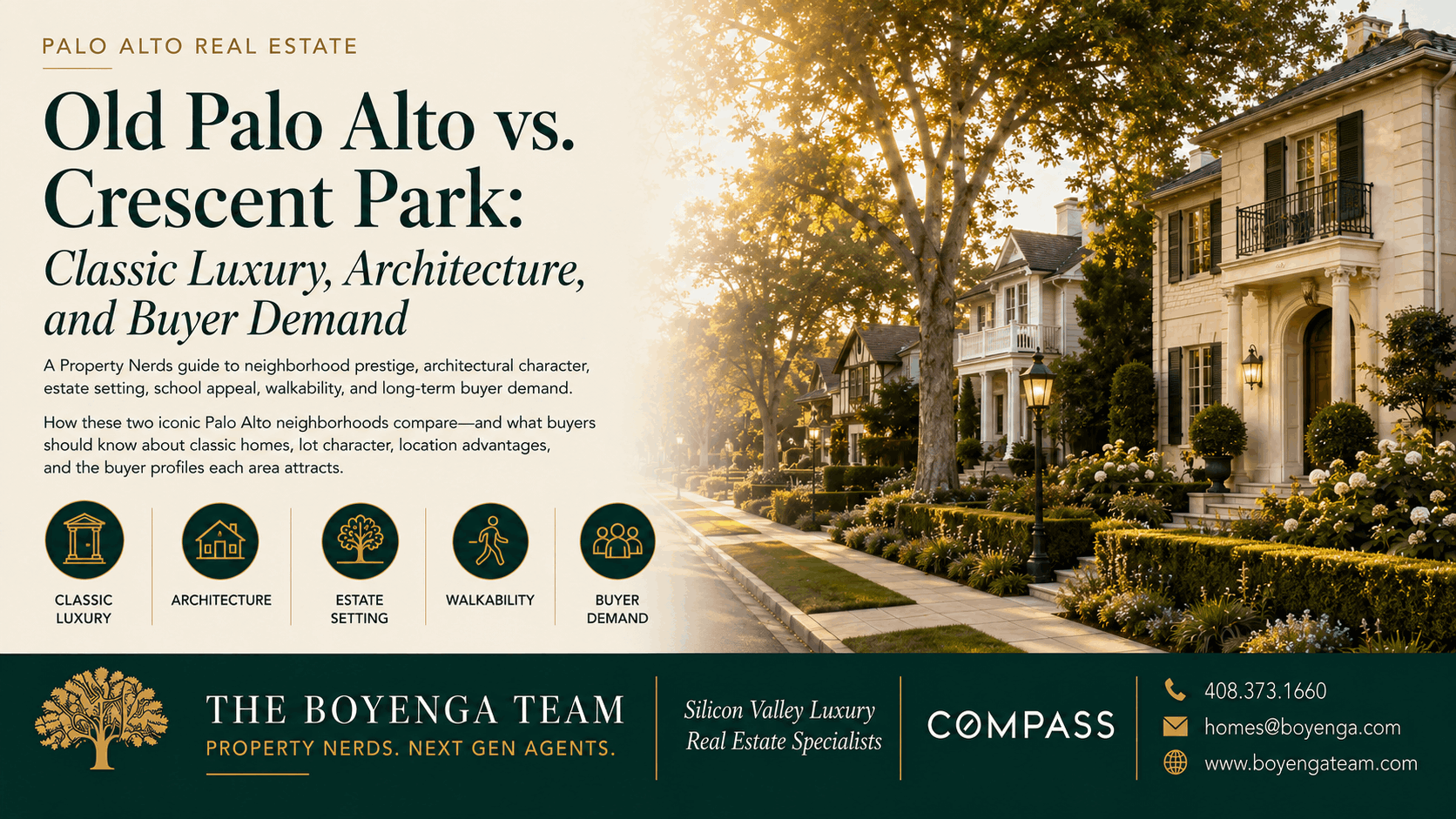
In Palo Alto luxury real estate, Old Palo Alto and Crescent Park sit in rare territory.
These are not just neighborhoods. They are identity markets.
Buyers do not simply say, “We want a house in Palo Alto.” They say, “We want Old Palo Alto,” or “We want Crescent Park,” because each neighborhood carries a different kind of prestige, architectural language, lifestyle rhythm, and buyer psychology.
Old Palo Alto feels historic, elegant, rooted, and deeply connected to Stanford’s legacy. Crescent Park feels grand, polished, estate-like, and close to downtown Palo Alto’s energy while still offering a refined residential setting.
Both are among Palo Alto’s most desirable luxury neighborhoods. Both attract sophisticated buyers. Both benefit from scarcity, schools, Stanford proximity, Silicon Valley wealth, and long-term demand. But they are not interchangeable.
That is the Property Nerd truth.
Old Palo Alto is often about legacy, architecture, and timeless residential prestige. Crescent Park is often about scale, luxury presence, mature streets, and proximity to downtown Palo Alto. One feels like old-world Palo Alto elegance. The other feels like classic Peninsula estate living with urban convenience nearby.
For buyers, the choice depends on lifestyle, architecture, lot preference, privacy, walkability, and emotional fit.
For sellers, the marketing strategy must be precise. An Old Palo Alto home should not be positioned the same way as a Crescent Park property. Each deserves its own buyer-pool narrative.
At the Boyenga Team, we help buyers and sellers decode these differences with a Property Nerd lens: micro-location, architecture, lot utility, buyer psychology, school pathway, commute access, remodel potential, and long-term resale value.
Why This Comparison Matters
Old Palo Alto and Crescent Park are two of Palo Alto’s most prestigious residential areas, but they appeal to luxury buyers in different ways.
A buyer choosing between the two is not usually asking, “Which one is better?”
They are asking:
Do we want historic charm or estate presence?
Do we want Stanford-adjacent legacy or downtown-adjacent luxury?
Do we want architectural character or larger-scale living?
Do we want a quieter old Palo Alto rhythm or a more formal luxury neighborhood feel?
Do we want the emotional pull of heritage or the convenience of Crescent Park’s location near downtown?
Do we value lot size, privacy, and grander homes, or do we value historic identity and architectural texture?
These questions matter because at Palo Alto luxury price points, the decision is not just financial. It is personal, strategic, and long-term.
A buyer is choosing a lifestyle asset.
A seller is marketing a rare piece of Palo Alto real estate to a highly specific buyer pool.
Old Palo Alto: Legacy, Stanford Energy, and Architectural Soul
Old Palo Alto is one of Silicon Valley’s most iconic residential neighborhoods. It has a sense of permanence that is difficult to recreate. The streets feel established. The trees feel mature. The homes often carry architectural history. The neighborhood feels connected to Stanford, Palo Alto’s early residential identity, and the kind of understated prestige that does not need to announce itself.
Old Palo Alto buyers are often drawn to the emotional weight of the neighborhood.
They are not only buying bedrooms, baths, and square footage. They are buying a setting. They are buying character. They are buying proximity to Stanford, beautiful streets, and a neighborhood with architectural memory.
Homes in Old Palo Alto may include historic estates, classic revival styles, Craftsman influence, early California architecture, elegant traditional homes, and newer custom residences designed to respect the neighborhood’s legacy. Even when homes are newer, buyers often expect a level of architectural sensitivity.
The best Old Palo Alto properties feel timeless rather than trendy.
What Buyers Love About Old Palo Alto
Old Palo Alto attracts buyers who value:
Historic prestige
Mature tree-lined streets
Architectural character
Stanford proximity
Quiet elegance
A legacy neighborhood identity
Large or highly valuable lots
Walkability or bikeability to Stanford and nearby amenities
Long-term resale confidence
A classic Palo Alto address
This buyer often has a high appreciation for place. They may be executives, founders, Stanford-affiliated buyers, international families, longtime Peninsula residents, or luxury buyers who want one of Palo Alto’s most established addresses.
They may be willing to accept an older home, preservation considerations, or a less conventional floor plan because the neighborhood itself carries so much value.
That is part of the Old Palo Alto premium.
The Property Nerd View of Old Palo Alto Value
Old Palo Alto value is driven by a layered mix of scarcity, history, land, architecture, and location.
The most valuable homes often combine:
A beautiful street
Strong architectural presence
A usable lot
Privacy
Mature landscaping
Good natural light
Proximity to Stanford
A floor plan that supports modern living
Renovation quality that respects the home’s character
A sense of timelessness
The mistake is evaluating Old Palo Alto only by square footage. In this neighborhood, character and setting can carry enormous value. A home with architectural integrity may command buyer attention even if it is not the largest property on the market.
The Boyenga Team looks at Old Palo Alto homes through both an architectural and buyer-demand lens. Is the home historically charming but functionally dated? Is it a candidate for sensitive renovation? Is the land the primary value? Does the home’s character broaden or narrow the buyer pool? Is the property priced for legacy, land, condition, or all three?
Those distinctions matter.
Crescent Park: Estate Presence, Scale, and Downtown Proximity
Crescent Park is one of Palo Alto’s premier luxury neighborhoods, known for beautiful streets, larger homes, mature landscaping, and a prestigious residential feel near downtown Palo Alto.
Where Old Palo Alto often speaks in the language of history and Stanford legacy, Crescent Park often speaks in the language of scale, elegance, privacy, and convenience.
Crescent Park buyers frequently want a refined luxury lifestyle with room to live, entertain, host, work, and retreat. They may want proximity to University Avenue and downtown Palo Alto without sacrificing a quiet, residential environment. They may be comparing Crescent Park with Atherton, Menlo Park, Los Altos Hills, and the most desirable Palo Alto pockets.
The neighborhood has a more estate-like quality in many areas, with grand homes, larger lots, substantial landscaping, and a sense of established Peninsula luxury.
What Buyers Love About Crescent Park
Crescent Park attracts buyers who value:
Larger luxury homes
Estate-style presence
Mature landscaping
Privacy
Elegant streets
Proximity to downtown Palo Alto
Indoor-outdoor entertaining
Family functionality
A refined residential setting
Long-term luxury demand
Crescent Park buyers are often lifestyle-driven. They want a home that feels impressive but still livable. They may be founders, executives, venture professionals, international buyers, or families moving up within Silicon Valley.
They may want more scale than Professorville or some downtown-adjacent pockets can offer, but more access than a more secluded estate market.
That is Crescent Park’s power: luxury scale with downtown Palo Alto nearby.
The Property Nerd View of Crescent Park Value
Crescent Park value is often driven by street quality, lot size, home scale, privacy, landscape maturity, and downtown proximity.
The strongest Crescent Park homes often offer:
A grand entry experience
Elegant curb appeal
A larger lot
A functional luxury floor plan
Strong indoor-outdoor connection
Privacy from neighbors
Entertaining spaces
Updated systems and finishes
Mature trees and landscaping
A quiet yet connected location
In Crescent Park, buyers often expect a higher level of polish. A dated home can still sell well if the land and location are strong, but luxury buyers may mentally calculate the cost and time required to bring it to current standards.
The Boyenga Team evaluates whether a Crescent Park property should be positioned as a finished luxury home, a prestige remodel opportunity, or a rare land-value estate site. The answer changes the marketing completely.
Architecture: Old Palo Alto’s Character vs. Crescent Park’s Scale
Architecture is one of the biggest differences between Old Palo Alto and Crescent Park.
Old Palo Alto often carries more visible historic and architectural character. Buyers may encounter homes with period details, classic proportions, old-growth landscaping, and a deeper sense of residential history. The architecture may be part of the emotional draw.
Crescent Park, by contrast, often emphasizes scale, luxury living, and estate presence. While it also has architectural variety and character, many buyers are drawn to the neighborhood for larger homes, elegant streets, and a more expansive residential feeling.
This does not mean Old Palo Alto lacks large homes or Crescent Park lacks character. Both neighborhoods have exceptional properties. But the buyer expectation is different.
In Old Palo Alto, a buyer may fall in love with a home because it feels like a piece of Palo Alto history.
In Crescent Park, a buyer may fall in love because the property feels like a complete luxury living environment.
The Boyenga Team uses this distinction when positioning listings.
An Old Palo Alto home might be marketed around architectural soul, Stanford adjacency, legacy, and timeless character.
A Crescent Park home might be marketed around scale, privacy, grounds, entertaining, downtown proximity, and elevated lifestyle.
Lot Value and Land Psychology
In both neighborhoods, land matters.
But land psychology can differ.
In Old Palo Alto, land value is often tied to prestige, scarcity, Stanford proximity, street identity, and architectural context. A smaller or older home on an exceptional lot may attract strong interest because the location is so difficult to replicate.
In Crescent Park, land value is often tied to scale, privacy, estate potential, mature landscaping, and the ability to support a substantial luxury residence. Buyers may be more focused on how the lot supports a grander home, pool, outdoor living, guest areas, or expanded entertaining spaces.
The Property Nerd questions are:
Is the lot flat and usable?
Does the home sit well on the lot?
Is there privacy?
Is the street quiet?
Are there protected trees or constraints?
Does the yard support modern luxury living?
Is the home underbuilt for the lot?
Does nearby new construction support a higher value ceiling?
Would future buyers see the same potential?
A buyer should not assume a larger lot is automatically better. Lot shape, sunlight, privacy, setbacks, trees, and orientation all matter.
A seller should not assume buyers will understand the land value without guidance. The marketing needs to help buyers see why the lot matters.
Walkability and Daily Lifestyle
Both Old Palo Alto and Crescent Park offer access advantages, but the lifestyle rhythm is different.
Old Palo Alto often appeals to buyers who value Stanford proximity, quiet streets, and a legacy neighborhood feel. Depending on the exact location, buyers may enjoy access toward Stanford, Town & Country Village, Palo Alto High School, and nearby amenities.
Crescent Park often offers strong access to downtown Palo Alto and University Avenue. Buyers may value the ability to enjoy restaurants, shops, cafes, and downtown energy while returning home to a quiet, prestigious residential setting.
This is a lifestyle distinction.
Old Palo Alto says: classic, Stanford-rooted, residential prestige.
Crescent Park says: luxury, scale, downtown-adjacent convenience.
For buyers, the question is which daily pattern feels more natural.
Do you want Stanford and heritage to anchor the lifestyle?
Or do you want downtown access and estate-like luxury to anchor the lifestyle?
Both are strong. They simply feel different.
Buyer Demand: Who Chooses Old Palo Alto?
Old Palo Alto buyers often include:
Stanford-affiliated families
Executives and founders
Historic-home lovers
International buyers seeking a classic Palo Alto address
Luxury buyers who value legacy
Families who want prestige and school access
Longtime Peninsula buyers moving within Palo Alto
Buyers who appreciate architecture and mature streets
These buyers may be more emotionally tied to neighborhood identity. They often understand that Old Palo Alto is not easily replicated elsewhere in Silicon Valley.
They may accept certain trade-offs if the property has the right street, architecture, lot, or proximity to Stanford. They are often buying long-term.
Buyer Demand: Who Chooses Crescent Park?
Crescent Park buyers often include:
Luxury move-up buyers
Tech executives and founders
Buyers comparing Palo Alto, Menlo Park, Atherton, and Los Altos Hills
Families seeking larger homes
Buyers who want downtown Palo Alto nearby
International luxury buyers
Executives who entertain
Buyers seeking privacy with convenience
These buyers may be more focused on scale, polish, privacy, and the ability to live and entertain comfortably.
They often want the home to perform as a luxury residence, not just a rare location.
Pricing Logic: Why Both Neighborhoods Command Premiums
Old Palo Alto and Crescent Park both command premium pricing because they combine scarcity with identity.
Old Palo Alto’s premium often comes from:
Historic prestige
Stanford proximity
Architectural character
Limited supply
Legacy buyer demand
Quiet, mature streets
Long-term neighborhood recognition
Crescent Park’s premium often comes from:
Luxury scale
Larger homes and lots
Downtown access
Elegant streets
Privacy
Established wealth appeal
Strong family and executive demand
The pricing mistake is comparing these neighborhoods too mechanically.
A price-per-square-foot comparison may miss the point. Old Palo Alto may justify a premium because of architectural or Stanford-related identity. Crescent Park may justify a premium because of scale, luxury presence, or lot utility.
The Boyenga Team analyzes pricing by asking what the buyer is actually paying for. Is it the house, the land, the architecture, the neighborhood identity, the lifestyle, or the future optionality?
In luxury Palo Alto real estate, the answer is usually a combination.
What Sellers Should Know in Old Palo Alto
If you are selling an Old Palo Alto home, the marketing should respect the neighborhood’s legacy.
The story should emphasize:
Architecture
History
Mature trees
Stanford proximity
Street quality
Timelessness
Quiet prestige
Long-term value
Lifestyle and neighborhood identity
The home should be prepared carefully. Over-modernizing can sometimes weaken the character if it feels disconnected from the architecture. On the other hand, leaving a home too dated can make buyers focus on cost and friction.
The Boyenga Team helps sellers find the balance: polish the property, clarify the opportunity, and preserve the emotional value.
Old Palo Alto buyers are sophisticated. They do not need gimmicks. They need a compelling, elegant, intelligent presentation.
What Sellers Should Know in Crescent Park
If you are selling a Crescent Park home, the marketing should communicate luxury, scale, and lifestyle.
The story should emphasize:
Estate presence
Curb appeal
Privacy
Grounds
Indoor-outdoor living
Entertaining
Downtown proximity
Family functionality
Quality finishes
Long-term luxury appeal
Crescent Park buyers often expect a strong visual presentation. Photography, staging, lighting, landscaping, and first impression matter significantly.
If the home is dated, the strategy must be clear. Is it a remodel opportunity? A land-value estate site? A lightly refreshed luxury property? A move-in-ready home needing only styling?
The Boyenga Team positions Crescent Park listings around the buyer pool most likely to respond.
What Buyers Should Know Before Choosing
Buyers comparing Old Palo Alto and Crescent Park should think beyond price.
Ask:
Do we want historic character or luxury scale?
Do we want Stanford proximity or downtown proximity?
Do we value architectural soul or estate-style living?
Do we want a home with legacy or a home with more modern luxury function?
Is the lot usable and private?
Does the floor plan support our life?
Are we paying for a true premium feature or just the neighborhood name?
Will future buyers value the same things we value?
Both neighborhoods can be excellent long-term choices. The smarter decision depends on how the property’s specific strengths align with the buyer’s life.
Old Palo Alto vs. Crescent Park: Property Nerd Comparison
Old Palo Alto is strongest for buyers who value architectural character, history, Stanford proximity, legacy, and quiet prestige.
Crescent Park is strongest for buyers who value scale, privacy, estate presence, downtown access, and polished luxury living.
Old Palo Alto feels more rooted in Palo Alto’s academic and architectural past.
Crescent Park feels more connected to classic Peninsula luxury and downtown convenience.
Old Palo Alto buyers may pay for irreplaceable character.
Crescent Park buyers may pay for lifestyle scale.
Old Palo Alto is often about soul.
Crescent Park is often about presence.
Both are premium. They simply express luxury differently.
The Boyenga Team’s Property Nerd Approach
The Boyenga Team helps buyers and sellers understand these nuanced Palo Alto luxury markets.
For buyers, we help decode:
Street quality
Lot utility
Architecture
School pathway
Stanford or downtown access
Remodel potential
Pricing logic
Future resale appeal
Buyer competition
True value versus surface premium
For sellers, we help determine:
Which buyer pools matter most
How much prep is worthwhile
Whether to emphasize architecture, land, lifestyle, or luxury
How to stage and photograph the home
How to price for the strongest response
How to use Compass marketing and local expertise
How to negotiate with sophisticated luxury buyers
In Old Palo Alto and Crescent Park, the details are the market.
The wrong positioning can make a rare home feel ordinary. The right positioning can help buyers understand why the property is exceptional.
Final Property Nerd Takeaway
Old Palo Alto and Crescent Park are two of Palo Alto’s most important luxury neighborhoods, but they command premiums for different reasons.
Old Palo Alto is classic, historic, Stanford-connected, architectural, and quietly prestigious.
Crescent Park is elegant, spacious, estate-like, downtown-adjacent, and luxury-driven.
Buyers choose between them based on lifestyle, architecture, lot preferences, privacy, walkability, and long-term goals.
Sellers need to market them with precision because the buyer psychology is different.
At the Boyenga Team, we bring a Property Nerd approach to Palo Alto luxury real estate — analyzing the neighborhood, the street, the lot, the architecture, the buyer pool, and the story behind the premium.
Whether you are buying or selling in Old Palo Alto, Crescent Park, or another high-demand Palo Alto neighborhood, the right strategy can make all the difference.
The Boyenga Team
Palo Alto & Silicon Valley Real Estate Experts
Compass
Website: www.BoyengaTeam.com
Email: homes@boyenga.com