

Blog > Old Mountain View: Walkability, Downtown Energy, and Silicon Valley Convenience
Old Mountain View: Walkability, Downtown Energy, and Silicon Valley Convenience
by
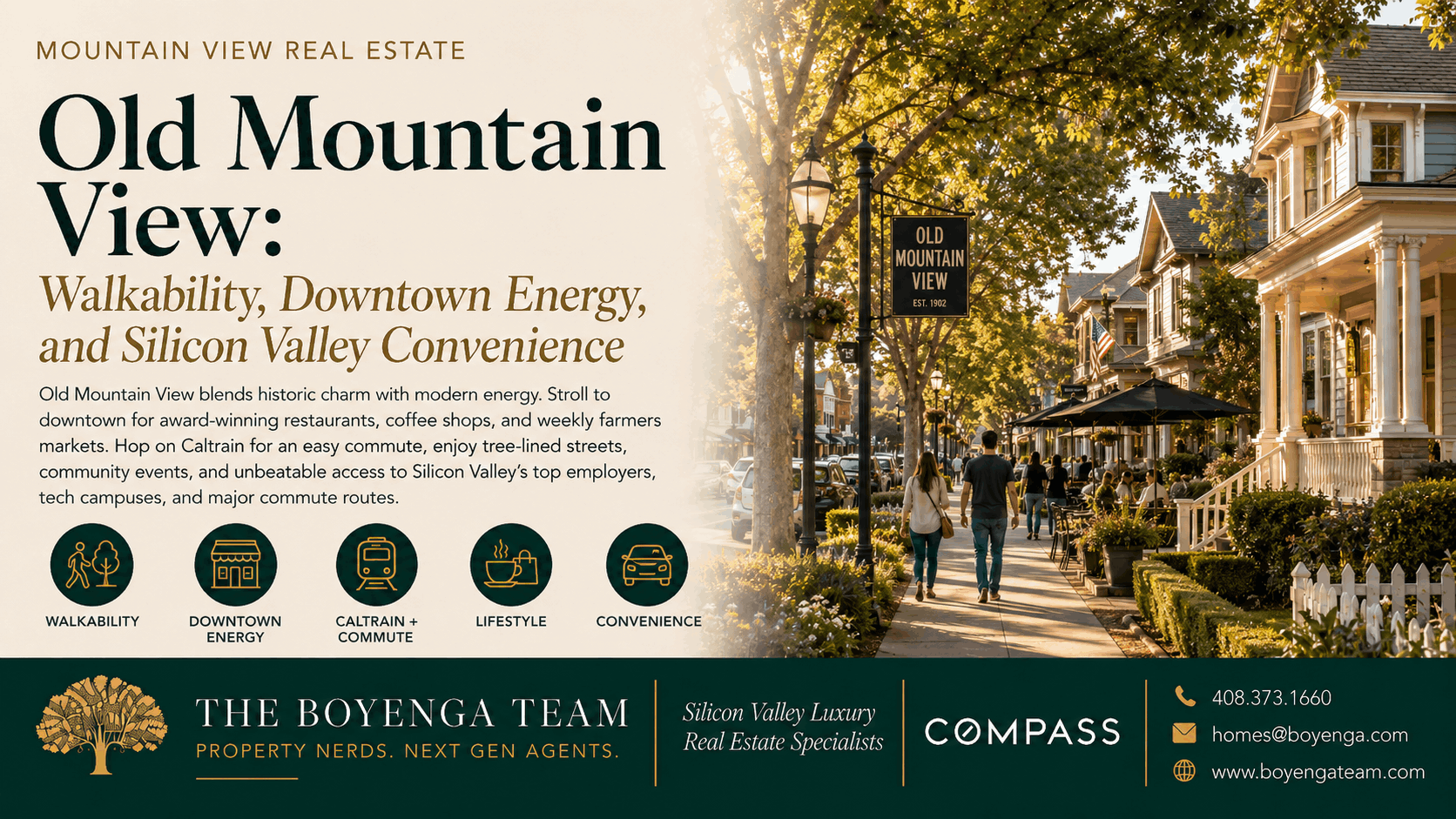
Old Mountain View is one of those Silicon Valley neighborhoods where the lifestyle explains the value.
It is not just about the house.
It is about walking to Castro Street for dinner.
It is about grabbing coffee without getting in the car.
It is about Caltrain access.
It is about being close to Google, LinkedIn, Intuit, Stanford, Palo Alto, Sunnyvale, Los Altos, and the broader Silicon Valley employment engine.
It is about living in a neighborhood that feels connected, social, convenient, and still residential.
That is why Old Mountain View has become one of the most desirable walkable neighborhoods in Mountain View real estate.
For buyers, Old Mountain View offers something that is increasingly rare in Silicon Valley: an urban-village lifestyle with access to major tech corridors and a true neighborhood feel. For sellers, that lifestyle needs to be marketed with precision because buyers are not only evaluating the home’s square footage. They are evaluating daily convenience, walkability, transit access, dining, commute geometry, housing type, and long-term resale appeal.
At the Boyenga Team, we see Old Mountain View as a classic Property Nerd micro-market. The value is not only in the property. It is in the location compression — the way the neighborhood pulls together downtown energy, transit, residential streets, and Silicon Valley access.
That is powerful.
Why Old Mountain View Feels Different
Old Mountain View feels different from many Silicon Valley neighborhoods because it has a real downtown rhythm.
Many Bay Area communities have nice homes but limited walkability. Others have urban convenience but lack a neighborhood feel. Old Mountain View sits in the sweet spot between the two.
Buyers are often drawn to the idea of walking to:
Castro Street restaurants
Coffee shops
Local services
Downtown events
Caltrain
Light rail connections
Parks
Shops
Fitness studios
Community gathering spots
Weekend dining and nightlife
This gives Old Mountain View a lifestyle advantage that purely suburban neighborhoods may not offer.
The Property Nerd truth is that walkability changes buyer behavior. A buyer may accept a smaller lot, older home, higher-density surroundings, or less privacy because the neighborhood gives them a more connected daily life.
That is the trade-off.
And for the right buyer, it is absolutely worth it.
The Downtown Mountain View Lifestyle Premium
Downtown Mountain View is one of the strongest lifestyle anchors in the city. Castro Street gives the neighborhood identity, energy, and a reason for buyers to pay attention.
Old Mountain View buyers often imagine a very specific routine:
Walk to coffee in the morning.
Take Caltrain to work or meetings.
Meet friends for dinner on Castro Street.
Bike to nearby parks.
Commute easily to Google or Palo Alto.
Enjoy a more social lifestyle without moving to San Francisco.
Live in Silicon Valley without feeling isolated in a car-only suburb.
That is the downtown premium.
It is not just convenience. It is emotional.
Buyers like the idea that their home is not disconnected from daily life. They like the ability to make spontaneous plans, walk to food, and feel part of a community.
For sellers, this means marketing should not simply say “close to downtown.” It should explain what that proximity feels like.
The Boyenga Team positions Old Mountain View homes around lifestyle, rhythm, and convenience — because that is what buyers are really buying.
Walkability Is a Real Value Driver
Walkability is one of the most important reasons buyers choose Old Mountain View.
But not all walkability is equal.
A home may technically be close to downtown, but the actual experience depends on the route. Is it pleasant? Are there sidewalks? Does the street feel safe? Is the walk shaded? Does the buyer have to cross busy roads? Does the home feel close enough that walking will become part of daily life?
The strongest Old Mountain View locations offer what we call usable walkability.
Usable walkability means the walk is not just possible. It is something people will actually do.
Buyers notice this.
They notice whether the route to Castro Street feels easy.
They notice whether Caltrain is truly convenient.
They notice whether the home feels close to the action but not overwhelmed by it.
They notice whether parking, noise, and density feel manageable.
This is where micro-location pricing becomes important.
A quiet residential street with a pleasant walk to downtown can command a different buyer response than a home that is technically downtown-adjacent but more exposed to traffic or noise.
Caltrain and Transit Access Matter
Old Mountain View has a major transit advantage because of its proximity to the Mountain View Transit Center, which connects Caltrain and VTA light rail.
For many buyers, this matters even if they do not use transit every day. Transit access creates optionality.
A buyer may use Caltrain for meetings in Palo Alto, Menlo Park, San Francisco, or San Jose. A household may have one person commuting by train and another driving. A relocation buyer may value being less dependent on cars. A tech worker may appreciate shuttle or transit options.
The Property Nerd concept here is mobility flexibility.
Old Mountain View gives buyers more ways to move through Silicon Valley. That can improve quality of life and long-term resale appeal.
For sellers, transit access should be part of the story when relevant — but it should be balanced with the residential feel of the home. Buyers want convenience, not noise or chaos.
Silicon Valley Convenience: The Commute Geometry Advantage
Old Mountain View is strategically positioned for tech buyers and Silicon Valley professionals.
It offers access to:
Google and North Bayshore
LinkedIn
Intuit
Microsoft
NASA Ames
Palo Alto
Stanford
Los Altos
Sunnyvale
Cupertino
Central Expressway
Highway 101
Highway 85
El Camino Real
Caltrain
This is why the neighborhood appeals to a wide range of buyers. It is not tied to just one employer. It offers commute optionality across multiple tech and professional corridors.
In Silicon Valley, commute optionality is a form of real estate value.
A buyer may work at Google today, join a startup in Palo Alto next year, take meetings in San Francisco, or shift to Apple, Nvidia, Meta, Stanford, or another employer later. Old Mountain View provides a central base that can adapt with changing careers.
That flexibility matters to tech buyers.
Housing Stock: Variety Is Part of the Story
Old Mountain View has a wide variety of housing types, which makes it different from more uniform single-family neighborhoods.
Buyers may find:
Historic cottages
Bungalows
Older single-family homes
Small-lot homes
Townhomes
Condos
Duplexes
Apartments
Newer infill development
Remodel opportunities
Properties with rental or investment appeal
This variety creates a broad buyer pool, but it also makes pricing more nuanced.
A charming older single-family home near downtown may attract buyers who value character and land. A newer townhome may attract buyers who want low-maintenance living. A condo may appeal to first-time buyers, investors, or commuters. A dated home may attract remodel buyers or builders depending on lot and zoning.
The Boyenga Team evaluates Old Mountain View properties by product type, not just neighborhood name. The buyer pool for a walkable cottage is different from the buyer pool for a newer townhome.
That difference should shape the marketing.
Buyer Profile: Who Loves Old Mountain View?
Old Mountain View attracts a wide range of buyers, including:
Tech professionals who want walkability
Buyers working at Google, LinkedIn, Intuit, Stanford, or nearby startups
Relocation buyers who want an easy Silicon Valley lifestyle
First-time buyers moving up from condos
Downsizers who want less car dependence
Investors who value rental appeal
Families who want downtown access and neighborhood energy
Buyers who prefer character homes over generic newer subdivisions
Transit-oriented buyers
Urban-to-suburban movers from San Francisco or Palo Alto
The common thread is convenience.
Old Mountain View buyers often want a home that reduces friction. They want to be close to work, restaurants, transit, services, and community life.
They may not need the largest lot in Mountain View. They may want the most useful location.
What Buyers Notice First in Old Mountain View
Old Mountain View buyers tend to notice the neighborhood before they notice the finishes.
They ask:
How close is it to Castro Street?
Can we walk to Caltrain?
Is the street quiet or busy?
Is parking manageable?
Does the home feel private enough?
Is there outdoor space?
Does the floor plan work?
Is it charming or just old?
Is the property a remodel opportunity?
Is there noise from downtown, trains, or traffic?
Does the location justify the price?
This is why sellers need to be honest and strategic.
If the home is highly walkable but small, market lifestyle and efficiency.
If the home is charming but dated, market character and opportunity.
If the home is newer and low-maintenance, market ease and convenience.
If the home has a quiet street near downtown, market the rare balance of calm and access.
The right story depends on the property.
Schools: Verify the Exact Address
Schools can be an important part of the Old Mountain View buyer decision, especially for families. But school assignments are address-specific and should always be verified directly with the appropriate district.
Mountain View can involve multiple school pathways depending on location and grade level. Buyers should never rely only on listing portals, assumptions, or neighborhood shorthand.
The Boyenga Team treats school information as a due-diligence item. Buyers should confirm directly with the applicable school district before writing an offer.
For sellers, the best strategy is to market the full lifestyle — walkability, parks, commute, downtown access, floor plan, and neighborhood convenience — while encouraging buyers to verify school assignments independently.
The Trade-Offs Buyers Should Understand
Old Mountain View is desirable, but it is not the perfect fit for every buyer.
The trade-offs may include:
Smaller lots compared with more suburban neighborhoods
More density
Parking constraints in some areas
Noise exposure near transit or busier streets
Older housing stock
Mixed property types
Less privacy than Waverly Park or Cuesta Park
Higher price per square foot for walkability
More competition for charming single-family homes
These trade-offs are not negatives for every buyer. They are simply part of the lifestyle equation.
A buyer who wants a large yard, quiet streets, and more traditional family space may prefer Waverly Park, Cuesta Park, or another residential pocket.
A buyer who values downtown energy, transit, and walkability may gladly accept less yard space in exchange for daily convenience.
That is the Property Nerd way to think about it: every neighborhood has a value stack and a trade-off stack.
Old Mountain View vs. Other Mountain View Neighborhoods
Old Mountain View is best understood by comparing it with nearby alternatives.
Old Mountain View vs. Cuesta Park
Cuesta Park offers more park-centered family living and a quieter residential rhythm. Old Mountain View offers stronger downtown walkability and transit access.
Old Mountain View vs. Waverly Park
Waverly Park often appeals to buyers who want larger lots, privacy, and a premium residential feel. Old Mountain View appeals to buyers who want downtown energy and convenience.
Old Mountain View vs. Shoreline West
Shoreline West can offer a balance of downtown proximity and residential texture. Old Mountain View is generally more directly tied to downtown and Castro Street lifestyle.
Old Mountain View vs. Monta Loma
Monta Loma attracts Eichler and mid-century modern buyers with design-focused appeal. Old Mountain View attracts walkability and downtown-lifestyle buyers.
Old Mountain View vs. Whisman Station
Whisman Station offers newer housing and transit-oriented convenience with a planned-community feel. Old Mountain View offers more downtown character and urban-village energy.
The best choice depends on whether the buyer prioritizes walkability, lot size, architecture, commute, schools, or housing type.
Why Sellers Need More Than Generic Mountain View Marketing
Old Mountain View homes should be marketed differently from other Mountain View properties.
A generic listing might say:
“Great location near downtown.”
A Property Nerd listing explains:
“This home offers a walkable Old Mountain View lifestyle with easy access to Castro Street dining, Caltrain, downtown amenities, and major Silicon Valley commute corridors — while still providing a residential base in one of Mountain View’s most connected neighborhoods.”
The second version helps buyers understand why the location matters.
The Boyenga Team’s marketing strategy for Old Mountain View may emphasize:
Walkability
Downtown energy
Caltrain convenience
Housing type
Character
Low-maintenance living
Remodel potential
Investor appeal
Commute optionality
Parks and amenities
Proximity to tech employers
Lifestyle photography
Digital-first presentation
Old Mountain View is a lifestyle market. The marketing should feel like one.
Home Prep for Old Mountain View Sellers
Preparation depends on the property type.
For an older single-family home, sellers may need:
Decluttering
Paint
Lighting updates
Floor refinishing
Landscape cleanup
Window cleaning
Staging
Inspections
Clear presentation of remodel potential
For a townhome or condo, sellers may need:
Fresh paint
Staging
Lighting
HOA document organization
Garage or storage presentation
Clean outdoor patio styling
Lifestyle-focused marketing
For a charming bungalow, sellers may need:
Character-preserving staging
Curb appeal
Warm lighting
Photography that emphasizes charm
Copy that highlights walkability and historic feel
For a dated property, sellers may need:
Opportunity-focused positioning
Pre-sale inspections
Cleanout
Basic refresh
Pricing that attracts both end-users and remodel buyers
The Boyenga Team’s question is always: what will change buyer behavior?
Do enough to make the home feel clear, clean, and compelling. Do not over-improve in ways the buyer may not value.
Pricing Old Mountain View Homes
Pricing in Old Mountain View requires careful product-specific analysis.
A single-family home, condo, townhome, duplex, and redevelopment opportunity should not be priced using the same logic.
Key pricing factors include:
Distance to downtown
Street quality
Noise exposure
Lot size
Parking
Home condition
Outdoor space
Walkability
Transit access
School pathway
Housing type
HOA fees if applicable
Rental appeal
Remodel potential
Current inventory
Buyer demand for that product type
The walkability premium can be real, but buyers still evaluate trade-offs.
The Boyenga Team prices Old Mountain View homes by looking at both comparable sales and buyer psychology. The goal is to create credibility, urgency, and strong market response.
The Next Gen Agent Advantage
Old Mountain View buyers are digital-first.
Before they visit, they have already researched the map, commute, downtown proximity, transit, restaurants, schools, photos, floor plan, and price. That means online presentation matters enormously.
The Boyenga Team uses a Next Gen Agent approach that focuses on:
Professional photography
Clear floor plans
Lifestyle-driven listing copy
Neighborhood-specific SEO
Compass marketing tools
Social media storytelling
Buyer-pool targeting
Agent outreach
Digital ad strategy where appropriate
Strong first-week launch positioning
Old Mountain View buyers are not just looking for a home. They are looking for a location that makes Silicon Valley life easier.
The marketing has to show that immediately.
Final Property Nerd Takeaway
Old Mountain View is one of Mountain View’s most compelling lifestyle neighborhoods because it combines walkability, downtown energy, transit access, and Silicon Valley convenience.
Buyers choose it because they want more than a house. They want a daily rhythm:
Walk to Castro Street.
Grab coffee nearby.
Use Caltrain.
Commute efficiently.
Stay connected to Google, Stanford, Palo Alto, Sunnyvale, and the broader tech ecosystem.
Live in a neighborhood that feels active, useful, and connected.
But Old Mountain View is also nuanced. Housing types vary. Lots can be smaller. Noise and parking matter. School assignments should be verified. Product type changes pricing. Micro-location can dramatically affect value.
That is why local expertise matters.
The Boyenga Team helps buyers and sellers understand Old Mountain View through a Property Nerd and Next Gen Agent lens — combining lifestyle analysis, commute logic, buyer psychology, property prep, and digital marketing strategy.
If you are buying or selling in Old Mountain View, the real question is not just what the home offers.
It is how the location lives.
The Boyenga Team
Mountain View & Silicon Valley Real Estate Experts
Compass
Website: www.BoyengaTeam.com
Email: homes@boyenga.com