

Blog > Mountain View Neighborhoods Explained: A Property Nerds Guide to Lifestyle, Schools, and Commute
Mountain View Neighborhoods Explained: A Property Nerds Guide to Lifestyle, Schools, and Commute
by
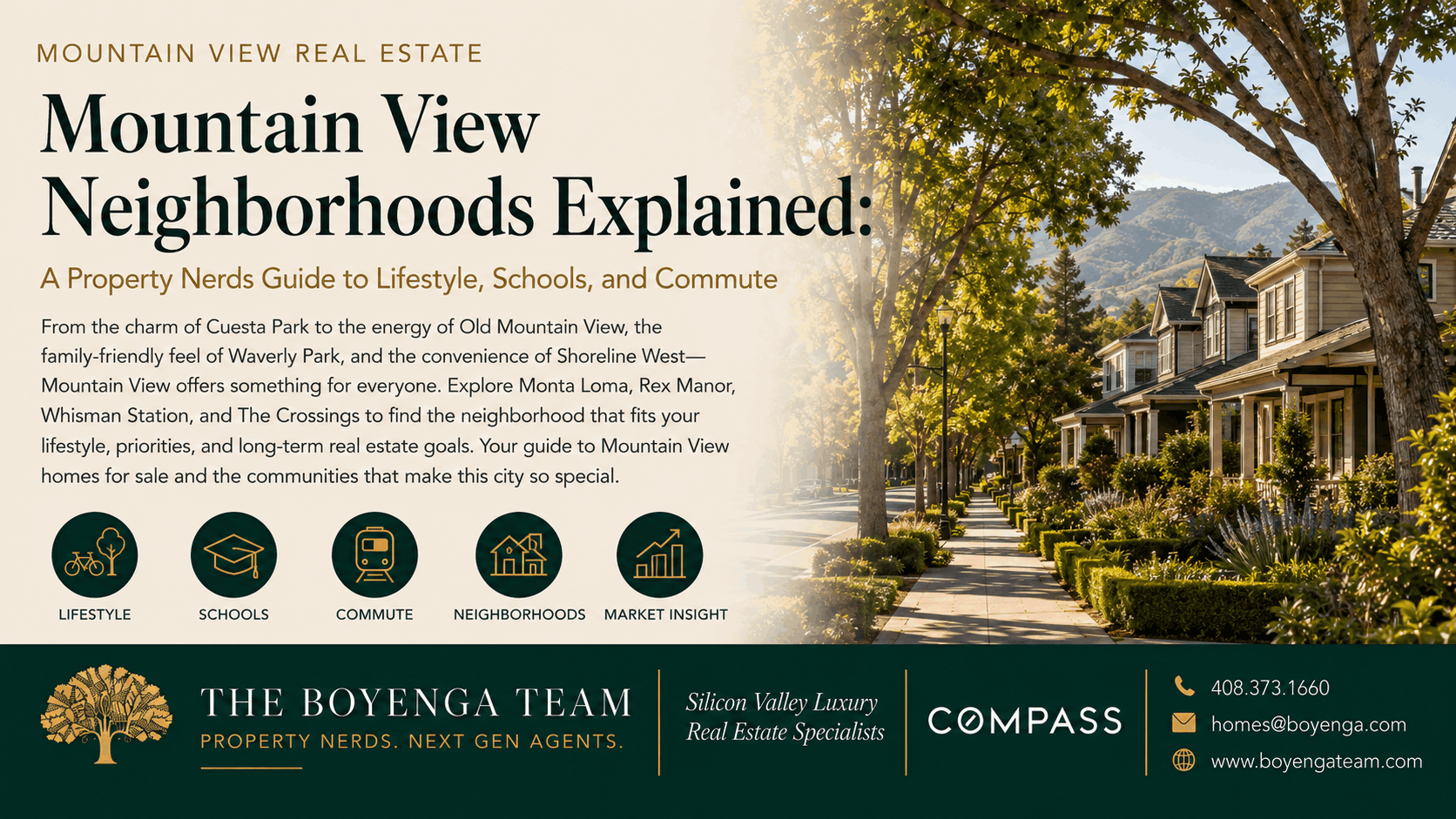
Mountain View is one of Silicon Valley’s most underratedly complex real estate markets.
On the surface, buyers see a city with Google, Caltrain, downtown energy, great commute access, established neighborhoods, parks, schools, and a wide range of housing options. But the Property Nerd truth is that Mountain View is not one market.
It is a collection of micro-neighborhoods.
Cuesta Park is not Old Mountain View. Waverly Park is not Monta Loma. Shoreline West is not Whisman Station. Rex Manor, The Crossings, and Monta Loma all attract different buyers for different reasons. Some buyers want walkability to Castro Street. Some want larger lots and a quieter residential feel. Some want Eichler and mid-century modern architecture. Some want Google proximity. Some want newer townhomes near transit. Some want school pathways, parks, and practical commute geometry.
That is why choosing the right Mountain View neighborhood is not just about budget.
It is about lifestyle fit.
At the Boyenga Team, we look at Mountain View the way serious buyers and sellers actually experience it: by commute routes, school districts, housing stock, lot utility, walkability, resale demand, architecture, outdoor space, tech proximity, and long-term value. We are Silicon Valley Property Nerds and Next Gen Agents, which means we do not just describe neighborhoods — we decode them.
This guide breaks down some of Mountain View’s most important neighborhoods, including Cuesta Park, Old Mountain View, Waverly Park, Shoreline West, Monta Loma, Rex Manor, Whisman Station, and The Crossings.
Why Mountain View Real Estate Is So Strategic
Mountain View sits in one of the most valuable positions in Silicon Valley. It offers access to major tech employers, including Google, LinkedIn, Intuit, Microsoft, NASA Ames, and the broader North Bayshore, Sunnyvale, Palo Alto, Los Altos, and Cupertino employment corridors.
For many buyers, Mountain View offers a rare blend of:
Tech proximity
Downtown lifestyle
Caltrain access
Diverse housing options
Established residential neighborhoods
Mid-century and Eichler architecture
Parks and trails
School-driven demand
Access to Palo Alto, Los Altos, Sunnyvale, and Cupertino
A more approachable entry point than some neighboring luxury markets
But within Mountain View, the value story changes block by block.
A buyer choosing Old Mountain View may prioritize walkability and downtown lifestyle. A buyer choosing Cuesta Park may want parks, family living, and access toward Los Altos. A Waverly Park buyer may want space, quiet, and larger lots. A Monta Loma buyer may love Eichler and mid-century modern architecture. A Whisman Station buyer may prioritize newer construction and transit access. A Crossings buyer may want urban-style convenience near Caltrain and San Antonio. A Shoreline West buyer may value downtown access with residential charm.
Mountain View rewards buyers who understand the micro-market.
The Property Nerd Framework for Comparing Mountain View Neighborhoods
Before choosing a Mountain View neighborhood, buyers should ask several key questions.
What is the real commute pattern? A home that looks close on a map may live differently depending on Central Expressway, El Camino Real, Highway 101, Highway 85, Shoreline Boulevard, San Antonio Road, or Caltrain access.
What school district and school pathway apply to the exact address? Mountain View can involve different school districts and boundaries, so buyers should always verify directly with the appropriate district.
What type of housing stock fits the lifestyle? Mountain View has single-family homes, townhomes, condos, Eichlers, mid-century modern homes, ranch homes, cottages, newer developments, and higher-density neighborhoods.
How important is walkability? Some buyers want downtown Castro Street or Caltrain nearby. Others want a larger yard and quieter streets.
Is the lot usable? Lot size alone is not enough. Shape, privacy, sunlight, trees, setbacks, and expansion potential matter.
What will future buyers value? Resale demand may be driven by schools, commute, architecture, Google proximity, lot utility, or walkability.
That is the Property Nerd way to evaluate Mountain View: not by neighborhood name alone, but by the combination of lifestyle, land, commute, schools, and buyer demand.
Cuesta Park: Family-Friendly, Park-Centered, and Close to Los Altos
Cuesta Park is one of Mountain View’s most desirable family-oriented neighborhoods. It offers a quiet residential feel, strong park access, and convenient proximity to both downtown Mountain View and Los Altos.
The neighborhood gets its name from Cuesta Park, one of the city’s best-loved green spaces. For families, this is a major lifestyle anchor. Buyers often value the ability to access playgrounds, tennis courts, walking paths, open lawn areas, and a true neighborhood park environment.
Cuesta Park homes often include ranch-style homes, remodeled family homes, and newer custom properties. The area tends to appeal to buyers who want more of a traditional single-family residential feel while still staying close to major Silicon Valley employers.
Buyer Profile
Cuesta Park buyers often include:
Families seeking parks and quiet streets
Move-up buyers from condos or townhomes
Buyers comparing Mountain View and Los Altos
Tech professionals working in Mountain View, Sunnyvale, Palo Alto, or Cupertino
Buyers who want a strong neighborhood feel
Sellers moving from longtime family homes
What Drives Value
Cuesta Park value is often shaped by:
Proximity to Cuesta Park
Quiet streets
Lot size and usability
School pathway
Home condition
Floor plan functionality
Access to Los Altos and downtown Mountain View
Commute convenience
Yard and outdoor living potential
Property Nerd Takeaway
Cuesta Park is a lifestyle-comfort neighborhood. Buyers often choose it because it feels balanced: residential, family-friendly, connected, and park-oriented.
For sellers, the marketing should highlight daily livability: parks, yard space, natural light, family function, commute access, and the rare ability to feel tucked away while still close to everything.
Old Mountain View: Downtown Energy, Castro Street, and Caltrain Convenience
Old Mountain View is one of the city’s most walkable and lifestyle-driven neighborhoods. It is centered around downtown Mountain View, Castro Street, Caltrain, restaurants, cafes, shops, and community events.
For buyers who want an urban-village lifestyle without leaving Silicon Valley, Old Mountain View can be extremely compelling. It offers a more connected rhythm than many suburban neighborhoods. You can walk to dinner, grab coffee, take Caltrain, meet friends downtown, and still live in a residential pocket.
Housing can vary widely. Old Mountain View includes cottages, bungalows, apartments, condos, townhomes, older single-family homes, and newer infill development. That variety creates a diverse buyer pool.
Buyer Profile
Old Mountain View buyers often include:
Buyers who want downtown walkability
Tech professionals who use Caltrain
Relocation buyers who want lifestyle convenience
Younger buyers and move-up condo buyers
Downsizers seeking less car-dependent living
Investors and rental-oriented buyers
Buyers who value proximity to Castro Street
What Drives Value
Old Mountain View value is often driven by:
Walkability
Caltrain access
Downtown lifestyle
Castro Street proximity
Lot rarity
Housing type
Parking
Street quality
Noise exposure
Home condition
Redevelopment or remodel potential
Property Nerd Takeaway
Old Mountain View is a walkability-premium neighborhood. The best properties offer downtown access without feeling too exposed to traffic, noise, or density.
For sellers, the marketing should sell the lifestyle, not just the square footage. Buyers here are often paying for convenience, energy, and the ability to live in a true Silicon Valley downtown environment.
Waverly Park: Larger Lots, Quiet Streets, and Classic Residential Appeal
Waverly Park is one of Mountain View’s most desirable residential neighborhoods for buyers who want a quieter, more spacious feel. It often appeals to families who want larger lots, established streets, and a more traditional single-family environment.
Waverly Park can feel more private and suburban than Old Mountain View or Whisman Station. It is a neighborhood where buyers may prioritize yard space, home size, privacy, and long-term family living.
Homes in Waverly Park may include ranch homes, expanded homes, remodels, and newer custom construction. Many buyers see it as one of Mountain View’s strongest move-up neighborhoods.
Buyer Profile
Waverly Park buyers often include:
Families seeking larger lots
Move-up buyers
Buyers comparing Mountain View, Los Altos, and Sunnyvale
Tech executives and professionals
Buyers who want quiet residential streets
Buyers seeking remodel or expansion potential
Long-term owners and luxury-oriented buyers
What Drives Value
Waverly Park value is often influenced by:
Lot size
Street quality
Privacy
Home condition
School pathway
Outdoor living
Expansion potential
Floor plan
Natural light
Neighborhood consistency
Access to major commute routes
Property Nerd Takeaway
Waverly Park is a space-and-stability neighborhood. Buyers often pay for the feeling of room, privacy, and long-term livability.
For sellers, the strategy should emphasize lot utility, quiet streets, family function, outdoor living, and the neighborhood’s premium residential feel.
Shoreline West: Downtown Access With Residential Charm
Shoreline West offers a compelling mix of downtown access, residential streets, and Mountain View convenience. It sits close enough to downtown and transit to attract walkability-focused buyers, but many blocks still feel neighborhood-oriented.
This area can appeal to buyers who like the energy of Old Mountain View but want a slightly different residential feel. Depending on the block, Shoreline West can offer access to downtown, parks, schools, and commute routes while maintaining a quieter daily rhythm.
Housing varies and may include older homes, cottages, remodels, duplexes, small-lot homes, and higher-density housing nearby.
Buyer Profile
Shoreline West buyers often include:
Downtown-oriented buyers
Families seeking walkability and neighborhood feel
Tech professionals
Buyers who want Caltrain or Castro Street access
Investors
Buyers seeking character homes or remodel opportunities
Relocation buyers who want convenient Silicon Valley living
What Drives Value
Shoreline West value is often shaped by:
Walkability to downtown
Street quality
Noise and traffic exposure
Lot size
Home condition
Parking
Remodel potential
Proximity to schools and parks
Access to Caltrain and commute corridors
Property Nerd Takeaway
Shoreline West is a balance neighborhood. It can offer the energy of downtown access with more residential texture than some buyers expect.
For sellers, the marketing should clarify the exact lifestyle: walkable, connected, neighborhood-oriented, and close to Mountain View’s most active amenities.
Monta Loma: Eichler Energy, Mid-Century Cool, and Design-Lover Demand
Monta Loma is one of Mountain View’s most distinctive neighborhoods because of its mid-century modern and Eichler identity. For architecture lovers, this pocket has a special kind of magnetism.
Buyers drawn to Monta Loma often care about design, indoor-outdoor living, post-and-beam architecture, atriums, glass walls, radiant heat, clean lines, and the relaxed modernist lifestyle associated with Eichler homes and mid-century neighborhoods.
This is not just housing stock. It is a design culture.
The Boyenga Team knows that Eichler and mid-century homes need a different marketing strategy. These homes should not be treated like ordinary ranch homes. Their value comes from architecture, light, lifestyle, and buyer passion.
Buyer Profile
Monta Loma buyers often include:
Eichler enthusiasts
Mid-century modern buyers
Architects and designers
Tech professionals with design taste
Buyers seeking indoor-outdoor living
Families wanting a unique neighborhood identity
Buyers comparing Mountain View Eichlers with Palo Alto, Sunnyvale, and San Mateo Eichler neighborhoods
What Drives Value
Monta Loma value is often driven by:
Eichler or mid-century architecture
Original details
Quality of renovation
Atrium condition
Roof and radiant heat systems
Indoor-outdoor flow
Natural light
Lot utility
Architectural integrity
Neighborhood identity
Proximity to Google and North Bayshore
Property Nerd Takeaway
Monta Loma is an architecture-premium neighborhood. Buyers are not only buying a home; they are buying a design philosophy.
For sellers, the marketing should be stylish, specific, and historically aware. A Monta Loma home should be positioned around modernist lifestyle, natural light, indoor-outdoor connection, and the emotional pull of mid-century Silicon Valley living.
Rex Manor: Practical, Central, and Often Overlooked
Rex Manor is one of Mountain View’s practical residential neighborhoods that can appeal to buyers seeking access, function, and relative value. It may not always carry the same name recognition as Cuesta Park, Waverly Park, or Old Mountain View, but it can offer strong livability.
Buyers may value Rex Manor for its central location, access to commute corridors, proximity to major employers, and mix of single-family homes and residential streets.
This is the kind of neighborhood where Property Nerd analysis matters because buyers may find opportunities that are not as obvious to the casual market.
Buyer Profile
Rex Manor buyers often include:
Tech professionals
First-time single-family buyers
Move-up buyers from condos or townhomes
Buyers seeking relative Mountain View value
Commuters needing access to 101, Central Expressway, or major employers
Investors and remodel buyers
Families looking for practical space
What Drives Value
Rex Manor value is often shaped by:
Commute convenience
Lot size
Home condition
Street quality
Proximity to employers
Remodel potential
Relative affordability
Floor plan functionality
Access to parks, schools, and services
Property Nerd Takeaway
Rex Manor is a practical-opportunity neighborhood. It may not always have the headline glamour, but the right property can offer strong value, access, and long-term upside.
For sellers, the marketing should explain the utility: location, commute, lot potential, livability, and value relative to more expensive Mountain View pockets.
Whisman Station: Newer Housing, Transit Access, and Tech Convenience
Whisman Station is a very different Mountain View lifestyle from Waverly Park, Monta Loma, or Cuesta Park. It is known for newer townhomes, planned-community feel, transit access, and proximity to major employers.
This neighborhood often appeals to buyers who want convenience, lower-maintenance living, and access to light rail, downtown Mountain View, Google, North Bayshore, and commute routes.
Whisman Station may be especially attractive to busy tech professionals who want a practical, connected home base without the responsibilities of a larger single-family property.
Buyer Profile
Whisman Station buyers often include:
Tech professionals
First-time buyers
Move-up condo buyers
Buyers seeking townhomes
Relocation buyers
Commuters using transit or employer shuttles
Buyers wanting lower-maintenance living
Investors in some cases
What Drives Value
Whisman Station value is often influenced by:
Townhome condition
HOA quality
Floor plan
Parking and garage setup
Transit proximity
Commute access
Proximity to Google and North Bayshore
Community amenities
Privacy within the development
Outdoor space or patio usability
Property Nerd Takeaway
Whisman Station is a convenience-and-connectivity neighborhood. It appeals to buyers who value efficiency, newer housing, and tech access.
For sellers, marketing should focus on ease: commute convenience, modern layouts, low-maintenance living, transit access, and proximity to Mountain View’s tech economy.
The Crossings: Transit-Oriented, Urban-Suburban, and Highly Connected
The Crossings is one of Mountain View’s best-known planned communities and offers a transit-oriented lifestyle near San Antonio Center, Caltrain, shopping, dining, and major commute routes.
This neighborhood is attractive to buyers who want more structure, convenience, and an urban-suburban feel. It can appeal to people who want access to Palo Alto, Los Altos, Mountain View, and Caltrain without relying exclusively on a car.
Housing may include townhomes, condos, and single-family-style homes depending on the exact property type.
Buyer Profile
The Crossings buyers often include:
Transit-oriented buyers
Tech professionals
Buyers commuting to Palo Alto or Mountain View
Relocation buyers
Downsizers
Buyers who want walkability to shopping and dining
Buyers seeking planned-community convenience
Investors and first-time buyers in some product types
What Drives Value
The Crossings value is often shaped by:
Caltrain access
San Antonio Center proximity
Floor plan
HOA quality
Parking
Outdoor space
Walkability
Access to Palo Alto, Los Altos, and Mountain View
Noise exposure
Home condition
Community feel
Property Nerd Takeaway
The Crossings is a location-efficiency neighborhood. Buyers value how easy it is to connect to work, transit, shopping, dining, and nearby cities.
For sellers, the marketing should emphasize convenience, connectivity, and the ability to live a lower-friction Silicon Valley lifestyle.
Schools: Why Buyers Must Verify the Exact Address
School pathways are a major part of Mountain View real estate, but they are also address-specific.
Mountain View can involve multiple school districts depending on location and grade level. Buyers should never rely only on listing portals, assumptions, or neighborhood names. They should verify directly with the appropriate district before writing an offer.
This matters because school assignments can influence buyer demand, commute logistics, and long-term resale. A home in Cuesta Park, Waverly Park, Monta Loma, or Whisman Station may appeal to very different buyers depending on school pathway and daily family logistics.
The Boyenga Team treats school information as a due-diligence item. The exact address matters.
Commute Geometry: The Hidden Mountain View Value Driver
Mountain View’s commute advantage is one of its biggest value drivers, but commute quality varies by neighborhood.
Old Mountain View and Shoreline West may appeal to buyers who want Caltrain or downtown access.
Whisman Station may appeal to buyers who want light rail, Google proximity, and tech-campus access.
The Crossings may appeal to buyers who want San Antonio Caltrain, Palo Alto access, and shopping nearby.
Cuesta Park and Waverly Park may appeal to buyers who want residential living with access to Los Altos, El Camino, Highway 85, and Central Expressway.
Monta Loma may appeal to buyers who want proximity to Google, North Bayshore, and mid-century lifestyle.
Rex Manor may appeal to buyers who want practical access to 101, Central Expressway, and major employers.
The Property Nerd question is not “how many miles away is work?”
The better question is: how does the commute actually live at 8:00 a.m. on a Tuesday?
How Buyers Should Choose a Mountain View Neighborhood
Choose Cuesta Park if you want parks, family-friendly living, and access to both Mountain View and Los Altos.
Choose Old Mountain View if you want downtown walkability, Caltrain, Castro Street, and an urban-village lifestyle.
Choose Waverly Park if you want larger lots, quiet streets, and a premium residential feel.
Choose Shoreline West if you want a balance of downtown access and neighborhood charm.
Choose Monta Loma if you love Eichlers, mid-century design, indoor-outdoor living, and architecture with personality.
Choose Rex Manor if you want practical value, commute access, and overlooked opportunity.
Choose Whisman Station if you want newer townhomes, transit access, and low-maintenance tech convenience.
Choose The Crossings if you want transit-oriented living, San Antonio Center access, and strong connectivity to Palo Alto, Los Altos, and Mountain View.
The best neighborhood is not the most expensive one. It is the one that matches your daily life.
What Sellers Should Know About Mountain View Positioning
Sellers should never market a Mountain View home generically.
A Cuesta Park home should be marketed differently from a Monta Loma Eichler. A Waverly Park property should not be positioned the same way as a Whisman Station townhome. A Crossings home needs a different story than a Shoreline West cottage.
The Boyenga Team positions Mountain View homes based on buyer pool and micro-location.
For a Cuesta Park home, we may emphasize parks, family lifestyle, and access to Los Altos.
For Old Mountain View, we may emphasize downtown walkability, Caltrain, and Castro Street.
For Waverly Park, we may emphasize lot, privacy, and premium residential setting.
For Monta Loma, we may emphasize Eichler architecture, design, light, and indoor-outdoor living.
For Rex Manor, we may emphasize value, commute access, and remodel potential.
For Whisman Station, we may emphasize transit, convenience, townhome living, and tech access.
For The Crossings, we may emphasize connectivity, San Antonio Center, Caltrain, and low-friction Silicon Valley lifestyle.
This is how sellers create stronger buyer understanding.
The Boyenga Team’s Property Nerd Approach to Mountain View
The Boyenga Team brings a deeply local, analytical approach to Mountain View real estate.
We evaluate:
Neighborhood identity
School pathway
Commute geometry
Housing type
Lot utility
Architecture
Street quality
Walkability
Transit access
Employer proximity
Remodel potential
Buyer pool
Pricing psychology
Resale narrative
For buyers, this helps identify the right neighborhood and avoid overpaying for the wrong fit.
For sellers, this helps position the property with the right story, the right preparation, the right marketing, and the right buyer targeting.
Mountain View is one of Silicon Valley’s most strategic markets — but it rewards people who understand the details.
Final Property Nerd Takeaway
Mountain View is not one neighborhood story.
It is many.
Cuesta Park offers family comfort and park-centered living. Old Mountain View offers downtown energy and Caltrain convenience. Waverly Park offers space and residential quiet. Shoreline West offers downtown access with neighborhood texture. Monta Loma offers Eichler and mid-century design culture. Rex Manor offers practical value and commute access. Whisman Station offers newer housing and tech convenience. The Crossings offers transit-oriented connectivity near San Antonio.
Each neighborhood has a different buyer pool, pricing logic, and lifestyle rhythm.
That is why local expertise matters.
The Boyenga Team helps buyers and sellers understand Mountain View at the micro-market level, combining Property Nerd analysis with Next Gen Agent marketing to create smarter decisions and stronger outcomes.
If you are buying or selling in Mountain View, the right neighborhood strategy can make all the difference.
The Boyenga Team
Mountain View & Silicon Valley Real Estate Experts
Compass
Website: www.BoyengaTeam.com
Email: homes@boyenga.com