

Blog > Los Altos vs. Sunnyvale: Bigger Lots or Better Value?
A Property Nerd’s Strategic Guide to Space, Schools, Silicon Valley Home Values, and Long-Term Resale
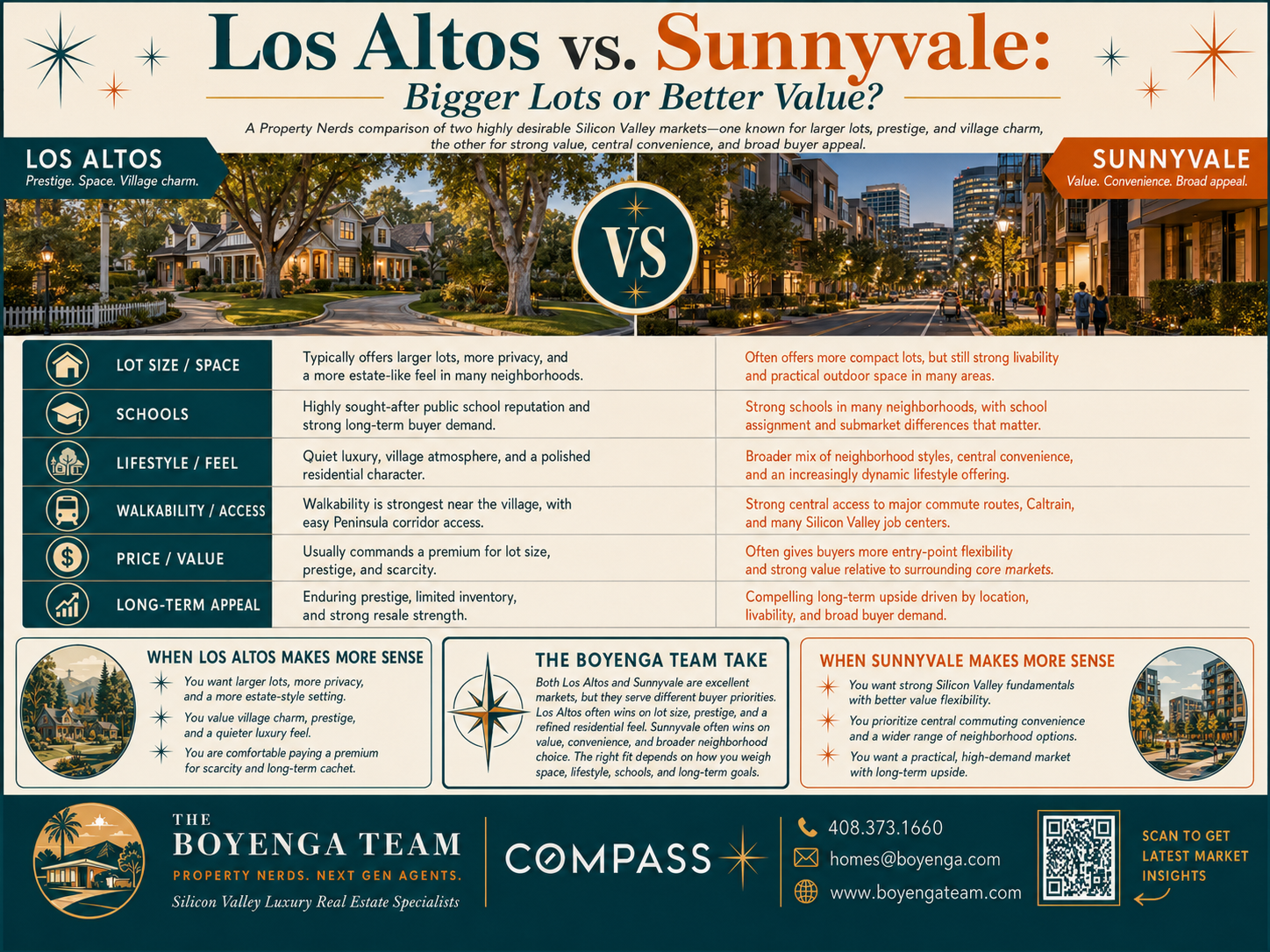
For Silicon Valley buyers, the choice between Los Altos and Sunnyvale is really a question of real estate philosophy. Are you buying the bigger lot, quieter street, and premium residential identity of Los Altos? Or are you buying the better value, broader school-path variety, tech commute flexibility, and future upside story of Sunnyvale? These two cities sit close together geographically, but they behave very differently in the market.
Los Altos is the classic premium residential asset. It is known for larger lots, quiet tree-lined streets, high-end single-family homes, strong school demand, village charm, privacy, and long-term prestige. Sunnyvale is the strategic value asset. It offers a wider range of neighborhoods and price points, strong school pockets, central Silicon Valley access, downtown growth, Eichler and mid-century neighborhoods, and practical commutes to Apple, Google, LinkedIn, Nvidia, Meta, Amazon, and major South Bay employers.
The simplest way to frame the comparison is this: Los Altos sells land, privacy, and prestige. Sunnyvale sells access, flexibility, and value. Both can be excellent long-term investments, but they solve different buyer problems.
Current market data shows how significant the pricing gap can be. Zillow reported the average Los Altos home value at approximately $4.65 million as of May 31, 2026, up 4.4% year over year, with homes going pending in around 10 days. Sunnyvale’s average home value was approximately $2.12 million as of the same date, up 0.1% year over year, with homes going pending in around 12 days. That means a buyer comparing the two cities is not just choosing between neighborhoods. They are deciding whether the Los Altos premium is worth roughly double the typical home-value benchmark.
Redfin’s three-month market data ending May 2026 showed Los Altos with a median sale price of about $4.25 million, while Sunnyvale’s median sale price was about $1.79 million. Redfin also described both cities as fast-moving markets, with Los Altos homes averaging around 10 days on market and Sunnyvale homes averaging around 11 days on market during that period. The Property Nerd takeaway is that Sunnyvale is not “slow” or “secondary.” It is highly competitive, but it operates at a different price band and with a much broader housing mix.
Los Altos buyers are often paying for scarcity. They want a quiet residential setting, larger lot utility, school confidence, architectural upside, privacy, and a sense of permanence. In Los Altos, the value is not always just the house. It is the land, the street, the school path, the mature trees, the separation from density, and the future ability to expand, remodel, add outdoor living, or create an estate-style environment.
Sunnyvale buyers are often paying for functionality. They want a smart Silicon Valley location that gives them access to major employers, school options, downtown amenities, Caltrain, parks, trails, and neighborhoods that still offer compelling value relative to Los Altos, Palo Alto, Mountain View, and Cupertino. Sunnyvale’s value proposition is not that it is inexpensive. It is that, inside Silicon Valley, it can offer a stronger price-to-function equation.
The bigger-lot conversation is where Los Altos usually has the advantage. Many Los Altos properties offer more privacy, larger yards, greater expansion potential, and a more residential luxury feel. For buyers who want a pool, guest house, ADU, outdoor kitchen, garden, sport court, detached office, or simply more breathing room between neighbors, Los Altos often justifies its premium. Land is the one thing Silicon Valley cannot manufacture, and Los Altos has built much of its long-term value around that scarcity.
Sunnyvale, however, can create a different kind of value. A buyer may trade some lot size or prestige for a better monthly payment, a shorter commute, a more updated home, a stronger floor plan, or access to a specific school pocket. In Sunnyvale, the best purchase is often not the biggest property. It is the home that combines neighborhood identity, school path, commute convenience, condition, and future resale demand at a price that still makes sense.
Schools are central to this comparison. Los Altos has a powerful school-driven reputation, but it is important to be precise. The City of Los Altos lists multiple school districts serving residents, including Los Altos School District, Cupertino Union School District, Santa Clara County Office of Education, Mountain View Los Altos High School District, and Fremont Union High School District depending on the exact address and grade level. Buyers should never assume school assignment based only on the city name.
Sunnyvale’s school story is even more address-sensitive. Sunnyvale includes several school paths, and the differences can materially affect buyer demand. Sunnyvale School District lists schools including Cherry Chase Elementary, Cumberland Elementary, Ellis Elementary, Bishop Elementary, Columbia Middle, and Sunnyvale Middle, among others. The district also directs families to use its school finder and attendance-boundary tools to verify the correct school for a specific address.
This is where Sunnyvale gets interesting from a Property Nerd perspective. A home in Cherry Chase, Cumberland, Birdland, Raynor Park, Ortega Park, Las Palmas, Fairbrae, or West Sunnyvale may attract a very different buyer pool than a home in another part of the city. Sunnyvale is not one school market. It is a collection of micro-markets, and those micro-markets can produce very different pricing behavior.
Los Altos tends to have a more consistent premium identity. Buyers often arrive with the assumption that Los Altos equals schools, space, and long-term stability. Sunnyvale requires a more granular explanation, but that granularity can create opportunity. A buyer who understands school boundaries, commute routes, neighborhood character, and resale dynamics may find a Sunnyvale home that functions extremely well without paying the full Los Altos premium.
Lifestyle is another major difference. Los Altos feels quiet, polished, and residential. Downtown Los Altos offers a village-style experience with restaurants, boutiques, community events, local services, and a slower pace. The city’s park network includes places such as Grant Park, Shoup Park, Heritage Oaks Park, Rosita Park, Hillview Park, Redwood Grove, McKenzie Park, and Marymeade Park, reinforcing the city’s family-oriented and outdoor lifestyle.
Sunnyvale feels more connected to the daily movement of Silicon Valley. It has a stronger urban-suburban growth story, especially around downtown. The CityLine project is a 36-acre site in the core of downtown Sunnyvale, with planned mixed-use retail, dining, entertainment, residential, and office uses. That kind of downtown investment gives Sunnyvale a lifestyle catalyst that Los Altos does not replicate in the same way.
For buyers who want quiet, privacy, and a retreat-like home environment, Los Altos often wins. For buyers who want restaurants, downtown energy, Caltrain access, tech convenience, and a more active urban-suburban rhythm, Sunnyvale can be the stronger lifestyle fit.
Commute logic is one of Sunnyvale’s biggest strengths. Sunnyvale sits in the middle of the South Bay tech grid. It can work for households commuting to Apple in Cupertino, Google in Mountain View, LinkedIn in Sunnyvale and Mountain View, Nvidia in Santa Clara, Meta on the Peninsula, Stanford, Amazon, and many AI and semiconductor employers across the region. A Sunnyvale buyer is often buying commute flexibility, especially when two people in the household work in different parts of Silicon Valley.
Los Altos can also be a strong commute location, especially for buyers connected to Mountain View, Palo Alto, Stanford, Apple, Google, or the 280 corridor. But Los Altos is usually less about commute efficiency alone and more about the total residential package. Buyers choose Los Altos because they want the home environment to feel more private and premium, even if the commute is slightly less convenient than a central Sunnyvale location.
Housing stock is another important difference. Los Altos tends to offer ranch homes, expanded ranches, custom luxury homes, new construction, estate-style properties, and homes on larger lots. Even older or dated properties may attract strong demand if the lot, street, and school path are strong. In Los Altos, a teardown or dated home can still be a premium asset because the land carries so much of the value.
Sunnyvale offers a much wider housing spectrum. Buyers can find Eichlers in Fairbrae, mid-century homes, classic ranch homes, remodeled family homes, townhomes, condos, downtown-adjacent properties, and larger West Sunnyvale homes that begin to compete with Los Altos and Cupertino buyer pools. This variety makes Sunnyvale more accessible to more buyers, but it also means the analysis must be more precise.
From a price-per-square-foot perspective, Los Altos usually looks expensive because buyers are paying for more than finished interior space. They are paying for the land, schools, neighborhood identity, privacy, and long-term prestige. Sunnyvale can look like better value because the entry point is lower and the housing mix is more diverse. But a lower price per square foot is not automatically a better investment. The best Sunnyvale homes are the ones with a clear resale story: strong school path, good commute location, functional floor plan, updated systems, and neighborhood demand.
Los Altos has stronger luxury identity. Sunnyvale has stronger range. That distinction matters for both buyers and sellers. A Los Altos seller should usually emphasize land, lifestyle, schools, privacy, architectural potential, and long-term scarcity. A Sunnyvale seller should usually emphasize value relative to Los Altos and Cupertino, tech commute access, school assignment, neighborhood identity, downtown growth, and practical livability.
The long-term value case for Los Altos is built on scarcity. There are only so many quiet, high-income, larger-lot communities near Stanford, Google, Apple, and the broader Silicon Valley employment engine. Buyers who want that combination have limited options. That scarcity supports resale strength, especially for homes with good lot utility, strong curb appeal, functional layouts, and clean architectural potential.
The long-term value case for Sunnyvale is built on diversification. Sunnyvale benefits from multiple demand engines: tech employment, school-driven neighborhoods, downtown redevelopment, Caltrain, proximity to Apple and Google, Eichler and mid-century appeal, and relative affordability compared with neighboring luxury cities. It is not dependent on one buyer type. It can attract first-time Silicon Valley buyers, move-up families, tech employees, investors, downsizers, and buyers priced out of Los Altos or Palo Alto.
There are risks in both markets. In Los Altos, the biggest risk is overpaying for the city name without fully analyzing the property. A buyer may pay a premium for Los Altos but end up with a compromised lot, awkward floor plan, busy street, drainage issue, expensive remodel path, or school assumption that is not accurate. The city brand is powerful, but the asset still needs to stand on its own.
In Sunnyvale, the biggest risk is underestimating micro-location. Sunnyvale changes quickly from pocket to pocket. School assignments, commute access, street quality, proximity to downtown, noise, housing density, and neighborhood character can all shift value. Two Sunnyvale homes with similar square footage may have very different resale strength depending on where they sit and who the future buyer will be.
ADU potential is increasingly important in both cities. In Los Altos, larger lots may allow for more natural ADU, guest house, or detached office opportunities, depending on setbacks, trees, utilities, and site constraints. In Sunnyvale, ADUs can also be valuable, especially for multigenerational living, rental flexibility, hybrid work, or future income potential. The difference is that Los Altos ADU value often supports estate flexibility, while Sunnyvale ADU value often supports practical financial and lifestyle flexibility.
Smart-home readiness matters in both markets. Buyers increasingly expect EV charging, solar, battery backup, heat pump HVAC, induction cooking, smart thermostats, leak detection, strong Wi-Fi, smart irrigation, security systems, and flexible home-office infrastructure. In Los Altos, these features support luxury, comfort, resilience, and estate management. In Sunnyvale, they support efficiency, convenience, tech-forward living, and long-term buyer appeal.
For buyers, the decision should start with priorities. If the goal is a larger lot, quieter street, premium school-driven identity, privacy, and long-term prestige, Los Altos may justify the higher price. If the goal is better value, strong commute flexibility, good school options, downtown growth, and access to the broader Silicon Valley job market, Sunnyvale may be the more strategic move.
For sellers, the positioning should be completely different. A Los Altos listing should make buyers feel the scarcity of the land, the calm of the neighborhood, the quality of the schools, and the long-term prestige of the address. A Sunnyvale listing should make buyers feel the intelligence of the purchase: the commute, the value, the school path, the tech access, the neighborhood demand, and the upside of owning in one of Silicon Valley’s most functional cities.
At the Boyenga Team at Compass, we view Los Altos vs. Sunnyvale as a strategic asset-allocation question. Eric and Janelle Boyenga, known as Silicon Valley Property Nerds and Next Gen Agents, help clients evaluate the details that actually drive value: lot size, school boundaries, commute patterns, neighborhood psychology, remodel potential, architectural style, smart-home readiness, ADU feasibility, buyer demand, Compass technology, and future resale positioning.
Compass gives the Boyenga Team a technology-forward platform that fits the way Silicon Valley buyers and sellers make decisions. In markets where private inventory, digital marketing, pricing intelligence, buyer behavior, and timing can materially affect outcome, tools matter. But interpretation matters more. Data tells you what happened. Experience explains why it happened and how to use that knowledge to win.
Los Altos and Sunnyvale are both powerful Silicon Valley markets, but they are not the same product. Los Altos is the bigger-lot, privacy, prestige, and luxury-residential play. Sunnyvale is the better-value, commute-flexibility, school-pocket, and long-term-access play. The smart move is not simply choosing the more expensive city or the better deal on paper. The smart move is choosing the city that best fits your lifestyle, budget, commute, school goals, and resale strategy.
The Boyenga Team at Compass represents buyers and sellers throughout Silicon Valley with a focus on luxury homes, Eichler and mid-century modern properties, school-driven moves, estate homes, trust sales, and high-value residential strategy. Known as Property Nerds and Next Gen Agents, Eric and Janelle Boyenga combine data, design, technology, negotiation, and local market intelligence to help clients make smarter real estate decisions in Los Altos, Sunnyvale, Palo Alto, Mountain View, Cupertino, Menlo Park, Saratoga, Los Gatos, and the greater Silicon Valley market. For expert guidance, contact the Boyenga Team at Compass at homes@boyenga.com or visit www.BoyengaTeam.com.