

Blog > Los Altos vs. Mountain View: Space, Schools, Walkability, and Price Per Square Foot
Los Altos vs. Mountain View: Space, Schools, Walkability, and Price Per Square Foot
by
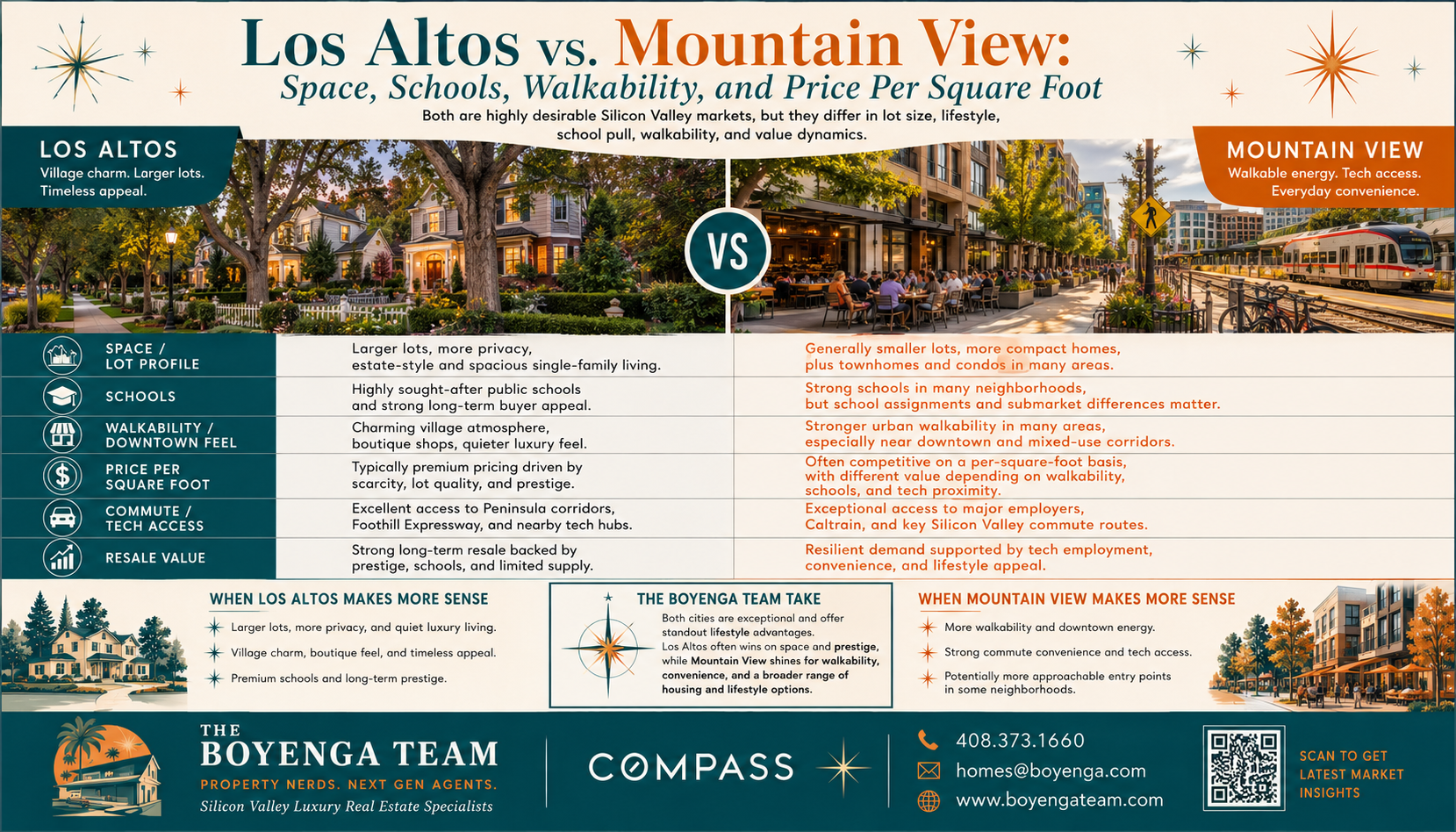
A Property Nerd’s Strategic Guide to Two of Silicon Valley’s Most Important Family Neighborhood Markets
For Silicon Valley buyers, the choice between Los Altos and Mountain View is rarely just about price. It is about what kind of life a buyer is trying to build, what tradeoffs they are willing to make, and how they define long-term value. On a map, these two cities sit side by side. In the real estate market, they behave like two very different investment categories.
Los Altos is the market of space, quiet streets, larger lots, village charm, and premium school-driven demand. Mountain View is the market of walkability, technology access, urban energy, transit, downtown lifestyle, and relative value compared with its luxury neighbors. One offers more privacy and residential calm. The other offers more connectivity and daily convenience. One feels like a classic Silicon Valley family enclave. The other feels like a tech-forward city where lifestyle, employment, and mobility intersect.
From a Property Nerd perspective, this is not a simple “which city is better?” comparison. Los Altos and Mountain View solve different problems for different buyers. Los Altos is often the choice for families prioritizing land, schools, quiet streets, and long-term prestige. Mountain View is often the choice for buyers who want proximity to Google, Intuit, LinkedIn, Caltrain, Castro Street, downtown restaurants, bike routes, and a more flexible price point. The smartest buyers do not just compare homes. They compare the operating system of each city.
The market data makes the contrast clear. Zillow reported the average Los Altos home value at approximately $4.65 million as of May 31, 2026, up 4.4% year over year, with homes going pending in around 10 days. Mountain View’s average home value was approximately $2.02 million as of the same date, up 0.3% year over year, with homes going pending in around 11 days. That means Los Altos is not merely “a little more expensive.” It is often a meaningfully higher capital allocation, and buyers should understand what they are getting in exchange for that premium.
Redfin’s city-level data tells a similar story through price per square foot. Over the three months ending May 2026, Redfin showed Los Altos with a median sale price of about $4.2 million and a median sale price per square foot of approximately $1,940. Mountain View showed a median sale price of about $1.9 million and a median sale price per square foot of approximately $1,050 during the same period. That price-per-square-foot gap is the heartbeat of this comparison. Los Altos buyers usually pay more for land, schools, privacy, and prestige. Mountain View buyers often get more pricing flexibility while gaining walkability, employment access, and downtown energy.
The simplest way to frame the comparison is this: Los Altos is a premium residential asset. Mountain View is a high-function lifestyle asset. Los Altos tends to reward buyers who value larger lots, single-family neighborhoods, quiet surroundings, and school confidence. Mountain View tends to reward buyers who value commute efficiency, downtown access, bikeability, transit, restaurants, tech campuses, and a lower entry point into the Silicon Valley single-family market.
Los Altos has a distinctly residential DNA. It feels polished, established, and intentionally calm. Downtown Los Altos gives the city its village identity, but the residential neighborhoods are the real engine of value. Buyers are drawn to tree-lined streets, traditional ranch homes, remodeled family homes, custom new construction, larger parcels, and the feeling of being near Silicon Valley without feeling swallowed by it. The Los Altos Village Association describes its mission as stewarding a vibrant downtown through civic engagement, local partnerships, beautification, events, and support for local businesses, which reinforces the city’s “village plus luxury neighborhood” identity.
Mountain View has a different rhythm. It feels more connected to the innovation economy on a daily basis. The city has major employers, downtown restaurants, Caltrain access, bike routes, apartment and townhome options, Eichler and mid-century pockets, and neighborhoods that range from walkable urban-adjacent areas to quiet single-family enclaves. Google has called Mountain View home for more than two decades, Intuit lists Mountain View as its headquarters location, and LinkedIn describes a campus spanning the Sunnyvale and Mountain View border. Those employment anchors shape buyer demand, rental demand, commute logic, and the broader lifestyle story.
For family buyers, schools often become the first major decision filter. Los Altos has a powerful school-driven reputation, but it is important to be precise because not every Los Altos address follows the same school path. The City of Los Altos lists Los Altos School District, Cupertino Union School District, and Santa Clara County Office of Education for kindergarten through eighth grade, with Mountain View Los Altos High School District and Fremont Union High School District serving grades nine through twelve depending on the property. This is a classic Property Nerd moment: buyers should not rely on city name alone. They need to verify the exact school assignment for the exact address.
Mountain View also has strong school appeal, but it is more varied by neighborhood and district path. Mountain View Whisman School District serves many elementary and middle school students in the city, while Mountain View Los Altos High School District includes Mountain View High and Los Altos High. MVLA states that both Los Altos High and Mountain View High rank in the top 2% nationally according to U.S. News & World Report, which helps explain why school-driven demand remains strong across both cities.
The school premium works differently in each city. In Los Altos, school demand is often embedded into the luxury premium. Buyers expect strong schools, and many are willing to pay substantially more for the combination of schools, land, and neighborhood feel. In Mountain View, school assignments can create sharper micro-market differences because the city has a wider variety of housing types, price bands, and neighborhood identities. A Mountain View home near a favored school path, walkable downtown pocket, or tech commute corridor can command a very different buyer response than another home only a short drive away.
Space is where Los Altos often wins. Buyers comparing Los Altos and Mountain View frequently notice that Los Altos homes tend to feel more private, more suburban, and more estate-like. Lots are often larger, streets may feel quieter, and outdoor living potential can be more compelling. For families who want a pool, an ADU, a guest suite, a large yard, outdoor entertaining, mature landscaping, or future expansion potential, Los Altos can justify its premium in ways that do not show up in a simple bedroom-and-bathroom comparison.
Mountain View, however, often wins on efficiency. A buyer may accept a smaller lot or a more compact home because the location does more work. Being close to downtown Mountain View, Caltrain, Google, Intuit, LinkedIn, Shoreline, Stevens Creek Trail, or Castro Street can change the way a household functions every day. The value is not always in the backyard. Sometimes the value is in leaving the car parked, biking to work, walking to dinner, reaching Caltrain quickly, or reducing commute friction.
Walkability is one of Mountain View’s greatest competitive advantages. The City of Mountain View adopted an ordinance in 2022 establishing pedestrian malls on portions of Castro Street, strengthening downtown Mountain View’s role as one of the most walkable and restaurant-rich urban centers in Silicon Valley. The Mountain View Transit Center also serves as a major multimodal node with Caltrain, VTA light rail, buses, private shuttles, and more than 12,000 typical weekday boardings and alightings, according to the city.
Los Altos is walkable in a different way. Downtown Los Altos is charming, boutique, and community-oriented, but most Los Altos living is still more car-oriented and residential than Mountain View. A buyer near the village may enjoy a delightful walk-to-town lifestyle, but many Los Altos neighborhoods are primarily designed around quiet residential living rather than transit-centered urban access. This is not a weakness. It is part of the value proposition. Los Altos buyers often want the village when they want it, but quiet when they come home.
Parks and outdoor access also tell two different stories. Los Altos emphasizes neighborhood parks and open spaces that reinforce its family-oriented residential identity. The city describes its parks as places to relax, play, connect with nature, and serve residents of all ages, with parks such as Grant Park, Shoup Park, and Heritage Oaks Park contributing to the community fabric.
Mountain View has a more urban recreation framework, with the city responsible for 45 urban parks and 9.95 miles of bicycle and pedestrian trails along Stevens Creek, Permanente Creek, and the Hetch-Hetchy right-of-way. That gives Mountain View a strong lifestyle case for buyers who want biking, trail connectivity, and daily outdoor access woven into a more urban-suburban environment.
Price per square foot is where the analysis becomes especially interesting. Many buyers look at Los Altos and wonder why they are paying so much more per square foot than Mountain View. The answer is that they are not only paying for the structure. They are paying for land scarcity, school demand, neighborhood quiet, prestige, lot utility, and long-term resale confidence. In Los Altos, the house is often only part of the asset. The lot, street, school path, privacy, and neighborhood character may carry equal or greater value.
Mountain View’s price per square foot can look like a better deal on paper, but buyers need to understand the mix. Mountain View includes condos, townhomes, smaller single-family homes, Eichlers, older ranch homes, renovated homes, and new construction. A citywide price-per-square-foot number can be useful directionally, but it does not replace micro-market analysis. Old Mountain View, Waverly Park, Cuesta Park, Monta Loma, Shoreline West, Rex Manor, Blossom Valley, St. Francis Acres, and North Whisman can behave very differently.
Los Altos also requires micro-market interpretation. North Los Altos, Old Los Altos, Country Club, South Los Altos, Loyola Corners, Highlands, Rancho, Grant Park-adjacent pockets, and the Los Altos-Mountain View border areas each attract different buyers. Some buyers want walkability to downtown. Others want a larger lot. Others want a specific school path. Others want access to Highway 280, Foothill Expressway, El Camino Real, or major tech campuses. Citywide averages are helpful for context, but the real money is made or lost at the neighborhood and street level.
For buyers optimizing around family life, Los Altos often feels like the classic premium choice. It gives many households the quiet-street lifestyle they imagined when moving to Silicon Valley: good schools, strong community identity, larger yards, parks, a charming downtown, and a strong sense of permanence. It is especially compelling for buyers who are less sensitive to commute differences and more focused on home environment.
For buyers optimizing around daily convenience, Mountain View can be extremely compelling. The city offers a more diverse housing stock, often a lower price point than Los Altos, excellent access to major employers, a stronger transit story, a highly active downtown, and a younger, more tech-connected lifestyle energy. Mountain View can be especially attractive for buyers who want Silicon Valley access but do not want to stretch into Los Altos pricing.
Resale value is strong in both cities, but the resale thesis differs. In Los Altos, future buyers will likely continue to pay premiums for schools, lot size, privacy, neighborhood quality, and prestige. In Mountain View, future buyers will likely continue to pay premiums for employer proximity, walkability, transit, bikeability, school access, and relative value compared with Palo Alto, Los Altos, and Menlo Park. Both markets benefit from scarcity, high incomes, and proximity to the technology economy. They simply express those advantages differently.
The risk profile also differs. In Los Altos, the mistake is often overpaying for a property that has the city name but not the premium fundamentals. A compromised location, awkward lot, weak floor plan, noisy street, unclear school assignment, or expensive renovation path can reduce the value of the Los Altos premium. Buyers should be careful not to assume that every Los Altos home has the same resale strength.
In Mountain View, the mistake is often underestimating micro-location. A home near downtown, transit, trails, or a strong school path may deserve a very different valuation than a home that is less connected or more impacted by traffic, train noise, office adjacency, or future development. Mountain View has more variety, which creates opportunity, but it also requires sharper analysis.
Architecture matters in both cities. Los Altos often rewards homes with timeless family functionality: open kitchens, strong indoor-outdoor flow, generous bedroom layouts, work-from-home spaces, remodeled systems, and yards that feel usable. Mountain View rewards functional design too, but the buyer pool may be especially responsive to efficient floor plans, Eichler and mid-century design, detached offices, ADUs, EV infrastructure, and homes that support hybrid work near major employers.
Smart-home and future-proofing features are increasingly important in both markets. Buyers in Los Altos and Mountain View often look for EV charging, solar, battery backup, heat pump HVAC, induction cooking, smart thermostats, lighting control, strong Wi-Fi, leak detection, security systems, smart irrigation, and flexible home-office infrastructure. The difference is how those features are perceived. In Los Altos, they support comfort, resilience, and estate management. In Mountain View, they support convenience, efficiency, and tech-forward living.
The ADU conversation also varies by city and property type. In Los Altos, larger lots may create more natural ADU opportunities, depending on zoning, setbacks, utilities, trees, and site constraints. In Mountain View, ADUs can be valuable but may require more careful site planning because lots are often smaller or more constrained. From a resale perspective, ADU potential is increasingly relevant because buyers want flexibility for guests, work, aging parents, rental income, or multigenerational living.
For sellers, the positioning strategy must match the buyer psychology. A Los Altos seller should usually emphasize space, schools, lot quality, privacy, lifestyle, outdoor living, and long-term prestige. The marketing should make the home feel like a sanctuary within reach of Silicon Valley. A Mountain View seller should usually emphasize commute, walkability, technology access, downtown proximity, flexibility, and value relative to surrounding luxury markets. The marketing should make the home feel useful, connected, and future-ready.
For buyers, the question should not be “Which city is cheaper?” The better question is “Which city gives me the best total return on lifestyle?” A family that deeply values privacy, yard space, and a specific school path may find Los Altos worth every dollar of the premium. A buyer who values walkability, tech proximity, and lower acquisition cost may find Mountain View the smarter move. The right answer depends on priorities, not ego.
Compass gives the Boyenga Team an additional advantage in this type of analysis because the platform is built for data, private inventory, digital marketing, buyer behavior, pricing strategy, and faster decision-making. In markets like Los Altos and Mountain View, where small differences in neighborhood, school path, lot utility, and presentation can translate into large differences in value, technology matters. But technology only works when paired with expert interpretation.
As Silicon Valley Property Nerds and Next Gen Agents, Eric and Janelle Boyenga approach these decisions through a strategic lens. The goal is not simply to identify a nice house. The goal is to understand the asset, the micro-market, the future buyer pool, the school story, the commute logic, the architectural potential, the remodel risk, and the resale narrative. That is what buyers and sellers need in a market where the difference between good and great can be measured in hundreds of thousands of dollars.
The final takeaway is simple. Los Altos is often the better fit for buyers who prioritize space, schools, privacy, larger lots, quiet streets, and a classic family neighborhood experience. Mountain View is often the better fit for buyers who prioritize walkability, tech proximity, price flexibility, downtown energy, transit access, and a more connected Silicon Valley lifestyle.
Both cities are exceptional. Both are resilient. Both attract high-quality buyers. But they are not the same product. Los Altos is the premium residential retreat. Mountain View is the connected innovation city. The smart move is to understand which one best fits your lifestyle, your budget, your commute, your school goals, and your long-term resale strategy.
The Boyenga Team at Compass represents buyers and sellers throughout Silicon Valley with a focus on luxury homes, Eichler and mid-century modern properties, school-driven moves, estate homes, trust sales, and high-value residential strategy. Known as Property Nerds and Next Gen Agents, Eric and Janelle Boyenga combine data, design, technology, negotiation, and local market intelligence to help clients make smarter real estate decisions in Los Altos, Mountain View, Palo Alto, Sunnyvale, Cupertino, Menlo Park, Saratoga, Los Gatos, and the greater Silicon Valley market. For expert guidance, contact the Boyenga Team at Compass at homes@boyenga.com or visit www.BoyengaTeam.com.