

Blog > Industry Beef Alert: The Zillow vs. Compass Data War
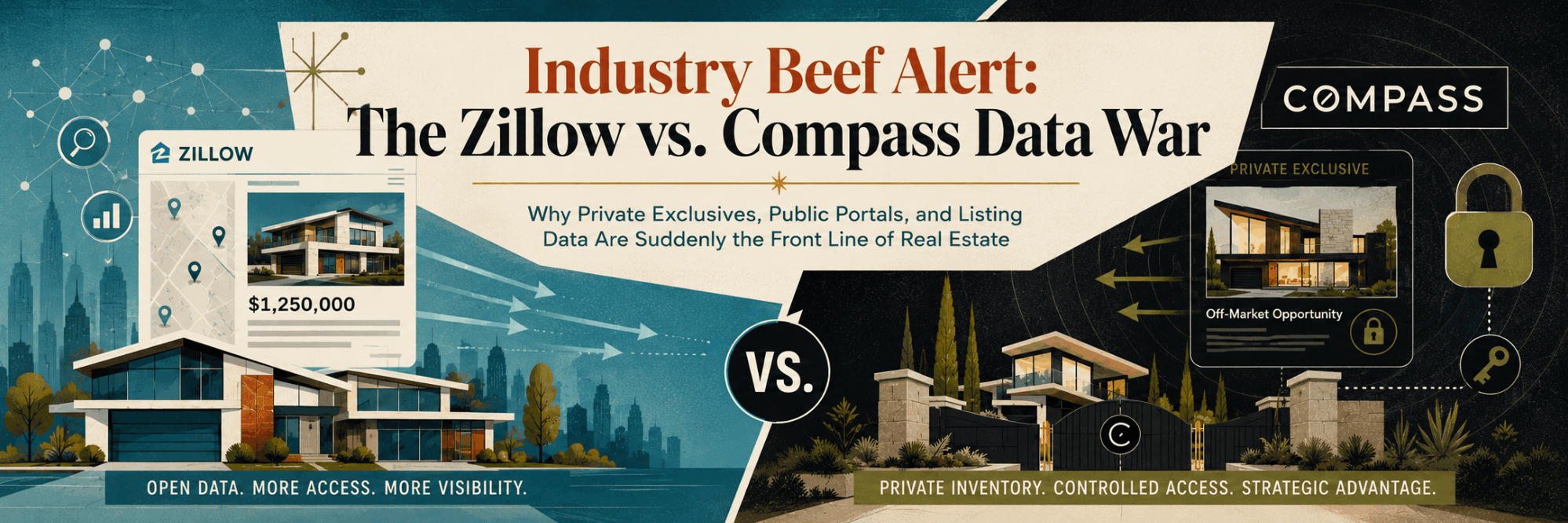 Why Private Exclusives, Public Portals, and Listing Data Are Suddenly the Front Line of Real Estate
What’s up, Property Nerds and next-gen agents?
Pull up a chair, because one of the biggest real estate battles happening right now is not just about commissions, portals, or corporate egos.
It is about control.
Control of listings.
Control of data.
Control of buyer attention.
Control of seller strategy.
Control of who gets to see inventory first.
The ongoing fight between Zillow and Compass is more than an industry headline. It is a full-blown data war that could reshape how homes are marketed, how buyers search, how agents create value, and how brokerages compete in a post-NAR-settlement world.
At the center of the debate is a deceptively simple question:
Should real estate inventory be fully public and searchable as quickly as possible, or should sellers and agents have the right to test, curate, and privately expose homes before they hit the open market?
That question is now driving lawsuits, MLS policy debates, brokerage strategy, consumer confusion, and a whole lot of agent group-chat drama.
So let’s break it down.
🔮 The Big Battle: Open Marketplace vs. Private Ecosystem
At the highest level, Zillow and Compass are fighting over two very different visions for the future of residential real estate.
Zillow’s Vision: Maximum Exposure, Maximum Transparency
Zillow represents the public-portal model.
In this world, listings should flow quickly from the MLS to the major consumer platforms. Buyers should be able to see what is available, compare pricing, track days on market, review price reductions, study past sales, and make decisions with as much visible information as possible.
The Zillow-style argument is simple:
The more open the data, the more efficient the market.
For buyers, this creates a familiar, searchable, consumer-friendly experience.
For sellers, it creates mass exposure.
For the marketplace, it promotes transparency.
In theory, everyone sees the same inventory at roughly the same time.
But in practice? The public marketplace can also become a pressure cooker. Once a home hits the MLS and syndicates to Zillow, Redfin, Realtor.com, and every major portal, the clock starts ticking. Days on market become visible. Price reductions become part of the property’s digital history. Buyer feedback becomes public through market behavior. And if the home does not sell quickly, the listing can start to feel stale — even if the property itself is fantastic.
That is where Compass sees an opportunity.
Compass’s Vision: Curated Exposure, Private Exclusivity, and Agent-Controlled Strategy
Compass has leaned heavily into a different model: the Private Exclusive.
Instead of immediately launching a listing into the public MLS ecosystem, Compass agents can privately market certain properties within the Compass network before going fully public.
The Compass-style argument is also simple:
Not every seller wants maximum exposure on day one. Some sellers want strategy, privacy, testing, and control.
A private launch may allow a seller to quietly test pricing, build demand, create early conversations, protect privacy, or avoid accumulating public days on market before the home is fully ready.
For luxury sellers, trust sellers, high-profile families, estate situations, or homeowners who are not fully committed to a public launch yet, that can be extremely appealing.
But here is where the controversy starts.
When inventory is kept inside a brokerage ecosystem, buyers outside that ecosystem may never see it. Agents outside that brokerage may not know it exists. Public market data may become incomplete. And the buyer pool may be smaller than it would have been on the open MLS.
That is the core tension:
Zillow wants the market to be open. Compass wants more control over how inventory is introduced.
And both sides claim they are protecting consumers.
🧠 The Property Nerd Take: This Is Really About Data Power
Real estate has always been about location, timing, and relationships.
But now it is also about data access.
Who sees the listing first?
Who controls the listing history?
Who tracks buyer demand?
Who owns the consumer search experience?
Who knows about inventory before the public does?
Who gets to monetize that attention?
That is why this fight matters.
Zillow’s power comes from consumer eyeballs and public search behavior. Compass’s power comes from agent networks, internal inventory, and seller relationships.
One side controls the digital front door.
The other side is trying to control the inventory before it reaches the front door.
That is not just a technology fight.
That is a real estate power shift.
📉 Impact 1: The Rise of the Two-Tiered Market
For next-gen agents, the most important takeaway is this:
The market is no longer one clean, fully visible marketplace.
We are moving toward a two-tiered inventory environment.
Tier One: The Public Market
This is the traditional MLS-to-portal pipeline.
A home goes live on the MLS, then appears on Zillow, Redfin, Realtor.com, brokerage websites, IDX feeds, agent alerts, buyer portals, and automated searches.
This tier is transparent, searchable, and familiar.
Buyers can see:
- Asking price
- Days on market
- Price reductions
- Photos
- Open house schedules
- Comparable sales
- Listing history
- Public competition
The public market is powerful because it creates broad exposure. But it also creates massive competition. Buyers all see the same property at the same time. The best homes get crowded fast. Multiple offers can happen quickly. And agents who rely only on public feeds are often reacting, not leading.
Tier Two: The Private Market
This is where Private Exclusives, office exclusives, agent-to-agent sharing, brokerage networks, and off-market conversations live.
This tier is quieter, less visible, and more relationship-driven.
Buyers may get early access to homes that are not yet on Zillow. Sellers may quietly test demand. Agents may float a property before a full launch. A listing may trade before it ever hits the open market.
For well-connected agents, this can be a major advantage.
For everyone else, it creates a blind spot.
👀 The Buyer Blind Spot
Here is where the Property Nerd alarm bells start ringing.
If a buyer is only watching Zillow, they may think they are seeing the whole market.
They are not.
They are seeing the portion of the market that has been publicly exposed.
That difference matters.
A buyer may be missing:
- Private Exclusives
- Coming Soon opportunities
- Quiet luxury listings
- Estate sales not yet launched
- Seller-tested inventory
- Agent-network listings
- Homes being shopped before MLS exposure
This is why the role of the buyer’s agent is evolving fast.
A next-gen buyer’s agent cannot just set up a portal search and wait for alerts. That is 2015 energy.
Today’s buyer’s agent has to be a market hunter.
They need to know what is public, what is private, what is coming, what failed quietly, what may relaunch, which agents have sellers circling the runway, and which homes may be available for the right terms before the market ever sees them.
The agent’s value is no longer just access to listings.
It is access to context.
🧾 The Pricing Problem: What Happens When History Gets Hidden?
There is another major issue: pricing intelligence.
Public listings create a visible trail.
Buyers can often see when a home was listed, when the price changed, how long it sat, whether it was withdrawn, and how the market responded.
That history gives buyers leverage.
If a home has been sitting for 45 days, buyers know it.
If the price was reduced twice, buyers know it.
If the seller tested too high, buyers know it.
If the market rejected the price, buyers know it.
But with private inventory, some of that history may not be visible in the same way.
A seller can test a price privately, gather feedback, adjust expectations, and then go public with a cleaner presentation.
From the seller side, that can be smart strategy.
From the buyer side, it can reduce transparency.
This is the core nerdy tension:
Private marketing may protect sellers from public market scars, but it may also remove valuable pricing signals from buyers.
That is why this debate is so emotionally charged. Both sides can make a consumer-protection argument.
Sellers want control.
Buyers want transparency.
Agents want access.
Portals want data.
Brokerages want leverage.
Welcome to the new real estate chessboard.
💰 Impact 2: Commission Strategy and In-House Deal Flow
Now let’s talk about the money.
One of the biggest criticisms of private listing networks is that they may increase the odds of in-house deals, where the listing brokerage also represents the buyer side.
For a brokerage, that can be a very big deal.
If a home is exposed first inside one brokerage ecosystem, the first serious buyer may also come from inside that same ecosystem. That means the brokerage has a better chance of keeping more of the transaction economics within its own walls.
This is where critics argue that private inventory can create incentives that are not always perfectly aligned with maximum seller exposure.
Because here is the uncomfortable question:
Is the private strategy being used because it is truly best for the seller, or because it is best for the brokerage?
That distinction matters.
A private launch can be a legitimate, thoughtful, high-level strategy for certain sellers. But it needs to be presented honestly.
Not every home should start private.
Not every seller benefits from limited exposure.
Not every property gains from being quietly tested.
And not every buyer pool is deep enough inside one brokerage network.
The best agents are not blindly pro-private or blindly pro-public.
They are strategy-first.
🏡 What This Means for Sellers
For sellers, the Zillow vs. Compass debate comes down to one key question:
Do you want maximum exposure immediately, or do you want controlled exposure first?
There is no one-size-fits-all answer.
The Public Launch Advantage
A full MLS launch gives the seller the widest possible audience. This is especially powerful when the home is properly prepared, beautifully staged, priced correctly, photographed well, and launched with strong marketing momentum.
The public route can create:
- More buyer eyeballs
- More showing activity
- More open house traffic
- More agent awareness
- More competitive pressure
- More potential for multiple offers
- A cleaner proof of market demand
For many homes, especially in competitive Silicon Valley neighborhoods, this is still the strongest path to the highest net result.
When demand is broad, exposure is your friend.
The Public Launch Risk
The risk is that the home goes public before the strategy is fully dialed in.
If the price is too high, the presentation is weak, the photography misses, the timing is off, or the seller is not ready for showings, the listing can accumulate days on market and lose momentum.
Once that happens, buyers start asking questions.
Why has it not sold?
What is wrong with it?
Is the seller overpriced?
Can we come in lower?
That is why public launch discipline matters.
Going public is not just flipping a switch.
It is a coordinated market moment.
The Private Exclusive Advantage
A private launch can give sellers a softer runway.
It may help them:
- Test pricing quietly
- Gauge buyer interest
- Protect privacy
- Avoid public days on market
- Create early demand
- Get feedback before the full launch
- Market discreetly during prep
- Reach serious buyers without full public exposure
This can be especially useful for luxury homes, unique architecture, celebrity/high-profile sellers, trust or estate situations, tenant-occupied homes, or properties where the seller wants to explore the market without fully committing.
The Private Exclusive Risk
The risk is limited exposure.
If fewer buyers see the home, fewer buyers can compete for it.
And fewer competing buyers may mean a lower final price.
That is the seller-side concern regulators, portals, and some agents keep raising:
Can a seller truly know they achieved the highest market value if the full market never saw the home?
That does not mean private listings are bad.
It means sellers need informed consent.
They should understand the tradeoff between privacy and exposure, between control and competition, between quiet testing and full-market demand.
🔎 What This Means for Buyers
For buyers, this new environment is both exciting and frustrating.
The public portals are still useful, but they are no longer enough.
A buyer relying only on Zillow is like a stock trader looking at delayed data.
They may still get useful information, but they are not seeing the whole board in real time.
The Public Search Advantage
Public portals give buyers powerful tools:
- Broad search visibility
- Saved searches
- Price history
- Listing alerts
- Comparable sales
- Neighborhood research
- Market pattern recognition
For data-oriented buyers, this is incredibly valuable.
The Public Search Limitation
But public portals cannot show everything that is not public.
That means buyers may miss early opportunities.
They may also enter the best listings only after everyone else has seen them too.
That is why a strong buyer strategy now requires more than automated alerts.
It requires agent intelligence.
A great buyer’s agent should be asking:
- What is coming soon?
- What is being whispered about?
- What has not launched yet?
- Which agents are prepping homes nearby?
- Which sellers may entertain pre-market interest?
- Which listings failed privately and may return publicly?
- Which homes are being held back for timing?
This is where next-gen agents separate themselves.
They do not just open doors.
They open information channels.
⚖️ The Client Conversation: How Agents Should Explain the Tradeoffs
The smartest agents will not turn this into a tribal debate.
This is not “Zillow good, Compass bad” or “Compass smart, Zillow outdated.”
That is too simple.
The better client conversation is about strategy.
For Sellers
You can explain it like this:
A public launch gives you the broadest exposure and the best chance to create open-market competition. That can be the strongest path when the home is ready, the price is right, and the market depth is strong.
A private launch gives you more control and privacy. It can help test demand and avoid public days on market, but it may also limit the buyer pool.
The right answer depends on your goals, timeline, property type, privacy needs, and pricing strategy.
For Buyers
You can explain it like this:
Public websites are helpful, but they do not always show every opportunity. Some homes are marketed privately, quietly, or within agent networks before they reach the public market.
That means our job is not just to watch the MLS. Our job is to actively search the market, network with agents, track upcoming inventory, and uncover opportunities before they become obvious.
🧭 The Next-Gen Agent Playbook
This is where the industry is heading.
The agents who win in this environment will not be the ones who simply know how to upload a listing or send a buyer portal.
They will be the ones who can combine:
- Public data
- Private network intelligence
- MLS knowledge
- Brokerage relationships
- Pricing strategy
- Seller psychology
- Buyer demand tracking
- Neighborhood-level expertise
- Launch timing
- Negotiation leverage
The future belongs to the agent who can see both markets: the visible market and the invisible one.
That is the real alpha.
🧠 The Property Nerd Framework
Here is the cleanest way to think about it:
Public Market = Visibility
Public listings maximize exposure, create transparent pricing signals, and allow the broadest buyer pool to compete.
Private Market = Control
Private listings allow sellers to test, refine, protect privacy, and create early demand before the listing becomes part of the public record.
Great Strategy = Knowing When to Use Each
The mistake is treating either path as automatically superior.
A well-prepared, well-priced home in a strong market may benefit from a full public launch.
A unique, high-end, sensitive, tenant-occupied, or not-quite-ready property may benefit from private exposure first.
The best agents know how to sequence the strategy.
Private Exclusive.
Coming Soon.
Broker network.
Public MLS.
Open house.
Offer deadline.
Negotiation.
The magic is not in choosing one lane.
The magic is in controlling the rollout.
🏆 The Bottom Line
The Zillow vs. Compass battle is not just corporate drama.
It is a preview of where real estate is going.
Inventory is becoming more fragmented.
Data is becoming more valuable.
Private networks are becoming more powerful.
Public portals are fighting to protect transparency.
Agents are being forced to prove their value beyond search alerts.
For consumers, the stakes are real.
Sellers need to understand whether they are optimizing for exposure, privacy, control, or price discovery.
Buyers need to understand that the home they want may not be visible on a public portal yet.
And agents need to understand that the future of real estate belongs to those who can operate in both worlds.
Because in this new market, the best opportunities may not be the ones everyone can see.
They may be the ones only the best-connected, most strategic, most data-obsessed agents know how to find.
That is the new edge.
That is the new game.
And yes, Property Nerds — the data war is just getting started.
💬 What’s Your Take?
Are Private Exclusives a smart seller strategy, or do they create too much hidden inventory?
Should the industry protect open-market transparency at all costs, or should sellers have more control over how and when their homes are exposed?
Drop your thoughts below. This one is going to shape the next chapter of real estate.