

Blog > How to Sell a Trust Property in Silicon Valley
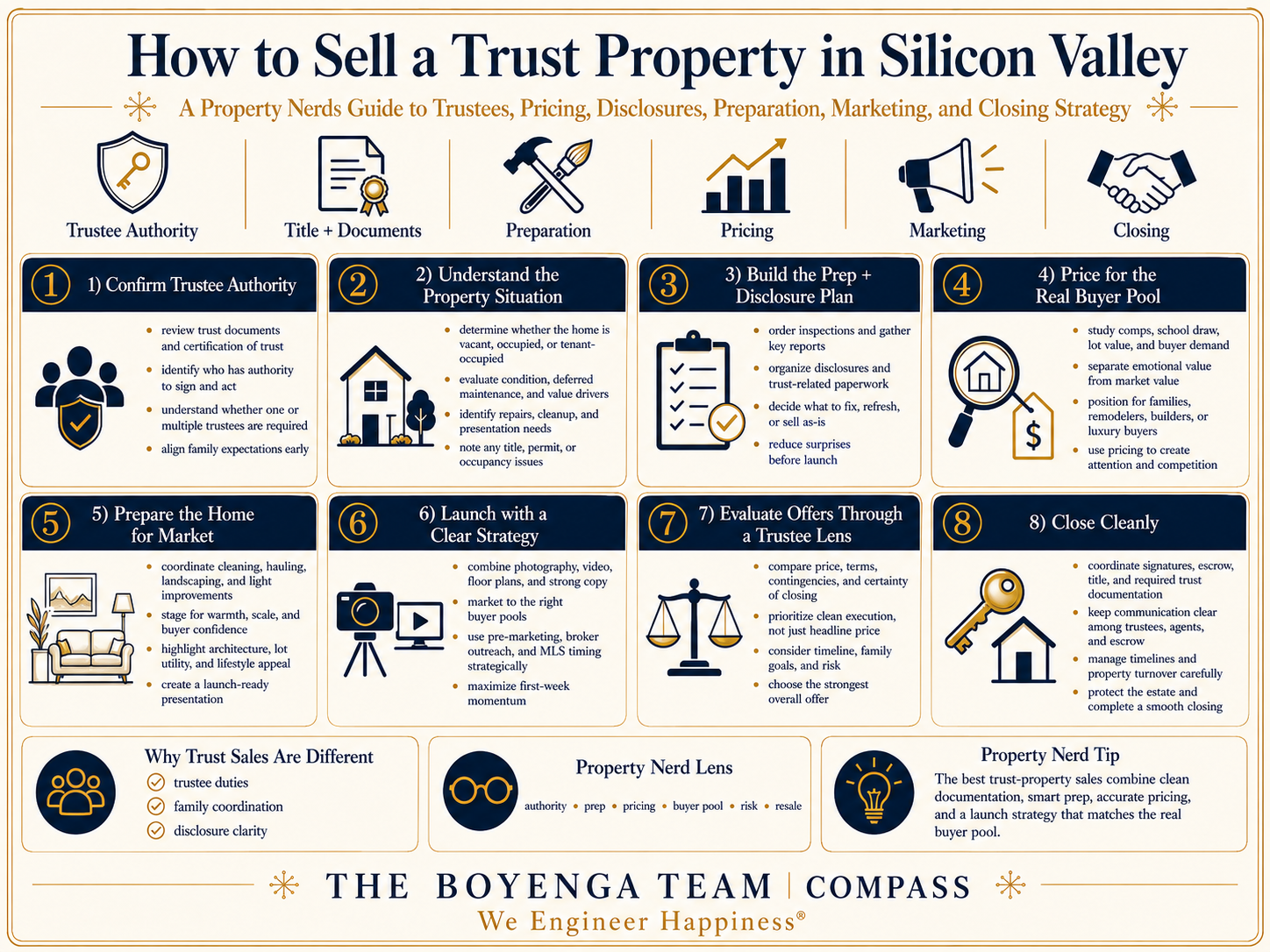
Selling a trust property in Silicon Valley is not just a real estate transaction.
It is usually a real estate transaction, family transition, legal process, property preparation project, disclosure exercise, pricing decision, and emotional event all happening at the same time.
A trust sale may involve siblings, beneficiaries, trustees, successor trustees, attorneys, accountants, tenants, long-time neighbors, deferred maintenance, old records, personal belongings, estate cleanout, repairs, inspections, and questions about whether to sell as-is or prepare the home for market.
And because many Silicon Valley trust properties are long-held homes in high-value neighborhoods, the financial stakes can be significant.
A dated ranch in Palo Alto may be a remodel opportunity, a family home, or a rebuild candidate.
An original Eichler in Mountain View or Sunnyvale may have architectural value.
A Los Altos or Saratoga home may need targeted preparation to attract family buyers.
A Los Altos Hills, Portola Valley, or Monte Sereno estate may be more about land, privacy, systems, and long-term potential.
A Campbell, Willow Glen, Santa Clara, or West San Jose property may appeal to multiple buyer pools depending on condition, school path, commute, and lot utility.
That is why selling a trust property requires more than simply putting a sign in the yard.
It requires a strategy.
The Boyenga Team’s Property Nerds approach helps trustees, heirs, and families understand the property, the buyer pool, the preparation options, the disclosure risks, the pricing strategy, and the launch plan before going to market.
The smartest question is not, “How fast can we sell it?”
The better question is:
How do we sell the property clearly, correctly, and strategically so the trust can make a confident decision?
Start With Authority: Who Can Sign?
Before the real estate strategy begins, the first question is authority.
Who is the trustee?
Is there one trustee or more than one?
Are there successor trustees?
Can one trustee sign, or do multiple trustees need to sign?
Is there a certificate of trust?
Is the trust name correct?
Is the property vested in the trust?
Are there any court requirements?
Is there an attorney involved?
Are beneficiaries aligned?
This step matters because the listing agreement, disclosures, purchase contract, escrow instructions, deed, and related documents need to be executed by the correct party or parties.
In many cases, a real estate agent can help coordinate with escrow, title, and the trustee’s attorney, but legal questions should be confirmed with qualified counsel.
The Property Nerds read: Before pricing, staging, or marketing, confirm who has the legal authority to act.
Understand the Trust’s Goals
Not every trust sale has the same goal.
Some trustees want the highest possible price and are willing to prepare the home carefully.
Some want a clean, low-risk sale with minimal work.
Some need to sell quickly to distribute assets.
Some want to avoid family conflict.
Some want to explore pre-market interest before going public.
Some need to coordinate with tenants.
Some want to understand whether repairs will actually pay off.
A good trust-sale strategy begins with clarity.
What does the trust need most: speed, simplicity, certainty, maximum price, minimal liability, or a balance of all of those?
There is no one-size-fits-all answer.
The Property Nerds read: The best trust-sale plan matches the legal, financial, emotional, and property realities of the situation.
Identify the Real Buyer Pool
A trust property may have several possible buyer pools.
A move-in family buyer.
A remodel buyer.
A builder.
An investor.
An Eichler or mid-century buyer.
A luxury estate buyer.
A school-focused buyer.
A tech commuter.
A downsizer.
A neighbor.
The right strategy depends on who is most likely to pay the highest price with the cleanest path to closing.
A long-held ranch home on a strong street may attract families and remodelers. A small older home on a valuable lot may attract builders. An original Eichler may attract architecture buyers. A home with deferred maintenance may appeal to buyers who want upside. A luxury estate may appeal to buyers who value land, privacy, and future customization.
The Boyenga Team evaluates trust properties through buyer-pool analysis before recommending preparation.
The Property Nerds read: Trust properties often have hidden demand, but the listing has to speak to the right buyers.
Decide Whether to Sell As-Is, Refresh, or Transform
One of the biggest trust-sale decisions is whether to improve the property before selling.
Many trust homes are dated, original, or partially maintained. The instinct may be to “fix everything” before going to market. But that is not always the best financial decision.
The options usually fall into several categories.
Sell As-Is With Strategic Positioning
This can make sense when the likely buyer will remodel, rebuild, or customize anyway.
Selling as-is does not mean presenting the home poorly. It means being clear about condition while still preparing the property enough for buyers to understand the opportunity.
This may include cleaning, decluttering, inspections, yard cleanup, floor plans, lot research, and strong photography.
Light Refresh
A light refresh can be powerful when the home has good bones but feels tired.
This may include paint, cleaning, lighting, landscaping, minor repairs, window cleaning, flooring touch-ups, and staging.
Targeted Updates
Sometimes a few focused improvements can remove buyer friction.
This might include replacing worn carpet, updating light fixtures, repairing safety items, addressing obvious pest or roof issues, or refreshing landscaping.
Full Pre-Sale Transformation
Some trust properties benefit from a more complete preparation plan, especially when the home can move into a stronger buyer category.
This may include paint, flooring, lighting, landscaping, repairs, staging, cleaning, inspections, and marketing repositioning.
Leave the Major Remodel to the Buyer
A full kitchen, bath, addition, or rebuild is often better left to the buyer unless the math is very clear.
The Property Nerds read: The goal is not to make the trust property perfect. The goal is to make the opportunity clear and marketable.
The Remodeling Penalty Applies to Trust Sales
Trustees should be especially careful about overspending on renovations.
A trustee has a duty to act responsibly, and beneficiaries may question large pre-sale expenses if they do not clearly increase the net return.
The remodeling penalty happens when the trust spends money on improvements buyers do not fully pay back.
This can happen when:
The buyer plans to remodel anyway.
The work is too taste-specific.
The property is really a rebuild candidate.
The neighborhood does not support the finished value.
The improvements are partial and leave the home feeling unfinished.
The project delays the sale.
The remodel erases architectural value.
The cost exceeds the likely premium.
For many trust properties, the better strategy is focused preparation, transparent disclosures, and strong positioning rather than a major remodel.
The Property Nerds read: In a trust sale, spending less can sometimes net more.
Get Inspections Early
Inspections are especially important in trust sales because trustees may not have lived in the property or may not know the full condition history.
A pre-sale inspection package can help identify issues before buyers do. Depending on the property, this may include:
Home inspection.
Pest inspection.
Roof inspection.
Sewer inspection.
Chimney inspection.
Pool inspection.
Foundation or structural review.
Drainage review.
HVAC evaluation.
Electrical evaluation.
Specialty inspections for Eichlers, hillside homes, or older estates.
The goal is not necessarily to fix everything. The goal is to understand the property and reduce uncertainty.
Buyers can accept issues they understand. They hesitate over mystery.
The Property Nerds read: Inspections turn unknown risk into known information.
Organize Disclosures Carefully
Disclosure strategy is critical in a trust sale.
Trustees may have limited knowledge of the property, especially if they did not live there. That does not mean disclosures are unimportant. It means they need to be handled carefully and honestly.
Important disclosure materials may include:
Trustee disclosures.
Seller property questionnaires where applicable.
Known repairs or defects.
Inspection reports.
Permit history.
HOA documents if applicable.
Death-on-property considerations where applicable.
Tenant information if occupied.
Insurance claims if known.
Neighborhood issues if known.
Roof, sewer, pest, drainage, or foundation information.
Trustees should consult legal counsel regarding disclosure obligations, especially where knowledge is limited or family members have different information.
The Property Nerds read: Clear disclosures protect the sale and help buyers write stronger offers.
Confirm Title, Vesting, and Trust Name Early
Trust sales can be delayed when title details are not addressed early.
Before launch, it is smart to confirm:
How title is currently held.
The exact trust name.
Who the trustee or successor trustee is.
Whether title needs corrective documentation.
Whether any deceased trustee issues need documentation.
Whether there are liens, loans, or judgments.
Whether property taxes are current.
Whether there are solar leases, assessments, or special obligations.
Whether all necessary parties can sign.
Title and escrow should be involved early, especially if the trust documents are older or multiple trustees are involved.
The Property Nerds read: Trust sale momentum depends on paperwork being right before the buyer shows up.
Handle Personal Property and Cleanout Strategically
Trust properties often contain decades of belongings.
This can be emotional and time-consuming. Families may need to sort heirlooms, furniture, documents, photos, tools, cars, art, jewelry, records, and household items before the property can be prepared.
A good cleanout plan should answer:
What stays with the family?
What is donated?
What is sold?
What is hauled away?
What may have value?
What should remain for staging or visual context?
What should be removed before photography?
Who has authority to make decisions?
The cleanout should be coordinated before staging, photography, inspections, and showings whenever possible.
The Property Nerds read: A trust home does not need to feel empty, but it needs to feel understandable.
Decide How Much to Stage
Staging can be especially valuable for trust properties because many are vacant, dated, or filled with furniture that does not help buyers understand the home.
The right staging depends on the buyer pool.
A family home should show bedroom function, office potential, dining flow, and yard connection.
An Eichler should be staged with architectural sensitivity.
A luxury estate should feel elevated but not overdone.
A remodel candidate may need lighter staging that shows scale and possibility.
A builder lot may not need full staging, but may need strong photography, floor plans, and lot presentation.
Staging helps buyers see use. It also helps online photos perform better.
The Property Nerds read: Staging is not decoration. It is buyer education.
Price Based on the True Comp Set
Trust properties are often hard to price because they may not fit neatly into a standard comp set.
A dated home may not compare to a fully remodeled home.
A rebuild candidate may need land-value comps.
An Eichler needs architectural comps.
A tenant-occupied property may need an access and condition adjustment.
A luxury estate may require property-specific analysis.
A home in a school-sensitive boundary may need exact address-level comps.
The Boyenga Team evaluates trust properties by condition, lot, street, school path, architecture, buyer pool, remodel potential, and current competition — not just price per square foot.
The Property Nerds read: The wrong comp can create the wrong strategy.
Consider Pre-Market Exposure Carefully
Pre-market strategy can be useful for trust properties, but it should be handled intentionally.
A Private Exclusive or off-market campaign may help test demand, gather feedback, protect privacy, or reach targeted buyers before a public launch. This can be helpful for unique homes, trust properties, tenant-occupied homes, luxury estates, Eichlers, or properties needing strategic positioning.
But not every trust property should sell quietly. Sometimes full market exposure creates the strongest competition and best fiduciary defensibility.
The decision depends on the trust’s goals, the property type, timing, privacy needs, and buyer pool.
The Property Nerds read: Pre-market is a tool, not a shortcut.
Manage Family Communication
Trust sales can become difficult when family members have different expectations.
One person may want to sell quickly.
Another may want to remodel first.
Another may believe the home is worth more than the market supports.
Another may be emotionally attached.
Another may worry about costs.
Another may want transparency around offers and decisions.
A structured process helps.
It is useful to establish:
Who is the decision-maker?
Who receives updates?
How vendor expenses are approved?
How offers will be reviewed?
What the timeline is?
What the pricing strategy is?
What preparation is recommended and why?
What the net proceeds may look like?
The Property Nerds read: A good trust-sale process reduces conflict by making the strategy visible.
Tenant-Occupied Trust Properties
Some trust properties are tenant-occupied, which adds complexity.
The trustee may need to consider lease terms, rent, tenant rights, showing access, notice requirements, relocation issues, property condition, and buyer-pool impact.
Tenant-occupied properties can still sell well, but they require careful planning.
Some buyers will see the tenant as a complication. Others may see rental income as a benefit. Builders or investors may evaluate the property differently than owner-occupant buyers.
Trustees should seek legal guidance on landlord-tenant issues before making decisions about access, notices, vacancy, or sale timing.
The Property Nerds read: Tenant strategy can change the buyer pool and the price.
Trust Properties With Deferred Maintenance
Many trust homes have deferred maintenance because the prior owner lived there for many years or was unable to keep up with repairs.
Common issues may include:
Old roofs.
Termite or dry rot.
Aging sewer lines.
Outdated electrical panels.
Old plumbing.
Foundation cracks.
Drainage issues.
Dated heating systems.
Single-pane windows.
Old appliances.
Unpermitted work.
Overgrown landscaping.
Safety hazards.
Deferred maintenance does not mean the home cannot sell well. It means the sale strategy must be clear.
Should the trust fix key items?
Disclose and price accordingly?
Offer reports up front?
Sell to a remodel buyer?
Target builders?
Prepare lightly and let the market decide?
The Property Nerds read: Deferred maintenance is manageable when it is disclosed, priced, and positioned correctly.
Trust Properties With Architectural Value
Some trust homes are architecturally significant.
They may be Eichlers, mid-century modern homes, Mackay homes, Mardell homes, Craftsman bungalows, Spanish-style homes, or custom estates.
These properties should not be generically remodeled before sale without careful thought. The buyer pool may value original features, period character, and design integrity.
For example, an original Eichler may benefit more from cleaning, landscaping, staging, roof documentation, radiant heat clarity, and design-focused marketing than from a generic kitchen remodel.
The Property Nerds read: Architectural homes need preservation-aware strategy, not random updating.
Trust Properties by Silicon Valley Market
Palo Alto
Palo Alto trust properties often attract strong demand because of schools, Stanford access, prestige, lot value, and long-term scarcity. The right strategy depends on whether the home is a move-in opportunity, remodel candidate, Eichler, historic property, or rebuild site.
Los Altos
Los Altos trust properties often appeal to family buyers, remodelers, and builders. Quiet streets, usable lots, schools, and Village proximity can all influence demand.
Los Altos Hills
Los Altos Hills trust properties are often about land, privacy, views, estate potential, and property complexity. Septic, drainage, slope, access, fire, and maintenance issues may require careful analysis.
Mountain View
Mountain View trust properties may attract Google-area buyers, families, remodelers, Eichler buyers, or investors depending on location and condition.
Sunnyvale
Sunnyvale trust properties can have broad buyer demand because of Apple, Google, schools by address, parks, and relative value. Ranch homes, Eichlers, and original family homes all require different strategies.
Cupertino
Cupertino trust properties may be driven by school demand, Apple proximity, remodel potential, or rebuild value. Exact school assignment and lot utility matter heavily.
Santa Clara
Santa Clara trust properties often appeal to buyers focused on commute, value, parks, and housing variety. West-side pockets may require school-by-address strategy.
Menlo Park and Atherton
Menlo Park and Atherton trust properties can involve high-value land, estate homes, privacy, Stanford/Sand Hill access, and complex buyer pools. Pricing and disclosure clarity are especially important.
Saratoga and Los Gatos
Saratoga and Los Gatos trust properties often attract family buyers, luxury buyers, remodelers, and estate buyers. Schools, privacy, foothill considerations, and lifestyle positioning matter.
Campbell, Willow Glen, Cambrian, and West San Jose
These trust properties may attract first-time buyers, family buyers, remodelers, investors, and builders. Street quality, school path, commute, lot size, and condition all shape the buyer pool.
The Trustee’s Offer Review
When offers come in, the highest price is important, but it is not the only factor.
Trustees may also need to evaluate:
Contingencies.
Financing strength.
Appraisal risk.
Inspection risk.
Deposit amount.
Closing timeline.
Rent-back or possession terms.
Buyer experience.
As-is language.
Request for repairs or credits.
Certainty of closing.
Beneficiary expectations.
A slightly higher offer with major uncertainty may not be better than a cleaner, stronger offer.
The Property Nerds read: In a trust sale, certainty can have real value.
Common Trust Sale Mistakes
Trustees and families should avoid:
Starting repairs before knowing the buyer pool.
Over-remodeling a property buyers will redo.
Assuming online estimates reflect trust property value.
Using the wrong comps.
Marketing the home generically.
Skipping inspections.
Delaying title review.
Not confirming who can sign.
Overpromising school assignment.
Ignoring tenant issues.
Letting personal belongings delay the launch.
Underestimating family communication needs.
Pricing based on emotion instead of market data.
The Property Nerds read: Most trust-sale problems are preventable with early strategy.
The Boyenga Team Trust Sale Process
The Boyenga Team helps trustees and families move through the trust-sale process with structure.
The process may include:
Initial property review.
Trustee authority and title coordination.
Buyer-pool analysis.
Pricing and comp review.
Preparation recommendations.
Vendor coordination.
Cleanout strategy.
Inspection planning.
Disclosure organization.
Staging strategy.
Photography and marketing.
Private Exclusive or public launch planning.
Offer strategy.
Escrow coordination.
Communication with attorneys, escrow, title, and family decision-makers as appropriate.
The goal is to reduce stress, create clarity, and help the trust make informed decisions.
The Property Nerds Bottom Line
Selling a trust property in Silicon Valley requires a thoughtful strategy.
The property may be dated, original, occupied, vacant, architecturally special, deferred-maintenance heavy, luxury, modest, tenant-occupied, or a potential rebuild.
The buyer pool may include families, remodelers, builders, investors, architecture buyers, luxury buyers, tech commuters, or neighbors.
The best result usually comes from understanding the property first, then matching the preparation, pricing, disclosures, staging, and marketing to the buyer pool.
The smartest trustees do not ask only, “What is the house worth?”
They ask:
Who has authority to sign?
What does the trust need?
Who is the likely buyer?
Should we sell as-is, refresh, or transform?
What inspections should we do?
What disclosures are needed?
What should we fix?
What should we leave alone?
Which comps actually matter?
How do we communicate clearly with beneficiaries?
How do we create the strongest and cleanest sale?
That is how you sell a trust property with confidence.
Thinking About Selling a Trust Property in Silicon Valley?
The Boyenga Team at Compass helps trustees, heirs, and families sell trust properties with a Property Nerds approach — blending pricing strategy, buyer-pool analysis, preparation planning, inspections, disclosures, staging, vendor coordination, title and escrow awareness, neighborhood knowledge, and market positioning.
Whether the property is in Palo Alto, Los Altos, Los Altos Hills, Mountain View, Sunnyvale, Cupertino, Santa Clara, Menlo Park, Atherton, Saratoga, Los Gatos, Monte Sereno, Portola Valley, Campbell, Willow Glen, Cambrian, West San Jose, or San Jose, Eric and Janelle Boyenga can help you understand the property, the buyer pool, and the best path forward.
Because a trust property is more than an address.
It is an asset, a responsibility, and often a family legacy.
The right strategy helps protect all three.