

Blog > How to Sell a Home with Tenants in Silicon Valley
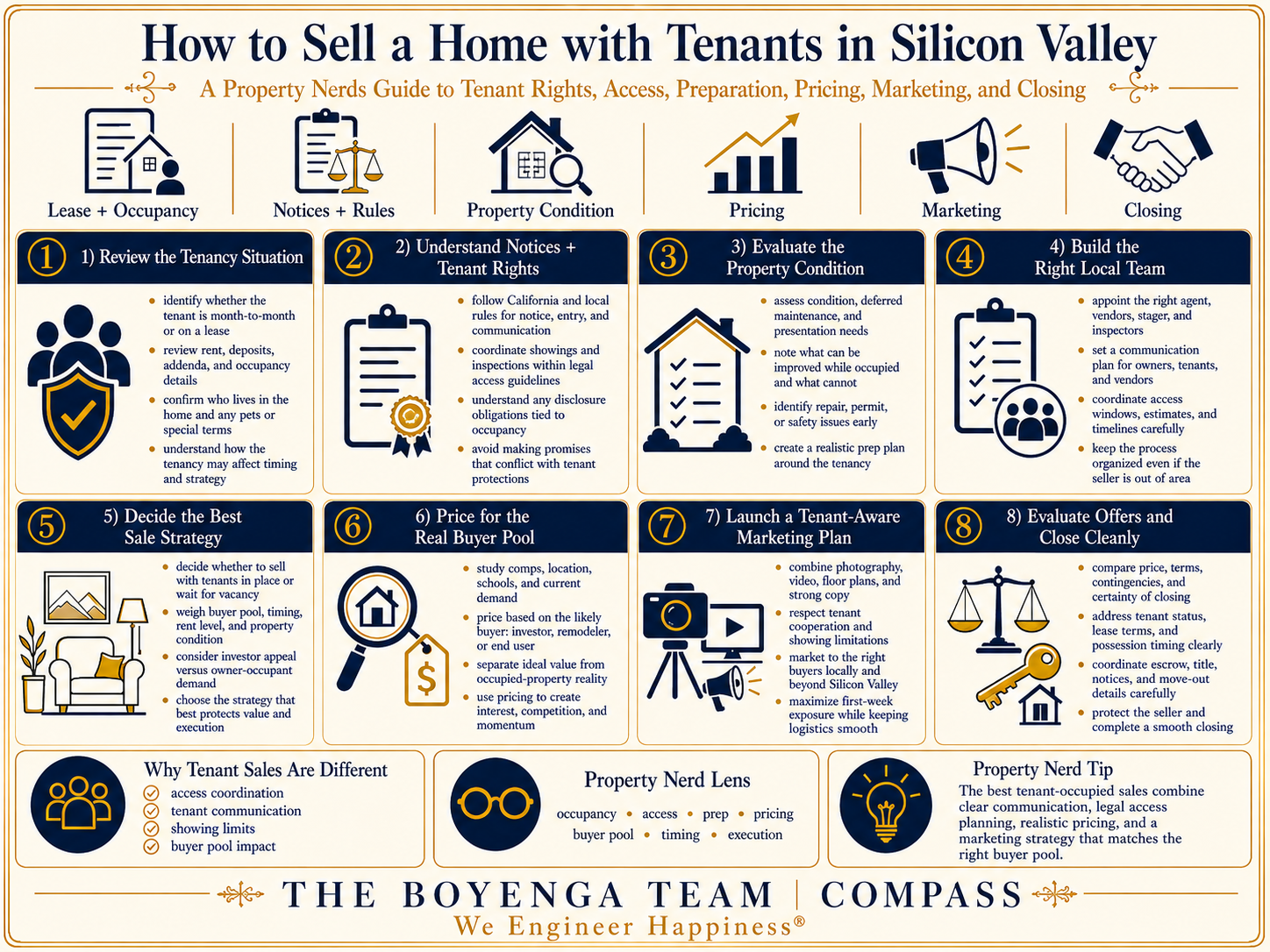
Before deciding how to sell a tenant-occupied property, it is important to be clear about the Boyenga Team’s preferred strategy. In most Silicon Valley home sales, especially luxury homes, trust properties, family homes, Eichlers, ranch homes, and owner-user properties, the Boyenga Team generally does not recommend selling with tenants in place unless there is no better practical option.
A vacant home usually gives the seller the best opportunity to prepare the property, complete inspections, clean, landscape, stage, photograph, and market the home properly. It also gives buyers a clearer emotional connection to the property and removes uncertainty around possession.
That does not mean a tenant-occupied sale is impossible. It simply means it should usually be treated as the fallback strategy, not the first choice.
Why Tenant-Occupied Sales Can Reduce Buyer Demand
Tenant occupancy can make a sale more complicated because it often limits access, showing flexibility, photography, staging, inspections, and buyer confidence. In Silicon Valley, those details matter.
A buyer spending millions of dollars wants to experience the home, understand the condition, imagine their future lifestyle, and know when they can move in. If showings are limited, rooms are cluttered, inspections are difficult, or possession is uncertain, some buyers will hesitate. Others may discount their offer to account for the risk and inconvenience.
This is why the Boyenga Team first looks at whether there is a lawful, respectful, and realistic path to deliver the home vacant before going live.
When Selling with Tenants May Be Necessary
There are situations where selling with tenants in place may be unavoidable. The lease may still have significant time remaining. The tenant may not be willing to move. Local tenant-protection rules may limit options. The seller may need to sell quickly. Or the property may be better suited for an investor buyer who is comfortable purchasing with an existing tenant.
In those cases, the strategy changes. The goal becomes minimizing the value loss and reducing buyer uncertainty. That means clear lease documentation, respectful tenant communication, controlled showing windows, accurate pricing, strong disclosures, and targeted marketing to the right buyer pool.
Review the Lease Before Making Any Promises
A seller should never promise that a home can be delivered vacant without first reviewing the lease and coordinating with the appropriate professionals. The lease may determine whether the tenant has the right to remain after closing, when possession can be delivered, and what options the seller may have.
The Boyenga Team recommends reviewing the lease early, before photography, pricing, or launch strategy. This helps determine whether the best path is to wait for lease expiration, negotiate a voluntary move-out, sell to an investor, or proceed with a tenant-occupied sale as a backup plan.
Consider a Voluntary Move-Out Agreement
When a vacant sale is likely to create significantly stronger market demand, sellers may want to explore whether the tenant would consider a voluntary move-out agreement. This should be handled respectfully, legally, and in writing with guidance from an attorney or property manager.
For many Silicon Valley homes, especially properties likely to appeal to owner-users, a vacant and well-prepared launch can create stronger emotional buyer response and better offer activity. A voluntary agreement may allow the seller to clean, repair, stage, inspect, and market the home properly.
However, this is not always possible. If the tenant remains in place, the sale strategy needs to be adjusted accordingly.
Price the Property Based on Occupancy Reality
If the home must be sold with tenants in place, the pricing strategy needs to reflect that reality. A tenant-occupied home should not automatically be priced the same way as a vacant, staged, fully accessible home.
Buyers may factor in limited access, uncertain possession, lease terms, deferred preparation, and the inability to fully experience the home. Investor buyers may focus more heavily on rent, lease terms, cash flow, condition, and future upside. Owner-user buyers may be more hesitant if they cannot move in when they need to.
The Boyenga Team analyzes both scenarios whenever possible: the likely value vacant and properly prepared versus the likely value occupied with tenant limitations. That comparison helps sellers make a more informed decision.
Market to the Right Buyer Pool
A vacant home often attracts the broadest buyer pool, including families, move-up buyers, luxury buyers, tech executives, relocation buyers, remodel buyers, and builders. A tenant-occupied home may attract a narrower pool, especially if the lease is long-term or rent is below market.
If selling occupied is the only realistic option, the marketing should be honest and strategic. The property may need to be positioned toward investors, 1031 exchange buyers, builders, or patient owner-users who understand the lease terms.
The Boyenga Team’s role is to identify the most likely buyer pool and create messaging that fits the reality of the property, rather than pretending it is a normal vacant sale.
Final Thoughts
Selling a home with tenants in Silicon Valley is possible, but it is rarely the ideal first strategy. In most cases, the Boyenga Team recommends first exploring whether the property can be legally, respectfully, and strategically delivered vacant before going to market.
When the home is vacant, sellers usually have more control over preparation, staging, inspections, photography, showing access, buyer experience, and timing. Those details can make a major difference in Silicon Valley, where presentation and buyer confidence often influence final sale price.
When a tenant-occupied sale is unavoidable, it should be handled carefully. The seller needs a clear lease review, legal guidance, respectful tenant communication, realistic pricing, proper disclosures, and marketing designed around the limitations of occupancy.
The Boyenga Team helps sellers evaluate both paths, understand the trade-offs, and choose the strategy that best protects the property’s value.