

Blog > How the Boyenga Team Positions Homes for Multiple Buyer Pools
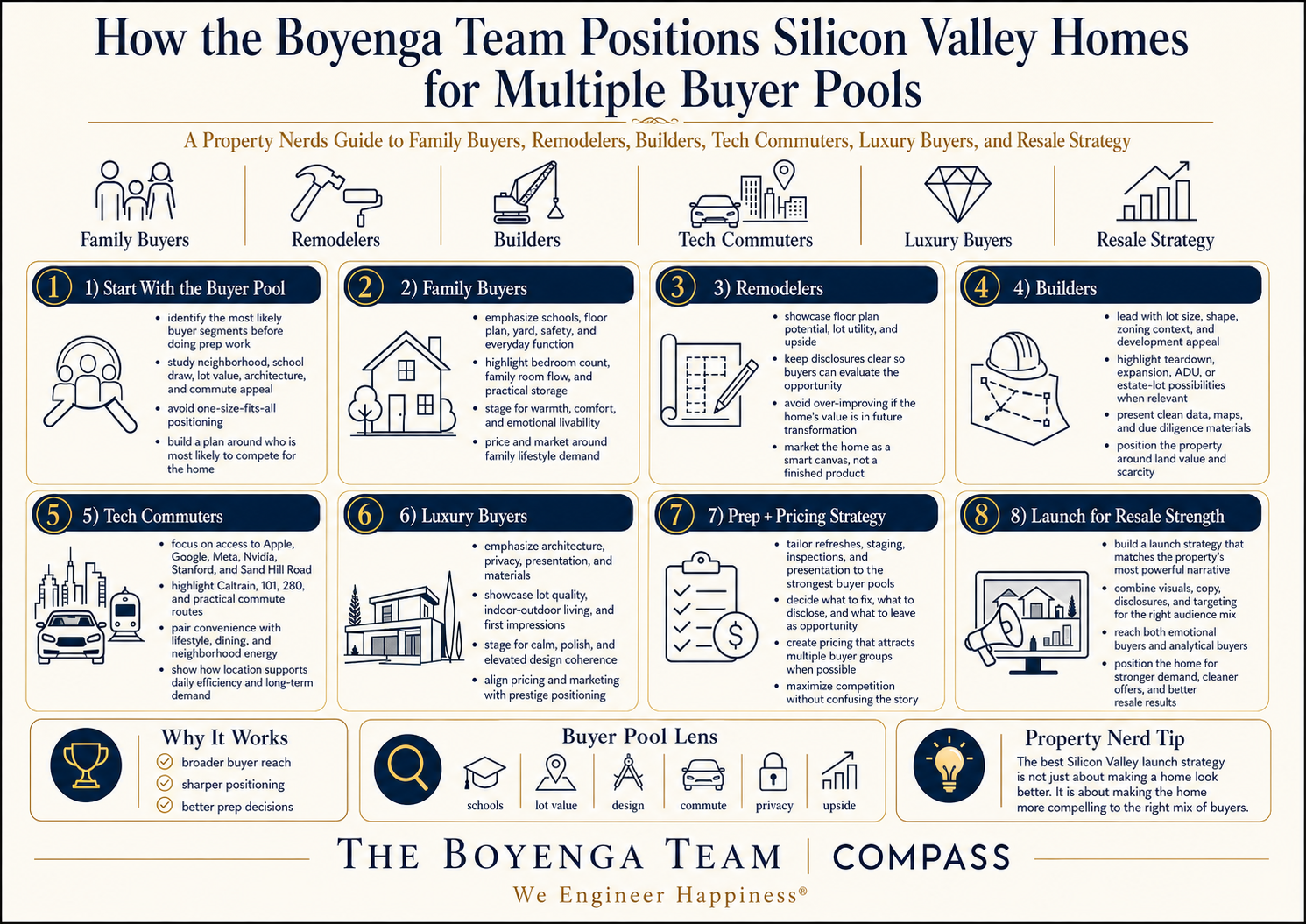
One of the biggest mistakes sellers make in Silicon Valley is assuming there is only one buyer for their home.
In reality, many homes have more than one possible buyer pool.
A dated ranch home may appeal to a move-in buyer, a remodel buyer, and a builder.
An Eichler may appeal to an architecture buyer, a family buyer, and a tech commuter.
A Los Altos Hills estate may appeal to a luxury family, a privacy buyer, and a land-value buyer.
A walkable Downtown Campbell bungalow may appeal to a first-time buyer, a downsizer, and a lifestyle buyer.
A trust property in Palo Alto may appeal to a remodeler, a builder, a Stanford buyer, or a family looking for long-term resale strength.
That is why positioning matters.
The Boyenga Team does not just market a home by bedroom count, square footage, and school district. Eric and Janelle Boyenga look at the home through multiple buyer lenses and ask a more strategic question:
Who could want this property, and what does each buyer need to understand in order to act?
That is the foundation of the Boyenga Team’s Property Nerds approach.
Why Multiple Buyer Pools Matter
In Silicon Valley, the final sale price is often shaped by how many qualified buyer groups can see a path to value.
If a home is marketed only as “move-in ready,” it may miss remodel buyers who see expansion potential.
If a home is marketed only as a fixer, it may miss a family buyer who would gladly live in it after a light refresh.
If a home is marketed only as land value, it may miss an architecture buyer who values the existing home.
If a home is marketed only around schools, it may miss tech commuters, downsizers, investors, or luxury buyers who care about other features.
The strongest positioning helps the right buyers see their own version of the opportunity without confusing the market.
That is the art.
The home needs one clear core story, but it can support several buyer interpretations.
The Property Nerds Positioning Formula
The Boyenga Team evaluates each home through a layered positioning framework:
Property condition: Is it turnkey, dated, original, remodeled, expanded, or a rebuild candidate?
Lot utility: Is the land usable, private, expandable, flat, view-oriented, or builder-friendly?
Neighborhood demand: What buyer groups are active in this pocket?
School and commute logic: Does the property solve a school, Apple, Google, Stanford, Meta, Nvidia, Netflix, or Adobe commute problem?
Architecture: Is the home a ranch, Eichler, mid-century modern, historic bungalow, luxury estate, or generic improvement opportunity?
Lifestyle: Is the value driven by walkability, parks, trails, privacy, downtown access, or estate living?
Resale story: What will the next buyer believe about long-term value?
The goal is to identify the buyer pools that are real, not imaginary.
A home does not need to be everything to everyone. It needs to be compelling to the buyers most likely to compete.
Buyer Pool 1: The Move-In Ready Family Buyer
The move-in ready family buyer wants confidence.
They care about floor plan, bedrooms, bathrooms, kitchen function, yard usability, schools, commute, storage, safety, inspections, and how easy the home feels to own.
For this buyer pool, the Boyenga Team positions the home around daily life:
How the kitchen connects to the family room.
How the yard works for kids, entertaining, or pets.
How the bedroom layout supports family routines.
How the schools and parks fit the lifestyle.
How the commute works.
How the inspections and disclosures reduce uncertainty.
The marketing needs to make the home feel livable, clean, and emotionally easy.
For these buyers, staging matters. Light matters. Yard presentation matters. A clear floor plan matters. Inspection confidence matters.
The Property Nerds read: Family buyers pay more when the home feels easy to understand, easy to love, and easy to move into.
Buyer Pool 2: The Remodel Buyer
The remodel buyer is not afraid of work, but they need to see the path.
They want to know whether the home has good bones. They look at the lot, roofline, foundation, floor plan, walls, natural light, yard, expansion potential, and whether the neighborhood supports the investment.
For this buyer, the Boyenga Team positions the property around potential:
Can the kitchen open up?
Can the primary suite improve?
Can the home expand?
Is the lot usable?
Is the street strong enough?
Will the neighborhood reward the remodel?
Are there inspection issues to price in?
Will the finished home have resale demand?
This does not mean overselling what is possible. It means helping buyers see opportunity clearly and responsibly.
The Property Nerds read: Remodel buyers need vision, but they also need confidence that the math makes sense.
Buyer Pool 3: The Builder or Rebuild Buyer
The builder buyer sees the home differently.
They are often less emotional about finishes and more focused on land, zoning, setbacks, lot dimensions, neighborhood resale ceiling, tree constraints, utilities, access, and what the finished product could sell for.
For this buyer pool, the Boyenga Team highlights land value and feasibility:
Lot size.
Street quality.
Neighborhood rebuild activity.
Surrounding home values.
Access.
Topography.
Potential buyer demand for a future new build.
School and commute value.
Any available permits, surveys, or planning context.
The messaging should be clear but careful. Sellers should not promise what has not been verified. The goal is to attract builder attention while keeping disclosures accurate.
The Property Nerds read: Builder buyers are not buying what is there. They are buying what the land can become.
Buyer Pool 4: The Architecture Buyer
Architecture buyers are different.
They may be looking for an Eichler, mid-century modern home, historic bungalow, Spanish Revival, Craftsman, or custom-designed property. They care about authenticity, proportions, materials, light, and whether updates respect the original design.
For this buyer pool, generic marketing does not work.
An Eichler should not be described like a standard ranch home.
A Willow Glen Craftsman should not be staged like a generic flip.
A Los Gatos historic home should not have its charm erased.
A mid-century home should not be stripped of warmth and architectural rhythm.
The Boyenga Team positions architectural homes around what makes them special:
Atriums.
Post-and-beam ceilings.
Original wood.
Indoor-outdoor flow.
Historic detail.
Period proportions.
Design lineage.
Light and privacy.
Architectural integrity.
The Property Nerds read: Architecture buyers pay for homes that still know what they are.
Buyer Pool 5: The Luxury Buyer
Luxury buyers notice everything.
They evaluate arrival, privacy, light, scale, ceiling height, kitchen quality, primary suite, indoor-outdoor connection, lot presence, landscape design, systems, neighborhood prestige, and resale logic.
For this buyer pool, the Boyenga Team positions the property around experience:
How the home feels when you arrive.
How private it is.
How the light moves through the space.
How the floor plan supports entertaining and daily living.
How the outdoor spaces function.
How the property compares with other luxury options.
Why the location supports the price.
Luxury buyers do not just want expensive. They want intentional.
The Property Nerds read: Luxury positioning is about making the home feel rare, calm, confident, and worthy of its price.
Buyer Pool 6: The Tech Commuter
The tech commuter buyer may care deeply about location efficiency.
They want Apple access, Google access, Meta access, Nvidia access, Netflix access, Adobe access, Stanford access, or Sand Hill Road convenience. But commute alone is rarely enough. They also care about schools, parks, housing type, lifestyle, and future resale.
For this buyer pool, the Boyenga Team positions the home around commute geometry:
Which employers are convenient?
Which routes matter?
Is there Caltrain, BART, light rail, or bike access?
Does the home work for hybrid schedules?
Can school drop-off and commute coexist?
Will future tech buyers value the same location?
The Property Nerds read: In Silicon Valley, commute is not just distance. It is daily-life math.
Buyer Pool 7: The Downsizer
Downsizers often want simplicity without sacrificing quality.
They may be moving from a larger estate, family home, or long-held property into something easier to manage. They often care about single-level living, low maintenance, walkability, storage, security, natural light, guest space, and lifestyle.
For this buyer pool, the Boyenga Team positions the home around ease:
Can they live mostly on one level?
Is there a primary suite that works long-term?
Is the yard manageable?
Is downtown or shopping nearby?
Is there guest space?
Is the home secure and easy to maintain?
Will it feel like a lifestyle upgrade rather than a compromise?
The Property Nerds read: Downsizers are not just buying smaller. They are buying easier.
Buyer Pool 8: The Investor
Investor buyers care about yield, location, tenant demand, future appreciation, property condition, zoning, and exit strategy.
They may be interested in a condo, townhome, duplex, ADU potential, student/faculty rental demand, tech-commuter location, or long-term redevelopment potential.
For this buyer pool, the Boyenga Team positions the property around fundamentals:
Rental demand.
Location.
Transit or employer access.
Condition.
Maintenance profile.
HOA health.
ADU or expansion potential where applicable.
Long-term neighborhood trajectory.
Resale depth.
The Property Nerds read: Investors want the story, but they also want the spreadsheet.
Buyer Pool 9: The Trust, Estate, or Out-of-Area Buyer
Some properties are being sold by trustees, heirs, fiduciaries, receivers, or out-of-area owners. These homes often need a different positioning strategy because they may be original, dated, tenant-occupied, or emotionally complicated.
The likely buyer may be a remodeler, builder, investor, or family willing to take on work.
The Boyenga Team helps position these homes with clarity:
Condition transparency.
Inspection reports.
Disclosure organization.
Lot value.
Neighborhood demand.
Remodel potential.
Trustee-friendly timelines.
Vendor coordination.
Property cleanout and preparation.
Buyer confidence.
The Property Nerds read: Estate and trust properties do not need to be perfect. They need to be clear, credible, and well-positioned.
How One Home Can Speak to Multiple Buyers
The best positioning does not create a messy message. It creates a layered one.
For example, a Sunnyvale ranch may be positioned as:
A move-in family home with parks and schools.
A remodel opportunity with expansion potential.
An Apple-commute property.
A long-term resale play in a strong neighborhood.
A Monta Loma Eichler may be positioned as:
An architectural home.
A Google-commute property.
A family-friendly indoor-outdoor layout.
A design-forward alternative to Palo Alto.
A Los Altos Hills estate may be positioned as:
A luxury privacy property.
A land-value opportunity.
A Stanford / Palo Alto access play.
A future legacy estate.
The key is hierarchy.
The home should have one main story, supported by secondary buyer angles.
Why Generic Marketing Leaves Money on the Table
Generic marketing usually sounds like this:
“Beautiful home in a great location.”
That is not enough.
In Silicon Valley, buyers are too sophisticated, and the market is too segmented.
A buyer needs to know why this home is better than the alternatives. Is it the school path? The lot? The street? The commute? The architecture? The remodel potential? The privacy? The walkability? The price point? The future resale?
The Boyenga Team’s job is to make the value obvious.
When buyers understand the value, they act with more confidence.
How the Boyenga Team Builds the Positioning Strategy
The process usually starts with a property and buyer-pool analysis.
First, the team studies the home’s physical condition, layout, lot, street, architecture, systems, inspections, neighborhood, and likely competition.
Then they identify the likely buyer groups.
Next, they decide which buyer pool is primary and which are secondary.
Then they build preparation, pricing, staging, photography, copy, disclosures, and outreach around that strategy.
This may include:
Targeted home prep.
Design-sensitive staging.
Inspection and disclosure organization.
Floor plans.
Neighborhood lifestyle copy.
Lot and remodel-potential language.
Agent-to-agent outreach.
Compass network exposure.
Private Exclusive strategy.
Luxury marketing.
Eichler or architecture-focused messaging.
Builder outreach.
Tech-commuter positioning.
School and park lifestyle framing.
The goal is not to attract random attention.
The goal is to attract the buyers most likely to compete.
The Role of Staging in Multi-Buyer Positioning
Staging is one of the most powerful tools for multi-buyer positioning because it helps buyers understand use.
A room can become an office for a tech buyer.
A bedroom can become a nursery or guest room for a family.
A bonus room can become a media space.
A yard can become an entertaining zone.
An atrium can become an architectural lifestyle feature.
A small dining area can become charming instead of awkward.
The right staging can help multiple buyer groups see themselves in the home without making the property feel generic.
The Property Nerds read: Staging should clarify the home’s best use cases.
The Role of Pricing
Pricing determines which buyer pools engage.
A home priced too high may only attract wishful browsing.
A home priced too low without strategy may confuse buyers.
A home priced correctly can create urgency across multiple buyer groups.
For example, a property may be priced to attract both owner-occupants and remodel buyers. Or it may be positioned to attract builder interest while still leaving room for an end-user buyer to compete.
The Boyenga Team evaluates pricing through both comp data and buyer psychology.
The Property Nerds read: Pricing is not just valuation. It is audience design.
The Role of Disclosures and Inspections
Multiple buyer pools need different types of confidence.
A family buyer needs to understand condition.
A remodel buyer needs to understand scope.
A builder needs to understand land and constraints.
A luxury buyer needs transparency.
An investor needs risk clarity.
A strong disclosure package helps all of them.
Pre-sale inspections, seller disclosures, roof reports, sewer reports, pest reports, permit history, HOA documents, surveys, floor plans, and upgrade lists can all reduce uncertainty.
The Property Nerds read: Better information creates stronger buyers.
The Property Nerds Bottom Line
The best Silicon Valley listing strategies do not assume one buyer.
They identify every credible buyer pool, then build a clear hierarchy around the most likely sources of demand.
A home may be a family home, a remodel opportunity, a tech-commute play, an architectural property, a luxury estate, a downsizer option, or a builder candidate.
Sometimes it is more than one.
The smartest sellers do not ask only, “What is my home worth?”
They ask:
Who will want this home?
Why will they want it?
What will each buyer value?
What objections will they have?
What preparation will increase confidence?
What buyer pool will pay the most?
How do we position the home without confusing the message?
That is how the Boyenga Team positions homes for multiple buyer pools.
In Silicon Valley, the strongest marketing does not just describe a home.
It explains the opportunity.
Thinking About Selling a Silicon Valley Home?
The Boyenga Team at Compass helps sellers position homes with a Property Nerds approach — blending buyer-pool analysis, neighborhood strategy, pricing, staging, inspections, design insight, preparation planning, architecture awareness, commute logic, and launch strategy.
Whether your home is move-in ready, dated, original, remodeled, tenant-occupied, architectural, luxury, or a potential rebuild, Eric and Janelle Boyenga can help identify the buyer pools most likely to create the strongest result.
Because in Silicon Valley real estate, the right buyer may not be obvious at first glance.
The right strategy makes sure they see the opportunity.