

Blog > How the Boyenga Team Creates Multiple Buyer Pools for One Silicon Valley Listing
How the Boyenga Team Creates Multiple Buyer Pools for One Silicon Valley Listing
by
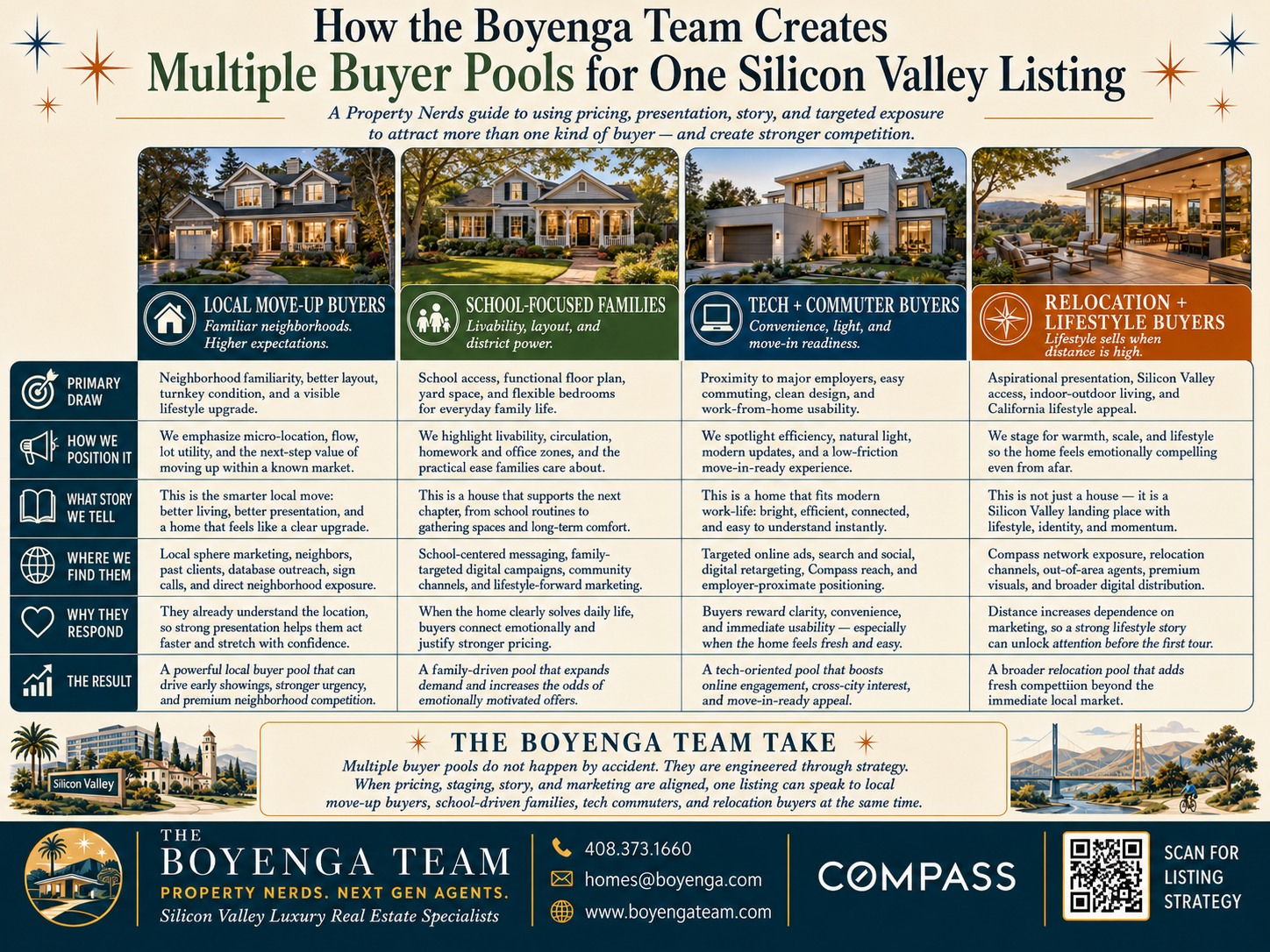
A Silicon Valley home does not have one buyer. It has a collection of possible buyers who may value the property for entirely different reasons.
One buyer may be drawn to the architecture. Another may prioritize proximity to Apple, Google, Nvidia, Meta, Stanford, or Caltrain. A third may focus on the lot, remodeling potential, flexible-use rooms, schools, walkability, or long-term resale. A fourth may simply fall in love with the light, garden, floor plan, or emotional quality of the home.
The mistake many listing strategies make is selecting one story and repeating it everywhere.
At the Boyenga Team, we take a different approach. We identify the property’s full demand surface—the different ways qualified buyers might discover, understand, and value the home—and then build multiple strategic pathways into a single, coherent listing campaign.
We call this Buyer Pool Engineering.
It is not about marketing a property as everything to everyone. That creates generic messaging and weakens credibility. It is about finding the home’s authentic value dimensions, matching each dimension with relevant search behavior, and creating specialized marketing that leads those audiences back to the same property.
In Property Nerd® terms:
More credible buyer entry points + stronger property-market fit + disciplined pricing = greater opportunity for competitive overlap.
That competitive overlap is the objective. A seller does not merely need attention. The seller needs enough of the right buyers to recognize value at the same time.
A Listing Is a Market, Not a Single Advertisement
Traditional listing marketing often begins with a familiar checklist: photography, MLS, property website, brochures, email, open homes, and social media.
Those tools are important, but they are distribution channels. They do not, by themselves, create a strategy.
The deeper question is: What idea is being distributed through each channel, and which buyer motivation is it designed to activate?
Consider a four-bedroom Eichler in Sunnyvale with an atrium, office, two-car garage, landscaped yard, access to major commute routes, and proximity to neighborhood amenities.
That one property may appeal to several overlapping buyer pools:
- Buyers searching specifically for Eichler or mid-century modern architecture
- Buyers comparing Sunnyvale with Cupertino or Mountain View
- Buyers prioritizing access to Apple, Google, Nvidia, or LinkedIn
- Buyers looking for a four-bedroom home with office flexibility
- Buyers seeking indoor-outdoor living
- Buyers focused on the home’s applicable school assignments
- Buyers who value a two-car garage, yard, or single-level floor plan
- Buyers relocating within or to Silicon Valley
- Buyers who initially planned to purchase a conventional ranch home but respond to the Eichler lifestyle
The home remains the same. The entry point changes.
The Boyenga Team’s work is to create those entry points without fragmenting the property’s identity.
The Buyer-Pool Equation
The potential demand for a listing can be visualized through five variables:
Property attributes × audience relevance × search visibility × buyer confidence × launch timing
If the property has meaningful attributes but the marketing does not connect those attributes to relevant audiences, demand may remain undiscovered.
If the marketing creates visibility but the disclosure package is incomplete, buyers may hesitate.
If the property is beautifully presented but priced beyond the search thresholds used by the most likely buyers, the campaign may miss its natural audience.
If the launch occurs before staging, photography, inspections, or digital materials are complete, the listing may spend its highest-attention period delivering an incomplete message.
Multiple-buyer-pool marketing aligns all five variables.
Step One: Decode the Property Before Writing the Marketing
Buyer Pool Engineering begins with a detailed property audit.
Before writing a headline or scheduling photography, we examine the home as architecture, land, location, lifestyle, and financial asset.
The audit may include:
- Architectural style and integrity
- Floor-plan functionality
- Bedroom and bathroom configuration
- Office and flexible-use capacity
- Lot size, orientation, privacy, and usability
- Indoor-outdoor relationships
- Natural light and sightlines
- Remodel condition
- Original architectural features
- Expansion or reconfiguration possibilities
- Garage, parking, and storage
- Energy and mechanical systems
- Neighborhood character
- Walkability and transportation
- Proximity to major employers and institutions
- School-district and attendance-boundary information
- Nearby parks, shopping, dining, and community amenities
- Recent comparable sales
- Current competing inventory
- Search-price thresholds
- Likely inspection questions
- Potential buyer objections
- Attributes that competing homes cannot easily reproduce
The purpose is to distinguish features from marketable advantages.
“Large windows” are a feature. “Walls of glass connecting the primary living spaces to a private garden” describe the buyer experience.
“Extra room” is a feature. “A defined flexible-use space positioned away from the main living areas” gives the buyer a credible use case.
“Near major employers” is generic. Explaining how the location connects with relevant employment corridors, transit, and surrounding communities gives buyers useful context.
The property audit becomes the source code for the campaign.
Step Two: Identify the Core Buyer Pool
Every property needs a primary audience. This is the buyer group most naturally aligned with the home’s location, configuration, condition, architecture, and probable price.
The core buyer pool anchors the listing strategy. It informs the principal staging decisions, first photograph, headline, listing description, pricing, showing schedule, and overall visual identity.
A Los Altos estate with a large lot and extensive indoor-outdoor living may have a different core audience from a compact downtown Mountain View bungalow. A restored Palo Alto Craftsman should not be positioned like a newly constructed contemporary home. An original Eichler should not be marketed as though its architecture were incidental.
The core audience gives the listing focus.
However, focus should not become tunnel vision. Once the primary market fit is established, the Boyenga Team looks for adjacent pools that can increase demand without diluting the property’s central story.
Step Three: Find the Adjacent Buyer Pools
An adjacent buyer pool contains buyers who may not begin their search with this exact property type, neighborhood, or city—but whose needs could still be satisfied by the home.
This is where local Silicon Valley knowledge becomes powerful.
A buyer searching in Cupertino may also consider Sunnyvale if the property offers the right combination of space, school assignment, architecture, commute, and price. A buyer focused on Palo Alto may expand into Mountain View or Los Altos after comparing lot size, condition, walkability, and value. A buyer searching for a newer modern home may respond to a carefully restored Eichler once the architectural advantages are explained.
Adjacent-pool strategy requires understanding not only where buyers are searching, but why they selected those areas in the first place.
Are they searching for:
- A particular commute?
- A specific type of neighborhood?
- Greater lot size?
- Walkability?
- Single-level living?
- Architectural design?
- An office?
- More flexible space?
- A quieter street?
- A particular school assignment?
- A more attainable entry point?
- A turnkey property?
- A home they can personalize?
Once the underlying need is identified, the search can expand without becoming random.
Buyer Pool One: The Location-First Buyer
Some buyers begin with a map.
They may prioritize proximity to Stanford, downtown Palo Alto, downtown Los Altos, Google’s Mountain View campuses, Apple Park, Nvidia, Caltrain, or a particular commute corridor. Others may focus on access to parks, restaurants, shopping, neighborhood services, or major roadways.
For these buyers, marketing must explain the home’s location with precision.
Generic phrases such as “conveniently located” do little to establish value. The campaign should provide credible context: the surrounding neighborhood, practical routes, nearby destinations, transportation options, and the relationship between the home and the larger Silicon Valley employment network.
The Boyenga Team’s regional resources at Silicon Valley Real Estate and Boyenga Real Estate Team help connect individual listings with broader neighborhood and city-level information.
Location-first buyers are often discovered through community articles, comparison guides, neighborhood pages, map-based searches, employer-proximity content, and relocation marketing—not only through the property’s MLS entry.
Buyer Pool Two: The Architecture-First Buyer
Architectural buyers may cross city boundaries to find the right home.
An Eichler buyer might consider Palo Alto, Mountain View, Sunnyvale, San Mateo, San Jose, Cupertino, Los Altos, or Foster City. Their geographic preferences may be flexible because the architecture is relatively scarce and difficult to reproduce.
The same principle can apply to Craftsman homes, Spanish revival properties, contemporary residences, modern ranch homes, and architect-designed luxury estates.
Architecture-first marketing must go deeper than using a style label.
For an Eichler, the campaign may discuss:
- Post-and-beam construction
- Atrium design
- Floor-to-ceiling glass
- Indoor-outdoor living
- Radiant-heated slab
- Open-plan organization
- Exposed ceiling decking
- Globe lighting
- Mahogany paneling
- Original versus modified elements
- Neighborhood context
- Restoration and modernization choices
A generic listing description might say “mid-century charm.” A specialized campaign explains why the architecture matters, which elements remain, how the home lives, and where it fits within the larger Eichler story.
This is where the Boyenga Team’s network of Eichler and modernist sites becomes a meaningful demand engine. Resources include Eichler Homes for Sale, Bay Area Eichler Homes, Bay Area Eichler Home, Joe Eichler, and MidMod Homes.
City-specific resources include:
- Palo Alto Eichler Home
- Los Altos Eichler Home
- Mountain View Eichler Home
- Sunnyvale Eichler Home
- Cupertino Eichler Home
- San Jose Eichler Home
- San Mateo Eichler Homes
- Foster City Eichler Home
These specialized platforms create multiple routes through which an architectural buyer can discover a single property.
Buyer Pool Three: The Lifestyle-and-Use Buyer
Many buyers do not begin with an architectural category. They begin with a life problem they need the home to solve.
They may need quiet workspaces, guest accommodations, flexible rooms, outdoor entertaining, storage, a workshop area, a large garden, single-level circulation, or separation between shared and private spaces.
Marketing to this buyer pool requires more than room counts.
A “four-bedroom home” may communicate less than:
- Three private sleeping rooms plus a separate office
- A flexible fourth room positioned for work, guests, or creative use
- A primary suite separated from secondary rooms
- A family room opening directly to the yard
- A detached structure with an established permitted use
- Multiple living zones supporting simultaneous activities
The language must remain accurate. A room should not be represented as a legal bedroom, dwelling unit, or office if its permitted status or configuration does not support that description. Potential uses should be framed carefully, and buyers should independently verify development or conversion possibilities.
Staging becomes especially important for lifestyle-and-use buyers because it demonstrates the property’s functionality. The office must look credible. The outdoor dining area must feel connected. The guest space must be legible. The furniture plan should answer questions rather than create them.
Buyer Pool Four: The School-Information Buyer
School assignments can influence Silicon Valley housing decisions, but this category requires precision and care.
The listing should provide factual information about applicable school districts and currently available attendance assignments, while advising buyers to verify boundaries, enrollment, eligibility, and availability directly with the appropriate district.
Marketing should not make guarantees about admission or use subjective language that improperly steers buyers. It should provide neutral, verifiable information and allow buyers to evaluate it according to their own priorities.
The same property may appear in searches related to a city, district, attendance area, or nearby community. Accurate school information can therefore become another search entry point, but it should never replace independent verification.
The Property Nerd approach is data first: identify the relevant jurisdiction, verify the available information, cite the appropriate source when possible, and avoid assumptions based solely on the mailing address.
Buyer Pool Five: The Condition-First Buyer
Some buyers want a turnkey home. Others specifically seek a property they can improve.
These are not the same buyer pool, and the marketing should not confuse them.
A turnkey campaign should emphasize condition, design coherence, completed improvements, system updates, maintenance, and ease of transition. Documentation, permits, warranties, and high-quality photography help support that position.
A renovation-opportunity campaign should focus on the home’s underlying assets: location, lot, architecture, floor plan, existing square footage, natural light, and credible potential. The property should still be cleaned, edited, and presented intelligently. “Opportunity” should not become an excuse for poor marketing.
There is also a hybrid buyer pool: buyers willing to make cosmetic changes but not undertake major structural work. These buyers may respond well to a home with strong fundamentals, organized inspections, and a clear distinction between immediate needs and optional improvements.
The listing should tell the truth about condition while helping buyers understand the difference between dated, damaged, and fundamentally compromised. Those are not interchangeable categories.
Buyer Pool Six: The Lot-and-Potential Buyer
In many Silicon Valley communities, the land may be as important as the existing house.
Lot-focused buyers may examine dimensions, orientation, privacy, setbacks, topography, existing structures, trees, utilities, and possible expansion or development options.
Marketing can help buyers understand the land by providing:
- Professional exterior photography
- Aerial imagery
- Available survey information
- Lot dimensions from appropriate sources
- Floor plans and site context
- Information about existing permitted structures
- Relevant public planning resources
- Clear photographs of side yards and rear setbacks
- A realistic explanation of outdoor usability
However, potential must be handled carefully. ADU possibilities, additions, lot splits, redevelopment, and other future uses may depend on zoning, overlays, easements, utilities, tree protections, design review, local ordinances, and property-specific conditions.
Rather than making unsupported claims, the Boyenga Team organizes the available information and helps buyers identify what requires independent investigation.
The goal is not to sell a speculative promise. It is to make the property’s existing land value and possible pathways easier to evaluate.
Buyer Pool Seven: The Comparative-Value Buyer
Some buyers reach a listing through comparison.
They may be considering:
- Palo Alto versus Mountain View
- Los Altos versus Sunnyvale
- Sunnyvale versus Cupertino
- Palo Alto versus Los Altos
- Mountain View versus Sunnyvale
- Menlo Park versus Palo Alto
- Los Gatos versus Saratoga
These buyers are not necessarily committed to one city. They are comparing space, schools, commute, lot size, walkability, architecture, condition, and price.
A comparative-value strategy positions the listing within that broader equation.
A Sunnyvale home may offer more lot or interior space than a similarly priced Cupertino alternative. A Mountain View property may offer a different balance of walkability and commute convenience than Palo Alto. A Los Altos home may provide land and privacy that are difficult to replicate elsewhere.
The marketing should not criticize competing communities. It should explain the property’s relative strengths and allow buyers to see how the tradeoffs align with their priorities.
Long-form comparison content is particularly useful because it captures buyers before they have finalized the boundaries of their search.
Buyer Pool Eight: The Relocation Buyer
Relocation buyers need context.
A local buyer may already understand the difference between Old Mountain View, Waverly Park, Monta Loma, Cherry Chase, Fairbrae, North Los Altos, or Midtown Palo Alto. A relocating buyer may not.
They need the property campaign to explain the neighborhood’s physical and practical relationship to the larger region.
Useful relocation content may cover:
- Commute geography
- Transportation options
- Downtown and retail access
- Architectural character
- Housing-stock differences
- General lot patterns
- Parks and recreation
- Relevant school-district resources
- Nearby cities and employment centers
- What distinguishes the neighborhood from nearby alternatives
The Boyenga Team’s broad digital footprint allows an individual listing to be connected with city guides, neighborhood articles, architecture resources, and Silicon Valley comparison content. This helps the relocation buyer move from unfamiliarity to informed interest.
Globally distributed marketing can increase access to property information, but audience segmentation should always be based on lawful criteria such as property interest, search intent, geography, and stated housing needs—not protected personal characteristics.
Buyer Pool Nine: The Luxury Buyer
Luxury is not simply a price category. It is a standard of execution.
Luxury buyers often expect a coordinated experience across preparation, staging, photography, disclosures, showing access, printed materials, digital presentation, and agent communication.
A luxury listing may appeal to several submarkets:
- Buyers seeking architectural distinction
- Buyers prioritizing privacy or land
- Buyers wanting turnkey condition
- Buyers drawn to a specific neighborhood
- Buyers needing flexible interior space
- Buyers seeking indoor-outdoor entertaining
- Buyers comparing new construction with established properties
The campaign must identify the property’s form of luxury.
For one home, luxury may mean acreage and privacy. For another, it may mean walkability, historical character, architecture, a rare view, a highly resolved remodel, or access to a particular location.
Generic words such as “stunning,” “exclusive,” and “one-of-a-kind” do not establish luxury. Evidence does.
The photography, writing, documentation, and showing experience should demonstrate what is scarce and difficult to reproduce.
One Listing, Multiple Digital Doorways
Creating multiple buyer pools requires more than inserting a long list of features into the MLS description.
Different buyers search differently. A successful digital strategy creates several credible pathways into the same listing:
- Property-specific website
- MLS and syndicated portal exposure
- City and neighborhood pages
- Architectural websites
- Eichler and mid-century content
- Employer-proximity articles
- School-information resources
- Community comparison blogs
- Lifestyle-focused social media
- Video and short-form content
- Agent-to-agent campaigns
- Email segmentation
- Relocation content
- Search-optimized editorial coverage
- Luxury and design-focused marketing
Each pathway emphasizes a different value dimension, but all paths return to a consistent property story.
This is the distinction between duplicating an advertisement and building a marketing ecosystem.
Search Intent Is the New Open-House Sign
A buyer may reveal their motivation through the words they search:
- Eichler homes for sale in Palo Alto
- Homes near Google in Mountain View
- Sunnyvale homes near Apple Park
- Los Altos homes with large lots
- Silicon Valley homes with an office
- Mid-century modern homes in the Bay Area
- Palo Alto versus Mountain View real estate
- Turnkey homes in Sunnyvale
- Los Altos luxury homes with pools
- Single-level homes in Silicon Valley
Those searches do not all lead naturally to the same generic listing page.
Long-form articles, neighborhood guides, specialized domains, property pages, and structured internal links allow the Boyenga Team to meet buyers earlier in the search process—when they are still defining what they want.
This is why the Boyenga Team’s network includes broad regional brands such as SiliconValleyRealEstate.com alongside specialized architectural platforms such as EichlerHomesForSale.com.
The buyer may begin with a city, employer, architecture, lifestyle need, or comparison question. The digital strategy connects that inquiry with the appropriate listing.
Staging Creates Buyer-Pool Flexibility
The staging plan should support multiple audiences without making the property feel generic.
A flexible room might be staged as an office if that use strengthens the broadest buyer understanding. The marketing can still describe other plausible uses, provided the language remains accurate.
An outdoor space may be arranged for dining and conversation because those uses communicate scale and connection. The buyer can imagine gardening, recreation, or a different furniture arrangement without the marketing attempting to depict every possibility.
Staging should identify the most credible use while leaving enough visual space for buyers to project their own priorities.
This is especially important when one room has several potential functions. Trying to stage it simultaneously as an office, gym, nursery, guest room, and media room will communicate none of them effectively.
Clarity first. Flexibility second.
Pricing Connects the Buyer Pools
Marketing can create multiple doors, but pricing determines which buyers can walk through them.
Silicon Valley buyers frequently search in defined price bands. A list price positioned just beyond a major search threshold may reduce exposure to an important buyer pool. A price set too low without a coherent strategy may create expectations that are difficult to manage. A price set too high can place the property against a stronger competitive class.
The pricing analysis should evaluate:
- Core buyer affordability
- Adjacent buyer search bands
- Recent comparable sales
- Current competition
- Property condition
- Lot and location premiums
- Architecture
- School assignments
- Search thresholds
- Appraisal support
- Timing and inventory
- The intended offer strategy
The objective is not simply to maximize the number of clicks. It is to create meaningful exposure among buyers capable of recognizing and acting on the property’s value.
Documentation Converts Interest Into Confidence
Multiple buyer pools increase the number and variety of questions a listing may receive.
The architectural buyer may ask about original features. The renovation buyer may examine inspections. The lot-focused buyer may want survey or planning information. The turnkey buyer may request permits, warranties, and improvement records. The relocation buyer may need neighborhood context.
An organized disclosure and information package allows each buyer to conduct relevant due diligence without forcing the property into a single narrative.
Depending on the listing, the package may include:
- Seller disclosures
- General property inspection
- Pest inspection
- Roof report
- Sewer information
- Permit history
- Improvement documentation
- Warranties
- Floor plan
- Survey or lot information
- Utility and system information
- Architectural background
- Planning resources
- Relevant neighborhood information
Transparency is not only a risk-management function. It is a marketing asset because buyers compete more confidently when they understand what they are purchasing.
The Launch Must Synchronize Demand
Buyer Pool Engineering is most effective when multiple audiences encounter the property within the same concentrated launch period.
If the architecture campaign begins one week after the property reaches the MLS, or the neighborhood content appears after the first open home, the seller may lose the opportunity to create overlap.
The launch should coordinate:
- MLS activation
- Property website
- Photography and video
- Social campaigns
- Email outreach
- Agent network distribution
- Architectural marketing
- Neighborhood content
- Relocation exposure
- Open-home scheduling
- Disclosure availability
- Follow-up strategy
The objective is simultaneity.
Several buyers valuing different aspects of the property should arrive at the same conclusion at roughly the same time: this home may be difficult to replace.
That is how distinct buyer motivations become competitive market energy.
Feedback Becomes a Live Dataset
Once the property launches, feedback should be treated as data.
Comments from buyers and agents can reveal whether the campaign is reaching the intended audiences, whether the property’s strongest attributes are understood, and which objections are recurring.
The Boyenga Team looks for patterns:
- Are buyers responding to the architecture?
- Is the office configuration understood?
- Does the yard appear larger or smaller than expected?
- Are buyers comparing the home with the intended competitive set?
- Is the condition being interpreted accurately?
- Are disclosures answering the principal questions?
- Is one buyer pool engaging more strongly than expected?
- Is an unanticipated buyer pool emerging?
- Are buyers reaching the listing through a particular content channel?
One comment is an opinion. Repeated comments form a signal.
The marketing can then be refined through follow-up, social content, agent communication, additional property information, or sharper explanation of an under-recognized feature. Material changes to pricing or positioning require more careful analysis, but the campaign should never stop learning.
Ethical Buyer-Pool Marketing
Multiple-buyer-pool marketing must remain grounded in fair housing and truthful advertising.
The Boyenga Team’s segmentation is based on property attributes, geography, search intent, architectural interest, price range, and stated housing needs. It is not based on race, color, religion, sex, gender identity, sexual orientation, familial status, disability, national origin, ancestry, source of income, or other protected characteristics.
Marketing should describe the property and provide neutral, factual information. It should not tell buyers who belongs in a neighborhood or make assumptions about the people who should purchase the home.
The property is the target. Search intent is the signal. Equal access is the standard.
The Property Nerd Buyer-Pool Formula
The Boyenga Team’s approach can be reduced to six connected variables:
Property intelligence + audience mapping + specialized content + search visibility + buyer confidence + synchronized launch
Property intelligence identifies what matters.
Audience mapping determines who may value it and why.
Specialized content gives each audience a credible entry point.
Search visibility helps those audiences discover the property.
Documentation creates confidence.
A synchronized launch converts separate streams of interest into competitive overlap.
No marketing strategy can guarantee multiple offers or a particular sale price. Market conditions, property characteristics, pricing, financing, and buyer behavior all influence results. But a listing built around several authentic demand pathways is better positioned than one relying on a single generic description.
One Home. More Than One Reason to Buy It.
The strongest Silicon Valley properties are often multidimensional.
A Palo Alto home can be both architecturally important and highly functional. A Los Altos property can offer privacy, land, and an adaptable floor plan. A Mountain View bungalow can provide charm, walkability, and commute convenience. A Sunnyvale Eichler can combine design history, indoor-outdoor living, office flexibility, and access to major employment centers.
The listing strategy should not flatten those dimensions into a paragraph of adjectives.
It should build a structured market around them.
That is what the Boyenga Team means by Buyer Pool Engineering: discovering every credible reason the right buyer might value the home, then ensuring those reasons can be found, understood, and compared.
The Boyenga Team’s Next-Generation Listing Strategy
Eric and Janelle Boyenga of the Boyenga Team at Compass combine neighborhood-level market intelligence, property preparation, staging, architectural expertise, search strategy, digital publishing, disclosure organization, pricing analysis, and agent-to-agent outreach.
Known as the Property Nerds®, they treat each listing as its own market ecosystem.
The objective is not to generate empty exposure. It is to connect a property with several qualified audiences while preserving one clear, credible identity.
Explore the Boyenga Team’s Silicon Valley real estate platforms at:
- BoyengaTeam.com — the Property Nerds® and “We Engineer Happiness®”
- Boyenga.com — the original Boyenga Team platform
- BoyengaRealEstateTeam.com — neighborhood guides and market intelligence
- SiliconValleyRealEstate.com — regional real estate and community information
- BoyengaGroup.com — helping clients find their place in the world
- JoinPropertyNerds.com — the Property Nerds® platform for real estate professionals
If you are considering selling in Palo Alto, Los Altos, Mountain View, Sunnyvale, Cupertino, Menlo Park, Saratoga, Los Gatos, or another Silicon Valley community, contact Eric and Janelle Boyenga for a property-specific buyer-pool analysis and launch strategy.
One listing should create more than one path to value. Let the Boyenga Team solve your buyer-pool equation.
keep exploring · property nerd guides
Thinking about a move in Silicon Valley?
The Boyenga Team at Compass has helped clients buy and sell more than 2,500 homes since 1996. Start with a guide, a search, or a conversation.
Search Silicon Valley homesWhat’s my home worth?
Talk to a Property Nerd: (408) 373-1660 · (650) 383-8606
city guides Palo Alto · Los Altos · Menlo Park · Cupertino · Sunnyvale · Los Gatos · San José