

Blog > How School Boundaries Affect Home Values in Silicon Valley
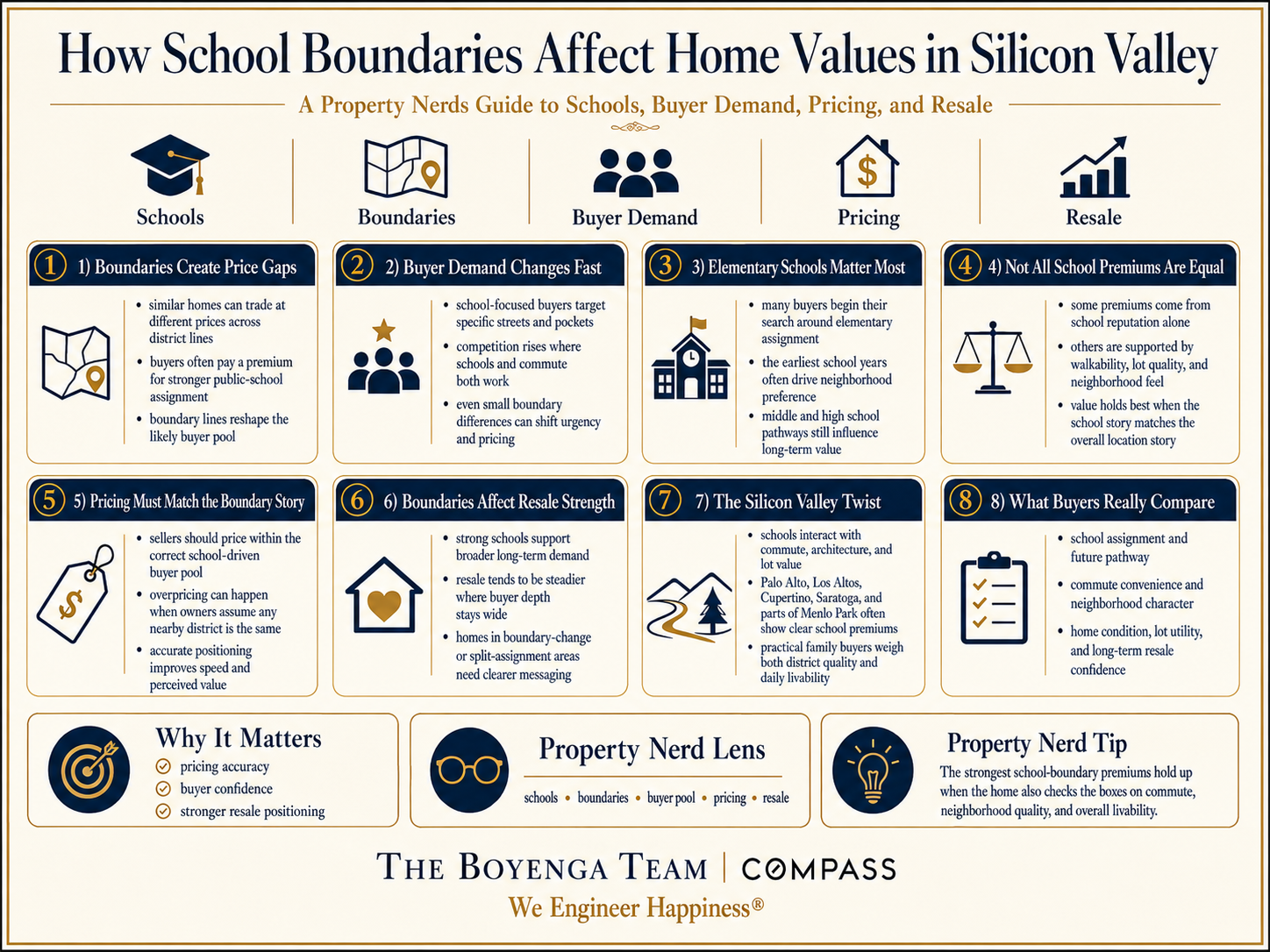
In Silicon Valley real estate, one block can change everything.
Two homes may look almost identical. Same bedroom count. Similar lot size. Similar condition. Similar commute. Similar neighborhood feel.
But if they are assigned to different schools, they may attract different buyer pools, different urgency, different pricing expectations, and different resale outcomes.
That is why school boundaries matter so much in Silicon Valley.
For many buyers, school assignment is not a side detail. It is one of the main value drivers. A home is not just a home. It is a school path, a neighborhood identity, a daily routine, and a future resale story.
The smartest buyers and sellers do not simply ask, “Is this a good school district?”
They ask:
What exact school assignment does this address have, how much does the buyer pool value it, and how does that affect pricing, competition, and resale?
That is the Property Nerds way to look at school boundaries.
Why School Boundaries Matter So Much in Silicon Valley
Silicon Valley attracts buyers who are highly analytical, highly education-focused, and often highly mobile. Many buyers are relocating for tech, startups, Stanford, Apple, Google, Meta, Nvidia, Netflix, Adobe, or Sand Hill Road. They may be comparing cities, commute routes, school districts, private school alternatives, and long-term resale all at once.
For these buyers, school assignment can become a filter.
A buyer may only search within a specific elementary boundary.
A buyer may prioritize a high school assignment.
A buyer may compare two cities primarily through the school path.
A buyer may accept a smaller or older home if the school assignment is strong.
A buyer may pay more for a quiet street inside a sought-after boundary.
A buyer may avoid a home if the school assignment is unclear or unexpected.
That demand can create price differences even between homes that are physically close to one another.
In Silicon Valley, school boundaries are not just education lines. They are market lines.
The Address Is the Truth
One of the biggest mistakes buyers make is assuming school assignment based on city name or neighborhood reputation.
That can be risky.
A Cupertino address does not automatically mean the school path a buyer expects. A Sunnyvale home may be tied to different elementary, middle, or high school districts depending on exact location. Mountain View, Santa Clara, West San Jose, Menlo Park, Los Altos, Palo Alto, Saratoga, and Campbell can all have address-specific school nuances.
Even homes on opposite sides of the same street may sometimes have different assignments.
That is why school assignment should always be verified directly with the relevant school district by exact property address.
Online real estate portals can be helpful starting points, but they should not be treated as final authority. Boundaries can change, enrollment policies can shift, and district tools should be checked before a buyer relies on a school path.
The Property Nerds read: Never buy based on school assumptions. Verify the address.
How School Boundaries Influence Home Value
School boundaries affect value by changing the depth and motivation of the buyer pool.
When a home is tied to a highly sought-after school path, more buyers may be willing to compete. That can lead to stronger showing activity, faster offers, and better price support.
When a home is just outside a sought-after boundary, it may still be a great home, but the buyer pool may shift. Some buyers may remove it from consideration entirely. Others may value it more for commute, lot size, condition, architecture, or relative affordability.
This does not mean every home in a sought-after school boundary automatically sells for more. Property condition, lot utility, street quality, pricing, and market timing still matter. But school assignment can materially change how buyers compare homes.
The Property Nerds read: School boundaries do not replace fundamentals. They amplify or narrow demand.
The “One Block Difference” Problem
The most dramatic school-boundary effects often happen near boundary lines.
A buyer may see two homes in the same general area and assume they are comparable. But if one has a more desired school assignment, the market may treat it differently.
This can happen in many Silicon Valley areas:
Sunnyvale near Cupertino or Los Altos school boundaries.
Mountain View near Los Altos-adjacent school pockets.
West San Jose near Cupertino, Moreland, Campbell, or Saratoga-related boundaries.
Santa Clara near Cupertino/Sunnyvale border areas.
Menlo Park near district boundary changes.
Saratoga and Los Gatos border pockets.
Campbell / Cambrian / Los Gatos edge locations.
Palo Alto pockets where buyers care about exact elementary assignment.
The homes may look similar online, but the buyer demand can be different.
For sellers, this means pricing should not rely only on distance-based comps. A comp across a school boundary may not be a true comp.
For buyers, this means a home that appears “cheaper” may not be a bargain if the school assignment changes the buyer pool.
The Property Nerds read: In school-sensitive markets, the wrong comp can mislead you.
Elementary, Middle, and High School Assignments Can Each Matter Differently
Not all buyers value school levels the same way.
Some buyers care most about elementary school because they have young children and want a neighborhood community.
Some care most about middle school because they see it as a key transition point.
Some care most about high school because high school reputation can drive broad resale demand.
Some buyers care about the entire school path.
Some buyers care less about schools personally but still care because they know future buyers will care.
For example, a home may have a strong elementary assignment but a less desired high school path. Another may have a strong high school assignment but a more mixed elementary perception. Another may sit in a city where the overall school reputation supports demand even if individual school assignments vary.
The Property Nerds read: The school path is a stack. Buyers need to understand all levels, not just one.
School Boundaries and Resale Value
School assignment can strongly influence resale value because future buyers often use the same filters.
A buyer purchasing today should think about the buyer who will purchase later.
Will future buyers understand the school assignment immediately?
Will the school path remain a key demand driver?
Is the home deep inside the boundary or near an edge?
Is the school story strong enough to support resale even if the market cools?
Does the home also have other value drivers, like lot utility, commute, or walkability?
The strongest resale properties often stack multiple advantages:
Verified school path.
Quiet street.
Usable lot.
Functional floor plan.
Good commute.
Strong neighborhood identity.
Move-in condition or clear remodel potential.
School assignment is powerful, but it is even more powerful when paired with a home that works well.
The Property Nerds read: Schools can help resale, but the best homes also solve daily life.
School Boundaries and Buyer Psychology
School-focused buyers often move with urgency, but they also move carefully.
They may study boundary maps, district websites, parent forums, commute routes, test scores, school programs, private school options, and resale history. They may have a very narrow search area. They may be willing to compete aggressively when the right home appears.
That creates opportunity for sellers.
If the school assignment is a major asset, the listing should make it easy for buyers to verify and understand. The marketing should be precise, not vague. It should avoid unsupported claims and instead direct buyers to confirm the school path with the district.
For buyers, the emotional side matters too. A strong school assignment can create confidence, but it can also create pressure. Buyers should still evaluate the home itself and avoid overpaying for a property with serious functional issues.
The Property Nerds read: School demand creates urgency. Good strategy keeps that urgency rational.
How School Boundaries Affect Pricing Strategy
For sellers, school assignment should be part of the pricing analysis.
A home inside a highly sought-after school boundary may justify a different pricing strategy than a similar home just outside it. But the premium depends on the current buyer pool, active inventory, comparable sales, and the property’s condition.
The key is using the right comps.
A comp in a different school boundary may not support the same value. A home with the same school path but inferior condition may also not be the right comparison. The best pricing analysis layers school assignment with home condition, lot, street, size, architecture, and timing.
For buyers, this means looking beyond price per square foot. In school-sensitive markets, price per square foot can be misleading if the homes are not assigned to the same schools or do not serve the same buyer pool.
The Property Nerds read: School boundaries can change the comp set.
How School Boundaries Affect Remodel and Rebuild Decisions
School boundaries can also affect whether a remodel or rebuild makes financial sense.
In a school-focused neighborhood, a dated home may be worth improving because the future family buyer pool is strong. A remodel that creates a functional family home may be rewarded by the market.
In a less school-driven pocket, the same remodel may not produce the same return. Buyers may be more price-sensitive or more focused on commute, architecture, or value.
For rebuilds, school assignment can help support the finished-home value. A new construction home in a sought-after school boundary may attract a deeper buyer pool than a similar home in a less school-driven area.
But school assignment alone is not enough. The lot, street, floor plan, privacy, and neighborhood price ceiling still matter.
The Property Nerds read: Schools can support remodel value, but they do not guarantee remodel ROI.
How School Boundaries Affect Different Silicon Valley Cities
Palo Alto
Palo Alto has broad school-driven demand, and many buyers are drawn to the city because of its school reputation. Still, exact school assignment can matter, especially for buyers focused on specific elementary schools or neighborhood communities.
Neighborhoods like Old Palo Alto, Crescent Park, Professorville, Community Center, Green Gables, Midtown, Palo Verde, Greenmeadow, and Fairmeadow can all attract school-focused buyers, but the property’s exact address should always be verified.
Los Altos
Los Altos is one of the strongest school-focused markets in Silicon Valley. North Los Altos, Old Los Altos, South Los Altos, Loyola, Grant Park, Woodland Acres, and Rancho-adjacent pockets can all attract families looking for schools, quiet streets, and long-term resale.
School boundaries can influence how buyers compare Los Altos, Mountain View, Cupertino, and Sunnyvale.
Cupertino
Cupertino is intensely school-driven. Buyers often focus heavily on elementary, middle, and high school paths, and small boundary differences can significantly affect demand.
Neighborhoods like Monta Vista, Garden Gate, Regnart / Creston, Seven Springs, Oak Valley, Jollyman / Stelling, Portal, Fairgrove, and Rancho Rinconada may all appeal to school-focused buyers, but verification is essential.
Sunnyvale
Sunnyvale is one of the most address-specific school markets. Some areas are highly school-driven, while others are more commute- or value-driven.
Cherry Chase, Cumberland South, Serra Park, Birdland, Ortega / De Anza, Fairbrae, Fairorchard, Ponderosa Park, and Washington Park can all have different buyer dynamics depending on exact assignment.
Mountain View
Mountain View has multiple buyer lanes: Google commute, downtown lifestyle, schools, Eichler architecture, and relative value. School demand can be strong in certain pockets, but the school story is highly address-specific.
Waverly Park, Cuesta Park, Blossom Valley / Springer-Miramonte, Grant / Sylvan Park, St. Francis Acres, and Monta Loma can all attract different school-focused or lifestyle-focused buyers.
Santa Clara
Santa Clara is very commute-sensitive, but school assignment still matters. West-side neighborhoods near Sunnyvale and Cupertino can be especially school-sensitive, while Rivermark and Central Park-area neighborhoods may attract different family buyer pools.
Forest Park, Laurelwood, Santa Clara Woods, Central Park / Westwood Oaks, Mariposa Gardens, Old Quad, and Rivermark should all be evaluated by exact address.
West San Jose and Cambrian
West San Jose and Cambrian are classic school-boundary micro-markets. A few blocks can change buyer demand dramatically.
Moreland, Payne, Country Lane, Happy Valley, Westgate, Bollinger / Miller, Lawrence / Mitty, Quito / Bucknall, Cambrian Park, and Campbell/Cambrian border areas all need address-level school verification.
Menlo Park and Atherton
Menlo Park and Atherton have strong school-sensitive pockets, but assignments vary. Central Menlo, Allied Arts, West Menlo Park, Sharon Heights, Belle Haven, Suburban Park, Menlo Oaks, Atherton-border areas, West Atherton, Lindenwood, and Lloyden Park can all carry different school and buyer-pool implications.
Los Gatos and Saratoga
Los Gatos and Saratoga both attract school-focused buyers, but the buyer psychology differs. Saratoga is often more intensely school-driven, while Los Gatos often blends schools with Village lifestyle, trails, and foothill charm.
Boundary verification is especially important near Los Gatos / Cambrian, Saratoga / Campbell, Saratoga / West San Jose, and Monte Sereno border areas.
Campbell
Campbell has a mix of lifestyle-driven and school-by-address demand. Some buyers focus on Downtown Campbell, Pruneyard, trail access, or relative value, while others are highly school-sensitive depending on the exact pocket.
San Tomas, West Campbell, John D. Morgan / Rincon, Dry Creek, Campbell / Los Gatos border, Campbell / Saratoga border, and Campbell / Cambrian border areas should be evaluated carefully.
The Risk of Marketing Schools Incorrectly
Sellers and agents need to be careful when marketing school assignments.
Incorrect school information can create buyer confusion, legal exposure, and transaction risk. Even if a seller believes the assignment is correct, buyers should always be advised to verify directly with the district.
The best approach is precise and careful:
List the currently understood assigned schools only if verified.
Encourage buyers to confirm with the school district.
Avoid making broad claims like “best schools” without context.
Do not assume based on neighborhood reputation.
Be careful near boundary lines.
Use district resources where appropriate.
The Property Nerds read: School marketing should be accurate, cautious, and buyer-verifiable.
What Buyers Should Ask Before Writing an Offer
School-focused buyers should ask:
What schools are currently assigned to this address?
Have we verified directly with the district?
Is the home near a boundary line?
Could enrollment policies affect attendance?
Are there transfer rules or special programs?
Does the full elementary-middle-high path work for us?
How does the commute work after school drop-off?
Is the street safe and quiet enough for our family?
Does the home function well for daily life?
Will future buyers value the same school assignment?
A strong school assignment is valuable, but it should not distract from property fundamentals.
What Sellers Should Do Before Listing
Sellers in school-sensitive markets should prepare carefully.
Verify the current school assignment.
Understand the correct comp set.
Prepare disclosures early.
Highlight family-friendly features.
Stage rooms with clear function.
Show the yard well.
Mention parks and commute access.
Avoid overclaiming.
Make buyer verification easy.
Price according to the real buyer pool.
The goal is to help buyers feel confident, not pressured.
The Property Nerds Bottom Line
School boundaries can have a major impact on home values in Silicon Valley because they shape buyer demand.
But school assignment is not the whole story.
The strongest school-focused homes combine a verified school path with a quiet street, usable lot, functional floor plan, logical commute, strong neighborhood identity, and clear future resale demand.
The smartest buyers do not simply ask, “What are the schools?”
They ask:
Is the assignment verified?
How deep is the buyer pool?
Is the home deep inside the boundary or on the edge?
Does the street support the value?
Does the lot work for family life?
Does the floor plan function?
Does the commute make sense?
Will future buyers care about the same school path?
For sellers, the same logic applies. A school assignment can be a powerful value driver, but it must be positioned accurately and supported by the home’s real strengths.
In Silicon Valley real estate, the address matters.
The boundary matters.
The buyer pool matters.
And the strategy matters.
Thinking About Buying or Selling in a School-Sensitive Silicon Valley Neighborhood?
The Boyenga Team at Compass helps buyers and sellers navigate school-boundary real estate with a Property Nerds approach — blending neighborhood knowledge, school-boundary awareness, pricing strategy, buyer-pool analysis, lot evaluation, commute logic, staging strategy, disclosures, and long-term resale thinking.
Whether you are comparing Palo Alto and Los Altos, Cupertino and Sunnyvale, Mountain View and Santa Clara, Saratoga and Los Gatos, Menlo Park and Atherton, or school-by-address opportunities in West San Jose, Cambrian, Campbell, or San Jose, Eric and Janelle Boyenga can help you understand the neighborhood math before you make your move.
Because in Silicon Valley, school boundaries do not just affect where students go.
They can affect what buyers will pay.