

Blog > Four Eichler Markets, Four Ownership Equations: How Palo Alto, Mountain View, Sunnyvale, and San Mateo Deliver Different Long-Term Value
Four Eichler Markets, Four Ownership Equations: How Palo Alto, Mountain View, Sunnyvale, and San Mateo Deliver Different Long-Term Value
by
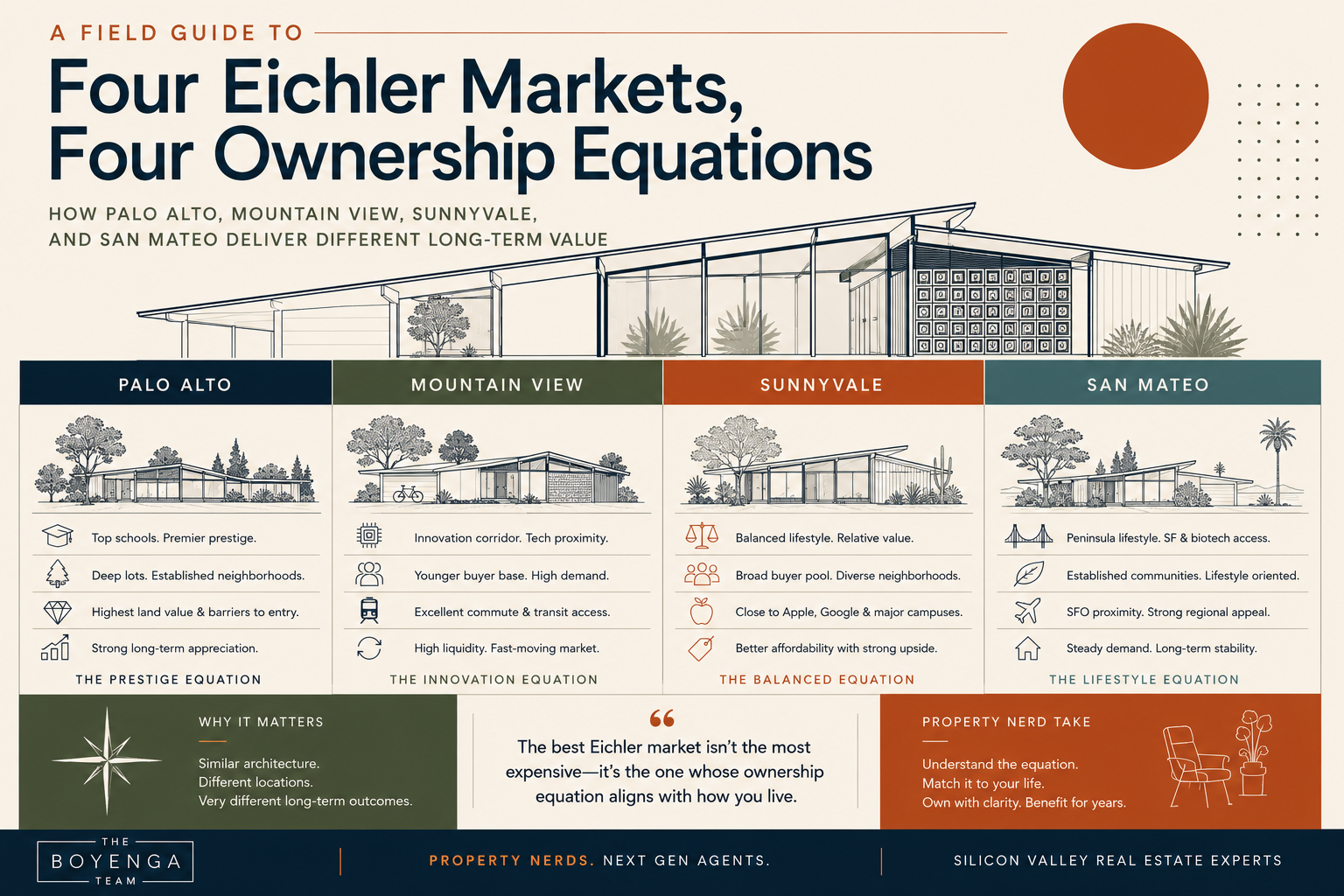 The enduring appeal of an Eichler home is often described through architecture. Buyers talk about atriums, post-and-beam construction, floor-to-ceiling glass, and the effortless connection between indoor and outdoor living. Those features are undeniably central to the Eichler experience, but they tell only part of the story.
An Eichler in Palo Alto is solving a different problem than an Eichler in Sunnyvale. A buyer choosing San Mateo is often making a fundamentally different lifestyle decision than someone competing for a home in Mountain View. The architecture may feel familiar, but the ownership experience changes dramatically from one market to another.
That distinction matters because real estate appreciation isn't driven by architecture alone. It is shaped by schools, employment centers, neighborhood identity, transportation, inventory, buyer psychology, and the long-term desirability of the community surrounding the home. Understanding those forces helps explain why nearly identical Eichlers can command very different prices—and why each market continues attracting a different kind of buyer.
For those beginning their search, understanding Silicon Valley's broader market dynamics provides valuable context before narrowing the focus to individual Eichler neighborhoods. The Boyenga Team's market guides at https://boyengarealestateteam.com offer a comprehensive overview of the communities that define the region.
One Architectural Language, Four Distinct Markets
Joseph Eichler developed communities throughout Northern California with a remarkably consistent architectural philosophy. Regardless of location, buyers can expect abundant natural light, open floor plans, exposed structural elements, and an emphasis on indoor-outdoor living. Walking through an Eichler neighborhood in Sunnyvale feels immediately familiar to someone who has toured homes in Palo Alto or Mountain View.
Yet the similarities begin to fade once buyers look beyond the architecture.
Each city has evolved within a different economic, educational, and geographic context. Those differences influence everything from daily routines to resale performance, creating four distinct ownership equations that extend well beyond the homes themselves.
Palo Alto: Where Architecture Meets Prestige
Among Eichler markets, Palo Alto occupies a category of its own.
The architecture is only one part of the value proposition. Equally important are proximity to Stanford University, mature tree-lined neighborhoods, and some of the most valuable residential land in Northern California. Buyers entering this market are often motivated by long-term planning as much as architectural appreciation.
Because land values account for a significant portion of overall pricing, Palo Alto Eichlers frequently command substantial premiums even when compared with architecturally similar homes elsewhere. Renovations also tend to be particularly thoughtful, reflecting the expectations of buyers who view these homes as both residences and long-term investments.
Inventory remains consistently limited, and homes often attract significant attention whenever they reach the market. For many owners, purchasing a Palo Alto Eichler represents a commitment measured in decades rather than years.
Detailed neighborhood guides, architectural histories, and current listings can be explored through the Boyenga Team's dedicated Bay Area Eichler Homes resource at https://bayareaeichlerhomes.com.
Mountain View: Architecture at the Center of Innovation
Mountain View tells a different story.
Its Eichler neighborhoods benefit from extraordinary proximity to some of the world's most influential technology companies, including Google and numerous startups throughout the innovation corridor. For many buyers, commuting convenience becomes just as important as architectural character.
The result is a market defined by liquidity.
Homes often attract tech professionals and move-up buyers who value modern design while remaining close to employment centers. The buyer pool tends to be broad, active, and highly competitive, creating consistent demand even during periods when other markets experience slower activity.
Mountain View also balances walkability, public transportation, and regional connectivity in ways that appeal to buyers seeking flexibility rather than permanence. Many owners eventually remain far longer than they originally expected, drawn not only by the architecture but also by the surrounding community.
Sunnyvale: The Balanced Ownership Equation
Sunnyvale has quietly become one of Silicon Valley's most compelling Eichler markets.
While it may not carry the same international reputation as Palo Alto, it offers something many buyers increasingly prioritize: balance.
Its neighborhoods provide exceptional access to Apple, Google, NVIDIA, and other major employers while maintaining a broader range of price points than neighboring communities. Buyers appreciate established residential neighborhoods, and the ability to enjoy modern architecture without entering the highest tier of Silicon Valley pricing.
This balance also creates one of the region's deepest buyer pools.
First-time Eichler buyers frequently begin their search in Sunnyvale before expanding elsewhere. Others intentionally choose Sunnyvale because they believe it offers one of the strongest combinations of lifestyle, accessibility, and long-term appreciation potential.
Rather than representing a compromise, Sunnyvale often becomes the market where buyers discover the ownership equation aligns most closely with their priorities.
San Mateo: A Different Peninsula Lifestyle
Although architecturally similar, San Mateo Eichlers serve an entirely different geography.
Positioned along the Peninsula, these neighborhoods attract buyers whose lives extend beyond Silicon Valley's traditional technology corridor. Access to San Francisco, biotechnology employers in South San Francisco, San Francisco International Airport, and the broader Peninsula all influence purchasing decisions.
The pace also feels different.
Many neighborhoods emphasize established residential character, mature landscaping, and strong community identity over rapid growth. Buyers often place greater value on regional accessibility and lifestyle flexibility than proximity to a single employment center.
That distinction creates a market with remarkably consistent long-term demand, supported by buyers seeking Peninsula living rather than exclusively Silicon Valley employment.
Why Similar Homes Sell for Different Prices
It is tempting to compare Eichlers by square footage, floor plan, or architectural condition alone. Yet those characteristics explain only part of the pricing differences observed across these four markets.
School district boundaries influence demand and long-term resale. Employment centers shape buyer competition, particularly in markets where commuting convenience carries meaningful value. Land scarcity, neighborhood identity, and local inventory patterns all contribute to pricing dynamics that have little to do with the architecture itself.
Even buyer expectations vary from city to city. In Palo Alto, architectural preservation may carry exceptional weight. In Mountain View, renovated kitchens and work-from-home flexibility often receive greater attention. Sunnyvale buyers frequently seek overall value, while Peninsula buyers may prioritize regional accessibility.
Understanding those differences allows buyers to think beyond individual listings and evaluate the broader market forces supporting long-term ownership.
For buyers interested in the broader world of mid-century architecture beyond Eichler neighborhoods, https://midmodhomes.com offers additional resources focused on modern homes throughout the Bay Area.
Choosing the Right Ownership Equation
The most expensive Eichler market is not automatically the best investment.
Likewise, the lowest entry price does not necessarily represent the greatest opportunity.
The strongest purchase is usually the one that aligns architecture with lifestyle.
A buyer planning to remain for twenty years may value school boundaries and neighborhood stability above all else. A technology professional may prioritize proximity to major campuses and future liquidity. Another buyer may simply want a thoughtfully designed home that balances affordability with long-term appreciation.
Each market solves a different problem.
Recognizing that distinction often leads to better long-term decisions than simply chasing prestige or the lowest price.
The Boyenga Team regularly examines these relationships between architecture, neighborhoods, and buyer behavior through the Property Nerds Blog, where design, market analysis, and long-term ownership strategy come together.
Explore more at https://www.boyengateam.com/blog.
The Property Nerd Take
The enduring appeal of an Eichler home begins with architecture, but its long-term value is ultimately shaped by place. Palo Alto, Mountain View, Sunnyvale, and San Mateo all offer authentic mid-century modern neighborhoods, yet each represents a different ownership equation built around schools, employment, lifestyle, scarcity, and buyer psychology.
For thoughtful buyers, the objective isn't to identify the "best" Eichler market. It's to understand which market aligns most naturally with the life they want to build over the next decade. When architecture and lifestyle reinforce one another, ownership becomes about far more than appreciation—it becomes about living in a home that continues to feel right long after the purchase is complete.
keep exploring · property nerd guides
Palo Alto homes, neighborhoods & schools in one guide
Live listings, recent sales, ZIP codes, school districts and commute notes for Palo Alto, from the Property Nerds® of the Boyenga Team at Compass.
Open the Palo Alto guideWhat’s my home worth?
Talk to a Property Nerd: (408) 373-1660 · (650) 383-8606
city guides Los Altos · Menlo Park · Cupertino · Sunnyvale · Los Gatos · San Jose