

Blog > A Field Guide to Silicon Valley Modernism: Eichler, Mackay, Streng, and Custom Post-and-Beam Homes
A Field Guide to Silicon Valley Modernism: Eichler, Mackay, Streng, and Custom Post-and-Beam Homes
by
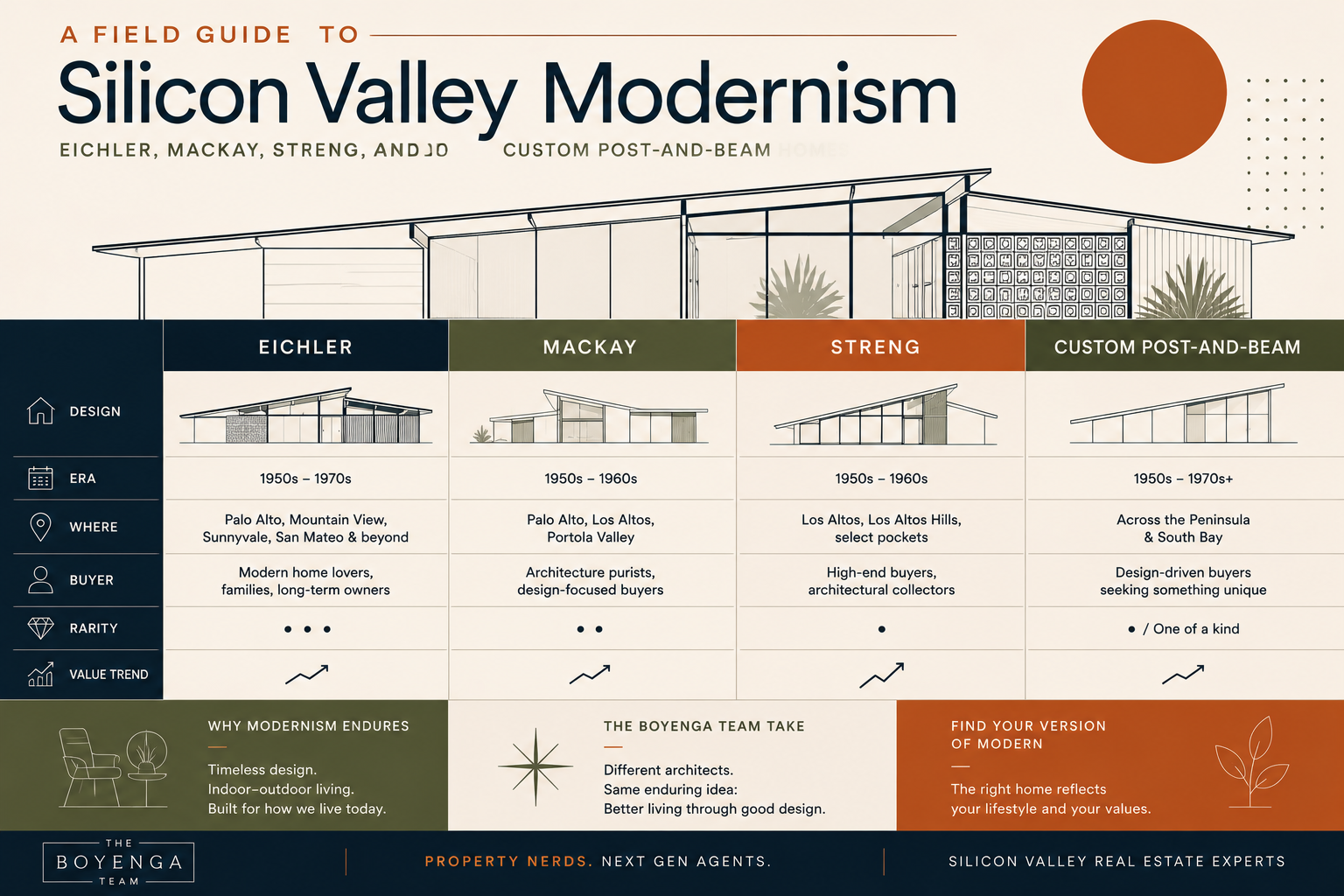 Silicon Valley is celebrated for changing how the world works, but long before it became synonymous with technology, it quietly reshaped how people lived. In the decades following World War II, a generation of visionary architects and developers rejected the conventions of suburban housing and embraced a radically different idea: homes filled with light instead of walls, connected to gardens instead of fenced off from them, and designed around everyday living rather than formal entertaining.
Today, those ideas define some of the Bay Area's most recognizable neighborhoods. Yet despite the growing popularity of mid-century modern architecture, many buyers still use "Eichler" as a catch-all term for nearly every flat-roofed home with walls of glass.
The reality is far more interesting.
Silicon Valley's modernist landscape is a collection of distinct architectural voices. Joseph Eichler made great design accessible to the middle class. Donald and Doris Mackay pursued a quieter, more organic interpretation of modernism. William Streng expanded California's architectural movement beyond the Bay Area, while countless architects created one-of-a-kind post-and-beam homes that remain some of Northern California's most extraordinary residences.
Understanding those differences isn't simply an exercise in architectural history. It fundamentally changes how buyers evaluate neighborhoods, understand long-term value, and appreciate why certain homes inspire almost cult-like loyalty.
For buyers beginning their search, architecture rarely exists in isolation. It intersects with schools, commute patterns, neighborhood character, and future resale—all topics explored throughout the Boyenga Team's Silicon Valley market resources at https://boyengarealestateteam.com.
Modernism Was a Philosophy, Not a Style
What united California's modern architects wasn't a particular roofline or floor plan. It was a shared belief that houses should improve the experience of everyday life.
Natural light became an architectural material rather than a byproduct of windows. Gardens became extensions of living rooms. Structural beams were left exposed rather than concealed because honesty in construction was considered beautiful. Ornament gave way to proportion, simplicity, and craftsmanship.
Those principles sound remarkably contemporary today, which helps explain why homes designed more than half a century ago continue feeling fresh.
Each architect, however, interpreted those ideas differently.
Eichler: The Architecture That Changed the Suburbs
Few developers have influenced California residential architecture as profoundly as Joseph Eichler.
Unlike many of his contemporaries, Eichler believed exceptional architecture shouldn't be reserved for luxury estates. Working with firms including Anshen & Allen and Jones & Emmons, he introduced modern design to ordinary neighborhoods without compromising architectural integrity.
The result wasn't simply a collection of attractive homes. It was an entirely different way of living.
Interior atriums became outdoor rooms at the heart of daily life. Glass walls dissolved the boundary between house and garden. Open floor plans encouraged connection long before "open concept" became a marketing phrase. Even the exposed post-and-beam construction reflected Eichler's belief that beautiful engineering deserved to be seen rather than hidden.
Perhaps his greatest achievement, however, was consistency. Entire neighborhoods were designed around the same architectural language, creating communities where individual homes felt connected to something larger than themselves.
Today, that consistency has become one of Eichler neighborhoods' greatest assets. Buyers aren't simply purchasing a house; they're joining one of Silicon Valley's most recognizable architectural communities.
The Boyenga Team's dedicated Bay Area Eichler Homes resource offers detailed neighborhood guides, floor plans, market updates, and architectural insights for buyers exploring these communities.
https://bayareaeichlerhomes.com
Mackay: Modernism With a Softer Voice
Donald and Doris Mackay approached modern architecture differently.
Where Eichler embraced repetition to create cohesive neighborhoods, Mackay homes often feel more personal and more closely connected to their surroundings. Their work favors warmth over drama, using carefully proportioned rooflines, natural materials, and thoughtful site placement to create homes that seem to belong to the landscape rather than sit upon it.
The distinction is subtle, but buyers often notice it immediately.
Mackay homes rarely announce themselves. Instead, they reward careful observation. Sunlight moves differently through their interiors. Views become part of everyday life. Spaces unfold gradually instead of revealing themselves all at once.
Their rarity only deepens their appeal. Because relatively few were built—and even fewer become available for sale—many architecture enthusiasts spend years waiting for the right opportunity.
Streng: A Parallel Chapter in California Modernism
Although William Streng built primarily around Sacramento, his work belongs in any conversation about California modernism.
Streng embraced many of the same principles that made Eichler successful while developing an architectural language that felt distinctly his own. His homes often introduced bolder rooflines and stronger geometric expression without abandoning the openness and simplicity that define mid-century design.
Today, collectors increasingly recognize Streng homes as important examples of California residential architecture in their own right rather than simply "Sacramento Eichlers."
That growing appreciation mirrors a broader trend. Buyers are becoming more knowledgeable about architectural provenance, placing greater value on the history behind a home rather than focusing solely on square footage or finishes.
The Art of the Custom Post-and-Beam Home
If Eichlers represent the democratization of great architecture, custom post-and-beam homes represent its most individual expression.
Scattered throughout Los Altos Hills, Portola Valley, Woodside, and Palo Alto are residences designed specifically for the owners who commissioned them. Rather than working within a production builder's vocabulary, architects responded to each site individually, allowing topography, mature trees, views, and sunlight to shape the final design.
No two are alike.
Some reveal the influence of Frank Lloyd Wright. Others borrow from Japanese residential architecture or Scandinavian Modernism. Many combine those traditions into something entirely unique.
These homes rarely compete with production neighborhoods because buyers are pursuing something fundamentally different. They are purchasing architecture itself.
Buyers interested in exploring the broader world of Bay Area modern homes beyond Eichler neighborhoods can find additional architectural resources through MidModHomes.com.
Looking Beyond the Name
One of the most common mistakes buyers make is assuming the builder alone determines a home's value.
In reality, architectural pedigree is only the beginning.
Original materials often matter more than people expect because authentic restoration becomes increasingly difficult over time. Thoughtful renovations can elevate a home, while insensitive ones may permanently diminish its architectural character. Neighborhood scarcity influences value just as much as design, particularly in communities where owners rarely sell.
Perhaps most importantly, buyers consistently pay for an emotional experience that cannot be measured on a floor plan.
The feeling of morning light entering through floor-to-ceiling glass.
The quiet transition between living room and garden.
The honesty of exposed wood structure.
The simplicity that allows architecture—not decoration—to define a space.
Those qualities explain why modern homes continue attracting new generations of buyers despite changing design trends.
Why Modernism Endures
Many architectural movements become snapshots of a particular era. California Modernism has proven unusually resilient because it wasn't designed around fashion. It was designed around how people actually live.
Buyers still value natural light.
Flexible living spaces remain practical.
Indoor-outdoor connections continue defining California life.
Good proportions never become outdated.
The result is architecture that feels remarkably contemporary despite being more than half a century old.
That longevity has helped transform many of these neighborhoods into some of Silicon Valley's strongest long-term real estate performers—not simply because supply is limited, but because thoughtful design continues attracting thoughtful buyers.
The Boyenga Team regularly explores these relationships between architecture, neighborhoods, and market performance through the Property Nerds Blog, where design, history, and real estate intersect.
Read more at https://www.boyengateam.com/blog.
The Property Nerd Take
The most valuable lesson Silicon Valley's modern neighborhoods offer isn't about architecture alone. It's that great design creates lasting demand.
Joseph Eichler, Donald and Doris Mackay, William Streng, and the architects behind the region's custom post-and-beam homes all approached modernism differently, yet each understood the same essential principle: houses should enrich everyday life.
Decades later, buyers continue responding to that idea. Not because these homes are old, rare, or fashionable, but because they still deliver something increasingly difficult to find—spaces that feel intentional, connected to their surroundings, and designed for living rather than simply occupying.
keep exploring · property nerd guides
Thinking about a move in Silicon Valley?
The Boyenga Team at Compass has helped clients buy and sell more than 2,520 homes since 1996. Start with a guide, a search, or a conversation.
Search Silicon Valley homesWhat’s my home worth?
Talk to a Property Nerd: (408) 373-1660 · (650) 383-8606
city guides Palo Alto · Los Altos · Menlo Park · Cupertino · Sunnyvale · Los Gatos · San Jose