

Blog > Downtown Sunnyvale and CityLine: How Urban Energy Is Changing Buyer Demand
Downtown Sunnyvale and CityLine: How Urban Energy Is Changing Buyer Demand
by
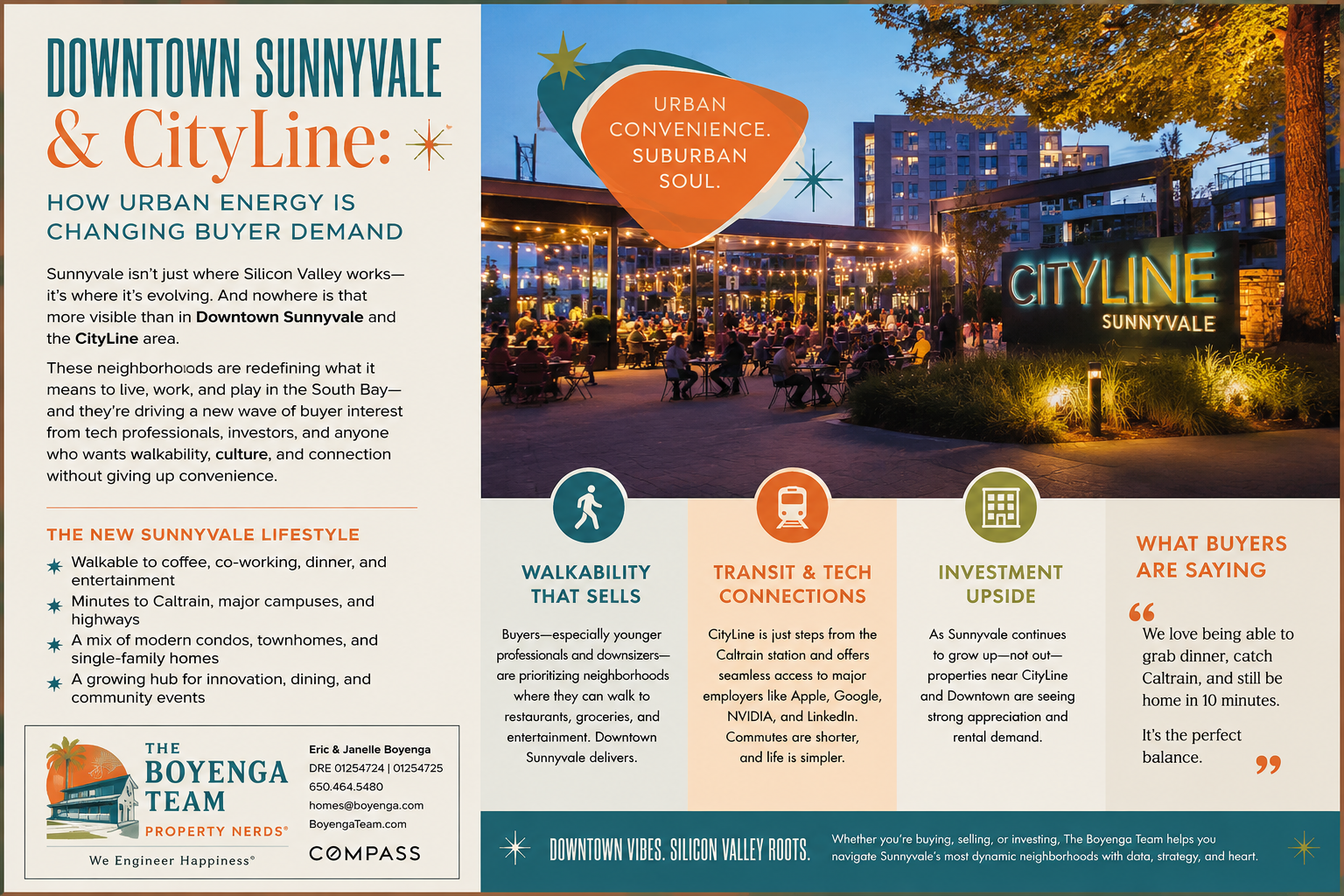
Downtown Sunnyvale is no longer just “the place near Murphy Avenue.”
It is becoming one of Silicon Valley’s most interesting urban-suburban real estate stories — and for buyers and sellers, that shift matters. A neighborhood that once served mostly as a convenient civic and dining center is now becoming a stronger lifestyle anchor with walkability, mixed-use development, Caltrain access, office energy, new residential density, grocery, entertainment, public spaces, and a more polished downtown identity.
That is exactly the kind of real estate evolution the Boyenga Team loves to nerd out on.
Because this is not just a story about new buildings. It is a story about buyer psychology.
For decades, Sunnyvale real estate was often understood through its classic residential neighborhoods: Cherry Chase, Cumberland South, Birdland, Raynor Park, Fairbrae, Ortega Park, Las Palmas, Ponderosa, Lakewood Village, and other school-and-commute-driven pockets. Those neighborhoods still matter deeply. But Downtown Sunnyvale and CityLine are adding another value layer to the city: urban energy.
The City of Sunnyvale describes Downtown Sunnyvale as an approximately 150-acre area bounded generally by the Caltrain tracks, Carroll Street/Bayview Avenue, Olive Avenue/El Camino Real, and Charles Street. The city identifies Historic Murphy Avenue, the Downtown Core, Plaza Del Sol, and Redwood Square as key elements of the downtown, and notes that many new projects are underway, with a majority connected to CityLine.
That is the setup.
Sunnyvale is no longer only a “good commute plus good schools” market.
It is increasingly also a lifestyle market.
The Property Nerd Thesis: CityLine Is Changing the Value Stack
In real estate, the value stack is the combination of reasons a buyer will compete for a home.
In Cherry Chase, the value stack may be school-path demand, classic ranch homes, quiet streets, and west Sunnyvale commute access.
In Birdland and Raynor Park, the value stack may be Apple-area convenience, park access, single-family homes, and remodel upside.
In Fairbrae, the value stack may be Eichler architecture, mid-century identity, school-path interest, and Silicon Valley convenience. For more on Sunnyvale’s architectural side, the Sunnyvale Eichler Homes and Bay Area Eichler Homes Sunnyvale pages are strong internal companion resources.
In Downtown Sunnyvale, the value stack is different.
It is walkability, Caltrain, Murphy Avenue, CityLine, restaurants, grocery, entertainment, office energy, public gathering spaces, lower-maintenance housing, and proximity to major Silicon Valley employers.
That is why Downtown Sunnyvale homes should not be marketed like generic Sunnyvale inventory. A downtown condo, townhome, bungalow, or Heritage District property is not only competing on square footage. It is competing on lifestyle compression.
Lifestyle compression means more of daily life happens closer to home. Coffee, dinner, groceries, transit, errands, workspaces, entertainment, and social life all become easier to access. For buyers, that reduces friction. For sellers, that creates emotional value.
CityLine’s own site describes it as a dynamic Downtown Sunnyvale destination that combines convenience, modern workspaces, thoughtful amenities, and a culture for “all day, everyday” enjoyment.
That is not just development language.
That is a buyer-demand signal.
CityLine Is Not Just a Project. It Is a Downtown Repositioning.
CityLine matters because it gives Downtown Sunnyvale a stronger center of gravity.
The City of Sunnyvale describes CityLine as a 36-acre site in the core of downtown, generally bounded by South Mathilda Avenue, Sunnyvale Avenue, Washington Avenue, and Iowa Avenue. The city also states that the planned development is mixed-use, with retail, dining, entertainment, commercial tenants, residential approvals, and office space.
That is a major repositioning of downtown.
A traditional downtown gives residents a place to eat and shop.
A true mixed-use downtown gives residents a reason to live differently.
That is the Property Nerd distinction.
When buyers see CityLine, they are not just seeing Target, Whole Foods, AMC, restaurants, offices, apartments, and plazas. They are seeing a lifestyle ecosystem. They are asking whether they can live with fewer errands by car, whether they can walk to dinner, whether Caltrain becomes realistic, whether downtown feels safer and more active, whether public spaces create community, and whether owning near downtown will make more sense over time.
CityLine’s construction page describes Phase 2 as under construction, including The Martin with 479 luxury apartments and 29,000 square feet of retail/restaurants, two seven-story office buildings totaling 645,071 square feet, more than 40,000 square feet of outdoor terrace space, 94,062 square feet of ground-floor retail, and Redwood Square as a one-acre public park. It also describes Phase 3 as future development with additional office expansion, retail, mixed-use development, a public park, and art installations.
That is why the buyer conversation is changing.
Downtown Sunnyvale is becoming more than convenient.
It is becoming experiential.
Murphy Avenue Is the Emotional Anchor
CityLine may be the development story, but Historic Murphy Avenue is still the emotional anchor.
Murphy Avenue gives Downtown Sunnyvale its memory, personality, and local rhythm. It is where the downtown feels less like a development and more like a place. Restaurants, patios, coffee, casual meetups, street activity, and a walkable corridor all shape how buyers experience the neighborhood.
The City of Sunnyvale calls Murphy Avenue a popular dining and entertainment destination and notes that the city is converting the 100 block of South Murphy Avenue into a pedestrian-only mall. The city’s page also states that Council adopted a conceptual design in November 2024 and that staff would develop construction documents and plans for bidding in summer 2025.
That pedestrian-mall detail matters.
A street with cars is a corridor.
A pedestrian street can become a living room.
For real estate, that matters because pedestrian energy changes how buyers feel about nearby homes. A buyer may be willing to accept less private yard space if the neighborhood gives them restaurants, coffee, events, and a true downtown routine. A downsizer may prefer a smaller home if it means less driving. A tech buyer may value being able to walk to dinner after a long workday. A relocation buyer may see Downtown Sunnyvale as easier to understand because Murphy Avenue gives the area a recognizable lifestyle center.
This is why a Downtown Sunnyvale listing should never just say “close to Murphy Avenue.”
It should explain the routine.
Morning coffee.
Dinner without a drive.
Caltrain access.
CityLine shopping.
Walkable errands.
A downtown that is becoming more active, more complete, and more urban-suburban.
That is the buyer story.
Caltrain Is the Mobility Layer
Downtown Sunnyvale’s transit access is a major part of the value story.
Caltrain describes Sunnyvale as being at the heart of Silicon Valley and notes that the Sunnyvale station empties out onto Murphy Avenue, making the area a transit-adjacent downtown destination.
For buyers, that creates mobility optionality.
A downtown resident may drive to Apple, bike locally, take Caltrain to Palo Alto or San Francisco, use shuttles, work from home part of the week, or combine multiple commute methods. Modern Silicon Valley buyers rarely think in one commute pattern forever. They know careers change. They know hybrid work changes schedules. They know one household may have two different work destinations.
That is why Downtown Sunnyvale homes can appeal to a buyer who does not even use Caltrain every day.
Transit access is not just about daily ridership.
It is about optionality.
And optionality is a Silicon Valley value driver.
The Buyer Shift: From “Where Do I Sleep?” to “How Does My Life Work?”
The old way of evaluating a home was simple: bedrooms, bathrooms, square footage, lot size, condition, price.
Those still matter.
But Downtown Sunnyvale buyers add another layer: daily utility.
Can I walk to dinner?
Can I get groceries without making a trip across town?
Can I take Caltrain?
Can I meet friends nearby?
Can I work from home, then walk outside and feel connected?
Can I own in Sunnyvale without living a fully car-dependent lifestyle?
Can I be near Apple, Google, Nvidia, LinkedIn, Amazon, Intuitive, and the broader tech ecosystem while still having an actual neighborhood center?
This is the CityLine effect.
It changes what buyers notice.
A buyer touring a downtown-adjacent condo may care less about a private yard and more about parking, storage, HOA health, balcony function, noise, elevator access, office space, and walkability.
A buyer touring a Heritage District bungalow may care about charm, lot size, remodel potential, and proximity to Murphy Avenue.
A buyer touring a townhome near downtown may care about work-from-home function, garage utility, EV charging, and whether the home feels private enough while still being close to the action.
The home is still important.
But the neighborhood becomes part of the floor plan.
Downtown Sunnyvale Homes Are Becoming Lifestyle Assets
The phrase “Downtown Sunnyvale homes” includes multiple product types, and each has a different buyer pool.
A condo near CityLine may appeal to tech professionals, investors, first-time buyers, and downsizers who want low-maintenance ownership near restaurants, Caltrain, grocery, and entertainment.
A townhome near downtown may appeal to buyers who want more space than a condo but still want an urban-suburban routine.
A Heritage District cottage or bungalow may appeal to buyers who want walkability and character, not just density.
A single-family home near downtown may appeal to a very specific buyer who wants land plus walkability — one of the most difficult combinations to find in Silicon Valley.
That is why the Boyenga Real Estate Team would not position these properties the same way. The marketing for each property type should identify the buyer’s pain point and solve it.
For the condo buyer, the pain point may be convenience.
For the townhome buyer, it may be lifestyle without too much maintenance.
For the single-family buyer, it may be walkability without giving up ownership of land.
For the investor, it may be rental-demand logic and future downtown momentum.
For the downsizer, it may be access without isolation.
That is Property Nerd positioning.
CityLine Gives Relocation Buyers a Map
Relocation buyers often know Sunnyvale because of tech.
They may know Apple. They may know Google. They may know LinkedIn, Amazon, Nvidia, or Meta. But they may not know the difference between Cherry Chase, Lakewood Village, Heritage District, Fairbrae, Birdland, and Las Palmas.
CityLine helps them understand Downtown Sunnyvale quickly.
It gives them a mental map: mixed-use downtown, Murphy Avenue, Caltrain, grocery, entertainment, restaurants, office, new residences, public spaces, and a more active core.
That matters because relocation buyers need confidence. They are often making expensive decisions quickly, sometimes while comparing Sunnyvale with Mountain View, Palo Alto, Santa Clara, Cupertino, San Jose, and Los Altos.
A well-marketed Downtown Sunnyvale home should educate them.
It should not assume they know why CityLine matters.
The listing copy, neighborhood description, photography, video, floor plan, map assets, and digital campaign should all connect the dots.
This is where the Boyenga Team and Boyenga Group approach is useful: Silicon Valley buyers need neighborhood interpretation, not just property exposure.
The Downsizer Angle: Downtown Energy Without a Fully Urban City
Downtown Sunnyvale may become increasingly attractive to downsizers.
Many downsizers do not want isolation. They may be leaving a larger home in Sunnyvale, Los Altos, Cupertino, Palo Alto, Mountain View, or Saratoga. They may want less yard maintenance, but they do not necessarily want a sleepy environment. They may want restaurants, coffee, grocery, transit, parks, and activity nearby.
Downtown Sunnyvale offers a middle lane.
It is more active than a purely suburban cul-de-sac, but less intense than San Francisco or downtown San Jose. It can offer a more manageable lifestyle with Silicon Valley access.
For sellers, this matters because the marketing should not only target young tech buyers. A downtown condo, townhome, or single-level character property may also be a downsizer play.
This buyer notices different things.
They notice stairs. They notice parking. They notice storage. They notice safety. They notice noise. They notice elevator access. They notice whether guests can visit. They notice whether they can walk to dinner but still come home to peace.
A strong listing speaks to that.
The Tech Buyer Angle: Hybrid Work Plus Lifestyle
Tech buyers are changing, too.
The old tech-buyer stereotype was simple: live near work.
Today’s tech buyer is more complex. They may work hybrid. They may need a real home office. They may own an EV. They may take Caltrain occasionally. They may work at Apple today, Google tomorrow, and a startup later. They may want downtown amenities not because they are “urban,” but because they are busy.
CityLine and Downtown Sunnyvale can appeal to this buyer because the area reduces friction.
Less time driving for errands.
More restaurant options nearby.
Transit if needed.
Shorter access to major employers.
A home base that can work across different job changes.
A lifestyle that feels efficient.
That is why Downtown Sunnyvale homes should be marketed with a tech-buyer lens.
Show the office.
Show the garage.
Show EV charging or electrical readiness if present.
Show storage.
Show the commute logic.
Show the Caltrain story.
Show the balcony, patio, or outdoor break space.
Show how the home works on both office days and remote days.
Tech buyers are not just buying proximity to work.
They are buying a system.
The Investor Angle: Downtown Momentum Can Broaden Demand
Investors may also watch Downtown Sunnyvale more closely as CityLine matures.
Mixed-use districts can create rental appeal because renters often value walkability, transit, restaurants, grocery, entertainment, and employer proximity. Downtown Sunnyvale can attract tech renters, relocation renters, temporary corporate renters, and people who want a more connected lifestyle without buying immediately.
That does not mean every downtown property is automatically a great investment. HOA dues, rental restrictions, insurance, property taxes, vacancy, condition, financing, and local rules all matter.
But CityLine can strengthen the investment story by making downtown more recognizable and complete.
For sellers, this can broaden the buyer pool.
A downtown condo might appeal to an owner-occupant and an investor.
A townhome might appeal to a tech buyer and a long-term rental strategist.
A single-family Heritage District property might appeal to a lifestyle owner and a buyer thinking about long-term land value.
The Boyenga Team’s job is to identify all credible buyer pools and position the property accordingly.
The Trade-Offs: Urban Energy Has a Price
Downtown energy is not free.
Buyers need to understand the trade-offs, and sellers need to be realistic.
Downtown Sunnyvale homes may involve more noise, more density, more parking complexity, more HOA details, more pedestrian activity, and more construction-related change than traditional residential neighborhoods. A property near Caltrain may be convenient but may also have sound considerations. A home near Murphy Avenue may feel vibrant but may not suit a buyer who wants total quiet. A condo near CityLine may offer amenities and walkability but may compete with newer rental inventory or other attached-home supply.
This is why the Property Nerd framing matters.
Urban energy is a feature for some buyers and an objection for others.
The best marketing does not pretend every buyer wants downtown.
It identifies the buyer who does.
Downtown Sunnyvale vs. Cherry Chase, Birdland, Fairbrae, and Lakewood Village
Downtown Sunnyvale is one version of Sunnyvale value. It should be compared thoughtfully with other neighborhoods.
Cherry Chase is the classic school-focused family neighborhood story.
Birdland and Raynor Park are west Sunnyvale fundamentals, park access, Apple-area commute, and ranch-home flexibility.
Fairbrae is the Eichler and mid-century modern story. Sellers with architectural homes should also point readers toward EichlerHomesForSale.com and BayAreaEichlerHomes.com because those platforms speak to a different kind of buyer psychology.
Las Palmas is a park-centered lifestyle story.
Lakewood Village is a north Sunnyvale tech-access and relative-value story.
Downtown Sunnyvale and the Heritage District are the walkability, Caltrain, Murphy Avenue, CityLine, and urban-suburban lifestyle story.
There is no universal winner.
The best Sunnyvale neighborhood is the one that solves the buyer’s real life.
What Sellers Near Downtown Sunnyvale Should Highlight
A Downtown Sunnyvale seller should make the lifestyle obvious.
Not implied.
Obvious.
If the home is near Murphy Avenue, explain that connection. If CityLine is part of the daily routine, describe it. If Caltrain is practical, say so accurately. If the property has parking, storage, EV charging, a balcony, a patio, a real office, or a quiet interior location, highlight those features. If the HOA is strong, make documents available early. If the home is a single-family property near downtown, emphasize the rarity of land plus walkability.
The Boyenga Team’s marketing would typically lean into lifestyle mapping.
Where do you get coffee?
Where do you eat dinner?
Where is Caltrain?
Where do guests park?
Where does work-from-home happen?
Where is the outdoor space?
How does the home feel when downtown is active?
What is the micro-location advantage over competing properties?
That is the difference between generic marketing and Property Nerd marketing.
What Sellers Should Avoid
Sellers should avoid vague claims.
“Close to downtown” is weak.
“Near CityLine” is better, but still incomplete.
The strongest marketing explains why it matters.
Buyers should understand whether the home offers walkable dining, Caltrain convenience, grocery access, lower-maintenance living, downtown energy, or future resale appeal tied to a more active urban core.
Sellers should also avoid hiding trade-offs.
If parking is limited, be clear. If there is train noise, price and position with realism. If the HOA has upcoming work, disclose early. If the unit is near a busy street, market the strengths without pretending the street does not exist. Smart buyers appreciate transparency.
The goal is not hype.
The goal is confidence.
Why Internal Linking Matters for This Article
From an SEO standpoint, this topic should connect to the full Boyenga ecosystem.
A Downtown Sunnyvale / CityLine article should naturally link to the main Boyenga Team site for Silicon Valley real estate authority, Boyenga.com for broader brand trust, BoyengaGroup.com for team and seller-resource depth, and BoyengaRealEstateTeam.com for blog and neighborhood strategy content.
It should also connect to specialty assets when relevant. If the article references Sunnyvale Eichlers, mid-century homes, or Fairbrae, link to EichlerHomesForSale.com, the Sunnyvale Eichler Homes search page, and BayAreaEichlerHomes.com/Sunnyvale. That creates a stronger internal web for buyers who move from downtown lifestyle content into architecture-specific searches.
The SEO logic is simple: a reader interested in Sunnyvale real estate trends may also be interested in Sunnyvale neighborhoods, Sunnyvale Eichlers, Sunnyvale school-boundary content, tech-commute content, and seller-prep content.
The article should guide them there.
The Boyenga Team’s Property Nerd Strategy for Downtown Sunnyvale Sellers
The Boyenga Team positions Downtown Sunnyvale homes around buyer intent.
For a Heritage District home, the story may be character plus walkability.
For a downtown condo, the story may be low-maintenance ownership plus Caltrain and CityLine.
For a townhome, the story may be work-from-home function, garage utility, storage, downtown access, and Silicon Valley commute optionality.
For a single-family property near downtown, the story may be land plus lifestyle.
For an investor-friendly property, the story may be rental appeal, location, transit, and downtown momentum.
For a downsizer-friendly property, the story may be ease, access, parking, safety, and daily convenience.
This is how the Boyenga Team turns a listing into a targeted campaign.
Not every buyer wants Downtown Sunnyvale.
But the right buyer may want it badly.
The marketing should find that buyer and make the value obvious.
Final Property Nerd Takeaway
Downtown Sunnyvale and CityLine are changing buyer demand because they are changing what Sunnyvale can mean.
Sunnyvale is still a tech-proximity market.
It is still a school-neighborhood market.
It is still a ranch-home and Eichler market.
It is still a family-housing market.
But downtown is adding a stronger lifestyle layer.
CityLine, Murphy Avenue, Caltrain, retail, restaurants, grocery, entertainment, office development, apartments, public parks, and pedestrian energy are creating a more urban-suburban Sunnyvale. That shift is attracting tech buyers, downsizers, relocation buyers, investors, and lifestyle-focused owners who want Silicon Valley access without a fully car-dependent routine.
For buyers, the opportunity is to choose the right version of downtown living.
For sellers, the opportunity is to market the lifestyle clearly, specifically, and intelligently.
At the Boyenga Team, we bring a Property Nerd and Next Gen Agent approach to Sunnyvale real estate — combining development awareness, neighborhood expertise, commute analysis, buyer psychology, Compass-powered marketing, and digital storytelling.
Because in Downtown Sunnyvale, the value is not only in the home.
It is in the energy building around it.
The Boyenga Team
Sunnyvale & Silicon Valley Real Estate Experts
Compass
BoyengaTeam.com
Boyenga.com
BoyengaGroup.com
BoyengaRealEstateTeam.com
EichlerHomesForSale.com
BayAreaEichlerHomes.com
Email: homes@boyenga.com