

Blog > Cupertino vs Sunnyvale: Schools, Apple Commute, and Resale Value
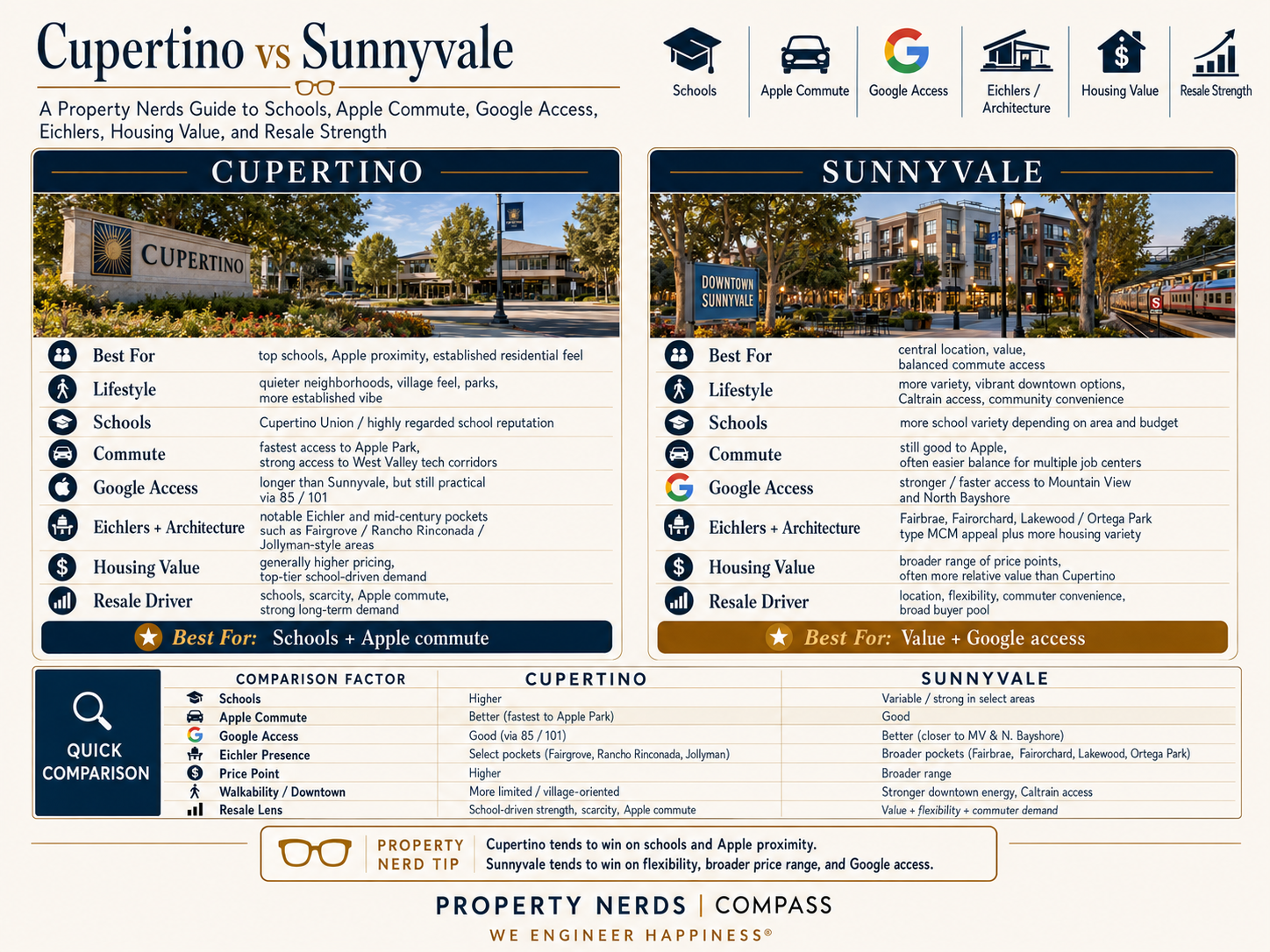
Cupertino and Sunnyvale are two of the most important real estate markets for Apple-area buyers, school-focused families, tech commuters, and long-term Silicon Valley homeowners.
They sit next to each other, share major commute corridors, and often compete for the same buyers. But they are not the same market.
Cupertino is often about school-driven demand, Apple proximity, prestige, neighborhood scarcity, and long-term family resale value.
Sunnyvale is often about housing variety, Apple and Google commute flexibility, parks, Eichlers, downtown energy, and relative value compared with Cupertino, Los Altos, and Mountain View.
The smartest question is not, “Which city is better?”
The better question is:
Which city gives you the best combination of school path, commute, neighborhood feel, housing type, budget, and future resale demand?
That is where the Property Nerds of the Boyenga Team look deeper. In Cupertino and Sunnyvale, value can shift block by block based on school assignment, street quality, lot utility, road exposure, commute route, remodel potential, and whether future buyers will understand the value story.
The Simple Difference
Choose Cupertino if you want a more school-driven, Apple-centered, family-focused market with strong buyer recognition and long-term resale demand.
Choose Sunnyvale if you want more neighborhood variety, more housing options, potentially better relative value, access to both Apple and Google corridors, Eichler and mid-century pockets, and a growing downtown lifestyle.
Both can be excellent. The right answer depends on the specific property.
Cupertino: Best for Schools, Apple Proximity, and Long-Term Family Demand
Cupertino is one of Silicon Valley’s most recognized school-driven markets. Buyers often come to Cupertino with a very clear priority list: schools, Apple commute, parks, quiet streets, and resale strength.
Cupertino has a strong international and tech-buyer reputation. Many buyers understand the city before they understand the individual neighborhoods. That city-level recognition can help support demand, especially for homes in well-known neighborhoods with strong school assignments and good commute access.
Top Cupertino neighborhoods include:
Monta Vista
Garden Gate
Rancho Rinconada
Seven Springs
Oak Valley
Jollyman / Stelling
Fairgrove
Portal / Portal Park
Main Street / Vallco
Regnart / Creston
Linda Vista
Northpoint / Idlewild
Homestead / North Cupertino
Cupertino is especially strong for buyers who want a highly recognizable school and Apple commute story. Homes in the right pocket can attract deep demand from families who are planning around education, commute convenience, and long-term ownership.
The Property Nerds read: Cupertino is the stronger choice for buyers who want school-driven resale strength and direct Apple-area identity.
Sunnyvale: Best for Housing Variety, Apple/Google Flexibility, and Relative Value
Sunnyvale is one of Silicon Valley’s most strategic real estate markets because it gives buyers more ways to win.
A buyer can find school-driven family neighborhoods, Apple-commute ranch homes, Eichler and mid-century modern pockets, downtown condos and townhomes, North Sunnyvale commute locations, and relative value compared with Cupertino or Los Altos.
Sunnyvale also has a broader employer-access map. Depending on the neighborhood, it can work well for Apple, Google, LinkedIn, Nvidia, Moffett Park, Mountain View, Santa Clara, and North Bayshore commutes.
Top Sunnyvale neighborhoods include:
Cherry Chase / Cumberland South
Birdland / Raynor Park
Serra Park / Belleville
Ponderosa Park
Heritage District
Washington Park
Las Palmas / Sunnymount
Fairbrae / Fairorchard
Lakewood Village / Fairwood
Ortega Park / De Anza
Morse Park
Downtown Sunnyvale / CityLine
East Murphy / West Murphy
Gavello Glen
Sunnyvale’s strength is that it offers multiple buyer lanes. The buyer who wants a Cherry Chase family home is not the same as the buyer who wants a Downtown Sunnyvale condo or a Fairbrae Eichler.
The Property Nerds read: Sunnyvale is the stronger choice for buyers who want choice, commute flexibility, architecture, and relative value.
Schools: Cupertino Is More Famous, Sunnyvale Is More Address-Specific
Schools are one of the biggest reasons buyers compare Cupertino and Sunnyvale.
Cupertino has stronger citywide school-name recognition. Many buyers associate Cupertino with high-performing public schools and will pay a premium for the right school path. Neighborhoods like Monta Vista, Garden Gate, Regnart / Creston, Seven Springs, and Jollyman / Stelling are often evaluated through a school-focused lens.
Sunnyvale is also very school-sensitive, but the map is more nuanced. Some Sunnyvale neighborhoods are highly sought after because of specific school assignments, while others are valued more for commute, architecture, downtown access, or relative affordability. Cherry Chase / Cumberland South, Serra Park / Belleville, Ortega / De Anza, and Birdland / Raynor Park can draw strong family demand, but buyers need to verify exact school boundaries.
In both cities, never assume based on city name alone. Verify school assignment by exact address.
The Property Nerds read: Cupertino often wins on broad school reputation. Sunnyvale can compete strongly in specific school-driven pockets, but address-level precision matters.
Apple Commute: Both Are Strong, but the Experience Differs
Cupertino has the most direct Apple identity. Apple Park is in Cupertino, and neighborhoods like Rancho Rinconada, Portal, Garden Gate, Fairgrove, Jollyman / Stelling, and Homestead / North Cupertino can be highly practical for Apple employees.
For buyers who want to be close to Apple and stay within the Cupertino school-demand ecosystem, Cupertino is hard to beat.
Sunnyvale is also one of the best Apple commute markets. Birdland / Raynor Park, Ortega / De Anza, Serra Park / Belleville, Cherry Chase, and Ponderosa Park can all work well depending on commute route. Sunnyvale may also be better for dual-commute households where one person works near Apple and another works near Google, Nvidia, LinkedIn, Mountain View, or North Bayshore.
The Property Nerds read: Cupertino wins for pure Apple identity. Sunnyvale wins for commute flexibility across multiple tech hubs.
Google and North Bayshore Access
Sunnyvale has an advantage for many Google and North Bayshore commuters, especially from northern and central Sunnyvale pockets. Lakewood Village, Fairwood, Downtown Sunnyvale, Ponderosa Park, and some west Sunnyvale locations can offer access to Mountain View, Moffett Park, and the 237/101 corridor.
Cupertino can still work for Google commuters, especially hybrid workers, but the commute is generally less direct than Sunnyvale or Mountain View.
The Property Nerds read: Sunnyvale is usually stronger for buyers balancing Apple and Google access. Cupertino is usually stronger for buyers focused primarily on Apple and schools.
Housing Type: Cupertino Is Scarcer, Sunnyvale Is More Varied
Cupertino has a relatively limited housing supply and strong demand for single-family homes. Buyers often compete for older ranch homes, remodeled family homes, newer custom builds, townhomes near Main Street or Portal, and luxury properties in west Cupertino or foothill-adjacent pockets.
Sunnyvale has more housing variety. Buyers may find classic ranch homes, Eichlers, mid-century modern homes, older cottages near downtown, condos, townhomes, newer urban-style housing, and North Sunnyvale commute-focused options.
This matters for budget. Sunnyvale can give buyers more ways to enter the market, while Cupertino can feel more constrained and premium because of school and Apple demand.
The Property Nerds read: Cupertino is more scarcity-driven. Sunnyvale is more product-diverse.
Neighborhood Feel
Cupertino is generally more suburban, school-centered, and family-oriented. It does not have the same traditional downtown energy as Mountain View, Palo Alto, Los Gatos, or Campbell, though Main Street and Vallco-area development have added more urban-style convenience.
Sunnyvale has more lifestyle variety. Downtown Sunnyvale / CityLine offers restaurants, Caltrain, and newer housing. Heritage District and Washington Park offer charm and central access. Birdland, Cherry Chase, Ponderosa, Las Palmas, and Serra Park offer traditional family neighborhoods. Fairbrae and Fairorchard offer Eichler identity.
The Property Nerds read: Cupertino feels more school-and-commute driven. Sunnyvale offers more lifestyle lanes.
Eichlers and Mid-Century Modern Homes
Sunnyvale has the stronger Eichler and mid-century modern story.
Fairbrae and Fairorchard are important Eichler neighborhoods, and Sunnyvale has multiple mid-century pockets that appeal to buyers who value architecture, indoor-outdoor flow, and design identity.
Cupertino has mid-century and ranch-home pockets, especially in areas like Fairgrove and Rancho Rinconada, but it is less of a headline Eichler market than Sunnyvale, Palo Alto, Mountain View, or San Mateo Highlands.
The Property Nerds read: Sunnyvale wins for Eichler and mid-century buyers. Cupertino wins when school and Apple proximity outweigh architecture.
Remodel and Rebuild Potential
Both cities have strong remodel and rebuild potential.
In Cupertino, Rancho Rinconada is one of the most important remodel/rebuild neighborhoods because of Apple proximity, older housing stock, and neighborhood transition. Garden Gate, Fairgrove, Jollyman / Stelling, and Monta Vista can also support strong remodel demand when the lot and street are right.
In Sunnyvale, Birdland, Cherry Chase, Serra Park, Ponderosa Park, Las Palmas, Fairbrae, Fairorchard, and Ortega / De Anza all have remodel potential. Sunnyvale ranch homes can be excellent candidates for thoughtful updates, expansions, or design-forward modernization.
The key is resale ceiling. A remodel should match what future buyers in that exact neighborhood will pay for.
The Property Nerds read: Cupertino remodels often ride school and Apple demand. Sunnyvale remodels often ride commute, parks, schools, architecture, and relative value.
Walkability and Downtown Lifestyle
Sunnyvale has a major advantage for downtown walkability.
Downtown Sunnyvale, Murphy Avenue, CityLine, Caltrain, Washington Park, and Heritage District create a growing walkable lifestyle. Buyers who want restaurants, transit, and newer condos or townhomes may prefer Sunnyvale.
Cupertino is more car-oriented. Main Street Cupertino and the Vallco area provide shopping and dining convenience, but Cupertino does not have the same historic downtown or Caltrain-centered lifestyle as Sunnyvale.
The Property Nerds read: Sunnyvale wins for downtown walkability. Cupertino wins for suburban school-and-commute living.
Lot Size and Yard Utility
Both cities have many older single-family homes with usable lots, but buyer expectations differ.
In Cupertino, lot value is heavily tied to school assignment, Apple proximity, and rebuild potential. Even modest homes on good lots can attract strong interest.
In Sunnyvale, lot value depends on neighborhood, school path, commute, and property type. A Cherry Chase lot, Birdland lot, Fairbrae Eichler lot, and Lakewood Village lot all tell different buyer stories.
The Property Nerds read: Cupertino lots often carry a school-and-Apple premium. Sunnyvale lots need to be analyzed by neighborhood lane.
Price and Relative Value
Cupertino often commands a premium because of school reputation, Apple proximity, and limited inventory.
Sunnyvale can sometimes offer better relative value, especially for buyers who are flexible on school assignment, housing type, or exact commute route. That said, top Sunnyvale neighborhoods like Cherry Chase, Birdland, and Serra Park can still be very competitive.
The Property Nerds read: Cupertino is usually the premium school/Apple market. Sunnyvale often offers more value flexibility without leaving the core Silicon Valley map.
Resale Strength
Both cities can have excellent resale strength, but they hold value for different reasons.
Cupertino resale is often driven by:
School demand
Apple proximity
Limited inventory
Family buyer depth
Neighborhood recognition
Remodel/rebuild potential
Long-term international and tech buyer demand
Sunnyvale resale is often driven by:
Apple and Google commute flexibility
School-specific demand
Parks and family neighborhoods
Eichler and mid-century architecture
Downtown growth
Housing variety
Relative value compared with nearby premium cities
The Property Nerds read: Cupertino resale is more school-and-scarcity driven. Sunnyvale resale is more diversified across commute, schools, architecture, and lifestyle.
Which Is Better for Families?
Choose Cupertino if your family prioritizes:
School reputation
Apple proximity
Long-term family resale
Central suburban convenience
Recognizable neighborhood demand
A more education-focused buyer pool
Choose Sunnyvale if your family prioritizes:
More neighborhood choices
Potentially better value
Parks and recreation
Apple/Google dual commute
Eichler or mid-century homes
Downtown access
A wider range of housing types
Both can be excellent for families. The right choice depends on school path, commute, budget, and whether the home itself works for daily life.
Which Is Better for Apple Employees?
Choose Cupertino if you want the shortest, clearest Apple identity and are comfortable paying the school/Apple premium.
Choose Sunnyvale if you want Apple commute access but also want more options, possibly more value, Eichler neighborhoods, or better flexibility for another household member commuting elsewhere.
Which Is Better for Long-Term Resale?
Cupertino may be stronger if the property has:
Strong school assignment
Good street
Usable lot
Apple proximity
Clean remodel or rebuild potential
A recognizable family buyer pool
Sunnyvale may be stronger if the property has:
Strong school assignment
Apple or Google commute logic
Quiet street
Good lot utility
Eichler or architectural appeal
Downtown or park access
Relative value compared with neighboring cities
The winner is not always the city. It is the property.
Quick Comparison
| Category | Cupertino | Sunnyvale |
|---|---|---|
| Best for | Schools, Apple, family resale | Variety, commute flexibility, value |
| Buyer identity | School-focused, Apple-oriented | Apple/Google, family, design, downtown |
| Apple commute | Excellent | Excellent in west/central pockets |
| Google commute | Less direct | Often stronger |
| Schools | Strong citywide reputation | Strong by exact address |
| Housing type | More scarcity-driven | More varied |
| Eichlers / MCM | Some pockets | Stronger Eichler identity |
| Walkability | More limited | Stronger downtown / Caltrain lifestyle |
| Remodel potential | Strong in Rancho, Garden Gate, Fairgrove | Strong in Birdland, Cherry Chase, Fairbrae, Ponderosa |
| Resale driver | Schools, Apple, scarcity | Commute, schools, architecture, lifestyle |
| Best buyer | Wants school/Apple premium | Wants options and flexibility |
The Property Nerds Bottom Line
Cupertino and Sunnyvale are both excellent Silicon Valley markets, but they solve different buyer problems.
Choose Cupertino if you want:
School-driven demand
Apple Park proximity
Strong family resale
Limited-inventory scarcity
Recognizable neighborhood value
Suburban convenience
Remodel/rebuild upside in high-demand pockets
Choose Sunnyvale if you want:
More housing variety
Apple and Google commute flexibility
Potentially better relative value
Parks and family neighborhoods
Eichler and mid-century options
Downtown Sunnyvale / Caltrain access
More product choices across budget ranges
The smartest buyers do not ask, “Is Cupertino better than Sunnyvale?”
They ask:
Which school path matters to us?
Which commute actually works?
Which neighborhood has the stronger future buyer pool?
Is the street quiet enough?
Is the lot usable?
Is the home priced for its condition?
Does the value come from schools, Apple access, Google access, architecture, walkability, or relative value?
That is how you choose between Cupertino and Sunnyvale.
For sellers, the same logic matters. A Cupertino home should often be positioned around schools, Apple access, scarcity, lot utility, and long-term family resale. A Sunnyvale home should be positioned around commute flexibility, parks, schools by address, Eichler or mid-century appeal, downtown access, and value relative to nearby cities.
Thinking About Buying or Selling in Cupertino or Sunnyvale?
The Boyenga Team at Compass helps clients compare Cupertino and Sunnyvale with a Property Nerds approach — blending neighborhood knowledge, pricing strategy, lot analysis, school and commute logic, design insight, preparation advice, inspection awareness, and buyer-behavior strategy.
Whether you are choosing between Garden Gate and Cherry Chase, comparing Rancho Rinconada and Birdland, evaluating Fairgrove versus Fairbrae, preparing a Sunnyvale Eichler, or positioning a Cupertino home near Apple Park, Eric and Janelle Boyenga can help you understand the neighborhood math before you make your move.
Cupertino and Sunnyvale are both powerful Silicon Valley markets. The right answer depends on how you want to live — and which property tells the stronger future resale story.