

Blog > The Apple Commute Equation: Cupertino vs. Sunnyvale by Housing Type, School Assignment, and Resale Liquidity
The Apple Commute Equation: Cupertino vs. Sunnyvale by Housing Type, School Assignment, and Resale Liquidity
by
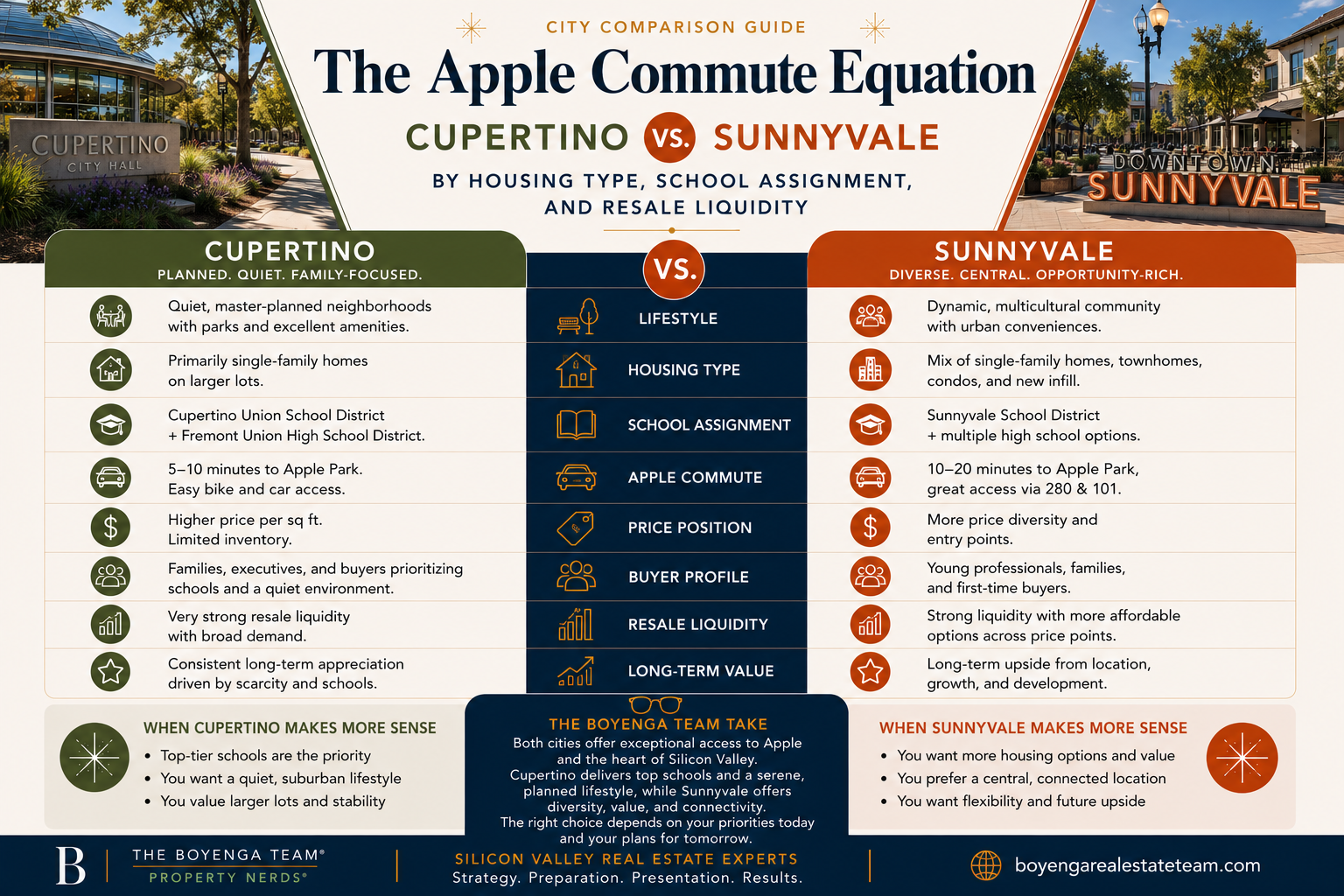 Apple Park has become one of Silicon Valley's defining landmarks, but proximity to Apple's campus influences far more than commute times. It shapes buyer demand, school preferences, pricing, neighborhood development, and long-term resale performance. Two cities illustrate this better than any others: Cupertino and Sunnyvale.
Located only a few miles apart, both communities offer exceptional access to Apple, outstanding public amenities, and strong long-term appreciation. Yet buyers searching in these markets often discover they are solving very different lifestyle equations. Cupertino emphasizes stability and established neighborhoods. Sunnyvale offers greater housing diversity, more neighborhood variety, and broader price points while maintaining excellent connectivity throughout Silicon Valley.
The choice isn't simply about getting to work faster. It's about understanding how each city balances convenience, housing, education, and future value.
Apple Proximity Isn't Equal Everywhere
Although Apple Park sits in Cupertino, not every Cupertino neighborhood offers the shortest commute. Likewise, many Sunnyvale neighborhoods provide remarkably easy access through Interstate 280, Highway 85, Wolfe Road, Homestead Road, and Lawrence Expressway.
For employees commuting several days each week, even a difference of ten or fifteen minutes can significantly affect quality of life. Buyers frequently begin their search focused on commute time, only to discover that schools, neighborhood character, and home type ultimately become more influential.
Apple's continued expansion has also strengthened buyer demand across both communities, creating resilient housing markets supported by one of the world's largest employment centers.
Housing Choices Look Very Different
Housing inventory is one of the biggest distinctions between Cupertino and Sunnyvale.
Cupertino remains dominated by established single-family neighborhoods, many built during the 1950s through 1970s. Buyers will also find custom homes, luxury rebuilds, and a limited number of newer developments, but overall inventory remains relatively constrained.
Sunnyvale offers considerably more variety. In addition to classic ranch neighborhoods, buyers can choose from townhomes, condominiums, mixed-use developments, newer infill communities, and modern single-family construction. This broader housing mix creates additional entry points for first-time buyers, move-up buyers, and investors.
For those interested in Silicon Valley's architectural history, many of Sunnyvale's mid-century neighborhoods are featured on Mid Mod Homes and Bay Area Eichler Homes.
https://bayareaeichlerhomes.com
School Assignments Drive Buyer Behavior
School assignments remain one of Cupertino's biggest demand drivers.
Cupertino is served by the Cupertino Union School District and Fremont Union High School District. Verify school assignment for a specific address with the district.
Sunnyvale's school landscape is more complex. Depending on the neighborhood, homes may feed into Sunnyvale School District, Cupertino Union, Santa Clara Unified, or other districts, along with several different high school attendance areas.
For buyers, this means school assignments should always be verified property by property rather than assumed based on the city name alone.
Pricing Reflects Different Priorities
Cupertino generally commands some of the Peninsula's highest prices per square foot outside Palo Alto and Los Altos. Limited inventory and sustained interest from technology professionals continue to support pricing.
Sunnyvale typically offers greater flexibility across multiple price ranges. Buyers can often choose between larger homes farther from employment centers, smaller homes in central locations, or newer attached housing with lower maintenance requirements.
The result is a broader range of ownership opportunities while still maintaining strong long-term appreciation.
Buyer Profiles Continue to Evolve
Although both cities attract technology professionals, their buyer pools differ in meaningful ways.
Cupertino often appeals to buyers who place schools at the top of their priority list. Buyers planning for long-term ownership frequently accept higher purchase prices in exchange for neighborhood stability and specific school assignments.
Sunnyvale attracts a broader mix of buyers. First-time buyers, move-up buyers, investors, and buyers relocating within Silicon Valley appreciate its central location, varied housing inventory, and strong connectivity to multiple technology campuses beyond Apple, including Google, Nvidia, LinkedIn, Amazon, and numerous startups.
That diversity contributes to strong resale liquidity across a wide range of home types.
Long-Term Value Is Driven by Different Factors
Both communities have produced exceptional long-term appreciation, but they benefit from different demand drivers.
Cupertino's value proposition centers on limited inventory and direct proximity to Apple Park.
Sunnyvale benefits from centrality. Its location provides convenient access to much of Silicon Valley while continuing to attract new residential and commercial investment. Ongoing redevelopment, expanding downtown amenities, and transportation improvements have strengthened buyer interest over the past decade.
Each city has demonstrated resilience through changing market cycles because each satisfies a different segment of Silicon Valley demand.
The Property Nerd Take
Cupertino and Sunnyvale both offer outstanding access to Apple, but they solve different buyer priorities.
If specific school assignments, established neighborhoods, and long-term stability lead your search, Cupertino remains one of Silicon Valley's most compelling markets.
If you value housing flexibility, multiple price points, central access to a broader range of employers, and diverse neighborhood options, Sunnyvale often provides exceptional long-term value.
The best choice isn't determined by the shortest commute. It's determined by how you want to live once the workday ends.
To explore more Silicon Valley neighborhood comparisons, buyer guides, and market insights, visit the Property Nerds Blog, Boyenga Real Estate Team, Mid Mod Homes, and Bay Area Eichler Homes.
keep exploring · property nerd guides
Cupertino homes, neighborhoods & schools in one guide
Live listings, recent sales, ZIP codes, school districts and commute notes for Cupertino, from the Property Nerds® of the Boyenga Team at Compass.
Open the Cupertino guideWhat’s my home worth?
Talk to a Property Nerd: (408) 373-1660 · (650) 383-8606
city guides Palo Alto · Los Altos · Menlo Park · Sunnyvale · Los Gatos · San Jose