

Blog > Cupertino Schools vs Palo Alto Schools vs Los Altos Schools: What Buyers Should Know
Cupertino Schools vs Palo Alto Schools vs Los Altos Schools: What Buyers Should Know
by
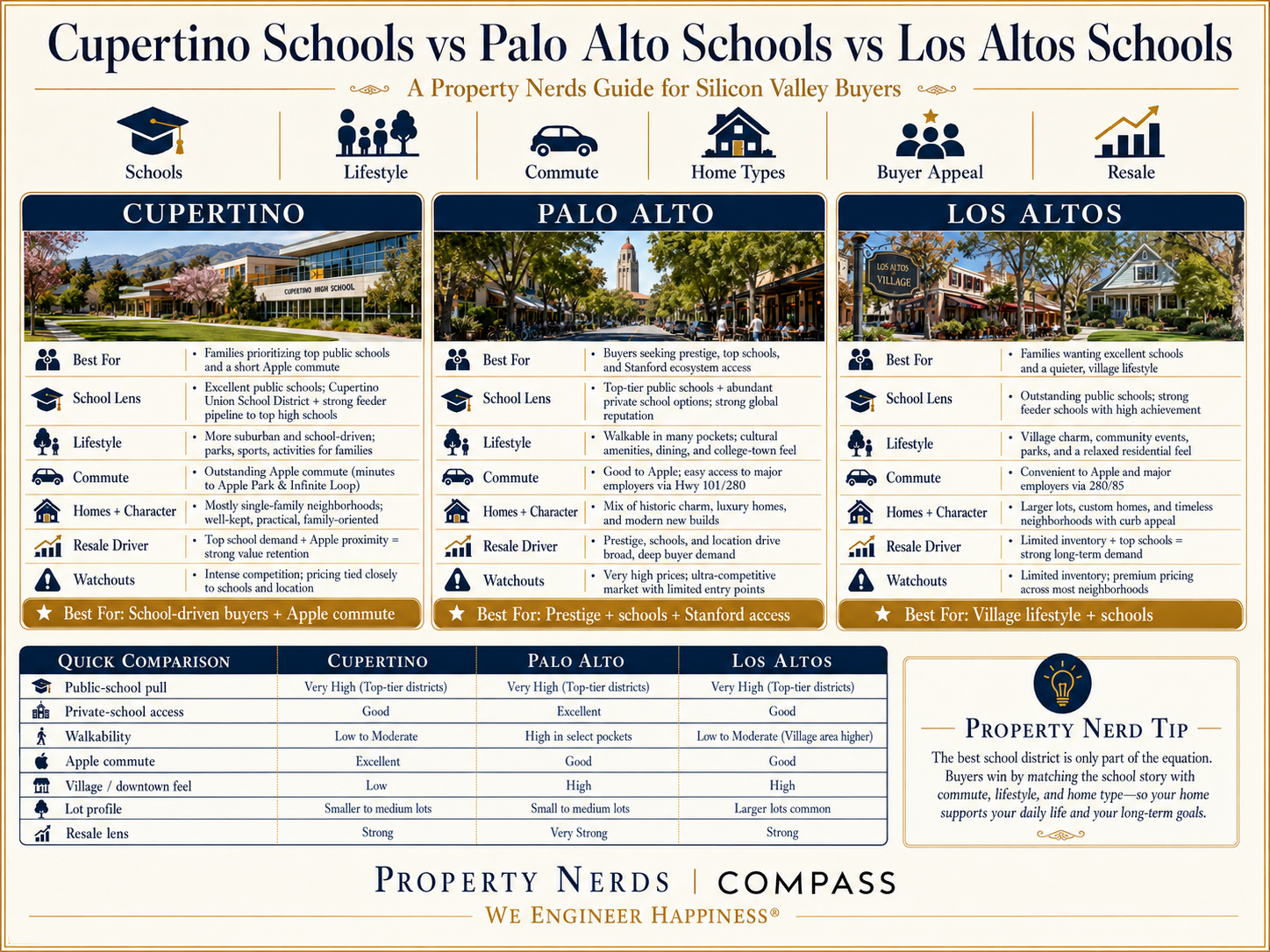
For many Silicon Valley buyers, the home search begins with schools.
Before they compare kitchens, yards, commute routes, or architectural style, they often ask one question first:
Should we buy in Cupertino, Palo Alto, or Los Altos for schools?
It is a smart question, but it is also more complicated than it sounds.
Cupertino, Palo Alto, and Los Altos are three of the most school-driven real estate markets in Silicon Valley. All three attract highly motivated buyers. All three can support strong long-term resale demand. All three have neighborhoods where school assignment can influence pricing, competition, and buyer urgency.
But they do not deliver the same lifestyle, housing stock, commute pattern, price profile, or buyer experience.
Cupertino is often about school intensity, Apple proximity, international buyer recognition, and strong family resale demand.
Palo Alto is often about school reputation, Stanford proximity, legacy prestige, historic neighborhoods, and one of Silicon Valley’s deepest buyer pools.
Los Altos is often about schools, quieter streets, larger lots, Village lifestyle, family livability, and a calmer residential feel.
The smartest question is not, “Which school system is best?”
The better question is:
Which school path, neighborhood, home, commute, and lifestyle fit your family best — and will future buyers value the same things when you sell?
That is how the Property Nerds of the Boyenga Team help buyers think through school-focused real estate.
The First Rule: Verify the Exact Address
Before comparing Cupertino, Palo Alto, and Los Altos, buyers need to understand one critical point:
School assignment is address-specific.
Never assume school assignment based only on city name, neighborhood reputation, zip code, or online listing information. Boundaries can be nuanced, and in some areas, a few blocks can change the assigned elementary, middle, or high school.
This is especially important in Silicon Valley because many cities overlap with multiple school districts, high school districts, and boundary lines. Some homes with a Cupertino address may follow a different school path than buyers expect. Some Sunnyvale, Los Altos, Mountain View, or West San Jose homes may be tied to highly sought-after school assignments by address. Some Palo Alto buyers may care deeply about the specific elementary school, not just the citywide school district.
The safest approach is to verify directly with the applicable school district by exact property address before writing an offer or marketing a home.
The Property Nerds read: In school-driven real estate, the address is the truth.
Why Schools Affect Home Values So Much in Silicon Valley
Schools affect home values because they affect buyer-pool depth.
A home with a sought-after school path may attract more buyers, faster showings, stronger emotional urgency, and more competitive offers. A similar home nearby with a different school assignment may still be valuable, but the buyer pool may change.
This does not mean buyers should purchase blindly based on schools alone. A great school path does not fix a bad floor plan, busy street, poor lot, weak inspection story, or unrealistic price. But in Cupertino, Palo Alto, and Los Altos, school demand is often a major part of the value stack.
The strongest school-focused homes usually combine:
A verified school path.
A quiet residential street.
A usable yard.
A functional floor plan.
A logical commute.
A strong neighborhood identity.
A home condition that matches the price.
A clear future resale story.
The Property Nerds read: Schools can create demand, but homes still have to function.
Cupertino Schools: School-Driven Demand and Apple Commute Logic
Cupertino is one of Silicon Valley’s most famous school-focused markets. Many buyers come into Cupertino already aware of its reputation and are willing to compete for the right school path.
For many families, Cupertino feels like the education-first market. Buyers often compare neighborhoods by elementary, middle, and high school assignment, then layer in commute access, lot size, home condition, and budget.
Top Cupertino neighborhoods often considered by school-focused buyers include:
Monta Vista
Garden Gate
Seven Springs
Oak Valley
Jollyman / Stelling
Fairgrove
Portal / Portal Park
Regnart / Creston
Rancho Rinconada
Linda Vista
Homestead / North Cupertino
Northpoint / Idlewild
Cupertino also benefits from Apple Park proximity. For many families, the ability to combine school-driven demand with an Apple commute is a major reason to buy there.
The trade-off is that Cupertino can feel highly competitive, highly academic, and premium-priced relative to home size or lot size. Some buyers love that intensity. Others may prefer a more relaxed residential feel in Los Altos or a broader lifestyle and prestige package in Palo Alto.
The Property Nerds read: Cupertino is ideal for buyers who want a school-focused, Apple-adjacent, family-demand market and are comfortable paying for that clarity.
Palo Alto Schools: Prestige, Stanford, and Deep Buyer Demand
Palo Alto is one of the most recognized school-driven markets in the country. Buyers often target Palo Alto not only because of schools, but because the city stacks several powerful value drivers together: Stanford proximity, historic neighborhoods, downtown lifestyle, Caltrain, major tech access, parks, architecture, and long-term prestige.
Top Palo Alto neighborhoods often considered by school-focused buyers include:
Old Palo Alto
Crescent Park
Professorville
Community Center
Green Gables / Duveneck-St. Francis
Midtown
Palo Verde
Greenmeadow
Fairmeadow
Charleston Gardens
Barron Park
College Terrace
Southgate
Evergreen Park / California Avenue
Palo Alto’s school demand is not just local. It is part of the city’s global real estate identity. Buyers from around the world recognize the Palo Alto name, and that recognition can support resale demand.
The trade-off is price. Palo Alto often commands a significant premium. Buyers may pay more for smaller homes, older homes, or properties needing work because the location, schools, and Stanford/Palo Alto identity are so valuable.
The Property Nerds read: Palo Alto is ideal for buyers who want schools plus Stanford access, prestige, walkability, architecture, and long-term legacy resale value.
Los Altos Schools: Quiet Streets, Larger Lots, and Family Livability
Los Altos is one of Silicon Valley’s most trusted family markets because it blends strong school demand with a calmer, more residential lifestyle. Buyers often choose Los Altos because they want schools, larger lots, quieter streets, parks, Village charm, and excellent access to Palo Alto, Mountain View, Google, Apple, and Stanford.
Top Los Altos neighborhoods often considered by school-focused buyers include:
North Los Altos
Old Los Altos / Village area
South Los Altos
Loyola Corners
Grant Park
Woodland Acres
Loyola / Springer
Rancho San Antonio-adjacent pockets
Country Club
Highlands
Compared with Palo Alto, Los Altos can feel less urban and less intense. Compared with Cupertino, it can feel more residential and spacious. Many buyers like the balance: strong schools, excellent resale demand, and a neighborhood feel that supports family life.
The trade-off is that Los Altos can still be expensive, and buyers may need to decide how much they value lot size, quiet streets, and lifestyle compared with the citywide prestige of Palo Alto or the school intensity of Cupertino.
The Property Nerds read: Los Altos is ideal for buyers who want schools plus daily livability, larger lots, quieter streets, and a more relaxed family lifestyle.
Comparing the Buyer Psychology
Cupertino buyers often lead with schools and Apple commute.
Palo Alto buyers often lead with schools, Stanford, prestige, and long-term value.
Los Altos buyers often lead with schools, lot size, quiet streets, and family lifestyle.
That buyer psychology matters because it affects pricing and resale.
In Cupertino, a buyer may accept an older or smaller home if the school path and Apple commute are strong.
In Palo Alto, a buyer may accept a higher price because the city has deep legacy demand and Stanford-driven value.
In Los Altos, a buyer may pay a premium for a quiet street, usable yard, and family-friendly floor plan because daily livability is such a core part of the value.
The Property Nerds read: The same buyer may compare all three cities, but they are usually buying a different version of school-focused value in each one.
School Pressure and Family Fit
Not every family wants the same academic culture.
Some buyers are drawn to Cupertino because they want a highly education-focused environment. Others may find that intensity too much and prefer Los Altos or Palo Alto. Some buyers want Palo Alto because of the broader ecosystem around Stanford, startups, arts, and community life. Others may prefer Los Altos because it feels quieter and more family-centered.
The best choice depends on the child, the family, the daily routine, and the buyer’s values.
Real estate buyers should think beyond reputation and ask:
What kind of school environment fits our family?
What commute can we realistically handle?
How important is walkability?
Do we want a larger yard?
Do we want a more intense academic culture?
Do we want a quieter neighborhood feel?
Will future buyers value the same school path?
The Property Nerds read: The “best” school market is the one that fits both your child and your life.
Commute: Apple, Google, Stanford, and Beyond
School-focused buyers still need to live their daily lives. Commute matters.
Cupertino is strongest for Apple, Cupertino, Sunnyvale, West San Jose, and parts of the West Valley. It can also work for Google or Stanford depending on hybrid schedules, but those commutes are usually less central than Apple.
Palo Alto is strongest for Stanford, Stanford Hospital, Palo Alto offices, Sand Hill Road, Menlo Park, and many Peninsula tech roles. It can also work for Google and Mountain View commuters, especially from South Palo Alto.
Los Altos is strong for Google, Mountain View, Palo Alto, Stanford, Apple, Cupertino, and Highway 280 access depending on neighborhood. North Los Altos is especially strategic for Palo Alto and Mountain View access, while South Los Altos can work well for Cupertino and 280.
The Property Nerds read: A great school path can feel less great if the commute creates daily stress. Test the actual route before buying.
Housing Stock: What Buyers Actually Get
Cupertino, Palo Alto, and Los Altos offer very different housing experiences.
Cupertino has many ranch-style homes, remodeled family homes, rebuilt properties, townhomes, and some luxury pockets. Many homes are valued heavily through school and Apple proximity.
Palo Alto has historic homes, luxury estates, Eichlers, mid-century homes, ranch homes, condos, townhomes, and high-prestige older neighborhoods. Buyers often pay a premium for location and identity.
Los Altos has ranch homes, custom homes, larger-lot family homes, Village-adjacent cottages, estate-style homes, and quieter residential pockets. Buyers often value lot utility and family function.
The Property Nerds read: Cupertino often asks buyers to pay for school/commute demand. Palo Alto asks buyers to pay for legacy identity. Los Altos asks buyers to pay for livability and land.
Lot Size and Yard Usability
For school-focused buyers, the yard often matters.
Cupertino lots can vary, but many buyers are comparing school assignment, Apple commute, and remodel potential. In some pockets, the lot may be more modest, but buyer demand remains strong because the school and commute story is powerful.
Palo Alto lots vary dramatically. Old Palo Alto and Crescent Park may offer larger prestige lots, while College Terrace, Professorville, Midtown, and South Palo Alto can have more varied lot profiles. Buyers often pay a high premium for location and schools even when the lot is not large.
Los Altos often has an advantage for buyers who want more traditional suburban lot utility. Many neighborhoods offer more usable yards, quieter streets, and better family outdoor function compared with the same budget in Palo Alto.
The Property Nerds read: Los Altos often wins on family lot utility. Palo Alto wins on prestige and Stanford identity. Cupertino wins when schools and Apple commute are the top priority.
Walkability and Lifestyle
Palo Alto has strong walkability around University Avenue, California Avenue, Downtown North, Professorville, College Terrace, and Evergreen Park. Buyers who want restaurants, Caltrain, Stanford, and urban energy may prefer Palo Alto.
Los Altos has walkability around the Village, Old Los Altos, downtown Los Altos, and Loyola Corners. The lifestyle is more village-like and calmer than Palo Alto.
Cupertino is more car-oriented. Main Street Cupertino and the Vallco area offer shopping and dining convenience, but Cupertino does not have the same historic downtown or Caltrain-centered lifestyle as Palo Alto or Los Altos-adjacent Mountain View.
The Property Nerds read: Palo Alto wins for urban walkability. Los Altos wins for village charm. Cupertino wins for school/commute focus more than walkable lifestyle.
Resale Value
All three markets can have excellent resale strength, but the resale drivers differ.
Cupertino resale is often driven by:
School assignment
Apple proximity
Limited inventory
Family buyer depth
International and tech buyer recognition
Remodel/rebuild demand
Palo Alto resale is often driven by:
Palo Alto schools
Stanford proximity
Historic prestige
Global name recognition
Downtown lifestyle
Luxury buyer depth
Architecture and scarcity
Los Altos resale is often driven by:
Schools
Quiet streets
Larger usable lots
Family livability
Village charm
Palo Alto / Mountain View / Google access
Long-term residential stability
The Property Nerds read: Cupertino resale is school-and-Apple driven. Palo Alto resale is prestige-and-Stanford driven. Los Altos resale is schools-plus-livability driven.
Price and Trade-Offs
Cupertino can be expensive relative to home size because school demand and Apple proximity create strong buyer competition.
Palo Alto is often the most expensive of the three on a comparable home basis because of its global name recognition, Stanford access, school reputation, and legacy neighborhoods.
Los Altos can also be very expensive, but buyers often feel they are paying for more space, quieter streets, and family livability compared with Palo Alto.
The question is not just what you can afford.
The question is what trade-off you are willing to make.
Would you rather have a smaller home in Palo Alto?
A school-focused home near Apple in Cupertino?
A larger lot and quieter street in Los Altos?
A remodel opportunity in a better school path?
A townhome in one city versus a single-family home in another?
The Property Nerds read: The right city is the one where the trade-offs match your priorities.
Quick Comparison
| Category | Cupertino | Palo Alto | Los Altos |
|---|---|---|---|
| Core school story | Highly school-focused and Apple-adjacent | Schools plus Stanford and prestige | Schools plus quiet family livability |
| Buyer identity | Education-focused, Apple/tech families | Stanford, prestige, schools, legacy buyers | Family buyers seeking space and calm |
| Commute strength | Apple, Cupertino, Sunnyvale, West Valley | Stanford, Palo Alto, Menlo Park, Google | Google, Palo Alto, Apple, Stanford, 280 |
| Lifestyle | More car-oriented, suburban | More urban/walkable in pockets | Village-oriented and residential |
| Lot profile | Varies, often school/commute premium | Varies, prestige premium | Often stronger usable lot feel |
| Price driver | Schools and Apple | Schools, Stanford, scarcity | Schools, land, livability |
| Resale driver | School path and tech demand | Legacy value and global recognition | Family buyer depth and lot utility |
| Best buyer | Wants education intensity and Apple access | Wants schools, prestige, and Stanford ecosystem | Wants schools, space, and a calmer lifestyle |
What Buyers Should Watch Carefully
Do not assume schools by city
Verify school assignment by exact address with the district.
Do not ignore the home
A strong school path does not fix a poor floor plan, road noise, bad lot, or major inspection problems.
Understand the full school path
Elementary, middle, and high school assignments can each matter differently.
Think about your child, not just the market
The most famous school path may not be the best fit for every student.
Test the commute
School drop-off plus work commute is the real daily test.
Evaluate resale
Ask whether future buyers will value the same school assignment and lifestyle story.
Compare trade-offs honestly
A smaller Palo Alto home, a Cupertino home near Apple, and a larger Los Altos home may all be similar in price but very different in daily life.
The Property Nerds Bottom Line
Cupertino, Palo Alto, and Los Altos are all powerful school-driven markets, but they solve different buyer problems.
Choose Cupertino if you want:
Strong school-driven demand
Apple Park proximity
Education-focused buyer pool
Suburban family neighborhoods
International and tech buyer recognition
Long-term school/commute resale strength
Choose Palo Alto if you want:
Palo Alto schools
Stanford access
Historic prestige
Downtown Palo Alto or California Avenue lifestyle
Luxury and legacy resale depth
Eichler and architectural options
Global name recognition
Choose Los Altos if you want:
Strong schools
Larger usable lots
Quiet residential streets
Village charm
Family livability
Palo Alto / Mountain View / Google access
A calmer luxury-family lifestyle
The smartest buyers do not ask, “Which school system is best?”
They ask:
Which exact address gives us the school path we want?
Which neighborhood fits our family?
Which commute works after school drop-off?
Which home has the best long-term resale story?
Which trade-offs are we willing to accept?
Will future buyers value this same combination of schools, location, and property quality?
That is how you compare Cupertino, Palo Alto, and Los Altos.
Thinking About Buying or Selling in a School-Driven Silicon Valley Market?
The Boyenga Team at Compass helps buyers and sellers compare school-driven neighborhoods with a Property Nerds approach — blending school-boundary awareness, neighborhood knowledge, pricing strategy, lot evaluation, commute logic, buyer-pool analysis, staging strategy, and long-term resale thinking.
Whether you are comparing Cupertino and Sunnyvale, Palo Alto and Menlo Park, Los Altos and Los Altos Hills, or trying to understand how one school boundary affects home value, Eric and Janelle Boyenga can help you understand the neighborhood math before you make your move.
In Silicon Valley, schools matter.
But the smartest real estate decisions happen when schools, lifestyle, commute, property quality, and resale strategy all work together.